Why the "hire a freelance technical writer" model is breaking — and what replaces it
AI drafts now replace commodity writing, leaving only review and expertise worth paying for.
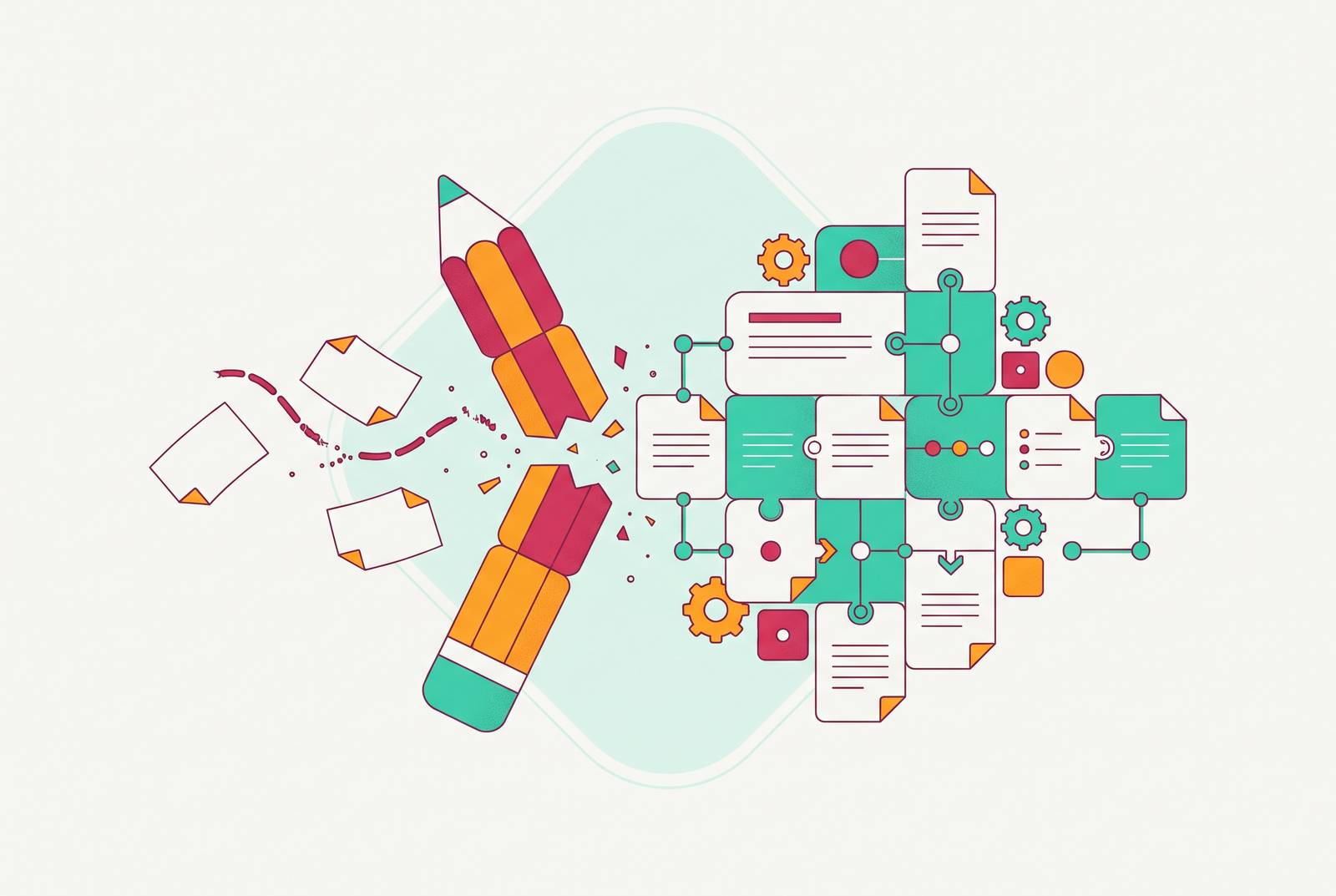
The “hire a freelance technical writer” model is breaking because its handoffs cost too much relative to the commodity content they produce, even while writers retain their skill. Its replacement is an integrated pipeline that joins domain expertise, AI drafting, and human review.
Why the freelance technical writer model is breaking now, not gradually
Upwork’s Content Writing category fell from 4,733 postings to 1,737 in the comparison window, the steepest drop of any writing subcategory. Editing and Proofreading fell only about half as fast as the platform overall. Its share of writing demand nearly doubled, from roughly one-sixth to roughly one-third. The contrast is more revealing than the decline alone. Clients are arriving with machine drafts and paying people to judge them, rather than commissioning every sentence from scratch.
Ramp’s February 2026 study, “Payrolls to Prompts,” found that more than half of businesses that spent on freelance platforms in 2022 had stopped entirely by 2025. The share of company budgets spent on freelance marketplaces fell sharply, while the share spent on AI models rose to 2.85%. The clients who left were those who bought large amounts of repetitive, short-form work and now prompt instead. Those who stayed still pay people at human rates for work that needs their judgment.
Could this simply be another downturn in freelance demand? The uneven losses argue against that reading. If buyers were merely cutting the same work across the board, the shift toward editing would be harder to explain. Instead, demand is moving away from producing commodity drafts and toward evaluating them. That substitution changes the basis of the market.
What collapsed is not writing skill — it is the coordination layer around it
A content team prepares a brief, routes it through a platform or agency, and waits for a freelancer to interpret it. A managing editor then reviews the draft, revisions travel back and forth, and invoices need reconciling. Someone also has to take care of quality assurance. Each handoff takes time, even when everyone does their job well.
That overhead once supported an output with a price premium. When producing a usable draft required substantial human labor, the work around the draft could be a tolerable part of its cost. AI changes that balance by compressing commodity production toward near-zero marginal cost without automatically removing briefing, routing, editing, or billing. A model can therefore become uneconomic even while its writers remain capable.
But doesn’t technical writing need more than sentences that read well? Skilled writers interview engineers, find their way through proprietary systems, and hold on to knowledge of the organization that a prompt cannot supply. A replacement that discards those abilities would misunderstand the work. They describe a specialist segment, however, rather than the repetitive, well-defined engagements that make up much of the freelance market. The distinction is between freelance writers and the freelance model. The liability is the arrangement that repeatedly separates expertise, production, and review, even as people’s expertise makes the result trustworthy.
The market is splitting, and the split explains who survives
A commoditized tier faces AI substitution, while a specialist tier can still command a premium for expertise. Freelancers who work on AI-related projects earn much more per hour than those who work on non-AI projects. That premium rewards working with the tools. That higher pay also suggests that whether work is at risk or still worth paying for depends on more than whether a human or a machine does it.
Brookings’ analysis complicates the reassuring idea that experience alone provides protection. Across AI-exposed fields, freelancers with strong skills and years of experience lost more work overall than their junior peers. AI compresses the skill distribution, weakening the premium that once justified a seasoned generalist over an AI-assisted junior. Seniority is not a shield by itself. Protection depends on whether a person contributes knowledge or judgment that the new workflow cannot cheaply reproduce.
Upwork’s September 2025 Monthly Hiring Report still listed content writing as one of the AI-related skills most in demand. That finding is compatible with falling demand for standalone drafting because the role is changing. Clients want writers who can operate inside an AI workflow, with human contributions concentrated in review, domain expertise, and system design. It means the replacement model has something specific to preserve. Expertise and editorial judgment remain valuable when they are applied at the points where the system needs them.
What content now needs to do that a freelance brief never asked for
The production model is changing just as the objective of content changes. Ranking on a search results page is no longer enough when users receive synthesized answers from ChatGPT, Claude, Gemini, and Perplexity. A brand can perform strongly in traditional search and still be absent from those answers. Google's top 10 and ChatGPT’s cited sources overlap only about 8% of the time. Search visibility does not automatically transfer to AI citation.
Generative Engine Optimization, or GEO, and Answer Engine Optimization, or AEO, address this new objective. They focus on structured content built so that AI answers can cite it. That requires more than adding a new phrase to a brief. Credible quotations, statistics, inline citations, fresh information, and structured data can improve citation share. These are decisions about evidence and presentation.
Why can’t a freelancer just get an assignment with more detail? An individual article can meet those requirements, but citation performance also depends on the wider content architecture. Global household names appear in AI answers far more often than mid-market brands, which appear far more often than niche or small brands. Publishing more pieces alone does not close that gap. Nor does doing well on one engine guarantee the same elsewhere, since the number of times a platform cites the same brand can differ by orders of magnitude. The production system must support consistent output, maintenance, and distribution over time. That is an engineering responsibility extending beyond the boundaries of a single assignment.
Why the replacement is a pipeline, not a better vendor
An integrated pipeline puts domain expertise, AI drafting, and human review in one system with a shared memory of brand voice, audience, and content history. Its distinct stages operate within an integrated system, a structural change from hiring a faster agency or a better freelancer. Hiring someone better still leaves the handoffs to and from that person in place. Integration removes the need to reconstruct context at each boundary.
The useful division of labor separates research, outlining, drafting, review, publishing, and repurposing. AI is strongest at briefs, outlines, first drafts, metadata, and variants. Humans should own facts, positioning, expert judgment, final approval, and brand-sensitive decisions. Review is not an optional finishing touch. Ungated output, often called “AI slop,” is the failure mode when a team confuses faster production with a complete publishing process.
The EU AI Act also gives substantive editorial control a regulatory role. Its transparency provisions, applicable from 2 August 2026, include an exemption for AI-generated text published to inform the public on matters of public interest when it undergoes human review or editorial control and a person or organization takes editorial responsibility. This is not a general exemption for all AI-assisted content. The scope is narrow, and cursory review is insufficient.
Within that architecture, a senior contributor’s role moves from executing each piece toward defining rules, training brand memory, reviewing output, and making strategic calls. Expertise moves upstream without disappearing from publication decisions. The same system can then support cadenced publishing, structured data, distribution, and freshness signals. Editing and quality assurance still require work, but their coordination no longer has to be rebuilt as a separate transaction for each article.
Ground-site and distributed content strategy as the foundation AI systems read
A brand’s owned site is its ground-site foundation, but AI answers draw on a composite of documentation, blog articles, forum threads, review sites, structured data, and authoritative third-party platforms. The owned site is not the whole source environment. A system that only sends articles to a blog handles production but leaves out some of the places where AI systems find information.
Entity grounding comes before a reliable presence in answers. A machine-readable identity, such as a Wikidata entry with proper properties, helps entity recognition systems tell which brand they are looking at. Without that grounding, recognition becomes less likely. The underlying constraint is simple enough to state. Even when an entity’s content is well written, a system needs to know which entity it is before it can reliably cite it.
Distribution extends that foundation beyond owned pages. A presence on surfaces such as discussion forums and authoritative third-party sites gives the brand a place in the broader source environment from which AI systems draw. This distributed seeding resembles link building, but the signal is not limited to a hyperlink. An unlinked mention on a highly authoritative source can be more valuable than a link from a low-quality one. The architecture must therefore account for both where information appears and where links point.
Ranked “best-of” listicles account for a disproportionate share of citations in large-scale citation studies, making them a particularly useful owned-site format for this purpose. That finding about structure leaves the need for evidence intact. Maintaining such a distributed presence requires tracking what has been published, where it appears, its format, and whether it remains fresh. Assigning work one brief at a time leaves that orchestration outside the assignment, even when the resulting piece is excellent.
Measuring whether the pipeline is working — AI citation as the operational metric
AI citation provides a way to test whether this architecture works. Whether and how often a brand appears in AI answers can be tracked, reported on, and used to revise the content strategy. That makes GEO and AEO operational functions. Publication is no longer the last observable step. The system can connect what it produces to whether that output helps the brand become a source.
The timing of that feedback depends on the platform. Perplexity can show results quickly because it crawls in real time, while AI Overviews take longer. ChatGPT and Claude can require substantially more time because of periodic training cycles. A lack of immediate movement cannot mean the same thing across systems with different update rhythms.
Measurement must also separate ChatGPT, Claude, Gemini, and Perplexity because the same brand can have dramatically different visibility on each. An aggregate can conceal that unevenness. Tracking the engines separately makes the evidence useful for decisions about content and distribution. It also allows the production system to distinguish a broadly weak presence from a platform-specific gap, rather than treating every disappointing result as a reason to commission more articles.
Work under the old freelance model usually stopped at delivery, with no feedback loop to show how the assignment affected AI citation. An integrated pipeline closes that loop by joining production, editorial responsibility, distribution, and measurement. Its durability does not come from generating drafts cheaply, since cheap drafts are what destabilized the previous arrangement. It lasts because it keeps expertise, cuts out the need to coordinate the same work over and over, and makes results clear enough to learn from. Measurement is what lets the system learn whether its work earns a place in the answer.