When a "cheap SEO" service says it spends a small budget on a short list of pages and measures each one: what a B2B startup buyer should check before paying
Check whether a cheap SEO vendor's reporting proves qualified demand.

A cheap SEO service that promises focused pages and per-page results should be judged first by whether its measurement can show what changed. For a B2B startup, that means more than rankings. It means evidence of qualified demand, separate tracking of AI citations, and clarity about which assets the buyer owns. Auditing that evidence before signing separates accountability from its appearance.
Why a cheap SEO pitch is a measurement problem before it is a pricing problem
A startup with a limited budget receives a pitch built around a short list of pages, careful spending, and results for each page. That sounds disciplined. But what counts as a result, and can the buyer inspect the evidence behind it? A page-level report can look precise while leaving unanswered whether the work reached likely buyers or helped create pipeline. The exposure is not simply overpayment, but an accountability gap.
This is an audit. The measurement has to pass two tests. First, does it track the places where buyers find companies, including AI answer engines where more and more B2B buyers start? Second, does it connect that activity to qualified leads or revenue? A vendor reporting only traffic and rankings leaves the second question unanswered, even if those figures are accurate.
What the pitch is actually promising across three distinct disciplines that each require their own measurement
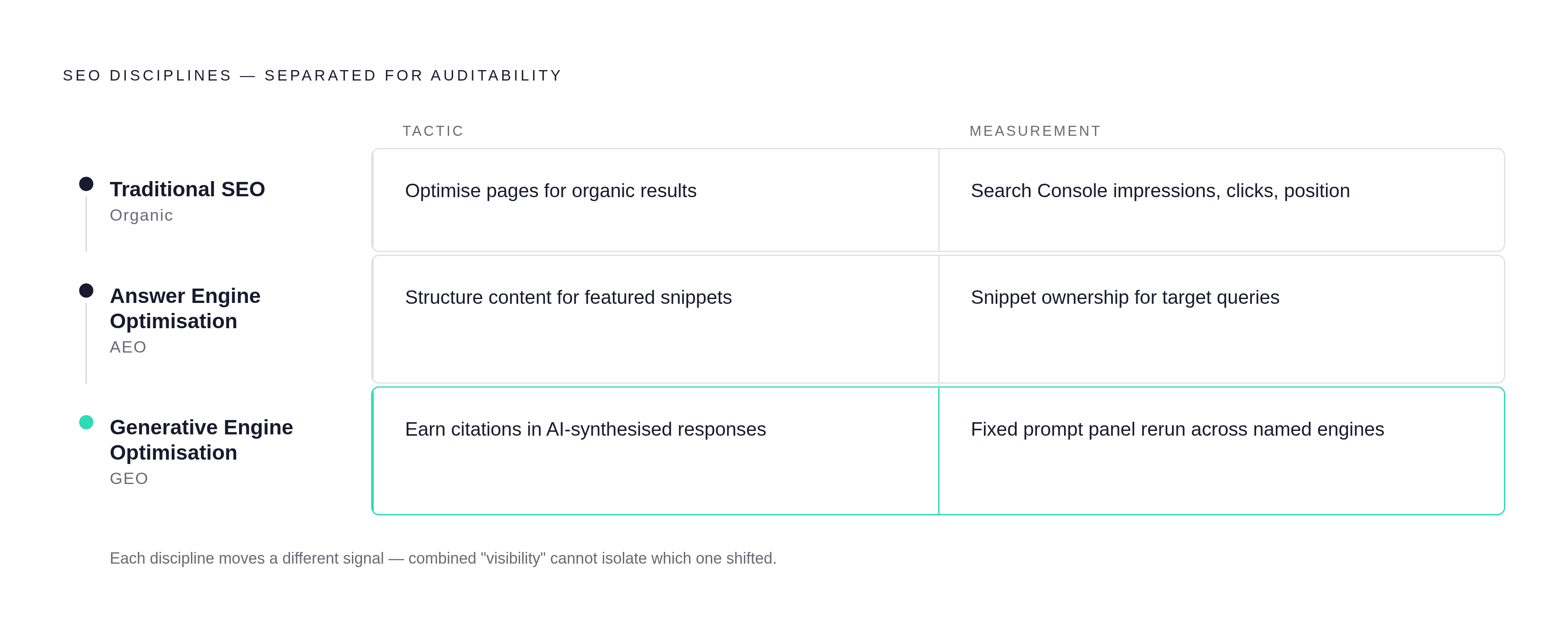
Traditional SEO, Answer Engine Optimization, and Generative Engine Optimization describe related but distinct work. Traditional SEO aims to get a page into organic search results, and Search Console impressions, clicks, and position show how it does for specific queries. Answer Engine Optimization, or AEO, structures content so it can be extracted as a direct answer or featured snippet. Its reporting should track snippet ownership for target queries. Those are different commitments, even when they concern the same page.
Generative Engine Optimization, or GEO, aims to earn citations when AI systems synthesize responses. It needs its own way to measure results with a prompt panel, beyond what a keyword-ranking report can show. Yet GEO does not bypass SEO foundations. AI engines retrieving live sources generally need pages to be crawlable and indexed, although the relevant index or crawler varies by platform. A citation does not always require a top search ranking, but a promise of AI visibility that ignores technical accessibility is internally inconsistent.
The buyer’s first scope question should therefore be explicit. Which of these disciplines does the engagement cover, what distinct tactics support each, and what will reporting show for each separately? One page may serve all three purposes. A single “visibility” result, however, cannot reveal whether the vendor improved organic discovery, won a snippet, or earned an AI citation. Separating those outcomes makes the promise auditable.
Why traditional rank tracking alone cannot tell a B2B buyer whether the work moved anything that matters
B2B search intent is narrower and takes longer to lead to a sale than B2C search intent, so it is easy to misread ranking gains. A category term can look like something buyers would search for even if prospects do not use it. If a service relies on keyword reports without engaging with sales conversations, it can miss the objections, vocabulary, and use cases that shape real demand. The budget then supports terms that look right in a report but do not reflect how buyers search.
SEO activity needs to show a link to demos, sales-qualified leads, or pipeline contribution. Organic sessions and position changes remain useful observations, but neither establishes that connection on its own. This needs to be clear before work starts. What will the vendor report beyond traffic, and how will it show whether those visits contributed to qualified demand? After a few months, a vendor unable to show that connection cannot be held accountable for the business outcome it was hired to influence.
The buyer should also confirm ownership of the measurement infrastructure before signing. Admin access to the domain, Google Analytics, and Google Search Console must remain with the buyer. Access is part of accountability. A vendor that resists it, or relies solely on third-party scrape data instead of first-party Search Console data, creates a structural risk regardless of price. The buyer needs access to the underlying evidence as well as the vendor’s interpretation.
How AI answer engines behave differently from each other, and why a single strategy cannot measure all of them
ChatGPT, Claude, Gemini, Perplexity, and Google AI Overviews cannot be treated as one reporting surface. Their source selection and citation behavior differ, and identical questions can produce little source overlap across engines. An aggregate score hides that distinction from the buyer. It can leave the buyer unable to tell which engine cites the brand, which does not, and where any change occurred. Reporting therefore needs an engine-level breakdown.
Their retrieval foundations differ as well. Google’s index is relevant to AI Overviews, while other engines use their own crawlers or indexes rather than simply reproducing Google’s organic rankings. The practical question is specific rather than speculative. Which engines does the vendor optimize for separately, and what distinct tactics does it use for each? A common content plan may support several engines, but that does not make their results interchangeable.
Citation sources also shift between runs of the same question, so a screenshot cannot establish a stable result. A fixed prompt panel rerun over time gives the buyer a way to see citation drift. The vendor should explain its cadence for each engine. Perplexity offers a particularly concrete conversion check because clicks from its cited links appear in server logs and GA4 as a distinct referral source. The buyer should ask whether those referrals are being pulled into GA4 as a separate channel.
What legitimate AI citation measurement looks like in practice, and how to tell it from a screenshot
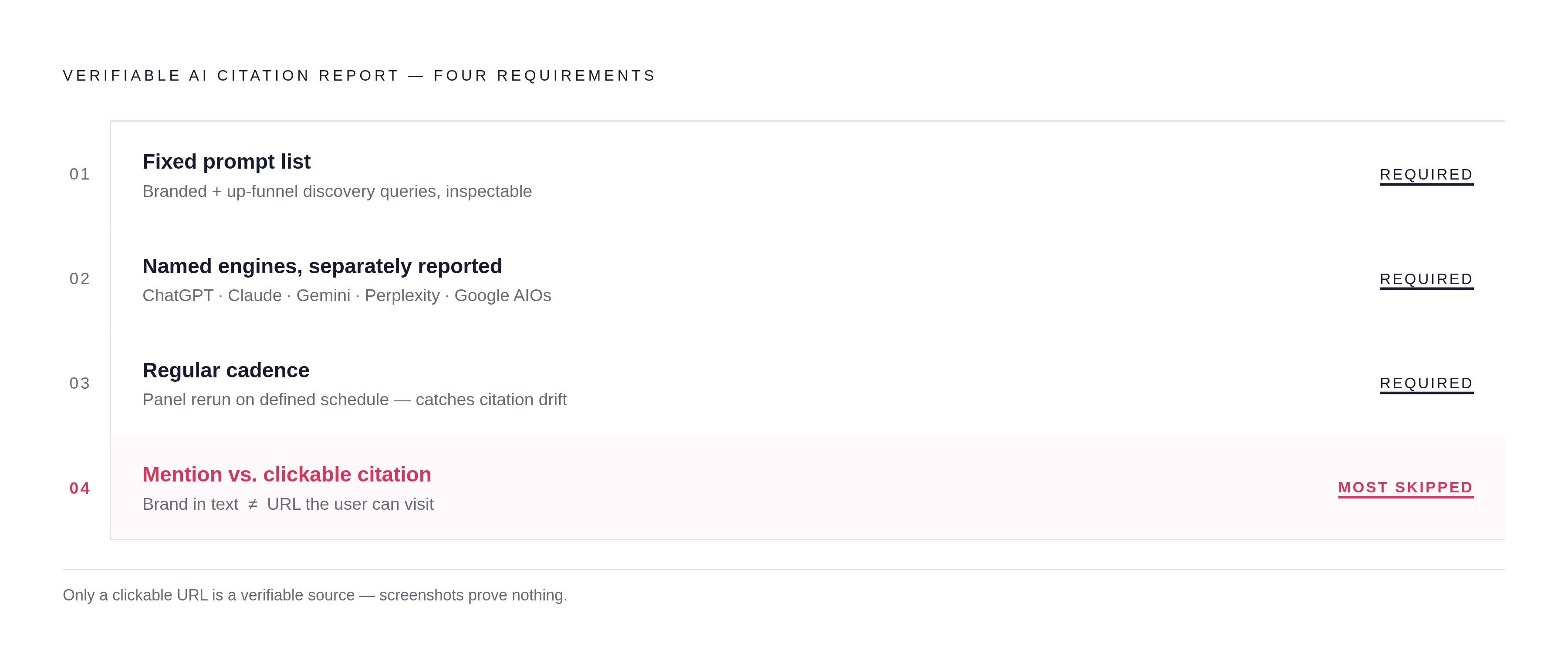
An AI citation report the buyer can trust starts with a fixed list of prompts run again and again across named engines, with results the buyer can see in a live dashboard. The prompt list must be inspectable. Without it, the buyer cannot tell whether a good result came from a typical discovery question or a carefully chosen branded query. A PDF or screenshot may record an appearance, but it does not by itself show a recurring measurement process.
The panel needs both branded questions and up-funnel discovery prompts. Branded queries tend to get citations often, while early-stage B2B brands tend to show up less often when buyers search the broader category. A panel with only branded questions can look healthy without showing whether the service helps buyers who do not know the company find it. Keeping the prompt list fixed also makes it easier to understand changes.
Cadence belongs in the deliverable. If a service claims to track active citation drift, the buyer can ask whether it reruns the panel each week, and the vendor should explain why it uses a different schedule for any engine. Quarterly screenshots leave long gaps between observations. The dashboard must also distinguish a mention, where the brand name appears in generated text, from a citation with a clickable URL. Only the latter supplies a source the user can inspect and visit.
The vendor call can make these requirements concrete with three questions. Can the vendor show the live dashboard and fixed prompt list, including both branded and discovery queries? How often is that panel rerun, and can the buyer inspect results separately for each engine? How does the system distinguish a brand mention from a citation with a clickable URL?
The phantom-site and content-distribution layer: what it can do, what it cannot, and what a buyer owns when it ends
Publishing on third-party platforms to earn AI citations is a valid way to get content in front of people. The so-called phantom-site layer can offer fast indexation, an existing audience, and eligibility for citations in ChatGPT, Perplexity, and Google AI Overviews. Those benefits have a defined boundary, however. They do not amount to lasting authority for the buyer’s own domain or a content asset the buyer controls. The infrastructure is rented.
That distinction changes what a citation report actually measures. If an AI answer links to a third-party placement, the citation points to that platform. It should not be counted as an owned-domain citation. Ranking stability on third-party platforms is also limited and can be volatile during algorithm updates. If the content disappears when the engagement ends or a platform changes policy, the citations tied to it can disappear too.
Google’s Site Reputation Abuse policy adds a separate risk when third-party pages are published to take advantage of a host site’s ranking signals. That does not make all third-party distribution illegitimate. The buyer should ask which platforms make up the network, who owns the content after the engagement, and what proportion of tracked citations link to each of the buyer’s domain and the platform. Those answers show whether the spend builds assets the buyer controls, pays to reach people for a limited time, or does both.
The human-review claim in AI content pipelines: what to verify before accepting it at face value
A multi-stage AI content pipeline with human review is a reasonable production model, but the review claim needs definition. Correcting grammar is not the same as evaluating a technical claim. Domain expertise is the missing distinction to test. B2B content that earns citations tends to cover real use cases, draw on expertise, and use the words practitioners use. A surface review cannot supply that grounding when it is absent from the draft.
Google’s spam guidance focuses on whether content serves readers or primarily manipulates rankings, rather than treating AI assistance itself as the problem. A volume-driven service can fail that usefulness test at scale. Content can be technically correct yet do a poor job of answering buyer-intent questions if it overlooks prospects’ actual objections and how they describe their use cases. The production method alone proves neither usefulness nor citation potential.
The buyer should ask for a sample article made through the proposed pipeline. The vendor should name the human reviewer and explain what expertise they have in the field. The buyer should also ask whether the article will be published on a domain the buyer controls and can verify in Search Console. The sample tests the output, while the reviewer and publishing details test the process behind it.
A pre-signature audit checklist: the questions that separate accountable vendors from those selling the appearance of accountability
For each topic, the buyer needs an answer they can check before signing, beyond a promise to explain it once work starts. The following questions can serve as the evaluation record, with any unanswered point remaining visible even in a sales deck.
Scope and measurement infrastructure. Which of SEO, AEO, and GEO does the engagement cover, with separate tactics and reporting? Does the vendor use first-party data from Search Console and GA4, or does it rely on third-party scrape data? How will SEO activity connect to demos, SQLs, or pipeline contribution?
AI citation tracking. Can the vendor show the live prompt panel, query list, cadence, and engine-level breakdown? Does the panel have both branded and discovery questions, and does it show mentions and clickable citations separately? How often is it rerun to catch citation drift, and are Perplexity referrals reported as a distinct channel in GA4?
Content and distribution. Which platforms make up the phantom-site network, and who owns the content when the engagement ends? What proportion of tracked citations point to each of the buyer’s domain and third-party platforms? Can the vendor provide a sample article with a named human reviewer and a relevant domain background?
Structural ownership. Will the buyer have full admin access to the domain, website files, and all analytics properties from day one? If the engagement ends, what content and access does the buyer retain? Which citations and rankings depend on placements or infrastructure the buyer does not control?
A vendor that answers with live evidence is offering accountability. One that cannot is offering its appearance. At a small budget, that appearance is the most expensive thing a B2B startup can buy.