"A person reads it before buyers do" is a process claim, not a quality test: how to check AI-assisted content for voice and sourcing with data a machine can verify
Machine-checkable tests for voice and sourcing show what human review alone cannot.
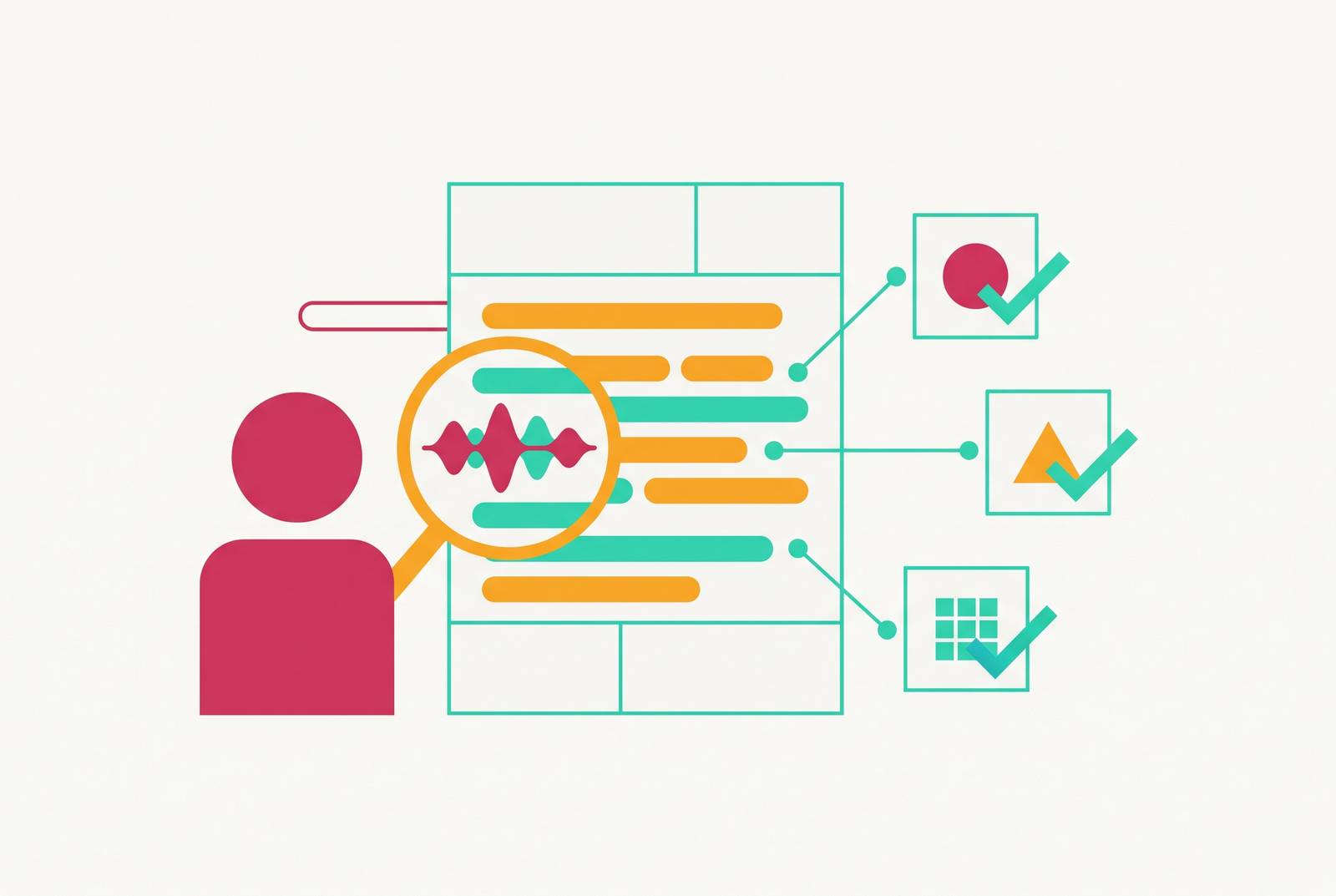
AI-assisted B2B content needs tests for voice and sourcing. Human review has a useful role, but its presence is not proof of quality. Buyers need machine-checkable evidence of how well content matches a defined voice and whether its sources support its claims, while people use their judgment on what those checks cannot settle.
Why "a human reviewed it" is a workflow step, not a quality outcome
“A person reads it before buyers do” sounds like an answer to a quality concern. It is not a quality test. The statement describes who touched the draft, but says nothing about the criteria they applied, the errors they found or the uncertainty they left unresolved. A reviewer can approve content that misstates a fact, misrepresents a source and drifts away from the brand’s voice. Reading is an activity, while passing a defined test is an outcome.
That distinction changes what a B2B buyer can learn from a vendor’s assurance. A process description may establish that an approval step exists, but it gives the buyer no independent way to assess what that step catches. Even confirmation that a person read every draft would leave the central question unanswered. Which parts of quality did the review actually test? Without results tied to clear criteria, buyers must trust that the review works without being able to see how well it works.
Factual accuracy, voice consistency and source integrity are separate properties of the output, and each needs evidence suited to it. A vendor decision based on the existence of a reviewer confuses the presence of a safeguard with its performance.
What quality dimensions are actually at stake in AI-assisted B2B content
Generic “quality review” groups together failures with very different consequences. An awkward sentence is not the same problem as a factual error that reaches a buyer or a citation to a study that does not exist. Voice drift creates another risk when content no longer reflects the positioning the brand is trying to establish. These failures need different instruments to detect them. For this purpose, voice consistency and source integrity provide two focused, measurable dimensions rather than one vague judgment of whether a draft seems good.
Answer engines synthesize material from across a site, so incoherent voice signals can make a brand harder to identify and cite consistently. A piece may read well on its own but fit poorly with the rest of what the brand has published. The draft needs to be compared with an established body of content.
AI generation can produce plausible citations that do not exist, but a real source can also be used to support something it never says. The presence of a citation settles neither issue. A draft can therefore look carefully sourced while leaving its central assertions unsupported. A single overall quality rating obscures this distinction, because a strong voice cannot compensate for weak evidence, and sound evidence cannot establish voice consistency.
Why human reviewers are poorly suited to catch the specific errors AI pipelines produce
An expert editor with deep brand knowledge offers a serious objection to automated scoring. People still need to use their judgment on decisions that a mechanical comparison cannot settle, and an editor who knows the brand may spot a tonal mismatch at once. That expertise deserves a well-defined job. A read-through can fall short when it is used to check every structural feature and every claim, especially as more content is published.
The International AI Safety Report 2026 documents that human reviewers frequently misidentify AI-generated text as human-written. That finding concerns recognition of generated text. It nevertheless challenges the assumption that a human reader can reliably recognize the surface signals of AI generation. The more specific problems of voice drift and unsupported claims still require their own checks.
Voice drift often occurs in structure even when the words remain familiar. A reviewer reading for sense and flow may approve a draft whose sentence lengths, formality or hedging frequency have moved away from the brand’s baseline. Words that look familiar can hide that change. To spot it reliably, reviewers need to compare drafts with each other and with reference material, beyond how each piece reads on its own. Beyond a modest monthly volume, that comparison becomes difficult to sustain through manual review alone.
Sourcing presents a different burden on the same reviewer. A fabricated or misrepresented citation is not visible unless someone independently examines the source and compares it with the claim. Reading the draft is not that examination. Manual verification of every assertion at scale is not a realistic substitute for a dedicated checking process, so assigning the whole task to an editor leaves a gap between what approval implies and what was actually tested.
What machine-verifiable voice consistency actually measures
A voice test starts with a documented baseline corpus of the brand’s reference content. The draft can then be scored against measurable features that give the instruction to “sound like the brand” testable criteria. Sentence length distribution shows the mix of short and long sentences, while reading grade level measures how hard the text is to read. Phrase counts show whether the draft uses banned wording and includes the wording it must have. Sentiment polarity range measures how positive or negative the language is.
These signals describe different parts of the voice. No single score captures the whole thing. A draft might follow phrase rules but use sentence patterns outside the baseline, or match how hard the text is to read but use a different emotional register. Keeping the dimensions separate makes the discrepancy visible. It also gives a reviewer something more precise to work with than a general request to adjust the tone.
Semantic similarity adds another comparison through embeddings and cosine similarity to reference content. It gives a continuous score that shows how close the match is, which helps flag drift even when the words look familiar. That score still needs an acceptance criterion. Minimum and maximum sentence lengths, required structural elements and banned transitional phrases can likewise be defined before generation, so the resulting draft faces criteria that were not invented to excuse it afterward.
Those thresholds still need to be tested against the voice people recognize. A number can be repeatable without being useful. The gold standard is blind discrimination, in which AI-generated pieces built from the extracted voice guide are mixed with real published copy and people who know the brand try to sort them. The test produces a repeatable, scorable result against human recognition of the brand. It gives the thresholds an external test rather than treating their existence as proof that they work.
What machine-verifiable source integrity actually measures
Source integrity follows the same principle of defining the signal before measuring it. Inspection focuses on the atomic claim, the smallest assertion that can be tested independently. A citation attached to a compound sentence may support one part while leaving another unsupported. Checking that its URL exists cannot show which parts it supports. The source text must be compared with each assertion the sentence makes.
Consider a sentence saying that an upgrade took place on a stated date, used a certain billing term and fell within a policy window, which made the customer eligible. It has four atomic claims that cover the upgrade date, billing term, policy window and whether the customer is eligible. Each needs its own evidence test. A source might support the date and billing term without establishing the policy window or the resulting eligibility. Treating the sentence as a single supported unit would conceal those gaps.
Washington University’s study of Google AI Overviews examined 98,020 atomic claims in research covering March–April 2026 and found omission to be the dominant failure mode. In this context, omission means that the cited page does not support the claim attributed to it. The citation is present, but the evidence is absent.
A complete sourcing check addresses three distinct layers. Internal consistency tests for contradictions within the draft, while external source verification compares each atomic claim with its cited page. Source freshness checks whether the cited data falls within a required recency window. Confidence scores then make uncertainty explicit, with claims below a defined threshold routed to human verification. This is not a judgment about the author’s honesty, but a response to a generation process that can combine plausible language with unsupported assertions.
How to sequence these checks so human review lands on the residual uncertainty, not the whole draft
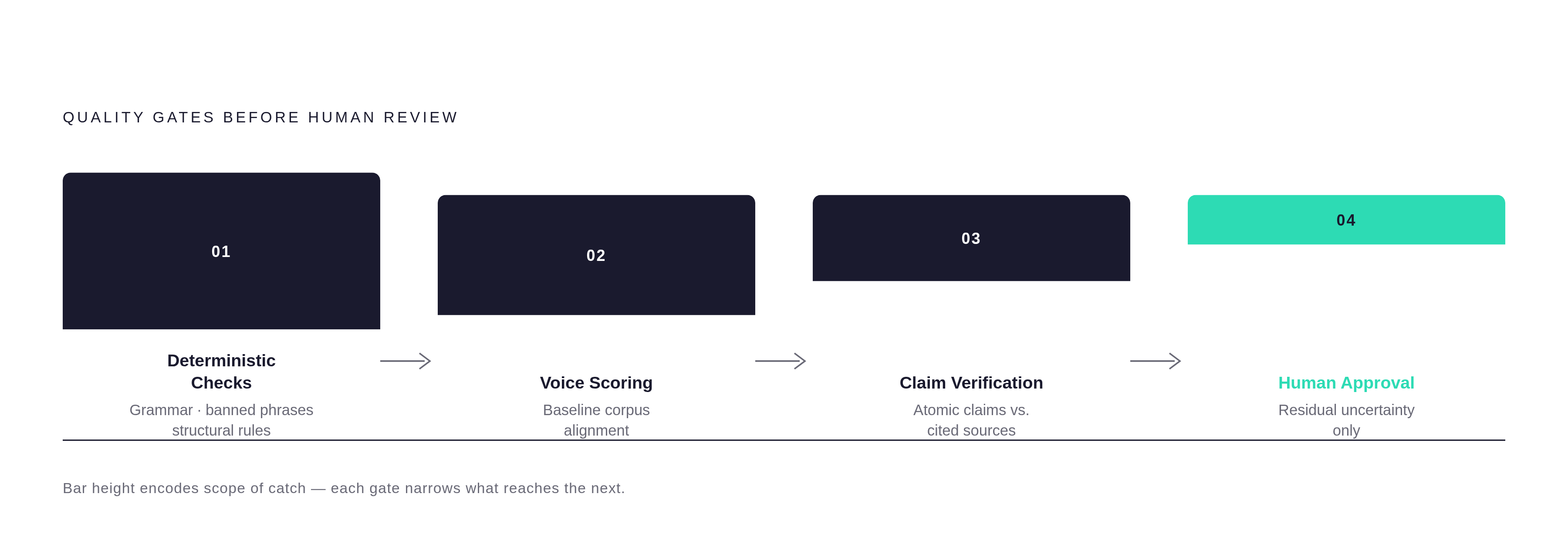
Deterministic checks come first to test grammar, banned phrases and structural requirements. Voice scoring against the baseline corpus follows, then atomic-claim verification against cited sources. Human approval comes after those gates have passed the tractable issues or exposed unresolved ones. That ordering gives the editor a draft with known test results rather than an undifferentiated field of possible errors.
The software analogy is useful because it clarifies the division of labor. Linting and unit tests run before a human code review. Tests prevent the review from becoming the first and only attempt to catch every mechanical fault.
This sequence must not turn automated confidence into unquestioned authority. Claims and evidence rigor are precisely where automated assessment can be over-optimistic, so a machine’s pass is not an unlimited guarantee. People need to verify claims when the checks give low-confidence results, and the final reviewer needs to see what is still uncertain. Writing clarity and mechanically detectable errors need not consume the same attention as disputed support for a consequential assertion. The purpose of routing is to focus that attention.
Human review therefore remains an approval step, but with a different remit. The editor is no longer expected to remember every voice parameter and independently rediscover every sourcing gap from a clean-looking draft. Prior checks provide a basis for deciding what deserves scrutiny. Human effort can then address residual uncertainty and high-value editorial decisions instead of repeating work that a machine can perform more consistently.
What buyers should demand as proof from any AI content pipeline, including their own
A pipeline should be able to export a scored comparison of its output against a documented voice baseline, using cosine similarity or an equivalent measure. It should also show drift trends over time and a revision rate indicating what fraction of AI drafts required voice corrections before publication. Each answers a different question. The comparison shows fit, the trend shows change and the revision rate shows how often correction was needed.
Sourcing evidence should be equally inspectable at the claim level. Buyers should ask for atomic-claim verification results with confidence scores, source freshness flags and a record of which claims triggered human review. That record should include the outcome of the review. An escalation is useful evidence only when its resolution can also be examined.
Neither set of signals requires proprietary tooling. Both can be instrumented and reported, which makes their absence informative when a vendor offers only an assurance about editorial care. The same standard applies to internal teams. Ownership of the pipeline does not turn an unmeasured approval step into a verifiable quality result, and an internal team should be able to produce the evidence it would request from a supplier.
Measuring whether an AI answer engine names and cites the brand does not by itself show which upstream content checks need attention. Clean voice and sourcing signals provide the feedback loop that citation measurement otherwise lacks.