When an AI marketing agency says "hourly billing keeps the AI saving from you": how a technical B2B founder should check who actually captures the time agents save
Four records show whether AI time savings reach you or the agency.

An AI marketing agency’s claim that hourly billing passes AI savings to the client is testable. A technical B2B founder can test whether recovered time leads to a lower bill or extra work that is on record, after platform costs are paid. The right model makes that transfer inspectable through metering, experiment records, clean traffic reporting, and ownership rights, rather than asking the buyer to accept an efficiency story.
Why the billing model is the allocation mechanism, not a contract detail
The billing model determines where an efficiency gain can go before anyone negotiates how to share it. Under hourly billing, less time spent on the same task means less revenue at the same rate. If quality stays the same or gets better, the client gains by paying for fewer billed hours. That is a mechanism, not a moral judgment. The same reduction in billable time cannot both lower the client’s invoice and remain inside the agency’s revenue.
The client must be able to see the reduction in time, and the agency must not silently fill the recovered hours with expanded scope. Otherwise, the task can take less time while the bill stays the same, with no clear record of what happened. Both conditions can be tested against records. A pricing label alone does not establish either one.
Consider a task that once took many hours and now takes a fraction of that time. At an unchanged hourly rate, the agency earns less for that task, provided the billed time falls with the actual work. If the retainer instead covers more deliverables, the question shifts from price to scope. Has the client knowingly bought more work, or has the original saving become an unstated expectation? Accepting the agency’s explanation without inspecting that distinction is a trust bet.
How AI time savings move between agency, client, and platform — and where they disappear
Recovered time has three possible destinations in economic terms. It can increase the agency’s margin, reach the client through a lower bill or more work, or be consumed by the platform costs that made the saving possible. Tokens, API calls, and compute are the third claimant. Even under outcome billing, unmetered platform costs leave both sides unable to tell what the work cost to produce.
A flat fee lets the agency retain the benefit of faster production when the deliverable stays the same. Hourly work can pass that benefit through, but an unchanged retainer with expanding scope can obscure the transfer. Six months later, more deliverables may have become the norm without either side having set a price for the change. The agency is doing more for the same fee. The client gets more output but has no record of what efficiency bought, while utilization tracking may show how much more work the agency has taken on.
This is the practical risk behind the “productivity disappearance rule.” Recovered hours that retain their original pricing, allocation, and scope beyond a short window become next month’s expectation. An intentional exchange of savings for more work is different because the exchange is visible. For the buyer, the useful question is therefore not whether the agency uses AI, but where the recovered time appears in the record.
What "saved time is visible" actually requires — metering as the minimum condition
The first audit check is a metered record of what the pipeline consumed for each deliverable. That means token counts for each draft, model calls for each piece, and compute runs linked to a campaign or content block. The entries should be readable line items. A total shared in a meeting cannot show which work used which resources or let the buyer check the regenerations behind a finished output.
Tokens and runs show the costs that underlie AI-assisted production. Hours worked describe the labor around it, so a report containing only hours leaves the engine out of view. But token counts alone do not show how many human hours were saved. Production metering needs to be read against the billed time and agreed scope before the buyer can judge where the saving went.
The practical request is simple and reasonable. Ask for last month’s line-item activity log, including tokens in, tokens out, runs, and regenerations for each deliverable. A token log is not an adversarial request. If the agency does not track consumption that way, the production cost remains unaudited and the claimed saving cannot be established from the hours report alone.
A composable, API-reachable system provides a useful standard for this inspection. Its primitives, including a draft, review gate, and publish action, emit log entries that the buyer or their coding agent can pull. The founder’s job here is to request the evidence.
Why experiment logs are the second check — and what a readable one contains
If the agency says recovered time funds more experiments, the same evidentiary test moves from production cost to strategic work. The buyer needs a readable experiment record. Each entry should contain a named hypothesis, a start date, the data used to evaluate it, the result, and its disposition. The last field answers a plain question. Was the finding acted on, or did it remain a result without a consequence?
A readable hypothesis says what is expected to outperform what, and on which metric. This is the same minimum a technical founder would expect from an internal team. A summary stating that five experiments ran last quarter does not meet it. Five rows with hypotheses and outcomes let the buyer inspect whether the experiments happened, were well-formed, and produced actionable signal. The distinction is between an activity claim and a record of work.
The client must also be able to get that record at exit. It can live in a shared document, a repo, or an accessible dashboard, provided the client controls the system or format and can export it. Agency-only tooling with no export path fails that ownership test. A stronger record is machine-readable and queryable, so the founder’s coding agent can pull it through an API or export it to CSV without agency involvement. If experiments are the stated destination of recovered time, an absent or inaccessible log leaves that reinvestment claim unverifiable under any billing model.
How bot traffic and AI crawlers contaminate activity reporting — and how to filter them apart
A dramatic jump in reported sessions can come from bots crawling URLs. AI crawlers, monitoring agents, and synthetic traffic from automation pipelines can show up as sessions unless the analytics setup filters them out. The resulting spike can look like growth. If that figure is then used to show the value of extra AI-funded work, the bots counted in it weaken the whole case for efficiency.
Ask whether reporting excludes bot and crawler traffic through user-agent strings, IP ranges, or behavioral patterns such as zero dwell time, no interaction events, and non-human request cadence. The reporting should preserve an unclassified segment rather than treating everything not identified as a bot as a person.
The most useful comparison puts filtered and unfiltered traffic side by side. It should also separate human sessions, known bot traffic, and unclassified activity, with AI-crawler traffic distinguishable within the reporting. Without that breakdown, the headline remains an unfiltered aggregate. A founder cannot tell how much of the gain comes from people paying attention and how much comes from automated access.
This distinction becomes more pressing in 2026 because AI indexers are a growing traffic source that most analytics setups do not filter by default. These crawlers read content to build retrieval corpora for LLM answer engines, and strong AI-citation visibility can attract more crawler traffic. More automated reading does not establish more citations, however. Whether ChatGPT, Claude, Gemini, or Perplexity name and cite a company requires a separate measurement instrument.
Account ownership, data portability, and exit rights as audit conditions, not contract boilerplate
Audit access is only durable if the buyer controls the records and systems needed to exercise it. When the agency owns the accounts, data, and workflow definitions, the ability to verify or inherit the efficiency gains can disappear at exit. A seat is not the same as ownership. The relevant test is whether the client has admin rights to the analytics property and CMS, and controls the content, prompt templates, pipeline definitions, experiment log, and token-usage data.
Can the buyer export the full content and configuration of every deliverable without agency involvement? Can another vendor use it, or can the client run it directly? Contract language alone cannot answer those questions. The export path and access rights need to be tested before signing.
Workflow definitions need a close look because finished content is only part of what an AI-assisted engagement makes. A multi-stage pipeline should have documented, exportable stages, prompts, review gates, and publish targets. Otherwise, the buyer may inherit outputs without inheriting the process that made production more efficient. A workflow confined to the agency’s internal tooling creates lock-in. It keeps the client from taking over the process whose savings helped make the case for the engagement.
For a technical founder, an API or MCP test makes composability concrete. Can the buyer’s own coding agent call the draft, review, publish, and measure primitives directly? If every capability needs an agency employee to initiate it, the system is not composable from the buyer’s side. When only the agency controls the records, it can choose what to report, but audit rights have force only if the buyer can get the evidence itself.
The complete audit checklist a technical founder can run before signing or renewing
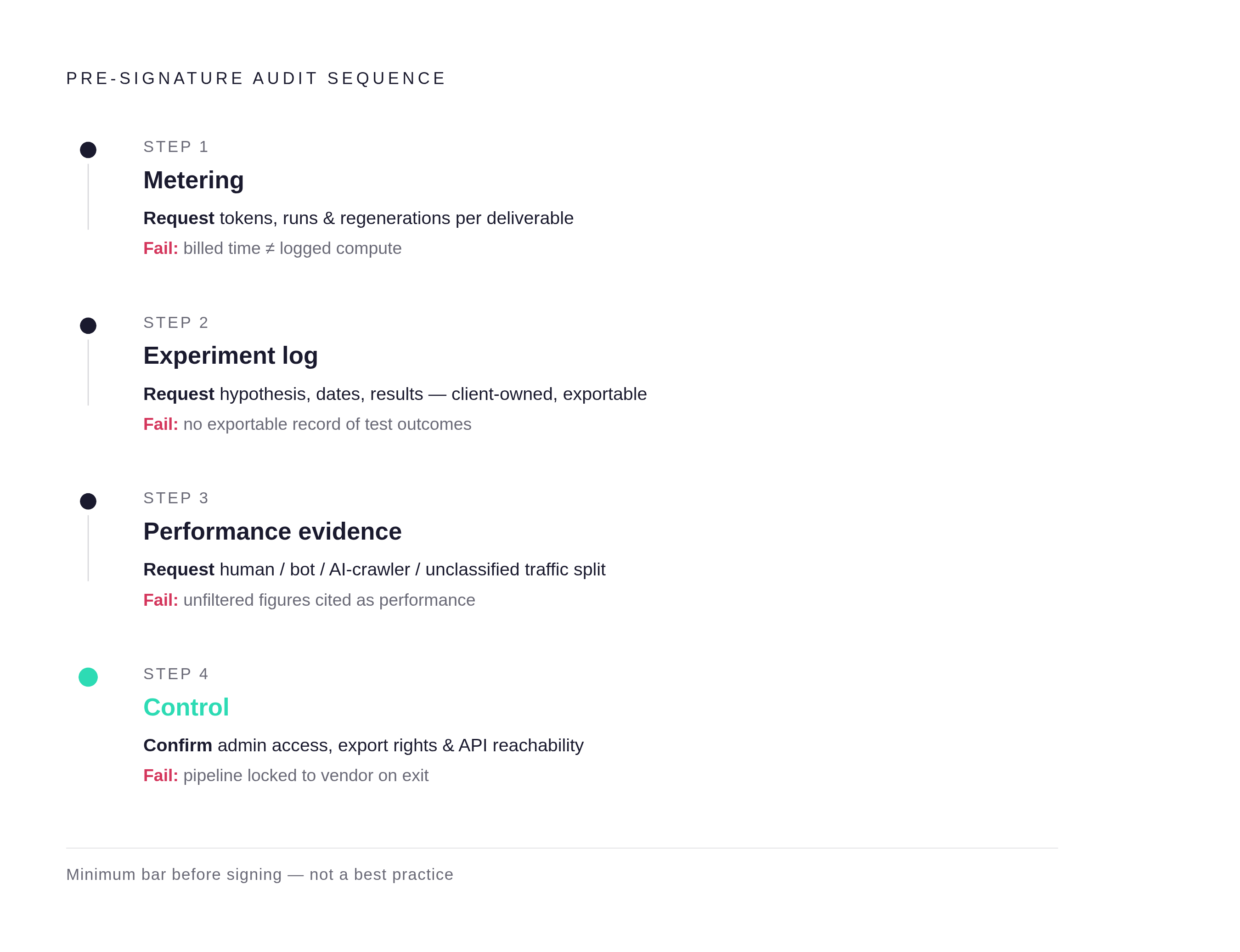
Before signing or renewing, the founder should first establish what the pricing claim promises. Is recovered time meant to cut billed hours, pay for more deliverables, or fund experiments? That answer gives the records a purpose. An hourly rate cannot be assessed in isolation from scope, and a flat fee does not by itself show whether the client receives any efficiency benefit.
The first check is metering for the prior period. Ask for tokens, runs, and regenerations for each deliverable, then check those line items against the time billed and the work agreed on. If the log does not exist, production cost is unaudited. The second check follows any claim that saved time supports experimentation. Request the hypothesis, start date, evaluation data, result, and disposition for each experiment in a client-owned, exportable format.
The third check tests the performance evidence. Request filtered and unfiltered traffic figures side by side, with human, bot, AI-crawler, and unclassified activity distinguishable. If the system cannot tell those signals apart, its headline traffic figures are still unaudited. The fourth check tests control of what was built. Confirm admin access, exportability of content and pipeline definitions, and whether the buyer’s agent can reach the workflow primitives through API or MCP.
Each check then needs a contractual counterpart. A metering-disclosure requirement, an experiment-log delivery obligation, an ownership schedule, and a data-portability clause turn requests for evidence into conditions of the engagement. Otherwise, even if the demonstration works before signing, the buyer may still have to rely on the agency to share records later.
The design standard is one account and one source of truth, with visible cost line items and workflow primitives reachable through the buyer’s own tooling. In such a system, the client can run the pipeline, hand it to another vendor, or add review gates without asking permission. The buyer can inspect the saving while the engagement runs and retain the means of producing it when the engagement ends.