"Drafts that already sound like you" is a claim you can test: how to evaluate AI copywriting tools on voice capture with samples, a diffable guide and a measurable edit rate
Test AI voice claims with a spec, blind samples and edit rate.

AI copywriting tools promise drafts that “already sound like you.” For developers and technical founders, that promise should be an acceptance test. To test that promise, start with a voice spec drawn from real material, test drafts without showing where they came from, and track how much human editing they need before they can be published.
Why "sounds like you" is a falsifiable claim, not a brand promise
What would make a draft fail to sound like the person it represents? If the answer is only that it feels insufficiently “warm and professional” or “confident but approachable,” the claim has no usable test. A vendor can call the output successful while an editor rewrites it.
“No exclamation marks, contractions always, never open with a question” gives a reviewer something to inspect and a machine something to follow. These rules make part of a voice falsifiable. The shift is from describing an impression to specifying acceptable output. Once a vendor claims to produce that output, the buyer is entitled to a test.
What voice actually consists of, and why style guides miss most of it
Voice is not just tone or sentence length. It includes the positions someone holds, the confidence with which they hold them, and the reasoning they use to explain them. A founder’s disagreement with a whole category may be more distinctive than any preferred adjective. So may a customer observation that competitors miss, or a way of framing a problem that appears in conversation but disappears from the pitch.
Copper Sun’s founder-voice guide distinguishes stylistic capture from substantive capture. The former reproduces surface markers, including short sentences and casual language. The latter captures positions, reasoning patterns, and characteristic explanations. That distinction explains why a draft can imitate someone’s verbal habits yet still feel unlike them. It has borrowed the register without the thinking.
Where, then, should the source material come from? Talks, Q&A sessions, sales calls, and podcast interviews expose language used under explanation pressure. Polished writing has a role too, particularly when it represents the intended publishing standard. But a spec drawn only from polished marketing copy risks extracting a cleaned-up average while losing the framing that made the voice distinctive.
Building a diffable voice spec: a seven-row structure the model can be held to
A machine-readable voice spec needs seven rows, each with an on-voice rule and a way to measure whether a draft follows it. The measurement method is the critical part. A row labelled “sentence rhythm” does little unless a reviewer can say how a draft passes or fails it. The document should turn editorial preferences into checks without pretending that every feature of voice is reducible to a word count.
The first row defines sentence-length range in words, with an acceptable band and a hard maximum. The second defines paragraph rhythm, measured by sentences between breaks and the deliberate use of one-line paragraphs. The third contains a short lexicon of words and constructions to use or exclude, including banned AI filler. These rows make surface habits inspectable. The selected corpus should set their values, in place of a guess at an ideal style.
The fourth row specifies hedging posture, including whether the voice asserts or qualifies and whether it names an objection before answering it. Reviewers check the relevant passages against those rules. The fifth defines person and tense defaults, with consistency checked across the draft. The sixth bans specific constructions, including sentence openings, rhetorical moves, and punctuation habits. The seventh records the ways the voice tends to open and close, checked against patterns found in authentic work.
Corpus selection is itself an editorial decision. The full published corpus yields an average, while edited best work establishes a chosen standard. Unscripted material supplies the substantive context that either selection may lack. Store the resulting plain-text spec in version control so that changes stay diffable. The diff then records intentional voice decisions rather than leaving editors to infer why the instructions changed.
How to load the spec so the model inherits it rather than forgets it
A document pasted manually into every session is a workaround. Under volume and time pressure, context loading becomes another step someone can omit. A team should also avoid assuming that conversational memory holds the full, up-to-date brand specification. The drafting environment needs to receive the approved spec and source material reliably.
To make that context persistent, load the spec with three to five voice exemplars into the tool’s project context. Claude offers a concrete pattern through a named Project with custom instructions, with client work kept inside it. The rules and examples serve different purposes. The spec defines constraints, while the exemplars demonstrate how the constraints work together in actual copy.
Copper Sun’s approach also uses transcripts and brand materials as indexed sources of direct quotes and specific positions, going beyond a summary of the style. That gives the model substance to draw from. A profile built from one interview is a starting point, while a year of talks, interviews, and written output supplies a richer source. The gain comes from more specific thinking being available.
Running the blind sample test: how to know whether the spec is working
A familiar draft can feel authentic simply because its author knows how it was made. Blind discrimination removes that cue. The test checks whether people who know the brand can reliably distinguish AI drafts from authentic copy when neither has a byline. If they can, the spec has not yet closed the gap that the vendor’s promise implies.
For a reproducible test, write one brief and generate AI copy using the loaded spec and exemplars. The comparison needs two AI samples and two authentic published pieces on the same subject or in the same format. Remove the bylines and present all four samples to three people who know the brand. Ask them to identify the two real pieces, then record their attribution accuracy. Keep the task explicit so that everyone is answering the same question.
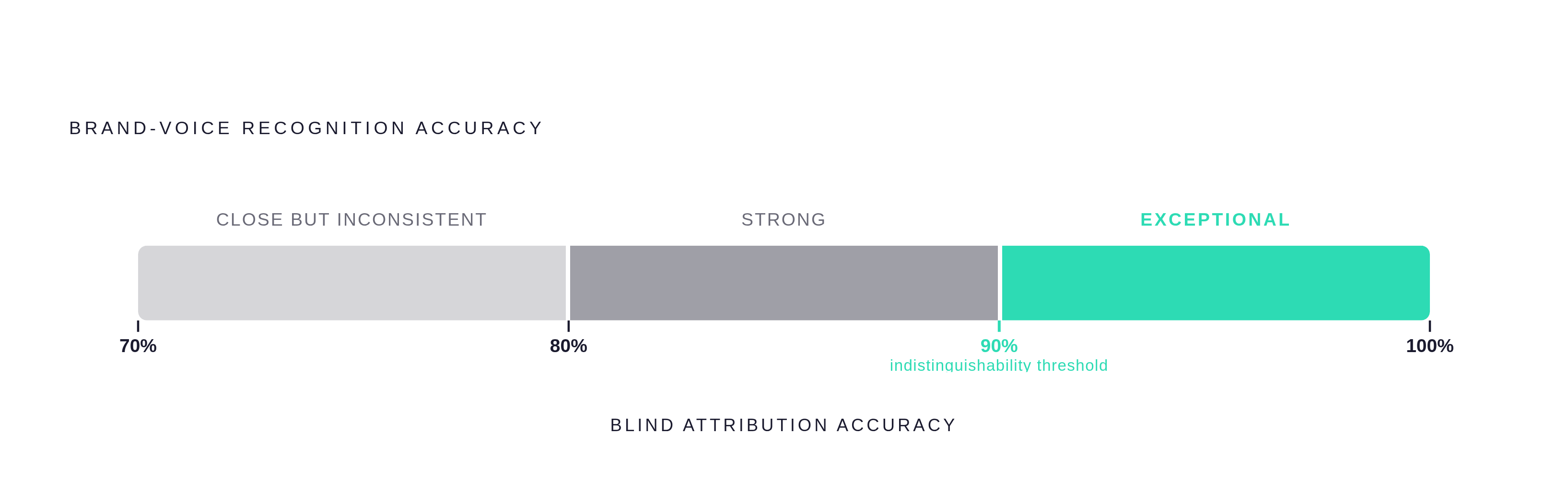
Correctly identifying the brand’s voice is not the same as correctly identifying which drafts are human. Brand voice recognition of seventy to eighty percent is labelled close but inconsistent, eighty to ninety percent strong, and above ninety percent exceptional. Those tiers need to change for human-versus-AI identification. In the latter test, high accuracy means reviewers can tell the sources apart, which works against the indistinguishability claim.
The test is also a diagnostic. If openings, closings, or transitions keep giving away the generated samples, the spec row that covers them needs work. Fix that row and run the test again. This makes blind review a development loop rather than a one-time demonstration built around a favourable draft.
Edit rate as a pipeline health signal, not a productivity metric
Blind testing evaluates voice capture, but production needs an ongoing signal. Edit rate is the percentage of AI-generated words that are changed before the work is published. It measures the distance between a generated draft and publish-ready copy. A low rate has value only when a human has actually reviewed the work.
Above roughly three-fifths, the editor is effectively rewriting the output, which points to failing prompts or a failing spec. A healthy rate comes from drafts that have been reviewed and need few changes. There is no universal numerical healthy band supplied here, so the workflow needs an explicit acceptance threshold. At the other extreme, zero edits without a review gate represents an absence of measurement.
First-Pass Yield provides a second view of pipeline health. It records the share of drafts that pass all automated guardrails on the first generation without regeneration. A yield below roughly seventy percent is a warning of prompt or model issues that may produce more editing downstream. These signals do different jobs, because a draft can pass automated checks and still fail to sound right.
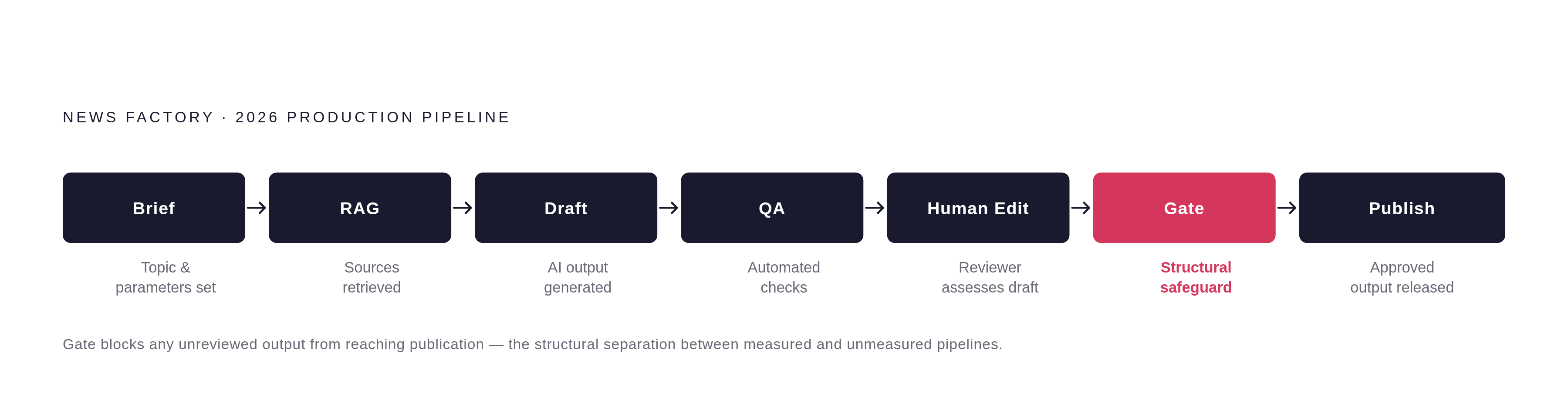
News Factory’s 2026 pipeline guide places Human Edit after Brief, RAG, Draft, and QA, and before Gate and Publish. Human review assesses the draft before release, while the gate prevents an unreviewed output from being mistaken for accepted work.
What edit rate trends tell you over time, and when to update the spec
A rising edit rate means more than a single difficult draft. Across successive content runs, it suggests that the spec has drifted from the actual voice, or that the voice has evolved without the spec following. The pattern helps narrow the diagnosis. When editors override an unchanged spec more and more often, that points toward prompt rot, while a sudden step-change on the same content type after a model update points toward model drift.
Volume blur describes a different failure at scale. The model falls back toward its defaults, and the spec needs reinforcement rather than an assumption that initial success will persist. These explanations are not interchangeable. A model that has changed, an editorial standard that is changing, and weak instructions each need a different fix, even if all three raise edit rate.
When the rate exceeds the workflow’s healthy limit for two consecutive content cycles, review the diff and the rows editors override most often. A targeted audit is preferable to rebuilding everything. After a large change, rerun the blind test to check whether it improved voice capture without making another part worse. The quarterly review can be a fifteen-minute comparison of spec versions, checking that changes were intentional and the named owner signed off. The cycle for keeping the spec up to date is spec → draft → edit → rate → review → update spec.
Why most teams cannot answer whether their AI pipeline is producing on-brand output
Content teams commonly track volume and publishing cadence, leaving gaps in the signals specific to AI drafting. That creates a category gap. A team may know how much it published without knowing how much generated copy required repair. More output does not answer whether the voice specification is working.
The missing feedback has two consequences that compound. First, degradation can remain invisible until it appears in lower engagement, editorial complaints, or lost deals, after weak copy has spread through published work. Second, without a baseline, an apparent improvement cannot be attributed confidently to a spec revision, model switch, or workflow change. The team has activity records but no clear comparison. Every adjustment remains partly a guess.
Content management systems and standard analytics platforms do not report edit rate and First-Pass Yield, so those measurements require deliberate pipeline instrumentation. Blind attribution needs its own review process as well. Without those feedback signals, teams lack a reliable way to tell whether their interventions improved the AI-assisted process.
Applying the framework when evaluating or switching tools
For vendor evaluation, the lesson is to build the spec independently of the tool. It belongs to the brand. Each candidate’s context mechanism, whether that is a project, custom instructions, a persistent brand profile, or an API system prompt, should receive it and the exemplars. This preserves a common standard instead of letting each platform redefine success around its strongest demonstration.
The context architecture needs to be checked before the prose is judged. Does it retain the spec and exemplars across sessions without manual repasting? Does it expose enough of the prompt and context layer for changes to be versioned and diffed? Can an API or agent hook apply the same specification to automated runs? These questions connect an attractive sample to the workflow that must keep producing it.
The acceptance criteria then cover blind-test performance, a healthy edit rate at volume, and stability over time. A strong first draft answers only part of that test. When comparing tools, the ongoing burden of correction is more informative than a voice preset’s name.
A plain-text, versioned spec also makes a switch less wasteful. Any tool that accepts a system prompt or persistent context can receive the same editorial investment. The claim that drafts “already sound like you” is now a spec, a test, and a metric. That turns marketing language into an engineering acceptance criterion a buyer can justify paying for.