The meta description generator is the wrong unit: refreshing titles and descriptions is a measured change, not a copy task
Start with high-impression, low-CTR pages, and measure every edit.

Refreshing titles and meta descriptions is a measured change. The useful unit of work is a hypothesis about a URL whose impressions and click-through rate make an edit worth testing. A generator can supply a draft, but the workflow has to begin with evidence of a missed opportunity and end with a result.
Why meta tag work keeps failing to move traffic
A team finishes a bulk rewrite, checks Search Console two weeks later, and finds that nothing changed. The new descriptions read better. Missing fields have been filled, and the work is complete by the standard the team set. Yet that standard says nothing about whether the edited pages appeared in search often enough for better copy to produce a measurable gain.
Opening a generator and pasting a URL frames the job as creation, so success becomes a file of finished copy. Pages with almost no impressions can take as much work as pages that searchers see often. Meanwhile, high-impression URLs with weak CTR remain untouched because no one sorted the report before choosing what to edit. The lack of results does not establish that metadata has no value.
Titles and descriptions also need different treatment. Google has been explicit that the meta description is not a ranking factor, so its direct search job is to influence the click. More is at stake when editing a title, so it needs more care than a description even when a generator shows both fields together. Bundling them into one writing task obscures which change is being tested and what would count as success.
What Google actually does with the copy you write
Google Search Central explains that snippets come mostly from page content and may change with the search query. Google sometimes uses the authored description when it describes the page better than the available page text. A polished summary of the page in the abstract can still lose to a passage that answers the particular query.
That constraint changes the writing brief. A description should sound compelling and match the dominant query cluster that brings the page impressions. When the queries in a cluster are closely related, the team has a clearer intent to write for. Investing equal effort across every page ignores that difference, as well as the difference in how often each page appears.
What about a large site with thousands of missing descriptions? Bulk generation can still close that gap. A hygiene task is done when an empty field is filled, but an optimization task stays open until the team has measured what the change did.
How the SERP environment makes every CTR point more valuable, not less
AI Overviews and expanded ad units make the click harder to win. Informational results compete with an answer already visible on the results page, while commercial results compete for space with ads. That competition is still there even with a strong organic position. The searcher may have learned enough before getting to the result.
If the AI Overview has already supplied the generic answer, repeating that promise gives the reader little reason to continue. A more useful title identifies something specific the page provides that the overview did not deliver. That distinction must come from the page itself, rather than from a promise added only to win attention.
Does lower organic CTR automatically make every improvement worth more traffic? When the impression count stays the same, a percentage-point gain brings the same number of extra clicks. The stronger argument is that avoidable losses become more consequential when fewer searchers reach organic results at all. High-impression pages with a CTR gap deserve attention because there is an existing audience whose choice the snippet may influence.
Descriptions may also have a second audience. AI systems can encounter them as summaries of what a page offers, although their effect on citation is disputed. That possibility adds a reason to write accurate, query-aligned text. Neither the human opportunity nor the possible extraction benefit can be assessed by reading generated copy alone.
The right starting point is a sorted impression report, not a list of pages
For a team putting this into practice, the starting point is Google Search Console. Sort pages by impressions in descending order, then inspect the top candidates. For each candidate, filter the report by page and examine the queries, current CTR, and average position. Look for a page that shows up in search but gets few clicks for its position and query type.
Position gives the comparison its necessary context. A page at position 3 with unusually low CTR is a different opportunity from a page at position 40 with no description. The latter has an obvious empty field, but that does not make copy its current bottleneck. The former has enough visibility to support a hypothesis about why searchers are passing it over.
The hypothesis should name the proposed change and expected effect. For example, front-loading the dominant query term in a particular title and adding a concrete value differentiator might be expected to lift CTR by a stated number of points during the next measurement window. The team sets that target before editing. Otherwise, almost any movement can be recast afterward as a successful result.
Only then does the writing begin. A description should address the dominant query cluster rather than summarize everything the page contains, while a title should make the page’s specific offer clear. Both changes need a preserved before-state and a timestamp. Search Console comparison reports can then support a before-and-after read, though that comparison is not, by itself, a controlled A/B test.
Treating a meta tag edit like a code change, with a diff, template, and measurement window
A metadata edit needs the same basic traceability as a code change. The record should show the URL, old text, new text, and date. The diff makes the intervention inspectable. Without it, a later CTR change cannot be tied to a precise decision about wording.
The CMS adds another layer to inspect. A page-level edit may be overridden by a template, while changing a title formula can affect hundreds of pages at once. Those are different interventions. After a template change, a team needs a broader measurement window and must check for other causes before deciding what the change did across the pages it affected.
For a page-level edit, compare impressions, clicks, CTR, and average position over equal periods before and after the change. Equal windows make the comparison more consistent, but they do not eliminate seasonal differences. The record should explicitly note seasonality in the query cluster, ranking shifts whether manual or algorithmic, changes to the AI Overview, and a competing page entering the results. A CTR increase that coincides with a better position is not a clean read on copy.
Consider a hypothetical change to /guide/x. Before the title edit, the page has healthy impressions, a mid-page-one position, and low CTR. During the equal period afterward, impressions and position hold steady while CTR rises meaningfully. That gives the team reason to think the edit helped. It becomes a stronger attribution only after the other plausible confounders have been considered, rather than because stable position alone proves causation.
Human review belongs before the change ships. The reviewer checks whether the title accurately addresses the dominant query cluster, distinguishes the page from the AI Overview summary, and fits the pixel budget. This is a narrow review. Its scope makes it fast while still separating a plausible AI draft from an approved change.
Why meta descriptions now do a second job, feeding AI extraction as well as earning the click
The possible extraction role asks a different question from the click role. A person deciding whether to open a result needs a reason to continue, while an answer engine needs text it can interpret without distorting the page’s claim. A description can serve both purposes when it is self-contained, accurate, and tied to the page’s actual subject.
The evidence calls for restraint, however. Claims that AI Overviews pull descriptions directly into citation snippets do not prove that rewriting descriptions leads to more citations. Seer Interactive’s controlled experiment found that crawler traffic and citations stayed much the same after descriptions were changed. That finding gives little reason to call the description a main way to improve AI visibility.
A useful writing standard survives that uncertainty. For the click, the description should match dominant query intent, provide a concrete value signal, and fit the available pixel budget. For extraction, it should make the page’s main claim clear enough to make sense on its own. Neither intent matching nor length guarantees that Google will display the authored text, but both help keep the draft focused on its intended use.
This places metadata within a wider legibility problem. Content structure, citations, and credibility signals also contribute to how a page can be understood and assessed. A description is one signal among those. The appropriate response is to test any claimed AI benefit separately from CTR rather than assume that an improvement in one channel establishes an improvement in the other.
Making the workflow composable, with audit, prioritize, edit, and measure as callable steps
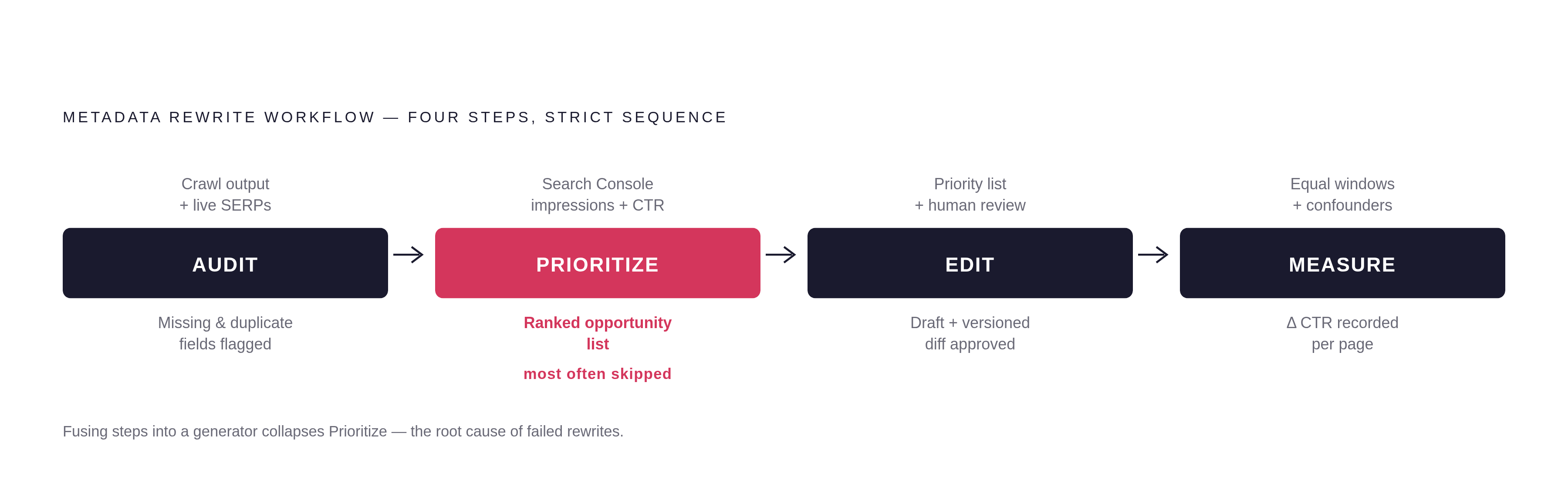
For technical teams, the workflow becomes easier to run when its four operations are independently callable and observable. Audit finds the pages, the titles and descriptions they have now, and any fields that are missing or duplicated. Prioritize adds Search Console impressions and CTR gaps to rank the opportunities. Edit produces a draft, routes it through human review, and records a versioned diff. Measure compares equal windows and records the relevant confounders.
Each operation has a different input and output. Fusing them inside a generator interface can leave the audit sorted by page inventory, with no explicit prioritization step and no preserved before-state for measurement. A callable step can instead be reached by an agent through an API or by a person through the same interface. Keeping the steps separate lets a team schedule audits, automate the sort by priority, send high-priority drafts for review, and get the results when the measurement window ends.
The same design can include AI visibility signals and keep them separate from CTR. Microsoft’s AI Performance report entered public preview in Bing Webmaster Tools in February 2026, covering total citations, cited pages, grounding queries, and page-level citation activity. Microsoft extended the report in June 2026 with Intents, Topics, Citation Share, and Compare. These signals create opportunities for comparison, but the edit history must exist before a team can connect a change to the relevant period.
Manual query testing provides another before-and-after record. A team can test a page’s top query clusters against ChatGPT, Perplexity, and Google, logging citation observations over time. That record can help show whether visibility changed after an edit, though it cannot prove that the description caused the change. As with organic CTR, the before-state has to be captured before the intervention.
The lasting asset is the history of decisions and results. Versioned changes, timestamps, and defined windows accumulate evidence about which edits moved CTR on that particular site and which failed to do so. The next refresh can begin from those results. Each measured edit narrows the hypothesis for the next one.