"Drafts that check the repo" is the right input, but a content platform is still a service: what a technical buyer should ask when an AI content platform says it writes from your code and docs
Repo access is only step one; here are the questions that test review, upkeep and agent-readiness.

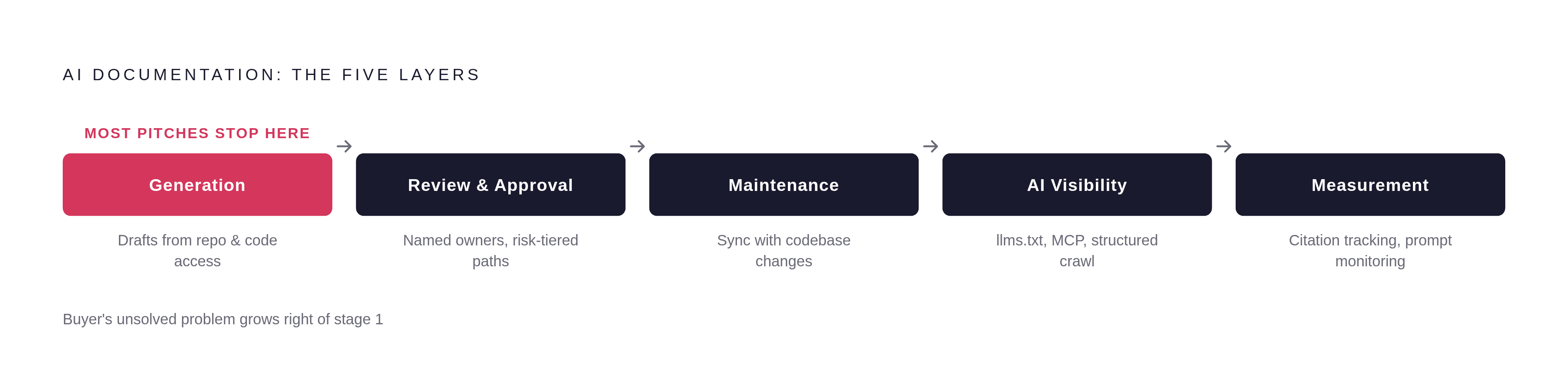
“Writes from your code and docs” describes a useful input capability. For a technical buyer, its value depends on what happens after generation, including review, publishing, maintenance and measurement. Without those layers, a platform can deliver a faster first draft while leaving the same downstream problems for the buyer to solve.
Why "writes from your code" is a narrow claim that leaves the service layer unaddressed
A platform that reads a repository has access to evidence that a prompt-only writing tool does not. DocuWriter.ai, for example, ingests source code from Git repositories and produces API references, UML diagrams and test suites. That is a substantive capability. The first distinction is whether the system can inspect the codebase at all.
Access, however, does not establish what happens to the output. A generated reference still has to pass through a review workflow, reach a publishing system and stay aligned with the product. Its usefulness then has to be measured. None of those steps follows automatically from repository access, so a demonstration of accurate drafting establishes only part of what the buyer needs to know before purchasing.
Does the draft enter a controlled process, or does responsibility simply pass back to the team that requested it? That question sets the boundary between a drafting capability and the broader service the buyer may think they are purchasing. In 2026, that boundary also includes AI agents, which read documentation to write integration code. The same page must now serve a developer making sense of the product and an agent using it as working material.
What the documentation layer is and isn't designed to do
Documentation platforms handle the authoring and publishing parts of that larger process. Those functions are useful in their own right, but they do not settle who approves a claim, how compliance is handled or whether a published page remains current. Publishing a page also leaves open whether an AI system can use it.
DocuWriter.ai explicitly acknowledges the need for judgment, stating that “while the AI output is highly accurate, it is best practice to have a human review for project-specific nuances”. That qualification is central to the purchase. Code can provide evidence about implementation without settling which changes are approved or what users actually need to do. A draft can thus draw on source material and still need fixes before it is published.
GitBook identifies llms.txt output, MCP server support and structured Markdown delivery as a 2026 baseline for documentation that agents can consume. A page can be readable to a person without being readily usable by an agent, just as machine-readable output can contain an unapproved claim. The buyer’s evaluation therefore needs to distinguish authoring and publishing from the review, compliance, freshness and measurement work around them, rather than assuming one strong layer supplies all the others.
The review and approval architecture the vendor pitch usually skips
“A human reviews it” leaves the crucial architecture unspecified. A production workflow needs named states, owners, automated guardrails and recovery paths, so that review is an enforced step. The minimum credible design separates deterministic drafting, multi-layered review and atomic publishing. Automated checks run before a human must sign off. Each phase should also be stateless and idempotent, allowing a failed step to be retried safely without double-publishing.
Automated checks can handle PII detection, toxicity scoring and factual consistency, while people judge the nuance, cultural context and strategic alignment. Neither pass replaces the other. Without a required human gate, a platform leaves the judgments people make unchecked, while a vague promise of human review leaves unclear which guardrails run first. The buyer should ask which checks are available and whether they can be configured or are fixed.
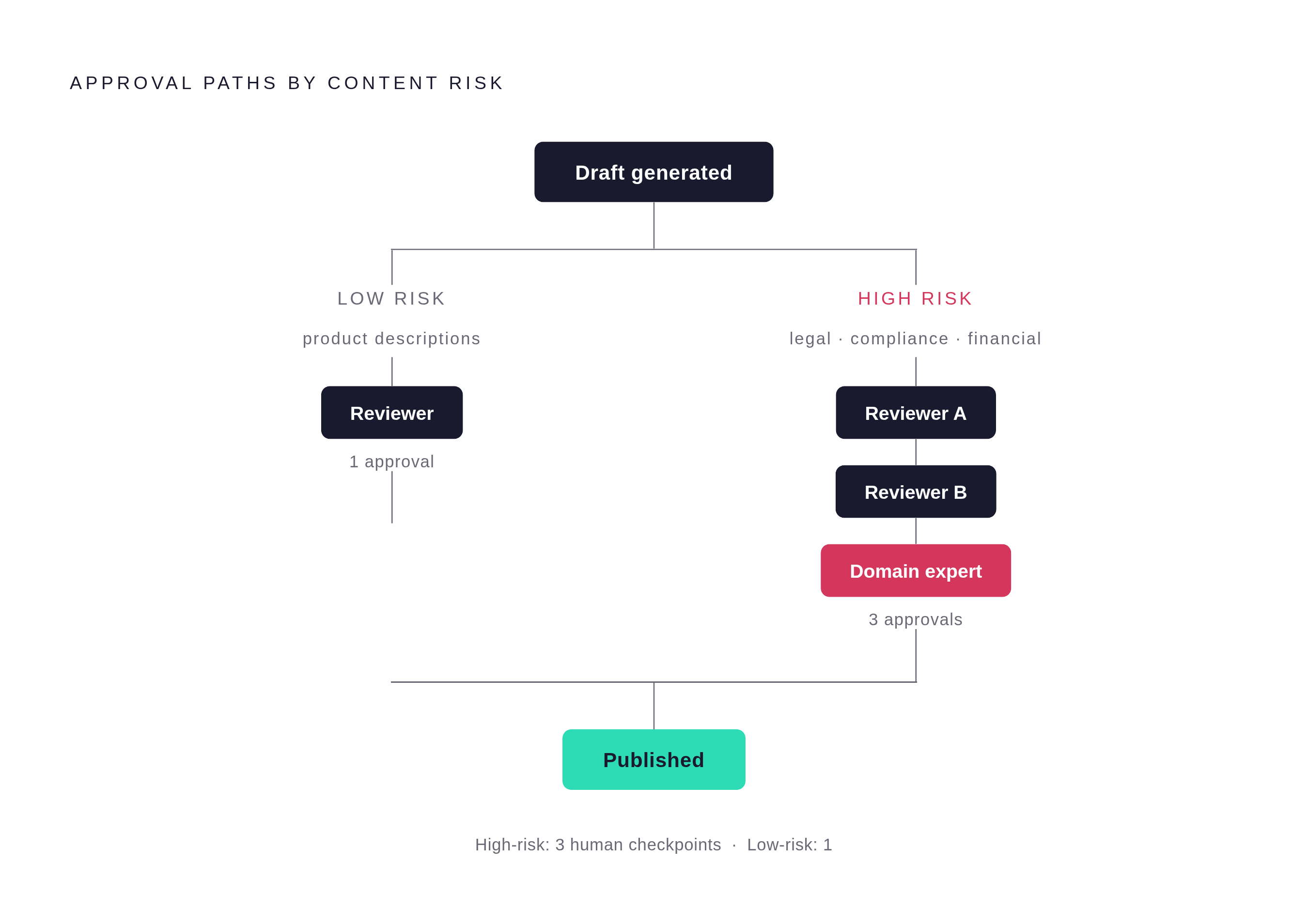
Risk should also change the approval path. Low-risk content, such as product descriptions, may need one reviewer, while high-risk legal, compliance or financial claims in developer documentation need two independent approvals plus domain expert sign-off. Treating every page identically misses that distinction. Can the platform require review based on the content risk class, or does every draft follow the same route?
Auditability begins before the reviewer opens the draft. Can prompt templates be versioned in source control, making changes to generation auditable in the same way as code changes? At the other end, does the platform record who approved what and when, with an audit log sufficient for SOC 2 or ISO 27001 compliance? Rejection needs a defined destination as well. The buyer should ask whether a rejected draft re-enters the queue, escalates or disappears. A vendor that cannot answer these evaluation questions concretely is offering drafting with a gap in the content pipeline, and the buyer should price that gap into the decision.
How the draft stays current when the codebase keeps changing
If a code change never produces a documentation update, the review architecture has nothing new to examine. The common failure is a good draft that remains published after the product has changed, leaving a gap between the instructions and the implementation. That divergence can be worse than having no documentation because the page still presents itself as useful guidance.
Some platforms address maintenance as part of their design. DocuWriter.ai describes a continuous Autopilot AI Agent that syncs with the codebase to prevent stale documentation. GitBook describes proactive agents that draft updates from pull requests and support tickets, giving teams a starting point before someone notices a gap. A change that the system proposes still needs a way into the review process.
GitBook also offers two-way Git sync with GitHub and GitLab, which can route a pull request through a change-request workflow before the documentation update publishes. That connects maintenance to a review gate engineering teams already use. The distinction is consequential. Automatic drafting can cut the work of finding and describing a change, while automatic publication can skip the judgment the buyer required for the original page. The buyer should ask whether machine-authored updates pass through the same gate as human-authored ones.
Triggering and signaling complete the maintenance questions. When a PR merges, does the platform draft an update automatically, or must someone start the process manually? Can it flag a potentially stale page using the last code change that touched the relevant function, and can the buyer configure which changes trigger drafts to limit the noise generated by every commit? “Writes from your code” is a durable claim only if it means keeps writing from your code as it evolves.
What the published documentation needs to do for AI visibility, not just human readers
For technical B2B products, documentation is both a developer resource and source material for AI answer engines responding to questions about which tool to use. Publication alone does not secure that role. A page has to offer material an AI system can retrieve, interpret and cite. Documentation choices thus affect whether people find the product as well as how it helps those who already use it.
AI systems use retrieval-augmented generation to base many answers on live web sources as well as training data. Indexability is therefore only an entry condition. If a page offers few extractable, contradiction-free statements, being indexed does not make it useful evidence for an answer. The system may leave that aspect unanswered to avoid supplying a wrong claim. The meaningful test is whether the content can support a specific answer.
Crawler access is a separate strategic choice. Allowing OAI-SearchBot for real-time citation while blocking GPTBot for model training distinguishes two uses of the same content. The buyer should ask whether the platform’s default robots.txt configuration is set up to make that choice. Delivery deserves equally concrete questions about whether llms.txt and an MCP server are provided automatically or require separate configuration. The output should also be examined for structured Markdown, rather than assuming that a published page needs no post-processing to become machine-parseable.
Organization schema, a Wikidata entry, LinkedIn and an About page corroborate the brand when they tell the same story. Divergent signals can instead prompt hedging and suppress citations even when the documentation itself is strong.
Measuring whether the content actually earns AI citations, not just traffic
A platform that cannot report whether ChatGPT, Claude, Gemini or Perplexity cites the product has finished the drafting job and left measurement to the buyer. Pageviews cannot close that gap. The final layer needs to distinguish appearance in an AI answer from a visit to the documentation, because the two events do not always happen together.
A user asks an AI engine which tool to use, sees a product mentioned and searches for that brand two days later. If the user then converts through branded search, the attribution model credits that search, leaving the AI mention that began the journey uncredited. Standard analytics can miss the initiating event. A rise in branded search therefore does not, by itself, reveal which AI answers influenced it.
Microsoft’s Bing Webmaster Tools AI Performance Report, in public preview, provides first-party citation data, including total citations, grounding queries and page-level citation activity. GA4 addresses a different part of the journey by filtering referral sessions from AI platforms through a custom channel group or the native AI Assistants channel added in May 2026. Those sessions are referral clicks that show what happened after a citation. Yet a significant share of AI clicks from mobile and desktop apps arrives without a referrer and appears as Direct, so GA4 undercounts true AI-driven visits. Neither tool covers all the engines a B2B buyer needs to track.
The buyer should therefore interrogate the measurement layer as closely as the generation layer, whether it comes with the platform or is added separately. Does it report AI citations apart from organic search traffic, and can it run scheduled prompts across the target engines to track citation share over time? That would let the buyer assess whether a documentation change improved or degraded visibility. A further question is whether it distinguishes content being mined without brand attribution from the brand being named in an answer. AI visibility should be measured with the same rigor applied to the workflow that produced the content.