Programmatic SEO vs. Traditional SEO: Why the Real Divide Is Between Static and Computational Marketing
Static operations can't evolve their presence when search results flow through AI citations.
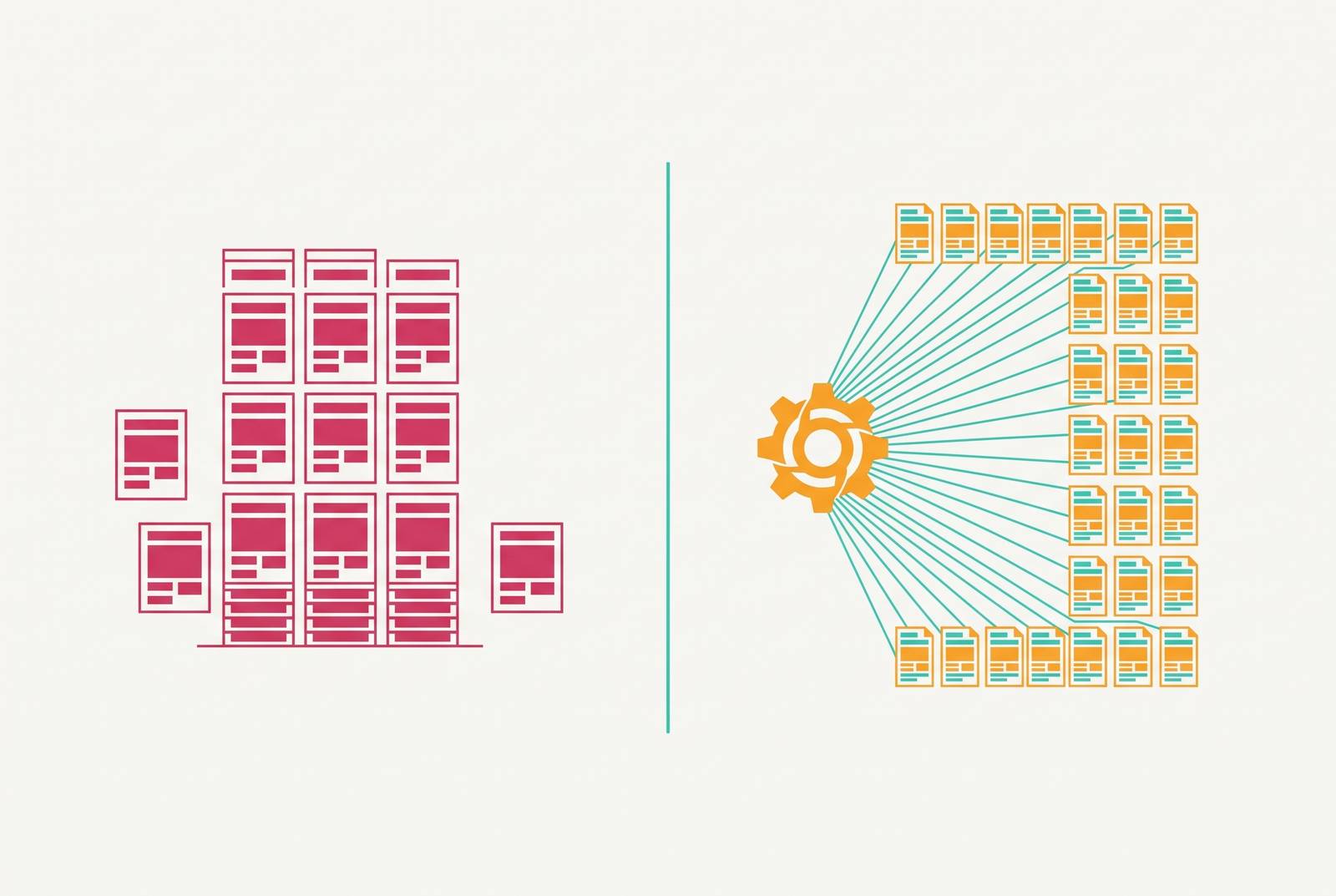
The choice between programmatic and traditional SEO is really a choice about how marketing works after a page goes live. A static operation produces content and stops. A computational one uses the results to decide what happens next. That feedback loop contributes more to a brand’s continued visibility in both search rankings and AI-generated answers than the choice between templates and handwritten pages does.
Why the programmatic-vs-traditional framing obscures the real strategic choice
Should a team write each page by hand or generate pages from a template? The familiar comparison sets editorial depth against publishing scale, starting with production. Traditional SEO puts manual work into a single page when the target keyword is worth that effort. Programmatic SEO multiplies a template across a dataset, producing hundreds or thousands of pages for narrow query variations. Both aim to earn rankings and traffic.
A competitive head term may need original insight and sustained editorial work, while a family of specific queries may be better served by structured data. Neither method defines the whole operation. Teams gain more useful insight by examining whether results from either kind of page change what they research, publish, update, or remove next.
What separates a static content operation from a computational one
A static operation repeats a familiar unit of work, namely one author, one brief, one page, and one keyword. Publication is the milestone, followed perhaps by a ranking check. When something underperforms, someone has to notice, diagnose the problem, and start another task. More output requires proportionally more human input because each page remains a separate job.
A structured dataset drives generation, while templates encode what the searcher wants as well as where headings belong. Performance data flows back into the process, exposing weak content patterns that can be refined across related pages. AI agents can analyze those patterns and adjust templates independently of someone inspecting every URL. The upfront work in data and templates can therefore support growth without an equivalent rise in manual effort.
Automation alone does not create that distinction. A team can automatically publish thousands of pages and still run a static operation if nothing learned after publication changes the system. Conversely, human decisions can remain central to a computational process when those decisions draw on a working feedback loop. When a page fails, does its performance inform the next brief or template, or does it remain an isolated disappointment?
How programmatic SEO functions as infrastructure, not just a volume tactic
The dataset gives a programmatic page its reason to exist. Each URL needs information that a searcher could not get by replacing one keyword with another. Wise’s currency converter pages show how this works because live exchange-rate data makes each currency pair different. The page serves a product function as well as a search query. Its usefulness does not depend on dressing up the same paragraph with a different modifier.
The template then turns that data into an answer. It must answer what the searcher wants to know from each query, which takes more than showing whatever fields are on hand. Internal links connect related pages so that the programmatic layer can contribute to topical authority. Publishing controls complete the infrastructure through quality thresholds, indexation monitoring, and decisions to cut underperforming pages. Domain authority cannot save every thin long-tail page.
A template is easy to copy, while proprietary usage benchmarks, pricing feeds, anonymized first-party results, difficult-to-clean public data, and computed scores are harder to reproduce. A growing page count is not evidence of a strengthening system. The infrastructure earns its value when each additional page gives a searcher a distinct answer that the operation can keep accurate.
Why the same page now competes on two surfaces at once — and why that changes the stakes
In 2026, distribution extends beyond a Google ranking. The same page can also compete to become a cited source in an AI-generated answer. Perplexity, Google AI Overviews, and Gemini ground answers in live web sources through Retrieval-Augmented Generation, while ChatGPT uses web retrieval selectively. A structured page with unique data and a clear answer to a specific question is well suited to that retrieval process.
Yet a ranking and a citation are different outcomes. A brand can perform well in organic search while remaining absent from AI responses if its content is difficult for machines to extract. Narrow programmatic pages have a useful starting position because they focus on answering one question. The operation still has to learn whether those pages actually appear in answers.
Even an appearance leaves another question unresolved. Does the brand return when the same prompt runs again, and does it appear on other platforms? ChatGPT, Google AI Overviews, and Google AI Mode can recommend different brands for the same query. A single citation may therefore reflect only momentary visibility. Citation rate and consistency become outputs to track independently of organic success.
The ground-site and phantom-site structure that determines AI citation
The brand’s own website forms the ground site, its canonical home for information about the entity. Documentation, articles, and structured data files need to be technically sound, consistent about the brand, and legible to machines. Human readability alone is not enough here. A computational operation treats this site as a living data asset, with updates, internal links, and audits for machine extraction built into its maintenance.
Entity recognition draws on more than one signal. A Wikidata entry can help anchor a brand, but its absence does not make the brand invisible. Models can also draw on training memory, Google’s Knowledge Graph, schema markup, co-occurrence with recognized entities, and authoritative third-party mentions. Consistent information across those sources supports recognition without making one directory a universal prerequisite.
The phantom layer consists of presence on third-party domains, including editorial coverage, Reddit threads, industry roundups, Wikidata entries, Wikipedia, technical papers, forums, and review sites. This layer is largely earned. The strategic work is to identify which publications in the brand’s field an AI system treats as authoritative and secure earned mentions there. A well-built ground site without that corroboration is unlikely to earn reliable citations, while third-party recognition cannot fully compensate for a machine-illegible site. Programmatic pages supply specific material to retrieve, and the phantom layer supplies evidence that the brand deserves trust.
Why a static operation cannot sustain presence on both surfaces
The first breakdown is a measurement gap. Keyword rank trackers do not show citation share of voice, consistency across repeated prompts, or differences between AI platforms. GEO monitoring helps answer those questions by tracking where brands appear in generated answers. Without that instrumentation, a static operation is missing an entire class of results showing whether its search success translates into AI discovery.
AI answer engines prioritize authoritative, current sources, while episodic publishing leaves data without a built-in route to renewal. Teams should audit a data source for completeness, accuracy, and update frequency before building its template, then maintain that discipline after launch. A page-generation system cannot compensate for stale inputs. Publishing more pages adds to the work of keeping them current if each update is still a separate manual job.
What good is a sophisticated pipeline if the domain has not earned enough trust to rank or be cited? A new or low-authority site can produce well-differentiated pages that still fail to index or rank. Better infrastructure does not create third-party editorial coverage or take the place of a base of authority.
A phased approach builds the traditional SEO foundation in months 1–6, introduces programmatic SEO in months 4–9, and then runs both in parallel. The calendar provides a framework for assessing readiness. In a computational operation, the results of foundation work inform whether authority is sufficient to expand. The system amplifies what has been built.
The multi-stage pipeline that makes computational content both fast and trustworthy
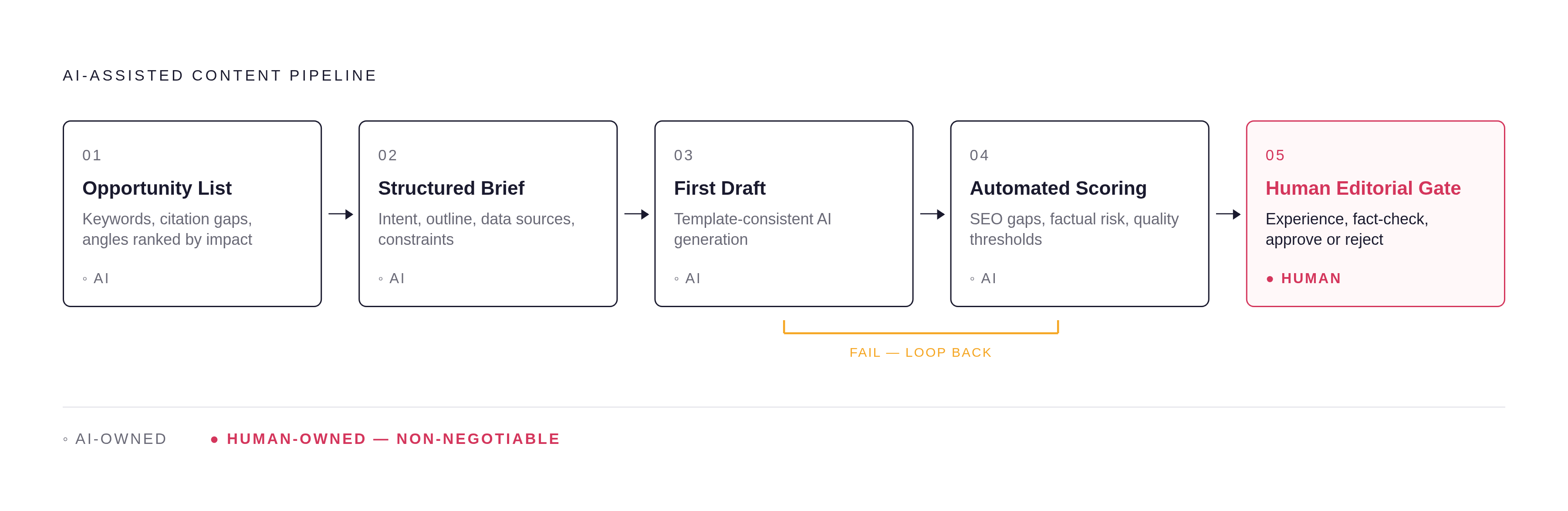
A staged pipeline makes that expansion manageable without treating publication as an automatic entitlement. AI can handle research, opportunity prioritization, structured briefs, first drafts, formatting, internal linking patterns, and SEO gap scoring. Humans retain strategy, original insight, editorial review, factual verification against primary sources, E-E-A-T compliance, and final approval. The split follows the kind of judgment required.
Stage 1 produces a prioritized opportunity list. Keyword patterns, citation gaps, and content angles are ranked by potential impact, so production begins with a reason to invest. Stage 2 turns each chosen opportunity into a structured brief that has intent, an outline, data sources, and constraints. The brief connects the opportunity to the information needed to answer it.
Stage 3 converts that brief into an AI-generated first draft while maintaining template consistency across the program. Stage 4 scores the draft for SEO gaps, factual risk flags, and quality thresholds. Drafts with low scores go back for more work before an editor sees them. Automated scoring is a preliminary filter. Its role is to flag problems before human attention is spent on the last editorial pass.
Stage 5 is the mandatory human review and publishing gate. The editor adds the experience layer, verifies claims, makes the final edit, and approves or rejects the page before release. Each stage can be automated independently or walked through by a person, so the system does not require full autonomy. Traditional editorial work still helps with competitive head terms that need depth, while the computational pipeline can handle hundreds to thousands of pages per month without doing all the manual work again for each page.
How to measure whether the computational system is actually working
Organic measurement begins at page level with rankings, traffic, and indexed status. Underperforming pages need decisions about removal or consolidation rather than indefinite storage in the published inventory. Measurement also needs to connect the programmatic layer to pillar pages. Are internal links helping those pages compete for head terms? When many pages have weak indexation, teams should check the quality of the data as well as consider more writing.
AI measurement needs a defined query set across ChatGPT, Gemini, Perplexity, and Google AI Overviews. Citation share of voice shows how often the brand is named, while repeated runs of the same prompts reveal consistency. Each platform needs separate tracking because results can differ materially between them. The cited sources deserve examination as well. Domains and URLs appearing when the brand is mentioned, or when it is absent, show which sources shape the answer and help inform phantom-layer work.
Platform data now supports part of that measurement. The Bing AI Performance Dashboard, public since February 10, 2026, provides first-party citation data, reducing reliance on inference from third-party tools. PR Newswire launched its AEO & GEO Brand Report, powered by Trajaan, in April 2026 to track brand share of voice, ranking position, model-specific visibility, and the domains and URLs shaping AI answers. That launch places citation monitoring within communications work rather than treating it as a separate technical experiment.
The final test is what those measurements change. Weak page patterns should feed template refinement, indexation problems should trigger scrutiny of inputs, and citation gaps should inform opportunity selection and earned-presence work. Human judgment remains part of those decisions, especially where authority and factual quality constrain expansion. But the evidence must return to the production process. Without that return path, a brand publishing at scale operates as a faster printing press.