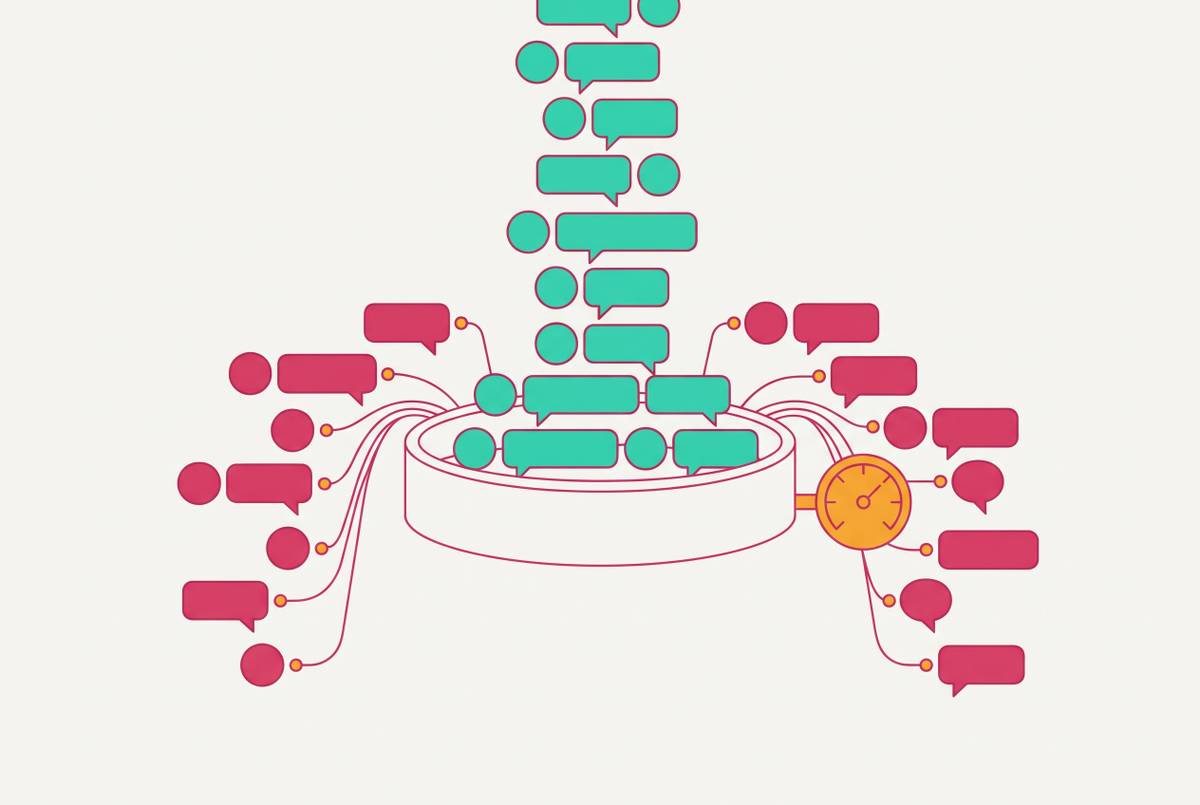
A launch plan you buy should come back as instruments, not just posts: how a technical B2B team keeps launch-day attribution, AI citations and follow-up in its own stack
Buy a launch plan that hands you the measurement tools, too.

A bought launch plan should leave a technical B2B team with more than published posts. It should deliver first-party attribution wiring, AI-citation-ready content assets, and follow-up infrastructure the team can run itself. Those tools let the team measure and improve what it does during the launch. Without them, the fee buys a moment of attention.
Why a done-for-you launch plan leaves technical B2B teams with a measurement gap
A vendor can consider a launch finished while the buyer still lacks the means to understand what it produced. Posts go live on Product Hunt, Hacker News, Reddit, Dev.to, and startup directories, community interactions wind down, and a summary arrives. The report can show engagement without letting the team see referral signals, citation propagation, or downstream assisted conversions for itself.
The gap comes from the scope of the work. When the contract closes on posts and interactions, a working measurement stack is not part of the acceptance test. Yet the buyer needs to connect those interactions to outcomes that happen later. A report records what the vendor delivered. It does not necessarily give the team a way to investigate what happened next.
Cookie deprecation cuts B2B attribution accuracy, while AI search visits grew materially from Q1 2025 to Q1 2026. AI-referred conversions also outperform traditional search sources, making unmeasured AI discovery a growing blind spot. Can the team simply add measurement later? It can install tools later, but it cannot reconstruct launch-day signals that those tools never captured.
What "owning the instrument" actually means for a B2B launch
Ownership has three separable layers, starting with first-party attribution wiring. This includes UTM tagging, server-side event capture, CRM milestone mapping, and an attribution model that fits the team's actual deal volume. The stack must cover acquisition, conversion, expansion, and signal metrics. The team needs to track what happens after the launch's first traffic and response.
The second layer is AI-citation-ready content that belongs to the team. These assets answer buyer questions in passages that a model can extract, while describing the company consistently across its public surfaces. They are not interchangeable with community posts. Their value depends on whether the team can edit, refresh, and reuse them after the launch engagement ends.
The third layer is follow-up infrastructure, including an owned publishing cadence, a content pipeline with reviewable outputs, and a measurement loop for AI-engine mentions. This gives the first two layers a working life beyond launch day. The team owns the system when it can run it on its own. A dashboard the team cannot query or export, or a process only the vendor can run, falls short of that definition.
Why attribution wiring must be installed before the first post goes live
Client-side-only tracking puts launch activity into a data-loss environment from the start. That loss is especially costly in B2B, where the first visit is rarely the whole buying journey. SMB buyers have multiple interactions on average over weeks, while mid-market buyers have more interactions over a longer time. Launch day is only the beginning of that sequence. A 30-to-90-day attribution window in a tool the team owns provides room to observe what follows.
To get that longer view, the team needs to link customer identities across systems. The team should audit every place an identity lives before publishing, including the CRM, product database, billing system, support inbox, and marketing automation. Otherwise, selecting a longer lookback window does not by itself connect the records needed to interpret it. Time coverage and identity coverage solve different problems. Both belong in the setup work.
A Show HN post that reaches the Hacker News front page can generate traffic and conversations that produce first customers or early beta users. Yet HN traffic arrives as direct or organic rather than as a tagged referral, obscuring its origin in ordinary reporting. The thread can also rank in Google for years. A modest-looking launch-day result can therefore conceal a longer discovery tail, while missing server-side capture and CRM tagging leave gaps that cannot be repaired retroactively.
Before signing, a team buying a launch plan should require the scope to include a documented UTM taxonomy, confirmed server-side event capture, CRM milestone events with single owners, and an attribution model suited to deal volume. The GA4 Conversion Attribution Analysis Report should also be configured before launch. Each is a required part of making the launch measurable.
Why AI citation is a separate tracking problem, not an extension of SEO or social reach
Attribution can link visits it has captured to what happens later, but it cannot show every place a buyer came across the brand. AI answers expose that limit. Rank tracking shows where a site ranks in search, while GA4 referral logs show traffic that reaches the site. Neither shows directly whether an AI answer engine named the company. A brand can influence a buyer through an answer without receiving a measurable click.
Only a fraction of ChatGPT's brand mentions include clickable citation links that appear in Google Analytics. That share grew a lot after a May 7, 2026 platform update, though most mobile app traffic still goes unseen. More visible referrals do not make mentions fully observable.
Reddit adds another path that a launch report can overlook. Its posts account for a material share of Perplexity's overall citations and an outsized share of its top results. A thread's role can therefore extend beyond the people who read or respond to it on Reddit. What happens when the thread later becomes a source in an AI answer? Tracking only community engagement misses that later use of the content.
The appropriate instrument is prompt-based monitoring. A team should track brand mentions against a fixed query bank across ChatGPT, Claude, Gemini, and Perplexity. Using the same questions lets the team compare readings over time. The deliverable should be a runnable process the team controls, so that testing continues after the vendor's final report.
What makes content AI-citation-ready, and why launch assets usually are not
Monitoring shows whether a brand appears, but the content itself must be easy to cite. Launch posts are generally optimized for engagement on their host platforms. AI answer engines instead cite material with passage-level clarity, consistent entities, and an answer-shaped structure. Those are different production requirements. A post that prompts discussion is not necessarily a page from which a model can extract a clear answer.
Models build an internal representation of a brand from many mentions, so conflicting descriptions across the site, LinkedIn, Crunchbase, and a podcast bio weaken the evidence. Consistent descriptions sharpen that representation. An entity audit belongs before distribution. Publishing more mentions without first aligning them misses the chance to make each new mention reinforce the others.
Answer-shaped content addresses the question a buyer would type into an AI chatbot. Its structure includes Q&A formatting with schema, clear summaries at the top of sections, and explicit claims a model can extract and quote. Each passage needs enough clarity to stand as an answer, rather than relying entirely on the surrounding launch narrative for its meaning.
For the buyer, those requirements translate into owned pages, including an FAQ with schema, a glossary of owned terms, and comparison pages. The contract should pair those assets with the entity-consistency audit. It should also provide a publishing cadence under the team's control, because recency must be maintained. A launch-day blog post is a starting asset.
The follow-up infrastructure problem: why a launch without a cadence expires
Citation position changes even after the content is published. In active categories, cited domains shift materially month over month, so a single visibility snapshot loses relevance as the answer environment changes. The launch establishes a baseline. Without a connected publishing cadence, the content becomes a depreciating asset.
A 30-to-90-day attribution window makes later interactions observable, but a window does not create those interactions. A burst of posts followed by silence leaves the team with no way to keep publishing through the time it plans to measure. Follow-up infrastructure connects those two needs. It pairs sustained content production with monitoring and measurement over time.
That infrastructure requires a pipeline for reviewable, accurate assets, a repeatable AI-mention monitoring process, and a measurement layer that shows trends. For lean B2B teams, manual publishing at cadence creates a speed-versus-quality constraint. Multi-stage AI pipelines paired with human review can address that tradeoff. The work can move through drafting and review without treating speed as permission to publish unchecked material under the brand's name.
There is a serious objection to investing early. AI citation measurement is still maturing, and repeated observations are directional. One reading establishes a baseline, while subsequent readings against the same query bank show a trend. That is a more useful basis for follow-up than treating either a single favorable answer or a single absence as decisive.
A phantom-site and ground-site strategy uses domains the team owns and subsidiary properties it controls. Citation credit then reaches surfaces the team can observe, modify, and develop, alongside third-party platforms. This gives community distribution a continuing relationship with assets the buyer can maintain.
What to require from a done-for-you launch plan before signing the contract
The buyer should make the instrument layer an explicit scope requirement before signing. Acceptance should depend on working systems and owned assets. This is the point to negotiate access. The team should not discover after launch that its measurement process depends on a vendor dashboard it cannot independently query.
For attribution, the contract should require a shared UTM taxonomy and server-side event capture before the first post goes live. CRM milestones should have single owners and cover demo booked, opportunity created, opportunity stage advanced, closed-won, activated, and first-value moment. An identity-stitching audit should map every system that holds customer identities. These requirements make ownership concrete. They identify both the events to capture and responsibility for defining them.
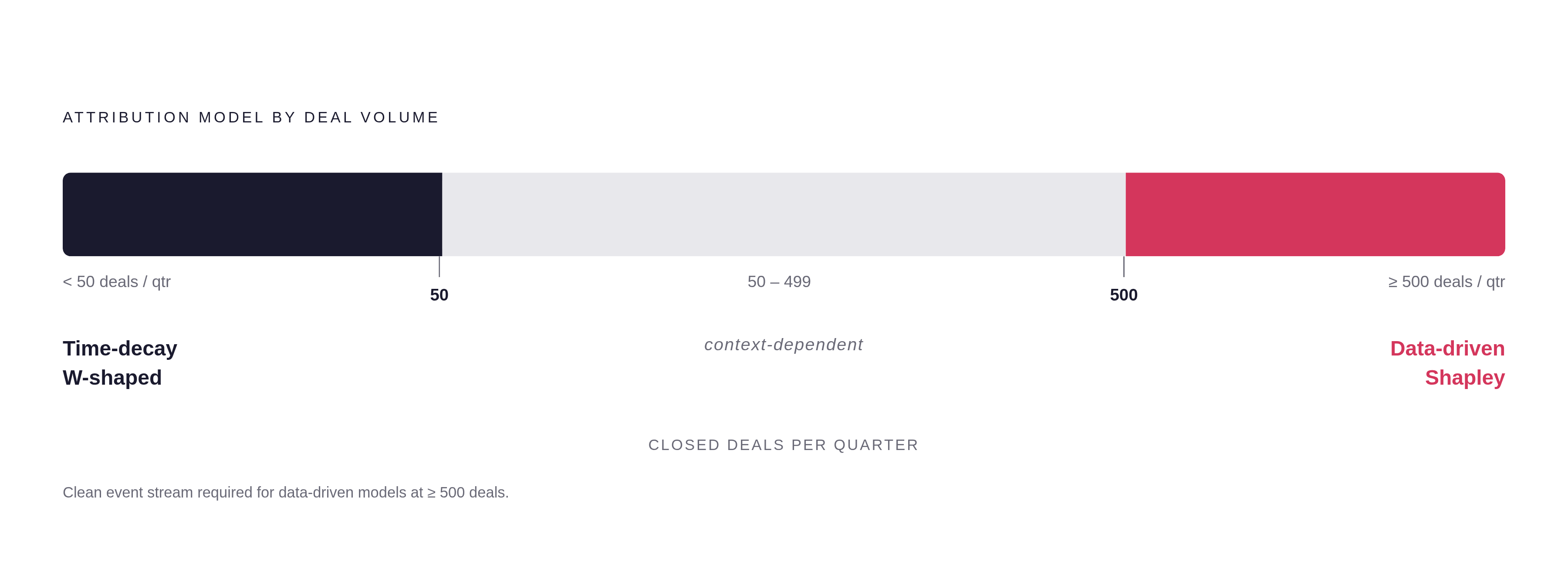
The model must also fit the available evidence. The specified options are time-decay or W-shaped attribution for teams below 50 closed deals per quarter, with data-driven or Shapley models reserved for teams with a minimum of 500 closed deals and a clean event stream. Complexity is not the acceptance criterion. The GA4 report should be configured before launch with a lookback window matching the actual sales cycle, up to a maximum of 90 days.
For content, the scope should require a canonical company description across the site, LinkedIn, Crunchbase, Wikidata, and any B2B directory profiles the launch touches. Owned deliverables should include an FAQ with schema, a glossary of owned terms, and at least one comparison page. Their format should support passage-level extraction through Q&A structure, explicit summaries, and quotable claims. Platform posts alone do not satisfy that requirement.
For follow-up, the handoff should include fixed-query monitoring across the four AI engines and a publishing cadence the team can operate after the engagement ends. Outputs should be reviewable and reversible at each step. All measurement endpoints should be reachable through an API or export, without data trapped in an inaccessible vendor dashboard. The final test is operational. Can the team query the evidence, refresh the assets, and run the next cycle itself?