A go-to-market plan is a set of testable hypotheses about a buyer: how to log the buyer, the signal and the message so replies can prove or kill them
Log each buyer, signal and message so replies can settle the plan.

A go-to-market plan should be a set of testable hypotheses about a buyer. For technical founders and heads of growth, a buyer log, a trigger signal and a message need defined conditions for confirmation or rejection, so that replies and behavior decide what happens next.
Why a GTM plan is a planning artifact by default, not a scientific instrument
The sales hires are in place, campaigns are live, and channels have funding. Six months later, the team finds out that the ideal customer profile was wrong or the message never landed. The plan produced plenty of activity along the way. What it did not produce was an early answer to whether buyers saw the problem as the product team did.
Who buys, what triggers the purchase, why choose this product, which motion fits, and what price closes the deal are usually treated as settled assertions. Yet each answer could be wrong. Without a defined test, an assertion can only be believed or abandoned after money is gone.
What would a buyer have to say or do to make the team stop funding this approach? If the plan cannot answer that question, its activity cannot reliably become evidence. The remedy is not a more detailed forecast, but a way to distinguish a failed assumption from an unfinished campaign.
The four hypothesis types every GTM plan contains, whether you name them or not
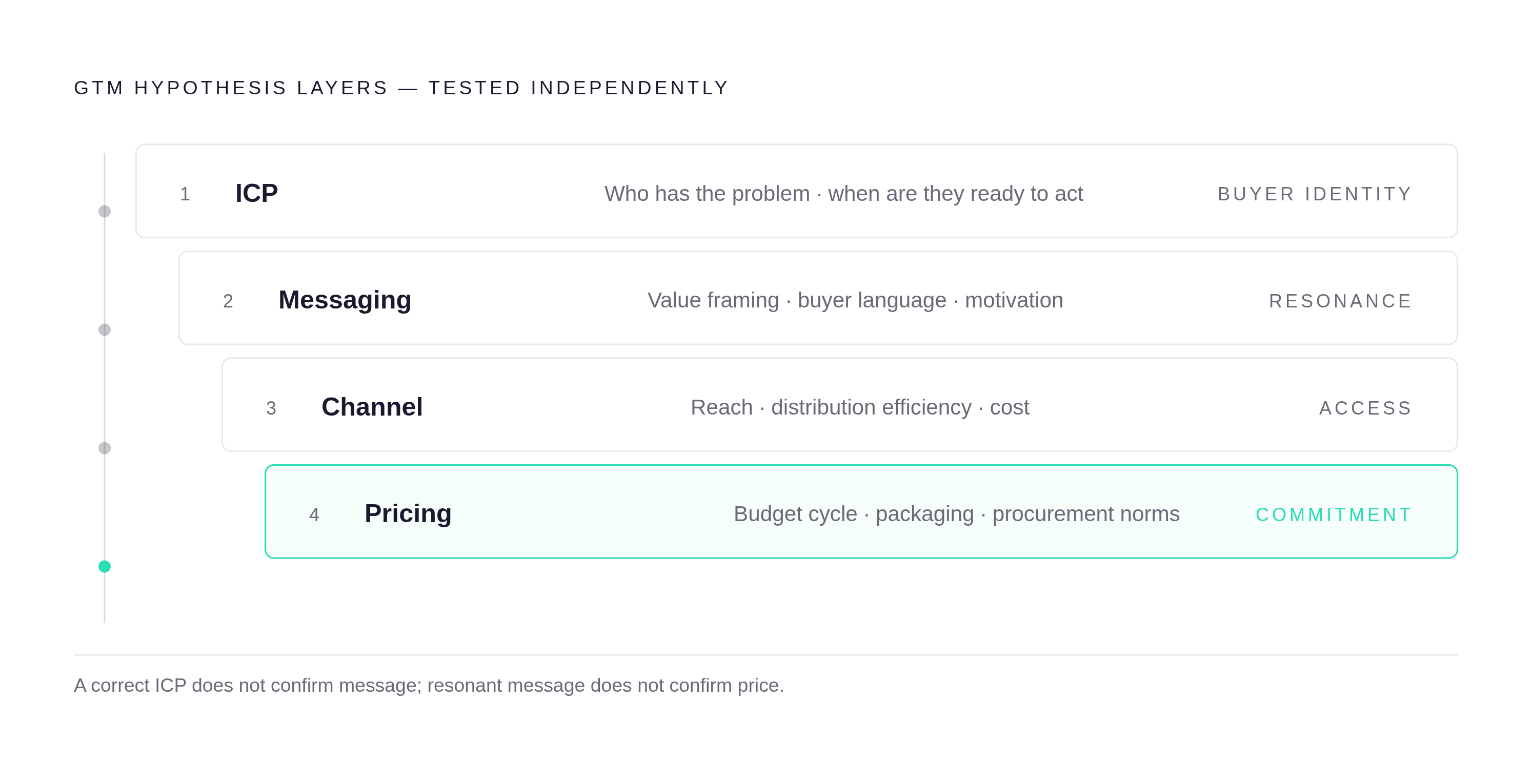
Every GTM plan contains at least four separable bets. The ICP hypothesis concerns which buyer has the problem and under what conditions that buyer is ready to act. The messaging hypothesis concerns whether a particular value framing matches the buyer’s language and motivations. The channel hypothesis concerns whether an outreach or distribution channel reaches that buyer efficiently and at acceptable cost. The pricing hypothesis concerns whether the price and packaging fit the buyer’s budget cycle and procurement norms.
These bets do not rise or fall together. A correctly identified buyer can reject a badly framed message, while a resonant message does not establish that the price fits procurement. Testing each layer separately makes a disappointing result useful.
The practical test is whether each bet describes an expected outcome and what would prove it wrong. A vague belief that an approach might work is not enough. Each hypothesis needs a reason to believe it and a date to settle it. At that date, the team must be able to choose between scaling, revising and stopping.
What goes in the buyer log and why the trigger matters as much as the profile
Fit tells you who could buy, while a trigger tells you when that buyer has reason to act. Outbound depends on the intersection of the two. An industry, company size or tech stack can point to an account that looks promising without showing that anything has changed its status quo. Generic pain is not the same as a buying moment.
To make that distinction usable, give the buyer log columns for industry, company size, tech stack, buying committee structure and approval thresholds. Record the champion’s role separately from the economic buyer’s role. Then record the observed trigger, the outreach sent and the outcome, including a reply, meeting, rejection or silence. The profile should be specific enough that someone who did not write it can recruit the same kind of buyer from scratch.
The trigger column records the incident that forces action. That might be a competitor’s pricing change, a regulatory deadline, a new executive who changes the buying mandate, or a failed implementation of an incumbent solution. Without this column, the log is a contact list. With it, the team can ask whether a particular trigger predicts response among buyers who fit.
This also changes how rejection is read. A buyer who says the problem was solved two years ago is contradicting the assumed buying condition while leaving acceptance of the product itself unresolved. The log gives that reply somewhere precise to land. It becomes evidence against the trigger hypothesis.
How to pick a signal that a hypothesis can be tested against
A trigger is the buying condition, while a signal is the observable clue used to detect it. A funding round or job posting alone shows activity, but does not establish a buying condition. A competitor’s pricing-page visit, an SDR hiring spike or a complaint about an incumbent provides a more specific indication.
Champion mobility can be more specific still. A satisfied user moves to a company within the ICP and takes a role with buying authority. Signals can also reinforce one another when they occur inside the same 30-day window. Funding, SDR hiring and a competitor pricing-page visit together support a stronger hypothesis that a company is building an outbound motion with budget approved than any input alone. Combining inputs that have already come in takes logic and adds no data cost.
But a useful signal also has a shelf life. A pricing-page visit on your own site loses most of its value within a day or two, so a weekly outreach cadence cannot act on it while it is fresh. Some signals demand action within hours. Choosing one therefore commits the team to the infrastructure needed to use it.
The evidence used to settle the test must also match the hypothesis. A channel test needs to tell how well the channel works apart from how well the message works, while a message test needs signs that it lands, such as replies, booked meetings and the language buyers use. Agree on what would confirm or reject the hypothesis before sending. Otherwise, an ambiguous outcome can always become an argument for continuing.
How the message is structured as a falsifiable claim, not a positioning statement
A testable message joins a specific framing, a defined audience and an observable outcome. For example, “audit readiness” and “risk visibility” are distinct framings that can be tested against the buyer profile in the log. A broad promise to save time is harder to settle. The test must say which response would support the chosen framing and which would contradict it.
Replies provide more than a count. A clarifying question can support the problem framing, while a reply that describes a different problem can show that the message missed. But a compliment without a meeting is not proof of progress. The useful sequence is a reply, a meeting and pilot interest.
To make that evidence interpretable, isolate the message variant. Sending different messages to different audiences changes both the framing and the buyer, leaving the cause of any difference unresolved. Define the kill condition in advance as well. That could be zero replies from 20 targeted sends to confirmed ICP matches, or replies that consistently redirect the pain toward something the product does not address. The condition belongs to the particular test.
When buyers investigate the problem inside AI answer engines before responding to outreach, email is only one place where the message is tested. Content must make that claim retrievable, citable and independently verifiable. This introduces a parallel question about discovery.
Why AI answer engines create a parallel hypothesis about whether the buyer will find you at all
For a buyer researching through an AI answer engine, a relevant message is useful only if the brand appears at all. That is a separate hypothesis from whether outreach resonates. Search rankings cannot settle it on their own. Google AI Mode and Perplexity draw the large majority of their brand citations from conventional top-10 search results, while ChatGPT draws only a small fraction from that pool.
The measurable outcome is Share of Model, or SoM. It is the share of AI-generated responses across a defined query set that include the brand. Defining that query set ties visibility to the problems the buyer actually researches. One optimization strategy cannot be counted on to make the brand show up consistently across engines.
To test the on-site part of this hypothesis, structure content so that each section can be extracted independently, using bottom-line-up-front openers. Pages above a certain length threshold receive materially more citations than thin pages, but length alone is not the whole condition. The site must not block major AI crawlers. Its content also needs to cover the query space buyers use to investigate the problem.
Only a small minority of citations come from pages the brand owns, so independent review platforms, structured knowledge bases, community discussions and analyst or editorial coverage can make the brand more likely to be cited. “Best-of” listicles are among the most-cited formats. Yet the brand may appear today and be gone tomorrow, so an audit at one point in time is not enough. Monitor whether ChatGPT, Claude, Gemini and Perplexity name and cite the brand across the defined query set.
How to wire the buyer log, signal, and message into a system that lets replies decide
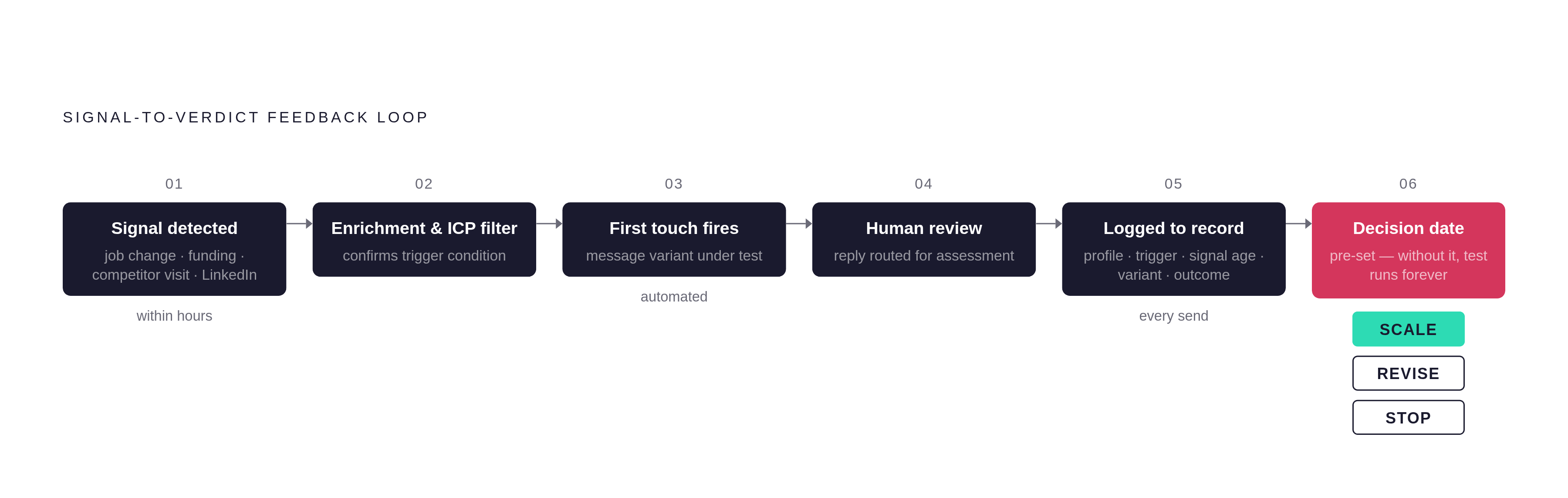
The operational loop starts when a tool detects a signal, such as a job change, funding event, competitor pricing-page visit or LinkedIn engagement, within hours of its occurrence. An enrichment layer then filters the contact against the buyer log’s ICP criteria and establishes whether the trigger condition is present. The first touch fires automatically while the signal is fresh, using the message variant under test. Replies go to a human for review.
Everything before that reply needs to be instrumented. For each send, log the matched buyer profile, observed trigger, signal age at send time, message variant and outcome. Signal age links the response to when the outreach was sent, so contacts can be judged with that timing in mind. Together, these fields let the team trace a result back to the hypothesis it was meant to test.
Each hypothesis also needs a decision date. At that point, the team chooses whether to scale, revise or stop using the conditions agreed before launch. Without that date, a test can run forever.
The content infrastructure runs in parallel with outreach. Publish the same framing in content structured for AI retrieval, so inbound discovery and signal-triggered contact test the claim from both directions. Multi-stage AI pipelines can expand the brief, draft the content and format it for distribution, with humans giving approval before it is published. Each step must remain reversible, because automation should not remove the ability to say no.
Replies in the buyer’s own language, meetings that progress and pilots that convert show which signal-plus-message combination to repeat. Until that pattern exists, the combination remains a hypothesis. The system’s output is permission to scale a supported motion.
How to classify what a test result means and feed it back into the plan
A useful test result identifies which hypothesis passed or failed and what to do next. “It did not work” cannot guide another test. A more useful classification records that the ICP and trigger were supported, the message failed on pain framing, and the next test changes that framing while holding everything else constant.
A kill result can narrow uncertainty as much as a pass. A buyer who cannot rephrase the value proposition provides evidence against the messaging hypothesis. The next step is therefore a message test that holds audience, channel and price constant. Update the plan after each result rather than waiting until the end of the quarter, tightening or shifting ICP criteria, changing trigger types and promoting or retiring variants as the evidence directs.
A drop in SoM is a kill signal for the content approach. Tracking the target query set over time shows whether the changes bring the brand back into the answers buyers see.
Over time, the buyer log becomes repeatedly validated, and the signal stack develops known conversion rates by trigger type. The message hierarchy reflects what buyers actually said, while the content layer has a measurable presence in AI answers. The plan never has to be a finished document. It earns its name as an instrument by getting sharper with every result.