Buying signals are a query, not a service: how a technical founder compares an outbound agency, an SDR hire and tooling
Design the signal-to-message loop first, then decide who runs it.

Comparing an outbound agency, an SDR hire and tooling starts with the wrong question if the signal-to-message loop is still undefined. Buying signals are queryable data, but they do not prove intent. For a technical founder, the better decision comes from designing a system that can be inspected, versioned and measured before deciding who should run it.
Why the agency-vs-SDR-vs-tool question is the wrong starting point
A founder opens a browser tab to compare agency retainers with SDR costs. That is already a step too far. Retainer versus salary and ramp time versus speed-to-launch look like sensible comparisons, but they answer who will execute before establishing what the system needs to know. This is a design problem before it is a purchasing decision.
Buying signals are observable behaviors or events that may indicate a change in purchase context. They include changes in leadership, funding announcements, tech-stack installs and first-party content engagement. A signal calls for a closer look, but it cannot make intent certain. Until the query is specified, an outbound service offers a fixed response to a question that is still taking shape. The team first needs to establish what the pipeline needs to know, and who or what can answer it fastest and cheapest.
What the signal-to-message loop actually consists of
Outbound is a two-stage information problem. Fit signals show whether an account should care, while intent signals show whether it cares right now. Industry, headcount, tech stack and revenue range are parts of account fit that tend to change slowly. They help define the relevant population, but they cannot alone establish when outreach is timely.
Timing adds a constraint that a static prospect list cannot resolve. For high-intent signals, the 0-to-48-hour response window is important because the value of the information decays. Waiting slows the workflow and leaves the team acting on worse data. The system therefore needs to connect evidence of fit with a recent event and a response layer that can act while the evidence is useful.
Outbound functions as a query engine that finds the accounts to focus on now, with a response layer. The response layer turns that finding into outreach, but it still needs judgment about who should receive the message and why. An agent layer can handle scale without settling those questions. Tooling therefore belongs in the comparison as more than an accessory to a hire.
What the three paths actually cost once hidden variables are included
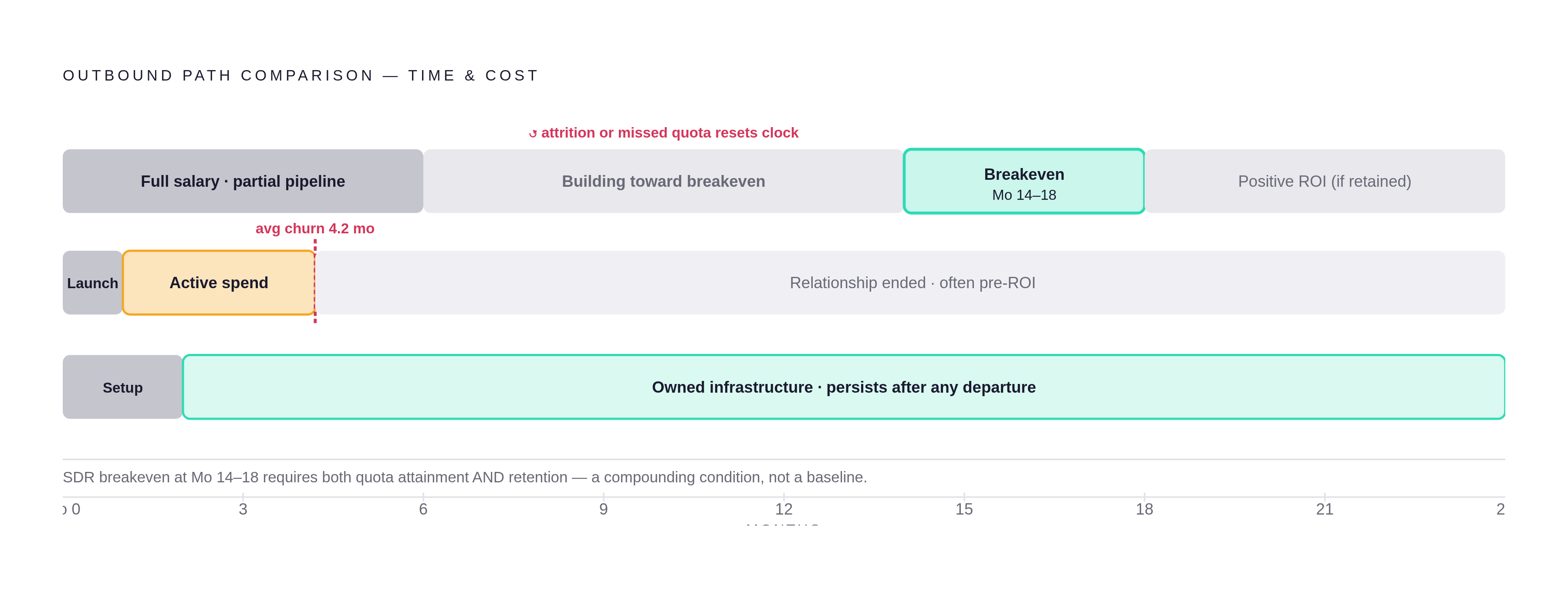
A base salary and an agency retainer do not describe equivalent costs. Advanced Client's 2026 breakdown puts SDR cash compensation, including base salary and variable pay, at roughly half the fully loaded cost once tools, recruiting, benefits, payroll burden, management time and ramp are included. Ramp typically takes three to six months before reliable output. During that period, full salary buys only partial pipeline. The expense is not just employing a person, but bringing a working outbound operation into existence.
Advanced Client identifies a further risk in asking the same person to build the system and run it. If that person leaves, what they know about the system goes with them. The breakdown places the in-house advantage roughly at month fourteen to eighteen, assuming the SDR stays and hits quota after ramp costs fall away. Division50's 2026 cost analysis treats missed quota and annual attrition as separate failure modes common enough to plan for. Turnover resets the clock, while underperformance can undermine the expected return even without a departure.
An agency offers a different deal, with a speed-to-launch advantage when the team needs pipeline fast. Its costs are harder to compare cleanly. Division50's research found that most major agency pricing was secondhand and disputed, with CIENCE among very few agencies publishing a public price ladder at the time. Bring My Customer's 2026 analysis puts the average agency relationship at 4.2 months before churn, often before positive ROI. That finding makes the relationship's duration part of the economics.
A proposal may also hide the cost of who owns the system. Advanced Client describes the structural agency risk as renting pipeline rather than building an asset, because the system disappears when the contract ends. This is a question about what survives the engagement. A quick launch has one value if the client retains the infrastructure and another if ending the contract also means losing the means of operating it.
The tool-first path changes that sequence by establishing infrastructure in the company's tools, accounts and CRM before hiring someone to operate it. Advanced Client argues that this lets the system exist before the person and persist after a departure. A lightweight stack combining first-party intent tooling, third-party intent data, org-change signals and outreach execution can cost a fraction of either alternative. The tradeoff is design responsibility. Someone on the team must decide whom to reach and own the logic, giving a technical founder direct control over what still needs to be learned.
The decision frame a technical founder should actually use
The first condition is how well-defined the ideal customer profile, or ICP, already is. Before product-market fit, or while exploring a new ICP, the definition of a useful signal is likely to change. A fixed agency motion is risky under those conditions because the system is being asked to execute a hypothesis that is still moving. Ownership makes revision easier to control. The technical founder's advantage is the ability to query and instrument the signal layer directly.
Urgency can point toward a different choice. If pipeline is needed this quarter, an agency's speed-to-launch advantage should count in the choice. With a longer timeline, building an owned system can compound as its logic improves. Annual contract value, or ACV, also changes which option makes sense. At very low ACV, agency economics strain, and founder-led outbound with a lightweight stack often wins because the cost of the motion must fit the value of the contract.
Advanced Client's “install then hire” approach establishes infrastructure first, transfers ownership and then staffs the operation. A team using an agency for speed should therefore keep the infrastructure in its own tenant, including sending domains, CRM data and enriched lists. That preserves the engine beyond the engagement. The hiring decision then concerns who can operate and improve something that works, rather than who can somehow discover, build and run it at once.
Signals as queryable data: what it looks like to run this as code
In practice, the system begins with incoming events such as funding announcements, leadership changes, tech-stack installs, intent surges and web visits. Those events are filtered and prioritized by account fit, then used to trigger a personalized first touch within a defined response window. The event alone does not dictate the message. Its meaning comes from the relationship between the account, the change that occurred and the reason the offering might now be relevant.
Four components make that relationship inspectable, namely the signal sources, prioritization logic, message templates and response cadence. Each can be versioned, tested and improved independently. This is what treating outbound as code means. It requires separating account selection from outreach. First sends become measurable experiments rather than output whose only visible property is whether a meeting followed.
There is a serious limit to intent data. Evidence that a company is researching does not identify the person with authority to buy. Signal-flagged accounts therefore need human research to locate the relevant stakeholder. The agent layer handles scale, while the human layer supplies specificity. Multi-stage pipelines with review gates preserve that division by placing judgment where automation is most likely to get the edges wrong.
That division also changes what improvement looks like. A weak result should prompt a question about signal quality, prioritization, stakeholder choice, message or timing, rather than an undifferentiated verdict that outbound does not work. The components provide places to investigate separately. As more B2B SaaS companies use intent data, having access to signals does less to set a company apart. The opportunity is to build durable instrumentation while early adoption still offers an advantage.
Why AI answer-engine visibility is part of the same signal loop
The prospect may run a query of their own before replying. Someone asking ChatGPT, Perplexity, Claude or Gemini “what tools do teams like mine use” is using an answer engine to filter possible suppliers. Outbound must pass the gate created by the answer. This sits downstream of the founder's signal query and upstream of the prospect's response, so measuring the outbound pipeline alone leaves part of the decision unexamined.
Search rankings cannot stand in for that measurement. Being cited in an AI answer and appearing on a search results page are different jobs, with different content signals and measures of visibility. Mention rate, URL citation rate and share of model address questions that rankings do not. The major answer engines also overlap little in the sources they cite. So being covered on one platform does not show that a brand is covered on the others.
Even a response from the same engine is not a permanent result. Probabilistic generation, retrieval variation and changing weights for diversity, freshness and relevance make citation share volatile. A brand can appear in one answer and disappear in the next. Measurement has to be continuous because a single answer is a sample of the brand's visibility.
At a minimum, the team needs to run the same set of category prompts across the major engines each week. The scores should cover mention rate, URL citation rate, sentiment, prominence and share of voice. This can be done manually or with dedicated tools such as Foglift or Promptwatch, while GA4 referral-source filters can track downstream clicks. The distinction is important for interpreting the results. Click tracking measures the traffic that arrives, while answer-level measurement looks at the filter a prospect sees before deciding whether to engage.
The connection to outbound as code is therefore operational. The founder instruments which accounts receive attention and which messages reach them, then instruments how the brand appears when those prospects investigate. Neither side makes the buying decision predictable. Together, however, they make more of the path open to inspection rather than leaving the answer engine outside the model of how outreach works.
The question a technical founder should ask before opening any vendor tab
Before comparing vendors, a founder should be able to specify what an offer would need to demonstrate. Which signals are being queried, and how will the team know when one fires? Who owns the instrumentation, and will it remain in the company's tools and accounts after a contract ends? These questions establish the boundary of the system. Without that boundary, a proposal can promise work while leaving the buyer with no control over the system that does it.
What response window is required, and can the proposed system meet it at the necessary account volume? How will the team test signal quality's predictive value for pipeline quality? The team should look just as closely downstream, where prospects use AI answers to learn about the category. A visible brand mention is evidence to measure over time alongside what follows.
This frame does not force a choice between speed and judgment. A well-designed pipeline uses automation for throughput and human review at the points that require specificity, producing faster and more accurate output than either unreviewed automation or a fully manual process. The durable vendor test follows from that division. Can the founder inspect how the system answers the pipeline's questions, change the logic when the evidence changes, and measure whether those changes improve the result?