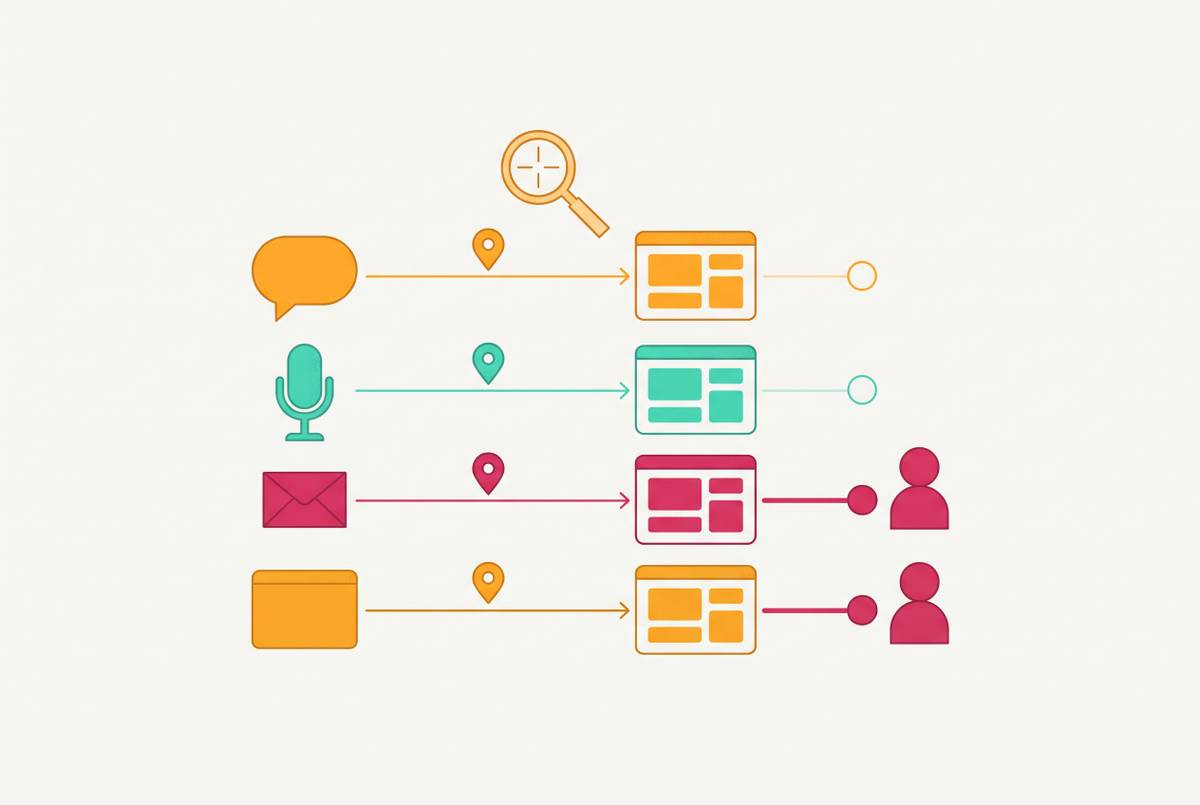
Cold outreach is an experiment, not a campaign: instrument the first 50 sends
Write a hypothesis, decision rules, and a send log first.

Cold outreach is an experiment. The first 50 sends should test whether to pursue a defined buyer segment. That requires a written hypothesis, verifiable triggers, decision rules, and a record of every outcome. The same discipline must extend beyond the outbox to the content buyers and their AI tools find when they look up the sender.
Why most outbound teams keep running the same low reply rate forever
The team runs the sequence again with a new subject line, and the reply rate barely changes. Someone remembers that the previous opening sounded warmer. Someone else points to a variant with more opens. There is plenty of activity to discuss. But what did the team actually learn about why anyone replied?
Often, the comparison cannot answer that question. The variants reached different audiences, several things changed together, or a winner was declared after only a few replies. Gangly’s 2026 Cold Email A/B Testing framework names these failures, including sample starvation and reliance on open rate. Apple Mail Privacy Protection pre-fetches images and fires the open pixel even when a user has not read the message. Opens therefore provide a directional hygiene signal.
A campaign can have a perfectly sensible goal, such as meetings booked, without a way to explain its results. An experiment needs a hypothesis, a defined variable, a control, a primary metric, and a stop rule. Without those commitments, the next revision is another guess.
What the first 50 sends can and cannot tell you
The first batch is a list-quality probe. Send the same message to all 50 contacts, changing only personalization variables, and read the reply rate after seven days. At this stage, the useful question is whether the targeting produced a cohort willing to engage. A difference of one or two replies cannot establish that one piece of copy is better.
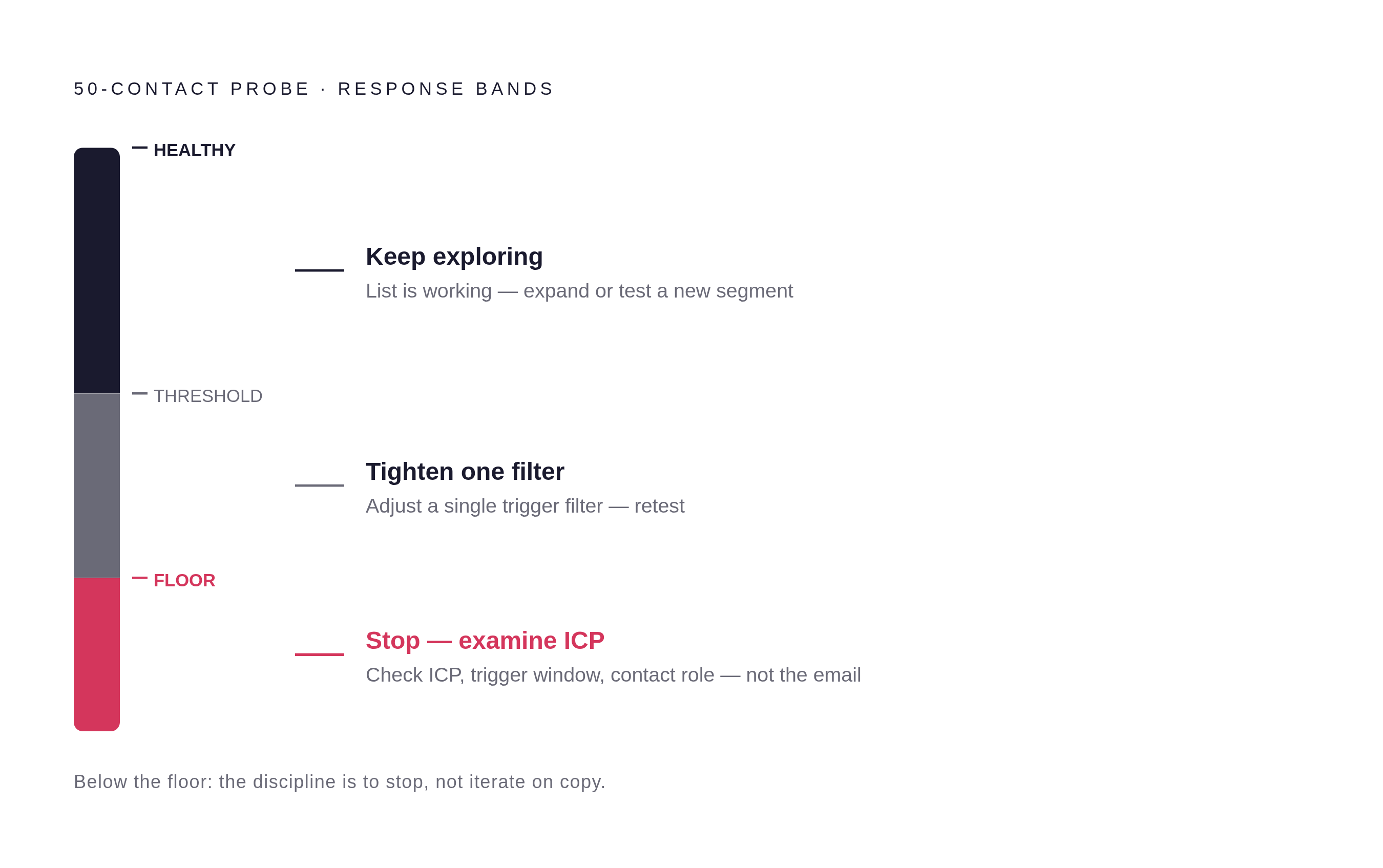
To make that probe actionable, define the response bands before sending. Above the healthy threshold, the list gives a reason to keep exploring. In the middle band, tighten one trigger filter and retest. Below the minimum floor, stop and examine the ideal customer profile, the trigger window, and contact-role accuracy while keeping the email unchanged. These rules guide what to do next, but they cannot prove statistically that targeting explains every outcome.
Changing the copy while fixing the list takes away the steady point of comparison needed to make sense of the next result. Statistical confidence in copy requires hundreds of sends per variant. An early probe answers “is this cohort worth pursuing?” An early probe answers “is this cohort worth pursuing?” and leaves “which sentence wins?” unanswered.
What belongs on paper before a single message leaves the outbox
To turn that probe into a repeatable test, write the protocol before opening the sequencer. Begin with a test name and the ICP segment, then state which trigger is believed to predict readiness to engage and why. Identify the single variable under examination and record the control and variant text where a comparison is planned.
Next, name positive reply rate as the primary metric and meeting booked rate as the secondary metric. Record guardrail thresholds for bounces, spam signals, and negative replies, followed by the decision rule. The stop rule belongs here. Otherwise, a test with poor results can run on and on because someone thinks it needs more time. Of these measures, meeting booked rate is the closest link to revenue, while opens only help check for problems.
Then make the trigger a verifiable account-note field. Quantonica’s example uses a careers page that lists maintenance technician roles in Leeds. That gives a reason to ask whether the team uses outside agencies. It does not establish a hiring bottleneck, an agency budget, or purchase authority. Record what the source supports and keep the hypothesis separate from it, so that an assumption about readiness does not quietly become a fact about the account.
Running parallel angle tests across the same segment to find the right theory of pain
Once the list-probe logic is clear, separate the next question from copy polish. Which problem gives this segment a reason to respond now? Test three to five angles in separate small-batch campaigns, keeping the same ICP segment and targeting criteria while changing the opening claim. Each angle needs a hypothesis and a batch of its own.
Hiring SDRs, missing a revenue target, and facing a competitor’s new feature are different reasons to care. They are not interchangeable personalization inserts. Each claim also needs the evidence required to support it. A response to one angle can reveal which pain is live for the cohort, something elegant prose alone cannot establish. At low volume, that response is a reason to investigate further.
After an angle gets a response, copy testing can help show what works within it. Gangly’s Single-Variable A/B Stack tests the subject line, first body line, call to action, and from name in sequence, locking each winner as the next control. Changing those elements together obscures their individual effects. Sendro’s A/Z framework offers broader exploration through many subject-line and body variants, even send distribution, and reply-rate measurement. That approach belongs after angle validation and identifies which tested combination performs, leaving every component’s contribution unresolved.
Logging every send, reply, and non-reply as a data record the next iteration can consume
The protocol becomes useful only if the pipeline preserves its results. Each send needs a record containing the experiment name, segment, hypothesis, variable changed, delivery or bounce status, opens, reply classification, meeting status, and event dates. Opens help check for problems. Replies are marked as positive, negative, or neutral. Dates put those outcomes in context. A scriptable, API-reachable pipeline should make these records available to the next iteration.
The outcome fields answer different questions. Reply rate indicates whether the message prompts engagement, positive reply rate whether the angle resonates, and meeting rate whether the offer earns time. Non-replies belong in the same record. Silence across every follow-up is evidence against the segment or trigger assumption. A cadence of three to five touches over two to three weeks can introduce new evidence or another view of the problem.
Guardrails need separate fields and separate decisions. A bounce records a delivery failure. Spam signals and negative replies should end a test early when they cross the thresholds set in its protocol, even if the overall reply rate looks good. Conversely, a single alarming event should be judged against that rule before a shutdown decision. The log then gives the next run a usable diagnosis, whether to revisit targeting, investigate delivery, or continue testing the angle.
Writing the email that earns a reply from a prospect who already knows whether to trust you
With the experiment defined, the first email can do a narrower job. A generic claim about helping companies grow revenue gives the recipient little to assess. Noticing that the team posted three new SDR roles last month provides a specific, verifiable reason for contact. One opening asks for belief. The other offers an observation the reader can confirm.
Quantonica’s 2026 Show Me You Know Me framework describes seven elements, including a personalized observation, a bridge to value, a problem-focused value proposition, and a respectful call to action. The bridge must remain a hypothesis, however, because a hiring notice does not prove a hiring problem. A single question can let the prospect confirm, correct, or reject that connection without having to accept the sender’s diagnosis first.
The account note should constrain every personalization field. Hiring, expansion, and funding can provide triggers, but an expansion announcement does not prove excess consumption, a permit problem, or vendor readiness. The email should offer something specific and useful without inflating what that signal establishes. Human review is the gate before sending. AI-drafted references to named roles, locations, or dated announcements need human verification before launch, because wrong personalization undermines the very relevance the message is meant to establish.
Why the buyer may already have an answer about you before they open your email
The experiment now has a defined audience, a message, and a way to read outcomes. But another process runs outside the sequencer. Buyers can ask ChatGPT, Perplexity, Claude, or Gemini about a company before deciding whether it deserves a conversation. The resulting view is not controlled by the opening line. Even a well-grounded email can arrive after the recipient has formed a judgment about its sender.
For outreach to engineers or CTOs, that creates a practical gap. The email may make a credible connection between an account signal and an offer, while the buyer’s AI assistant presents little supporting evidence about the company. Conversely, useful material found during research can give the recipient more to assess than the email alone provides. Neither outcome is visible in a subject-line test. What happens after a reply therefore cannot always be explained by what happened inside the campaign.
There is no single AI audience to satisfy, either. A brand can appear prominently in one engine and be absent from another, so checking only one produces an incomplete view of buyer exposure. The sender’s public evidence is another variable in the path from attention to trust, and one that needs its own measurement system.
Building the content infrastructure that makes a brand citable before the first send
To address that gap, apply the same engineering discipline to the content operation. A canonical site structured for machine extraction can make its material easier for answer engines to use. Direct-answer blocks, schema markup, and AI crawler access support that work. Structure alone is not enough, though. The content must contain accurate, useful answers that deserve to be retrieved.
Owned pages are only part of the system. Most AI brand mentions originate from third-party sources, which makes distribution to industry publications, authoritative forums, and review platforms central. Thin satellite content created merely to increase citation surface area does not solve that problem. Promotional tone and keyword stuffing correlate negatively with citation rates. The stronger requirement is material that independent, high-trust platforms are willing to host.
An AI content pipeline with several stages needs a person to approve the work before anything reaches a live site. That gate serves the same purpose as reviewing an account-specific email claim. It stops production speed from outrunning the evidence. To measure the published work, run a fixed prompt set across engines on a schedule and log brand appearance, position, sentiment, and citation link. Traffic data alone cannot show whether the brand is in the answers buyers get.
Report share of mention separately for each engine, together with a position-aware measure of presence among the top-cited brands in an answer. Otherwise, an engine that returns longer lists can make a weak appearance look stronger than it is. This creates a second feedback loop beside the outbound log. One improves who gets contacted and which problem the message addresses. The other improves the evidence available when that person looks up the sender. Neither loop advances merely because more emails or pages were produced.