How to get traffic to a new B2B site is an attribution problem before it is a channel problem: instrument every borrowed-audience placement, give each one its own landing page and tracked outcome, and keep the ones that send buyers
A placement ledger and per-placement landing pages show which borrowed audiences send buyers.
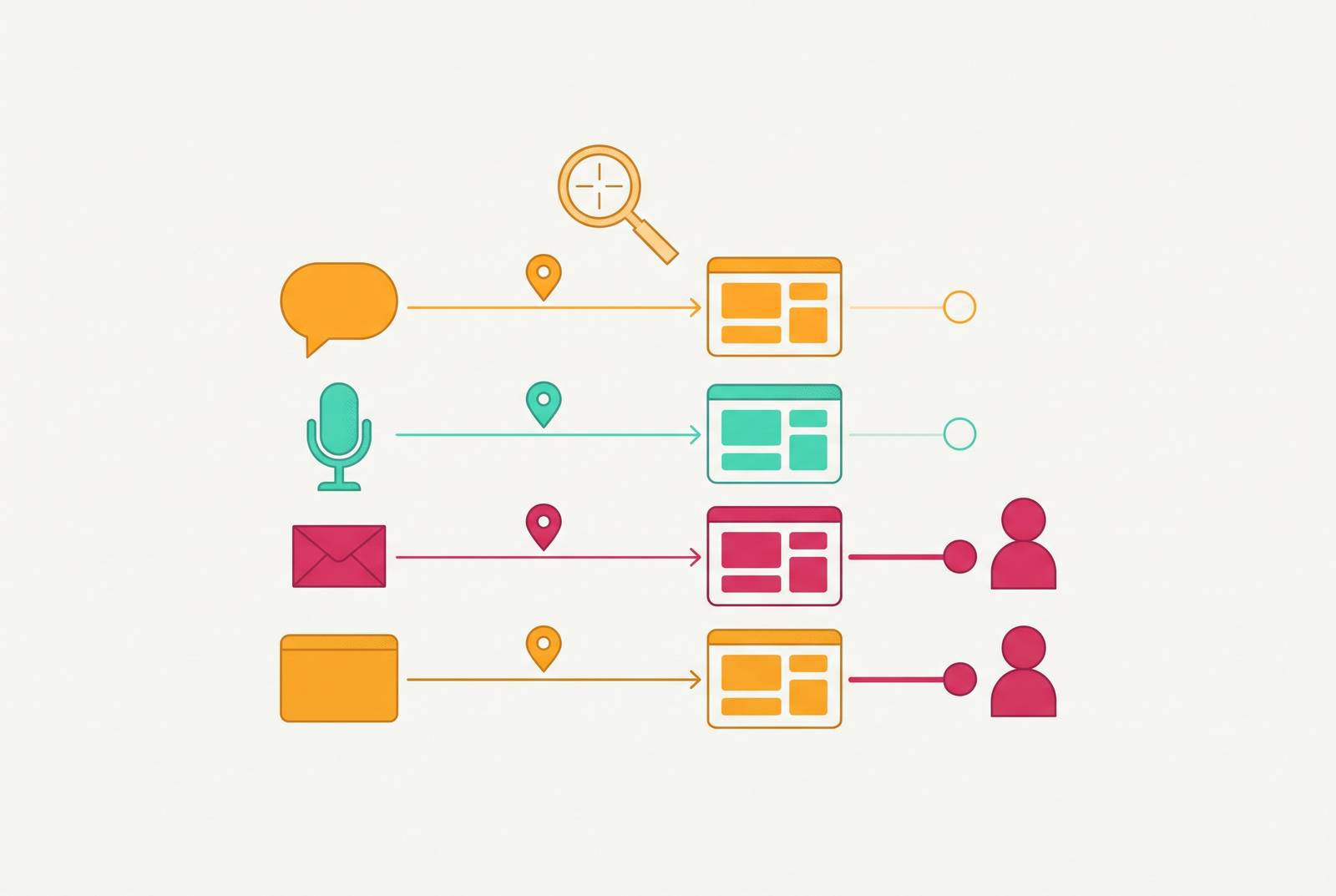
Getting traffic to a new B2B site starts with attribution before channel selection. Each borrowed-audience placement needs a tracked destination and a defined outcome so the team can tell which venues send buyers. A placement ledger, intent-matched pages, clear review rules, and AI citation tracking turn outreach into evidence for the next investment.
Why new B2B sites face a measurement problem before a channel problem
Tracking shows what visitors did, identification shows which company was behind a visit, and attribution connects a channel to a deal. Teams often treat these as one capability when shopping for visitor tracking software. They then discover that session-level reports cannot tell them which companies visited the pricing page or which placement produced pipeline.
The gap extends beyond the software. Peer conversations, Slack communities, Discord servers, podcast episodes, and private LinkedIn DMs can influence a purchase without passing campaign tags to the site. The traffic they drive may be classified as direct or organic traffic in session-level reports instead. Buying committees deepen this blind spot because more stakeholders can share research through channels the site cannot see.
What, then, would more placements actually prove? Without a way to connect them to buyer outcomes, more traffic only makes the uncertainty larger. The practical response is to define the destination, the outcome, and the review rule before buying or earning the next placement. That gives each experiment a question it can answer.
What borrowed-audience placements actually are and why they are the right starting channel for a new site
A borrowed audience already gathers somewhere else. It might read a newsletter, trust a podcast host, research vendors in a community, or visit a third-party publication or directory. The venue is that gathering place, while the placement is the particular sponsorship, guest appearance, thread, article, or listing. For a new site without domain authority, this offers access to an established audience without waiting for organic traffic to compound.
That access makes these placements a useful starting point, but not a substitute for measurement. Each has a different traffic signature. A newsletter click can arrive with a referrer, a podcast listener may type a URL, and a community link may arrive with or without campaign tags. Without that preparation, traffic can end up in GA4’s Direct or Unassigned buckets, so the team cannot tell which of the experiments it paid for brought the visits.
A placement ledger and the fields to record for every placement
Log each placement in a shared ledger before it goes live. A spreadsheet works because the discipline lies in the fields. Each row should describe one placement, the reason for choosing it, the destination it promises, and the outcome used to judge it. Filling those fields forces decisions that otherwise get deferred until traffic has already arrived.
Start with a unique Placement ID, such as revops-weekly-2026-09. This is the row’s anchor. It ties the ledger entry to the UTM string and receiving page, so the placement remains identifiable through the review. Record the venue name and type, including newsletter, podcast, community, directory, or editorial. Add audience size and an ideal customer profile, or ICP, fit score, and note whether the audience size is confirmed or estimated.
Next, record the placement date and flight window, including the start and end that establish the evaluation period. Capture the negotiated deliverable, whether an ad read, guest post, listing, or reply. The Destination URL field should contain the specific receiving page, never the homepage. Record the cost or time spent here too, so the team can weigh qualified outcomes against the cash or hours it spent.
The UTM string needs all five parameters populated, namely utm_source, utm_medium, utm_campaign, utm_content, and utm_term. The medium deserves particular care. It is the primary channel-classification signal in GA4’s default grouping rules, so omitting it undermines channel attribution. GA4 does not recognize utm_medium=podcast in that default grouping. To keep this traffic out of Unassigned, set up a custom channel group that matches Session medium to podcast.
Spoken placements also need a Vanity path field. A path such as yourbrand.com/revops-weekly can 301-redirect to the fully tagged destination, preserving campaign detail without asking listeners to type a long tracking link. Finally, define one Primary tracked outcome, such as a demo request, trial start, or asset download. The Result after the review period field should capture visits, qualified outcomes, and the keep, rewrite, or drop decision. Without a defined outcome, the ledger is only a traffic log.
One receiving page per intent, with its own tracked URL and outcome
A tracked link identifies where a visitor came from. It does not make a generic destination useful. A homepage speaks to many audiences at once, so sending every placement there makes it harder to tell whether the audience is a poor fit or the page fails to meet the visitor’s intent. Use a separate receiving page for each group with a different audience or intent, and keep each placement’s own tracked URL and outcome.
The page should deliver the promise that earned the click. Before judging it, record the entry source and campaign context to check that the UTM arrived correctly. Record the first meaningful interaction timestamp and scroll depth at the trust and call-to-action sections. These reveal whether visitors engage and reach the proof and the ask. Field-level drop-off, confirmation events, and follow-up engagement then help distinguish form friction from a genuine conversion.
Competing navigation can interrupt that path before the intended outcome. Menus, footer links, social icons, and alternative calls to action all offer exits. Flare, a B2B SaaS cybersecurity company, rebuilt a “Book a Demo” page by removing competing calls to action and streamlining the form layout. It saw a substantial increase in conversions within one week. Because the changes combined navigation and layout, the example supports a focused destination, with the effects of individual form fields still undetermined.
Forms still need judgment beyond submission rate. A qualifying field such as company size may lead to fewer submissions while raising the lead-to-opportunity rate. Whether removing it produces more pipeline or less merits assessment. A “How did you hear about us?” field with controlled options such as Podcast, Newsletter, and Community adds a different kind of evidence. Tied to a contact record, that answer connects dark-funnel influence to the ledger and CRM pipeline data.
Exit criteria for keeping, rewriting, or dropping a venue
At the 90-day review, the ledger should trigger a decision. Start with the visits and qualified outcomes in the Result field, and compare them with the Primary tracked outcome. A low qualified outcome rate from one source points toward audience quality when the same page converts well for other sources.
Before blaming the audience, check the message-to-traffic match. Does the first screen echo the specific benefit the placement promised? Compare the placement headline with the landing page H1, using the recorded deliverable and destination to examine the actual path. If the promise is missing, fix the headline first. A click shows that the placement earned attention, but it does not prove that the visitor found the promised answer.
Keep the placement when it brings qualified outcomes and self-reported attribution and CRM evidence link later deals to the channel. That supports repeating or expanding it. Rewrite the page when traffic arrives but exits before engaging, starting with the headline’s match to the placement promise. A continued lack of qualified outcomes after a rewrite and a full 90-day window warrants dropping the venue. The ICP fit score then helps the team choose a venue with a better-fitting audience for its next spend.
Downstream attribution should recognize the placement that first surfaced the buyer. Self-reported answers and CRM pipeline data provide the quality check that a download or demo count cannot supply alone. Qualified outcome rate is an intermediate signal.
Measuring AI-answer citations and AI-referred visits alongside direct referrals
The review also needs evidence beyond direct placement traffic. The same third-party mention that sends a visitor can become a source for an AI answer, giving the placement another route to buyers. AI engines are more likely to cite a brand through third-party sources than through its own domain. A session-only review can therefore undervalue a placement whose strongest contribution is citation.
Seer Interactive’s analysis found ChatGPT-referred traffic converting at a markedly higher rate than Google organic for a single B2B client. A likely explanation is that AI search compresses research into one interaction, answering low-intent questions without a click while sending visitors with more concentrated purchase intent. The implication is to assess AI referrals by conversion quality.
Recognizing those visits remains difficult. Google Analytics added an “AI Assistant” channel group in May 2026 for recognized referrers such as ChatGPT, Gemini, and Claude, but the full referrer list is unpublished. In-app browsers often send no referrer, and agents fetching pages on a user’s behalf rarely identify themselves. Some AI-driven visits thus show up as Direct. A sudden rise in direct traffic to a specific comparison or use-case page is a clue to investigate for possible AI attribution.
To capture the missing evidence, segment recognized AI referrals in GA4 and run a fixed panel of buyer-intent prompts monthly across ChatGPT, Perplexity, Gemini, and Google AI Overviews. Record the raw citations themselves. This makes it possible to see which venues or placement-generated content appear in answers. Add an “AI citation observed” field to the ledger so that evidence stays attached to the original experiment.
The broader measurement set should cover AI citation rate, share of voice across AI engines, sentiment and accuracy of brand mentions, AI referral traffic, and AI-influenced pipeline. These describe different parts of the journey. A citation shows that the brand is visible, while a referral or pipeline signal says more about whether that visibility can lead to sales.
Persistent citation can change a placement decision. A venue with modest direct referrals may deserve to stay if its content keeps appearing in relevant AI answers. Individual citations typically have a half-life of only a few weeks, so one observed mention is not evidence of lasting influence. A sustained series of authoritative third-party placements can instead build referrals across related queries. The monthly panel distinguishes that pattern from a brief appearance.
What the full system looks like running, from first placement to compounding evidence
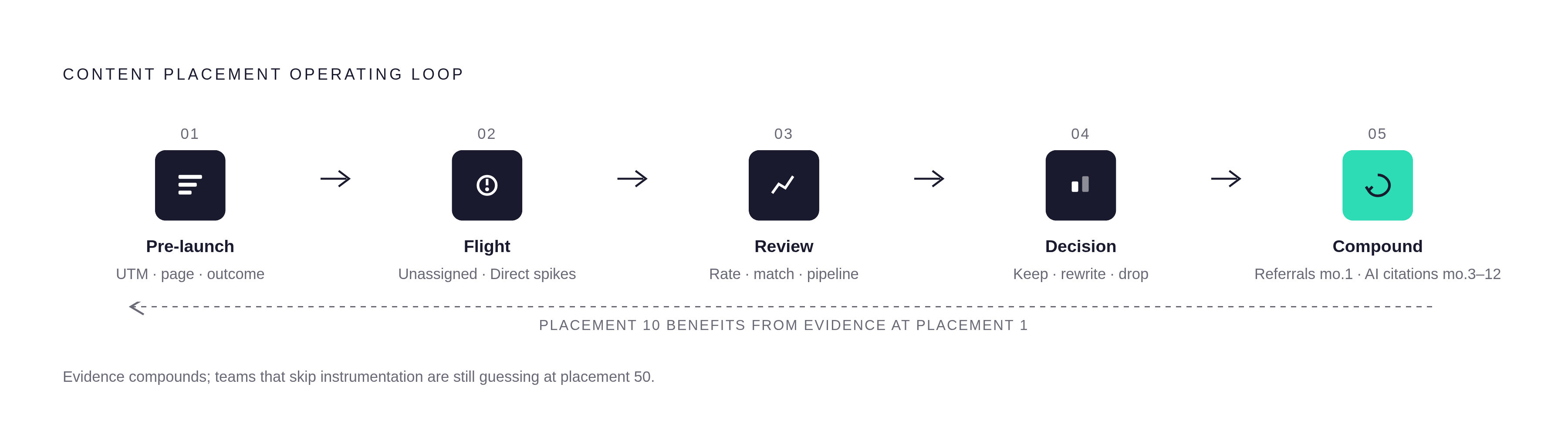
The operating loop begins before a placement goes live. Fill the ledger row, build or assign the receiving page, set the UTM string, confirm the vanity path for spoken placements, and define the outcome. During the flight window, monitor anomalies before the review. An Unassigned spike can signal a tagging problem, while a Direct spike to a deep page can prompt an AI citation check.
At the review milestone, combine qualified outcome rate, message match, downstream pipeline evidence, and observed citations. Apply the keep, rewrite, or drop decision and record it in the ledger. No UTM string can reveal every private recommendation, so self-reported attribution and channel-level pipeline patterns remain necessary complements. The system offers an improving approximation of a buying committee’s activity.
Its value grows as the evidence accumulates. A kept placement earns another cycle with refined copy and a tighter call to action, while a third-party article can generate referrals in month one and AI citations in months three through twelve. The prompt results from each month show how citations change over time alongside the placement history. The team that instruments placement one has a dataset by placement ten. The team that skips it can still be guessing at placement fifty.