How to market a product after your friends have bought: a weekly channel-test loop you can script, instrument and have an agent run
A weekly loop of falsifiable channel tests that an agent can run.

Marketing after friends have bought requires evidence as well as reach. The way forward is a weekly loop of small, falsifiable channel tests, each with an owner, a metric and a stop rule. Instrument the path to payment before scaling, then let an agent run the bounded steps and report back, with human approval wherever an action changes something.
Why warm-network sales stall and what the data says about cold-market AI visibility
Friends lower the bar when they evaluate a product. Warm contacts can soften criticism and buy with trust that a stranger has no reason to grant. That compresses the signal from early sales, so more outreach does not necessarily fix the problem. The cold market applies a different test. It needs evidence of fit without the relationship doing part of the selling.
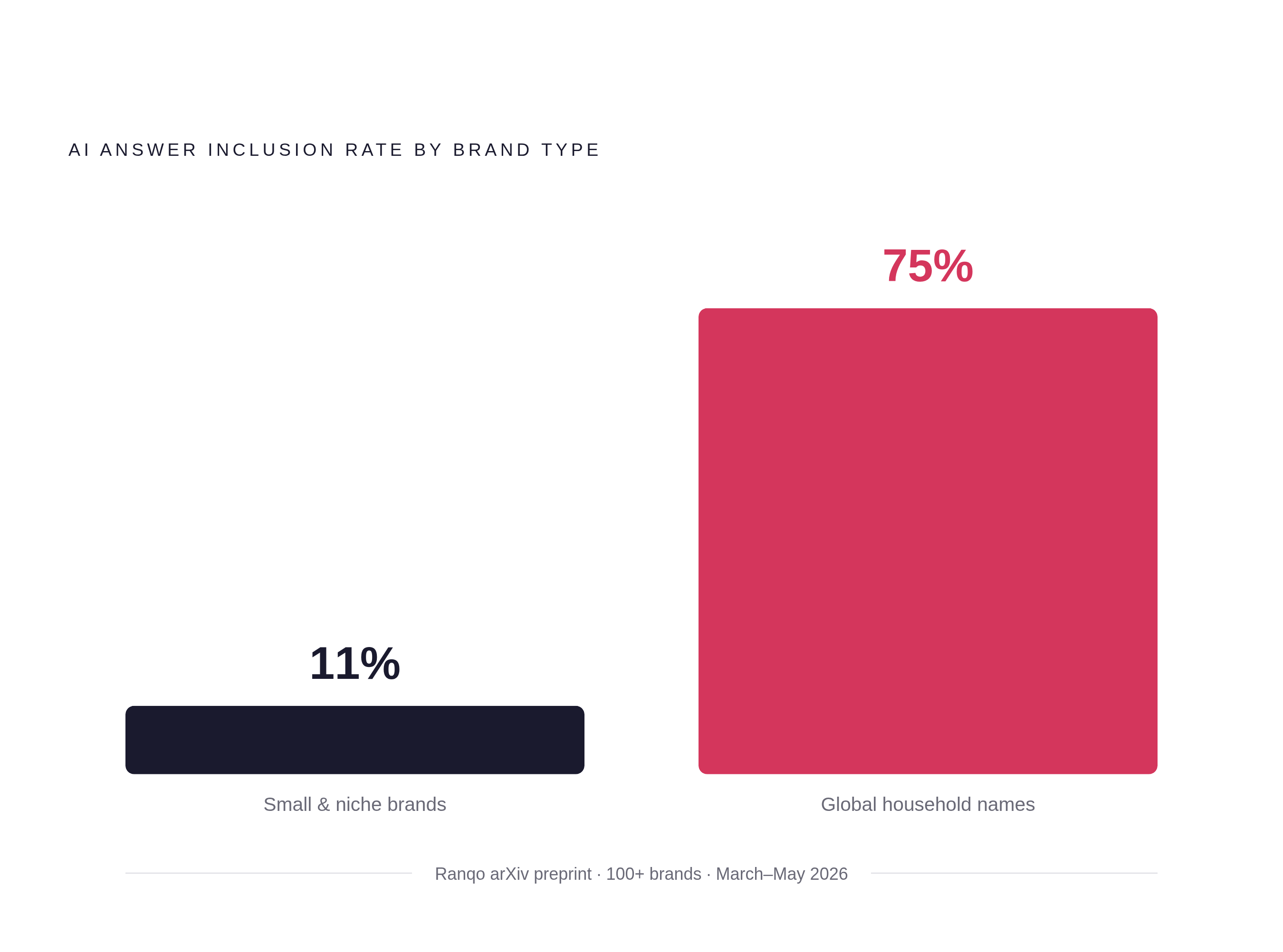
At the same time, that evaluation increasingly begins inside an AI answer. Similarweb’s 2026 Generative AI Brand Visibility Index found that a substantial share of US consumers now use AI at the product discovery stage, ahead of traditional search. The Ranqo arXiv preprint, studying prompt responses across 100+ brands from March–May 2026, found niche and small brands appeared in just 11% of relevant AI answers on their first run, versus nearly three in four for global household names. Brands that are absent lose that chance to be found, however well they rank in organic search. Closing this gap requires treating marketing like a software system, with a repeatable, instrumented loop rather than a larger push built on uncertain feedback.
What a weekly channel-test loop actually is and why the engineering analogy holds
A channel test resembles a unit test because it states what should happen under defined conditions and what result would count against it. Each test needs a hypothesis, an owner, one pre-committed metric and a stop rule. Without those commitments, the team can call almost any result a success. The analogy has a limit, though. Market responses vary, so the loop tests evidence against a threshold.
A skeletal test-log row could name cold email as the channel, account-level personalization as the variable, and a hypothesis that targeted messages will clear an agreed reply-rate floor by Friday. The metric is reply rate, the owner is the founder, and the stop rule is a result below that floor after the agreed number of sends. The values must be filled in before execution. Otherwise, the team can move the goalposts once it sees the result.
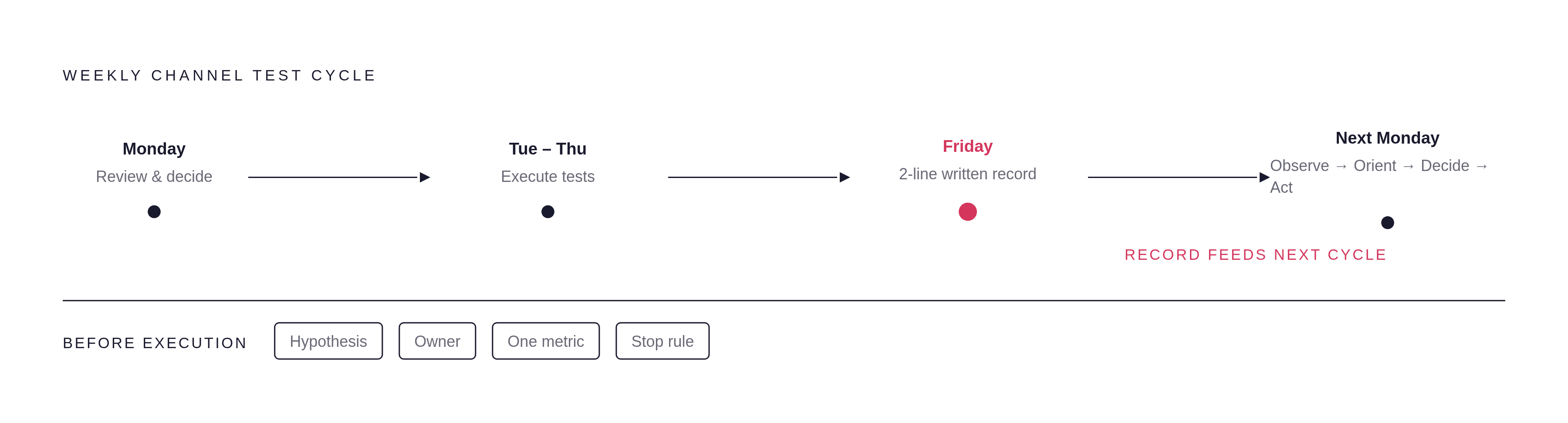
The weekly rhythm puts review and decisions on Monday, execution on Tuesday–Thursday, and a two-line written record per test on Friday. That required record preserves what ran and what happened for the next cycle’s observe, orient, decide and act sequence. Tests run in parallel so a channel needing three weeks does not hold up every other experiment. However, they must be genuinely independent, because a shared landing page or audience segment can confound the results and make separate channel effects hard to distinguish.
The five channel categories worth testing first and what a falsifiable hypothesis looks like for each
Signal speed, rather than potential reach, determines the first candidates. A channel needing eight weeks to produce data is not a week-one test, although a short test can include a later outcome checkpoint. The five categories below differ in what they can reveal quickly. Each needs a narrow hypothesis specifying what it would mean to “build awareness.
Direct outreach tests whether a specific, verifiable problem earns a response from a defined buyer. The hypothesis might be that sending an agreed number of targeted cold emails to a chosen customer segment, with a hook tied to each account, will clear a reply-rate floor by Friday. Account-level personalization is the variable to isolate first. A first name alone does not establish relevance, and a generic pitch can produce a null result that teaches little about the problem.
Content distribution tests an article format and a place to distribute it. The hypothesis might be that publishing a comparison article on a chosen external platform will generate an agreed number of referral visits within one week. This also creates a foundation for generative engine optimization, or GEO. Similarweb’s GEO guide explains that indexing alone is insufficient, because content must also be clear and authoritative enough to cite.
Community participation tests whether answering people’s questions earns attention without turning into promotion. Its hypothesis might be that answering an agreed number of relevant threads in a chosen community will generate a defined number of site visits by Friday. Links belong only where genuinely relevant. Moderator concern about spam is a stop signal even if visits rise, while substantive participation can also create third-party material available to AI engines.
Earned media and third-party listings test whether the brand can get into an outside source. A hypothesis might be that submitting to a chosen platform by Wednesday will produce a live listing by Friday and at least one referral within two weeks. Source choice is crucial here. The preprint identifies ranked “best-of” listicles as the most-cited format, at roughly one in five citations, while G2 and Capterra account for a very small share.
AI answer-engine visibility is the newest and least instrumented category. Its hypothesis might be that adding a comparison table to a specified page will increase mention inclusion on a chosen engine within two weeks. The structural change is the variable. Like every other test, it needs an owner and a stop rule, although measuring its result requires more than a single prompt run.
How AI answer engines decide which brands to cite, and what that means for content structure
Strong search rankings do not guarantee inclusion in an AI answer. The GEO guide describes retrieval-augmented generation, or RAG, as two gates, one where the engine retrieves candidate documents and another where it builds an answer with citations. A page can clear the first and fail the second. An engine must be able to find the page and use its text as evidence for the answer.
For a team building that evidence, the lesson is to put the direct answer before the preamble. An opening answer capsule gives the engine a passage it can extract, while an inverted-pyramid structure places each section’s conclusion before its support. Comparison tables make alternatives explicit rather than leaving relationships scattered across paragraphs. Named expert quotations, with title and organization, make human claims attributable. Claims based on evidence should likewise give a named source, date and hyperlink so readers can see what backs them up.
Check robots.txt first because it can block AI crawlers without warning, and use structured data to help earn citations. Yet an accessible, well-structured owned page is only part of the source picture. The preprint found that the large majority of citations go to corporate websites, but YouTube leads among non-corporate sources, ahead of Reddit, editorial media and Wikipedia. It also found that brands with a single source type receive a fraction of the coverage of brands with five or more.
Publishing across sources still does not settle how a brand will be represented. The preprint found that positive or negative framing flips much more often than mention presence does. Monitoring therefore has to follow publication.
Why AI visibility measurement is broken by default and how to build a prompt-cluster tracking system
What does a screenshot of a favorable answer prove? Only that the answer appeared on that run. The same prompt on the same engine can return different brand lists on the same day, so a single result cannot establish progress. Non-determinism makes repeated, consistent measurement necessary. It does not make measurement impossible.
The practical instrument is a prompt cluster, a set of questions the target customer asks about the category, grouped by discovery, comparison and decision intent. Run the same cluster every week across ChatGPT, Perplexity, Gemini, Claude and Google AI Overviews. Archive the raw responses. They provide the audit trail when a reported change needs examination and the material an agent can later work through.
For each cluster on each engine, track the mention inclusion rate, share of citation, cited-source diversity and competitor displacement. A mention names the brand, while a citation links to its domain as evidence, so these are separate outcomes. Position also changes the interpretation. A lead mention carries a different meaning from appearing late in a list, and a competitor repeatedly appearing where the brand is absent gives the team a specific gap to investigate.
Attribution remains an unsolved industry problem. A buyer can discover a brand through ChatGPT and search its name two days later, leaving branded search with the credit. Tracking branded search volume provides a practical leading indicator, but growth without a paid campaign is circumstantial evidence of AI influence. A weekly agent-run report should therefore preserve the underlying observations, including engine, prompt, mention yes or no, position, cited URL, sentiment and competitor present yes or no.
Scripting the full instrumented path from channel test to payment so an agent can walk it
Consider a hypothetical B2B SaaS test that adds a comparison table to a page meant to answer a category-comparison prompt. Its primary metric is mention inclusion on the selected engine, with a pre-committed threshold and stop rule. The founder must first make the path explicit, from publication to AI mention, referral or branded search, and payment. The script must distinguish observable steps from inferred connections, particularly when branded search stands between the AI answer and the eventual purchase.
Each action then needs an instruction with clear limits and an interface the agent can use. Querying Perplexity with a specified prompt and checking whether the brand appears in positions 1–3 is walkable. “Check AI performance” is not. Every pipeline action needs to be reachable through an API. Reads can be automated broadly, while writes, including publication, sending and recording, require human approval before taking effect.
For the comparison-table test, the agent first sweeps the agreed prompt cluster across all five engines and prepares a structured difference from last week. It then pulls the live test metrics and flags any crossed stop rule. The report can show changes in branded search alongside the mention result without claiming that the table caused them. For a confirmed signal, the agent drafts the next content variant and queues it for review. For a negative result, it prepares a kill entry and one-line post-mortem for approval.
A researcher agent passes its work to a drafting agent and a critic agent, and a human must approve the outline and the draft before a publisher agent acts. Outline review catches structural problems before they spread through a full draft. Factual verification remains mandatory before publication, because fabricated statistics or misattributed quotations enter the public record.
Before Monday’s review, the agent delivers a one-page summary of tests, metrics, proposed kills, promotions and AI mention trends. For this example, the report must also show whether the path toward payment moved. The written record prevents later reinterpretation of the original test.
What to scale, what to kill, and how to know the difference after four weekly cycles
Four weekly cycles provide the minimum horizon for a falsifiable signal in most channels. One week gives a sample, while more weeks begin to show a trend. A clearly crossed positive or negative stop rule is the exception and warrants immediate action. Otherwise, an encouraging first result is not enough to justify scale.
A channel graduates when its metric consistently exceeds the pre-committed threshold, a second person or agent run can replicate the result, and the full path to payment shows movement. All three conditions constrain the decision. AI visibility may show that more buyers are finding the brand before their path to payment can be traced, so branded search serves as a bridge for now while evidence from later steps is still needed. Scaling without that instrumentation would recreate the uncertainty of warm-network sales at greater volume.
A killed test has still produced useful information. A killed test’s one-line post-mortem should say what was tested, what the metric showed and why it stopped, so the team has a record that helps it avoid the same failed attempt. After four cycles, the team should also audit the loop itself. Which channels produced a signal worth pursuing, which engines consistently named the brand, and which formats earned citations? Weak results may show that the hypotheses were weak while leaving open whether the channel can work.
The preprint proposes seven v1.1 causal testing protocols for GEO, reinforcing the distinction between a citation change following an edit and being caused by it. The aim is to rank investments by the evidence for them while avoiding an early claim that one channel has won. From there, the loop can become a durable publishing and visibility system with continuous monitoring and agent reports before expansion. As AI answers become a front door to cold discovery, brands that accumulate evidence about what earns citations can compound that knowledge, while brands focused only on a ranked link leave the new discovery path untested.