An ads MCP server that sits beside your repo: what technical B2B buyers should ask before letting a coding agent near their Google Ads account
Buyers should demand proof of approval gates and credential ownership.

Connecting a coding agent to Google Ads through an MCP server can bring account analysis and some account changes into the same workflow as code. But access to live advertising needs more than a working connection. Whether to buy depends on whether the architecture can enforce approval, limited write access, credential ownership, and conversion review, and whether logs can show that those controls worked.
What an ads MCP server beside your repo actually does — and what it cannot do
Google released version 0.0.6 of its official Google Ads MCP server on November 2, 2026, with four new write tools: create_asset, upload_video_asset, manage_labels, and manage_label_associations. Each uses a two-step propose-and-confirm flow, with a dry-run and checksum before a change is committed. The official server still cannot change campaigns, budgets, bids, or keywords.
Those write tools shipped on by default. Google’s developer integration guide, last updated October 30, still described the server as strictly read-only at the time of the release. That creates a concrete review problem for teams that approved the integration on a read-only basis. They now have a different tool from the one they vetted, even though its name has not changed.
The wider landscape offers different coverage. The official server pairs a narrow write surface with first-party trust, while third-party servers can expose broader account operations. Pipeboard’s server, for example, covers campaigns, ad groups, keywords, asset uploads, and generic mutate operations. With self-hosted community tools, users run the software with their own credentials. These are architectural differences, and policy now helps determine which arrangements are viable.
Google's August 31, 2026 policy change and what it means for hosted MCP integrations
Google’s updated Help Center policy, effective August 31, 2026, restricts a category called “programmatic proxy”. The definition explicitly includes MCP servers, wrapper services, and proxy endpoints that “solely replicates, wraps, or re-exposes Google Ads programmatic capabilities as an intermediate layer”. Every integration must connect through its own dedicated Google Cloud project, and shared developer proxy services are prohibited. This changes the starting point for vendor evaluation. A working developer token does not establish that an integration complies with the policy.
The policy includes carve-outs for developers automating their own accounts and for open-source tools that end users run with their own credentials. The latter is the basis on which many self-hosted community servers operate. Vendor evaluation therefore shifts from checking API access to identifying which Cloud project underpins the integration. Hosted access under shared developer credentials and self-hosted access under advertiser credentials are not interchangeable arrangements.
Google gave no enforcement date, grace period, or list of affected vendors. The Ads API Compliance team contacts each developer who needs to make changes. Separately, teams setting up the official server on fresh Cloud projects have reported refusals since October 9, 2026, within a minute of setup, with the reply “The Google Cloud project is only approved for use with test accounts”. These reports signal tighter access-tier enforcement, rather than establishing when the proxy policy will be enforced.
For a buyer, the useful response is specific due diligence. Which Cloud project number underpins requests, what is its verification status, and is it dedicated to this integration as the August policy requires?
Why write access to a live ad account is a materially different security surface than read access
Read access can expose sensitive account information. Write access can also cause immediate harm to spending and to how an account runs. Depending on its tools, an agent that needs no human approval can increase budgets, pause campaigns that perform well, or publish creative that breaks policy before anyone sees it. The danger is not confined to bad advertising judgment. A compromised tool can act through the same permissions as a legitimate request.
MCP’s optional authentication model complicates that boundary. Centralized servers may hold OAuth tokens, API keys, and database passwords without cryptographic protection, secure storage standards, or credential rotation policies. Security researchers had disclosed more than 40 CVEs across MCP SDKs, servers, clients, and marketplaces by April 2026. The count is a warning about security maturity. Buyers need controls that still work when a component is compromised.
Pillar Security found a live campaign in August 2026 whose server stayed harmless for its first three tool calls, then instructed the agent to collect SSH keys and cloud credentials. Cycode’s research team disclosed a serious flaw, rated CVSS 7.5, in the MCP Python SDK in September 2026. A malicious server could hijack OAuth login discovery and receive the client secret, authorization code, and PKCE proof key. These findings make structural safeguards more useful than assurances about normal behavior. Human approval, separate credentials, and limits on write scope leave an integration with less it can do when normal behavior breaks down.
The propose-and-confirm mechanism in the official server and why it is not the same as a human approval gate
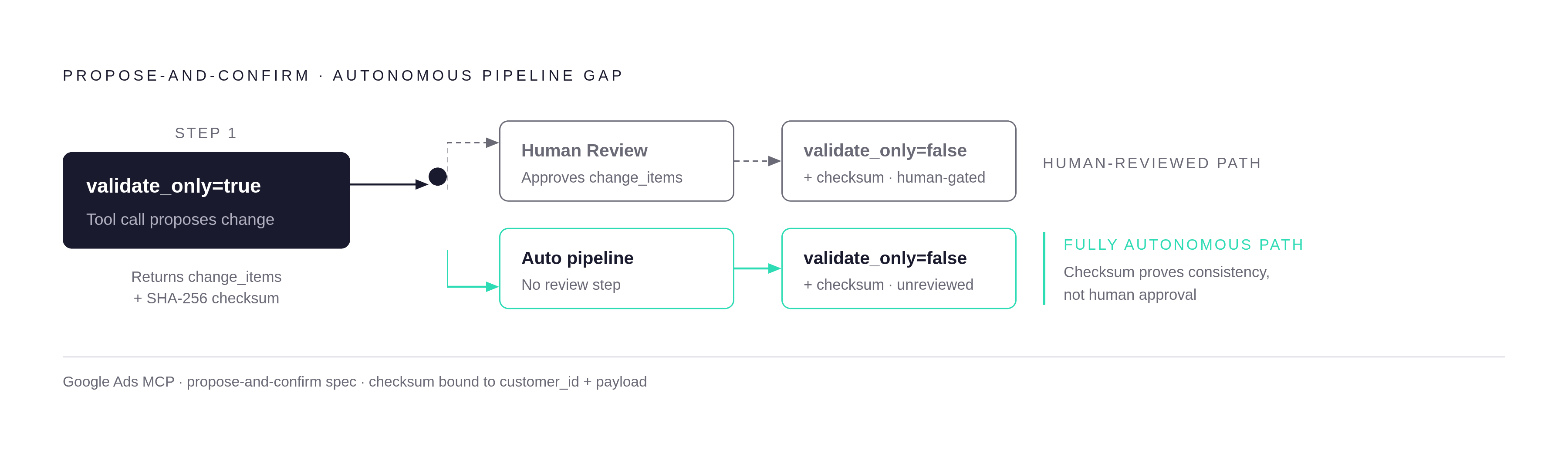
On the first call, validate_only defaults to true, and the response includes human-readable change_items and a stateless SHA-256 checksum digest bound to customer_id and the request payload. A second call must set validate_only to false and supply the same parameters and exact checksum. Any mismatch is rejected before the account changes. This binds the write to the validated request.
That binding provides a real protection. Prompt injection between the two steps cannot silently substitute a different payload while preserving the validated operation’s checksum. The checksum establishes consistency. It cannot, by itself, demonstrate that someone read the proposed changes or approved their advertising consequences. A valid request can still be a bad decision.
Google’s README says confirmation comes after the user has explicitly approved the change. Yet an orchestration layer configured for full autonomy can complete both calls in one unreviewed pipeline pass. The distinction is between a mechanism that supports review and an architecture that requires it. A buyer should ask not merely whether a dry-run exists, but where in the pipeline a human is structurally required to unblock a write, and whether configuration can bypass that requirement.
Credential model questions that separate safe integrations from risky ones
For a hosted integration, the key distinction is between a vendor’s shared Cloud project and a dedicated project owned by the advertiser. A shared vendor project is the pattern prohibited for multi-tenant proxy services under the August policy. It also leaves control of the project with the vendor. An advertiser cannot independently revoke credentials it does not own.
A dedicated per-client project with advertiser-held credentials keeps revocation under the advertiser’s control and aligns with the policy’s carve-outs. Ownership is only part of the test, however. Separate read and write tokens provide another boundary, because an exposed read token cannot be used to change budget or creative. Buyers should ask whether those scopes are issued and stored separately, since different tool names alone do not show that the credentials are separate.
MCP servers may accumulate OAuth tokens without enforced rotation, so the review needs to cover rotation policy and whether team-member offboarding automatically revokes access. Agency and multi-client setups need a closer look when one developer’s credentials are used for many unrelated end clients. Two questions bring the decision back to control. Can the advertiser revoke this access unilaterally, without the vendor, and does the credential running write operations belong to the advertiser’s Cloud project or the vendor’s?
Conversion-action gating and why write scope without conversion fencing is the highest-risk configuration
Campaign and budget controls do not cover the whole advertising risk. When an agent can produce many asset variants instead of a few, human-paced review can fail simply because production volume has changed. Creative that would have been caught in a review meeting can reach a live auction if no pipeline stage has the job of stopping it. Speed amplifies the gap in the process. The agent does not have to be reckless for oversight to fall behind.
Offer and pricing claims make this especially consequential. A wrong price or an unsubstantiated claim can spread across many variants, creating compliance exposure that performance monitoring cannot resolve after publication. ROAS does not show whether an offer was accurate. This is a separate review task from judging whether a campaign performs well, and it requires an assigned human decision point.
Conversion-action gating protects another boundary, namely what the account optimizes toward. It means agent-initiated campaign or asset creation is not wired to a conversion action without explicit human review of the action being used. An agent that creates campaigns and assigns conversion tracking autonomously can otherwise change that objective silently. Integrations with broader write access need this fence alongside campaign and budget controls. Analytical and operational work can be automated, while strategic decisions, creative direction, budget approval, and policy compliance review should remain human responsibilities.
Audit logging and the measurement requirement that makes any other safeguard verifiable
An approval gate is difficult to assess without a record of its use. The same is true of credential controls and write-scope limits, yet most MCP implementations ship without enforced audit logging. Logs are not just evidence for a later investigation. They make it possible to observe whether safeguards are doing their intended job and to improve controls on that basis. Unobserved approval behavior cannot be meaningfully tuned.
For an ads integration, the record needs every MCP tool call, including reads, with its timestamp, tool name, parameters, and calling agent or session identity. Write records need to identify the propose step and the confirm step separately and show whether a human unblocked confirmation. Authentication events and credential use are also needed to reconstruct the reach of a compromised token. A successful write alone is insufficient evidence. It says nothing about who authorized it.
Google Cloud’s native audit logging covers the infrastructure layer for teams running the official server on Cloud Run, but not the MCP tool-call layer. Those teams need instrumentation in the server as well as platform logs. A vendor evaluation should therefore request a time-ordered record of every write tool call, its parameter payload, and its confirmation event. The record must also be exportable independently of the vendor’s platform, so the buyer can examine the evidence directly.
The due-diligence checklist, assembled as a set of testable questions
The following questions can be taken into a vendor evaluation or an internal architecture review. Each calls for an inspectable answer. For policy compliance, which Cloud project number authenticates this MCP server to the Google Ads API, what is its verification status, and is it dedicated to this integration under Google’s August 31, 2026 policy? Is the service hosted under shared vendor developer credentials, or does it run under credentials owned and controlled by the advertiser?
For write scope, what is the complete list of exposed write tools, and can each be disabled individually? Are campaigns created paused by default, and is there a hard server-side gate on destructive operations, including deletes and campaign pausing, that prompt instructions cannot bypass? Does the server expose budget modification or campaign status changes, and what approval step governs those operations?
Where is a human structurally required to unblock a write, and is that requirement enforced at the server level or merely stated in an advisory prompt? Can propose-and-confirm complete autonomously when the orchestrator is configured for full automation? Does assignment of a conversion action to a new campaign require explicit human confirmation?
Are read and write credentials issued and stored as separate tokens with separate scopes? Can the advertiser revoke write access unilaterally, without coordinating with the vendor? What is the credential rotation policy, and does team-member offboarding automatically revoke access?
Does every read and write tool call have a timestamp, parameters, and session identity? Do write logs show proposal and confirmation separately and prove that a human approved the change? Can those records be exported independently of the platform? Vague answers are themselves informative, because a safeguard that cannot be explained or demonstrated is not a sound basis for granting access to live spend.