"Growth assistant" for a B2B founder: prompt a tool, brief a hire, or buy a weekly service? What a technical buyer should be able to inspect before choosing
Tool, hire, or service: judge each by what you can audit.

Choosing a “growth assistant” for a B2B founder means choosing between prompting a tool, briefing a hire, and buying a weekly service. The buyer needs an option that lets them measure results, audit decisions, and change the work before it ships. That is an observability decision, and AI-driven discovery makes it harder to leave inspection until later.
Why B2B buyers now start their search in a chat window, not on a search engine
Consider a buyer who opens a chat window, types a category question, and books a demo with a vendor the answer names. The vendor’s website need not be the starting point. AI can help buyers compare vendors and make a final choice as well as do early research. That changes what a growth program needs to make visible, because a buyer can encounter a recommendation without following the path that website analytics records.
A June 2026 panel of commercial B2B software queries found that AI could name vendors and recommend them without linking to their own sites. The same panel found that the majority of AI Overview citations did not appear in the organic results for the same query. Search rank therefore tells only part of the story. A search result gives a vendor a chance to get a click, while an AI mention puts the vendor in the answer itself. Optimizing for one does not automatically secure the other.
What AI engines actually cite, and why a brand's own site is rarely the primary source
Brands are far more likely to get AI citations through third-party sources than through their own domains. Much of the work therefore sits off-site, in earned media, review platforms, directories, and community presence. Who publishes the evidence becomes part of the problem. A program that produces polished website copy alone may leave the sources shaping the answer largely untouched.
Aggarwal et al.’s GEO research paper, published at ACM KDD 2024 by researchers from Princeton / IIT Delhi, established that targeted content changes could meaningfully lift visibility in generative engine responses. Effective changes included adding statistics, citing credible sources, and including expert quotations with named attribution. These give a retrieval-augmented system facts and quotes it can pull out. An attributed quotation from a named expert with a job title offers a clearer citation target than a general assertion. The work is not simply to make prose sound authoritative, but to supply evidence that can be passed on.
The mechanism also affects which work can help. Retrieval-augmented generation, or RAG, indexes and retrieves material at query time, favoring crawlable, well-structured, authoritative pages. Parametric training data is a different route into an answer, so the same changes do not serve both mechanisms identically. Gated content is unavailable to retrieval behind the form.
Across sources, consistency becomes another technical dependency. A brand’s name, description, founding year, and services must match across its website, LinkedIn, industry directories, and Wikipedia/Wikidata. Conflicting details create room for hallucination, while independent corroboration gives a claim a stronger basis than publication on the brand’s site alone. Repetition helps explain why entity consistency and verifiable findings belong in the program a founder is buying.
The three growth assistant models a founder actually chooses between
In the tool model, the buyer operates the software directly and controls the inputs. They can inspect outputs before anything ships. The buyer or their team also supplies the judgment layer, including prompt quality, editorial review, and interpretation of results. Every prompt and draft can be available for inspection, but that possibility is not a review workflow. Someone still has to build and run the checkpoints.
CMI’s 2026 B2B content survey found that most B2B marketers used AI to create content, while only a minority said their content performed better. Reports on quality were mixed, with some seeing improvement and others decline. Production and performance are different things. The tool supplies a way to generate material whose fitness for publication still needs to be assessed. The tool model therefore assumes that the buyer has someone trained to review the work.
With an in-house or fractional hire, the buyer owns the relationship and can direct priorities. Inspection depends on the artifacts the person produces and the reporting cadence agreed with them. The role can include measurement as well as production. But if tracking is left unspecified, activity may be visible while its effects remain unauditable. Briefing the hire defines not only the work, but also what evidence the founder will receive.
A weekly managed service takes on the work and lets the buyer see whatever reports, approval workflows, and change logs its system has. The work needs to repeat because a large share of cited domains change each month in active categories. A one-time optimization can decay without ongoing management. A service that publishes autonomously removes the chance to say no before publication, while defined checkpoints with named human sign-off preserve it.
What a technical buyer should demand from any growth model — the five inspection surfaces
A technical buyer should inspect these arrangements as systems. What can be measured, audited, and changed before publication? Five surfaces make that question concrete. Each calls for evidence of a working process.
The first surface is measurement infrastructure across ChatGPT, Perplexity, Claude, and Gemini. A buyer should ask for a demonstration of a fixed panel of category prompts run weekly, recording mention rate, URL citation rate, sentiment, prominence, and share of voice. The panel is the measurement anchor. Citation share against stable prompts gives the buyer a basis for comparison, while GA4 session counts are a lagging and incomplete signal. A demonstration of that tracking is a good answer, whereas website traffic alone does not satisfy the requirement.
The second surface is pipeline transparency and human checkpoints. At the brief, draft, and final stages, who reviews the work, and can the buyer see and reverse a decision? Named sign-off makes responsibility inspectable before publication. Microsoft’s 2026 preprint auditing tens of thousands of accepted academic papers found hallucinated citations in a subset, showing that even peer review can miss fabricated references. That finding helps explain why a statistic or quotation needs to be checked before it goes public.
The third surface is content retrievability and technical legibility. Does standard work include audits of robots.txt, structured data, schema markup, and internal link density, or are these add-ons? Classic SEO remains a base layer because AI engines need pages they can reach, that match the query, and that they are permitted to preview. Organic rank also belongs in that assessment, despite the differences between citation and search results. A credible answer addresses those foundations rather than leading with llms.txt, for which the brief’s cited research provides no credible evidence of a measurable citation effect.
The fourth surface to check is off-site authority and entity consistency. Does the program build and track the brand’s presence on review platforms, directories, and third-party publications, and check that entity details match across them? Owned content alone is an incomplete answer. Original research and verifiable data also offer more citation weight than opinion alone. A good response therefore covers both where evidence appears and what evidence the program produces, rather than treating publication on the brand’s domain as the whole job.
The fifth surface is cadence and compounding. What are the publication and monitoring rhythms, and what happens when citation share drops? The buyer should be able to distinguish an automatic alert or a triggered workflow from a monthly report that merely records the loss. Monitoring below a weekly cadence is too slow for the volatility described here. Scale without a feedback loop from measurement into production is a content mill.
How each of the three models scores on the five inspection surfaces
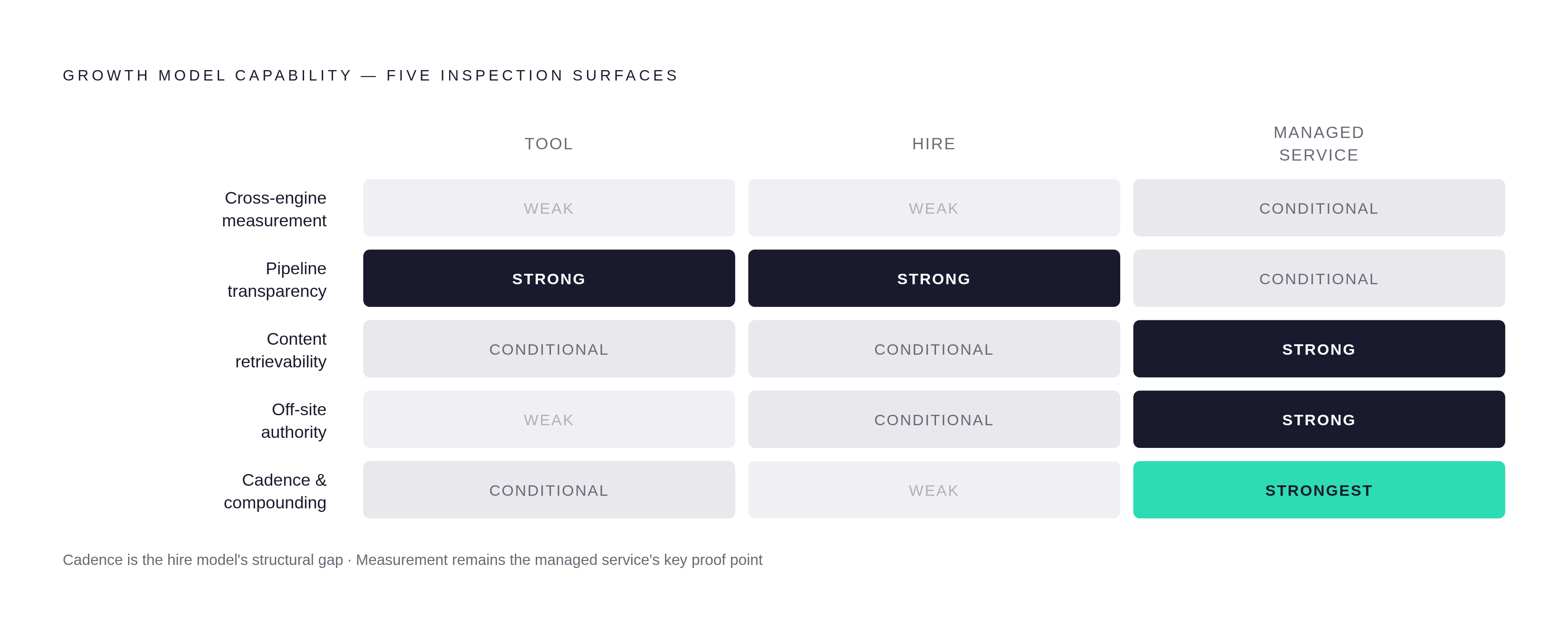
No model wins across all five surfaces by default. The choice depends on which responsibilities the founder can keep internally and which must come with the arrangement. Inspection turns that distinction into something testable. A capability the buyer must build is not the same as a capability the provider already exposes.
The tool model can offer strong pipeline transparency because the person running it can see every draft and decide whether it ships. That strength depends on an actual review workflow. Most AI tools do not include cross-engine citation tracking, so measurement needs a separate layer. Producing content with the tool does not by itself get the brand onto review platforms or into directory listings, or earn it third-party citations. Retrievability checks and a weekly feedback loop remain work for the operator to arrange, making this model a fit for a technical founder with time to run it personally, rather than a team needing consistent output without a dedicated operator.
The hire model can provide strong transparency when the brief specifies artifacts and review points. Measurement is less assured, since most individual hires do not arrive with a cross-engine citation tracking setup. The role’s scope is therefore decisive. A hire can take ownership of GEO, but only a remit that includes measurement moves beyond content production. Technical retrievability and off-site authority also depend on the role’s scope, neither of which follows automatically from hiring someone to write.
Cadence is the hire model’s particular vulnerability. If a solo hire is unavailable, the rhythm can break while citation share decays without an alert. That is a structural dependency. Knowing who owns the work helps a program mature, but it does not by itself give the program a measurement system. The buyer needs to know which parts depend on the person being present.
A managed weekly service is strongest on cadence by design when it both publishes and monitors on a fixed weekly cycle. Measurement infrastructure is then the clearest way to tell stronger offerings from weaker ones. Before signing, the buyer should ask to see the cross-engine tracking layer at work in a live demonstration. Technical retrievability and off-site authority still require inspection of the actual scope, because the subscription label proves neither. Pipeline transparency is the chief control risk, so the approval workflow must show whether the buyer can halt publication at any step.
None removes the need for evidence. The useful comparison is between what each arrangement demonstrably provides and what the founder still has to supply.
The baseline a founder can run before buying anything
Before weighing an arrangement, a founder should set a citation baseline with the questions buyers actually ask. The same questions should run across ChatGPT, Perplexity, Gemini, and Claude, in a fresh unauthenticated session each time. For each answer, the founder should record whether the brand appears, how prominently it appears, and which sources the engine cites. This starts with an observable condition. It asks whether the brand has an AI visibility problem, and how severe that problem is, before a vendor supplies its interpretation.
Each prompt should run at least three times on each platform. The same question can yield different answers, so one screenshot reveals very little. Repeated runs distinguish a brand that appears consistently from one that appears sometimes or not at all. The fixed panel can then serve as an acceptance test over a defined trial period. A service that cannot improve the brand’s standing against that panel has not demonstrated performance against the agreed test.
If the founder cannot sustain measurement more often than monthly, that is evidence of how much automation and infrastructure the purchase needs to supply. The weekly cadence demanded from a provider should address that gap. Running the process manually is the first engineering step, to instrument the work before automating it.