When "all-in-one SEO software" means search, product and billing data in one project: what a buyer should test before trusting the next-page decision
Search clicks mislead unless product and billing data share the same project.

“All-in-one SEO software” is useful for page prioritization only when its evidence reaches beyond search. For a technical buyer, the test is whether Search Console clicks, product usage events, and paying-customer signals share an inspectable project context. AI citation data adds another requirement. The next-page decision should follow what discovery produces for the business, rather than whichever traffic or visibility metric is easiest to display.
Why "all-in-one" is doing two different jobs in a buyer's evaluation
A growth engineer or founder reads a tool comparison to help decide which page to work on next. The comparison scores crawl depth, backlink index size, and rank-tracking accuracy. Those are useful measures of search tooling. But they do not answer whether visitors to a page engage with the product, become paying customers, and stay.
The phrase “all-in-one” therefore makes two different promises. In the usual roundup, it means keyword research, rank tracking, backlink analysis, and site audit under one subscription. For the technical buyer, it means search, product, and billing data can inform one decision in the same project context. The second concerns whether their evidence connects, and selecting for the first does not establish the second.
What the standard platforms actually bundle and where their data stops
The standard platforms converge on a familiar module set, including crawl and site audit, keyword research, rank tracking, and backlink analysis. Their differences include crawl depth, index freshness, and usability. These distinctions remain useful when the job is finding technical problems, assessing search demand, or tracking competitors. The boundary is what happens after discovery. Search positions and link graphs do not, by themselves, explain what a visitor did in the product or whether that visitor became a paying customer.
Semrush illustrates both the breadth of this category and why its boundary needs a precise description. It includes competitor traffic analysis and local SEO as well as the core search modules. Its AI Visibility Toolkit also tracks citations and mentions across ChatGPT, Google AI Overviews, Gemini, Perplexity, and AI Mode. AI visibility is not absent from every standard platform. The harder gap is the lack of a native join from these discovery signals to product usage events and billing state.
A platform may track many ways people find a brand without showing what those people do as customers. Adding another discovery module expands the view upstream. For page prioritization, the buyer needs to know where that boundary falls, rather than treating a longer feature list as proof that it has disappeared.
Why a recommendation built on search-layer data alone will routinely point at the wrong page
A page-priority recommendation needs to answer three connected questions. Does the page attract relevant search traffic, do those visitors engage with the product, and do they convert and retain as paying customers? Each answer qualifies the one before it. Traffic can establish that a page attracts attention, but product and billing evidence establish whether that attention leads to the outcome the business wants. A platform showing only whether a page attracts relevant search traffic is a reporting layer.
Consider two pages whose search performance points in opposite directions from their customer value. One has strong organic traffic but no conversion signal. The other has weak organic traffic but a high share of product-qualified visitors. Search-only evidence makes the first look like the stronger investment and the second look like a low priority. When the goal is to gain paying customers, that order can be backwards.
The error comes from the missing join. A traffic report can be correct while the recommendation drawn from it is wrong. Without the customer evidence, someone must reconcile Search Console exports, product analytics dashboards, and billing reports to work out what a page delivered against what it generated in revenue. Someone becomes the integration layer regardless. That work slows prioritization and leaves return on investment out of view until the reconciliation is done.
Why not join the data in a BI tool or spreadsheet? That is a real option, and the argument for joined evidence does not require every source to live in one vendor’s software. The difficulty is that manual joins introduce latency and attribution errors, while the decision becomes as stale as the slowest refresh in the chain. A joined project context must therefore mean more than displaying three reports together. It needs to let the decision update from connected evidence, rather than depend on three separate schedules and a person stitching their results together.
How AI answer engines add a third data stream that widens the gap further
AI answers add another way people find a brand to the picture of search and customers. They also introduce a new aggregation problem. The major engines have different sourcing philosophies, so visibility in one does not reliably stand for visibility in another. The overlap between sources cited by ChatGPT and Perplexity is strikingly small. Gemini, meanwhile, leans heavily on brand-owned websites, where entity data in Google’s Knowledge Graph does real work.
A pooled AI visibility score conceals those differences. The total can look healthy even when one engine ignores a brand, so the buyer cannot tell where the gap is. Raw citation counts need care too. Some engines give much longer answers than others, so more mentions may come from longer answers. Those counts need engine-normalized measurement before they can be used to compare engines.
The architecture of AI measurement tools reveals two ways to approach this additional evidence. DataForSEO’s AI Optimization Data API offers AI visibility as a separately callable, separately billed data line. It checks brand mentions primarily through a prebuilt database, with live querying of models such as ChatGPT, Gemini, and Claude available through separate endpoints. It provides no built-in reporting layer. A team pays for the lines it calls, but must design and build the reporting and joins itself.
SE Ranking illustrates a more joined platform approach. Its AI Search API includes a Leaderboard endpoint for benchmarking a defined set of competitors across major LLMs simultaneously. Its Prompts by Brand feature shows which queries surface a brand name in AI results, keeping that evidence in the same project context as rank tracking and audit. This connects AI discovery with search measurement. It does not, by itself, establish the further connection to product usage and billing that a customer-focused page decision needs.
What content built for AI citation looks like compared to content built for search rank
Even a well-joined measurement system cannot make organic ranking and AI citation the same production job. Organic rank depends on work on on-page signals, internal linking, and backlink acquisition, which standard search modules help with. AI citation calls for entity clarity, structured data, extractable content, and consistent mentions on the sources models ingest. Those are different levers. A page-priority decision that conflates the two can misallocate production effort even when its underlying data is connected.
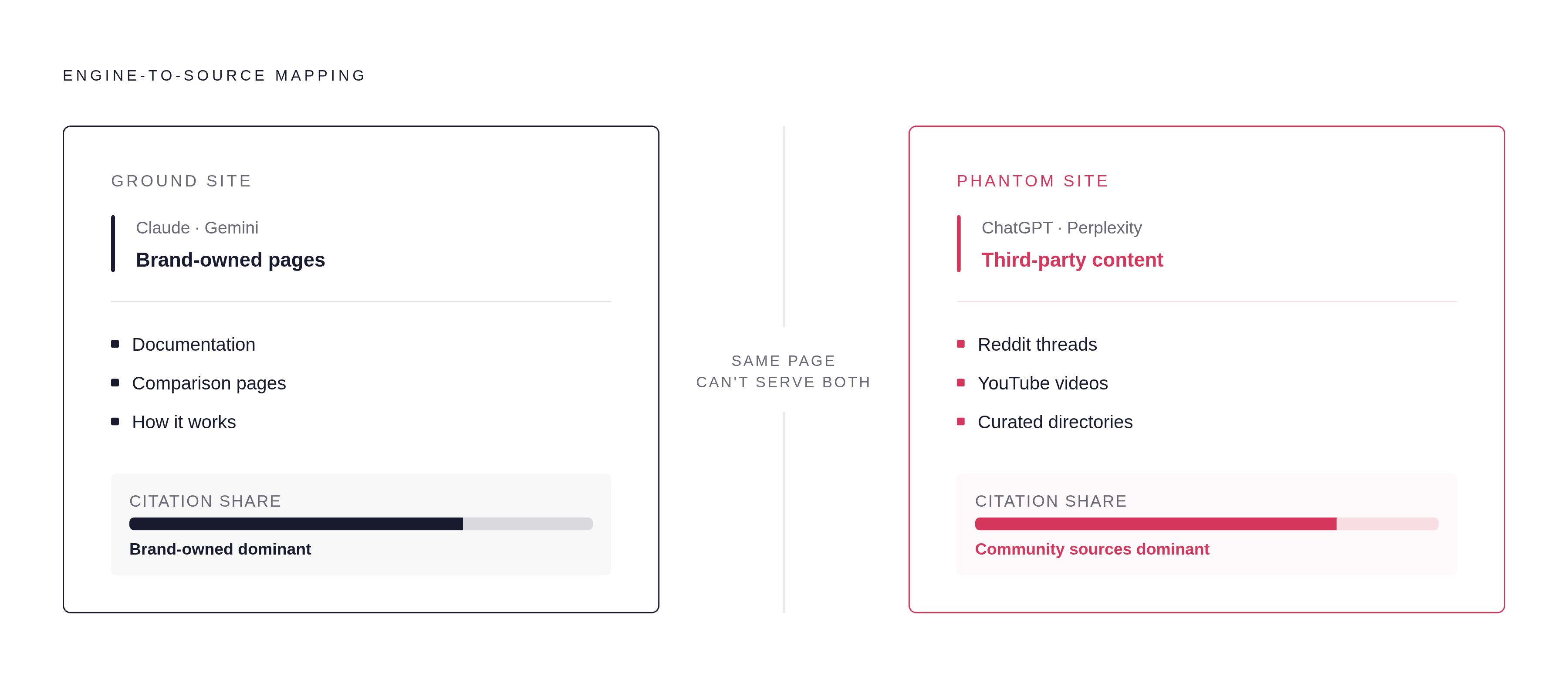
The content strategy follows the engines’ sourcing differences. For teams that act on that evidence, the brand’s canonical domain, or ground site, should be a reference-grade site. Documentation-quality product, comparison, and “how it works” pages target Claude and Gemini, where brand-owned sites dominate citation share. The page needs to work as a source. This gives the work a different purpose from improving a page’s search position alone.
Phantom-site work uses a different set of sources. Content seeded in third-party settings such as Reddit threads, YouTube videos with spoken answers, and curated directories targets ChatGPT and Perplexity, where community and video sources dominate. This is a split-site strategy tied to where particular engines draw their answers, which makes engine-level measurement essential to judging the work.
Aggarwal et al.’s GEO research found that a source’s position-adjusted word count share in AI answers rose both when it added quotations from credible sources and when it added statistics. Quotations and statistics can improve source visibility in the measured setting. It does not establish that quotation marks alone explain how a model judges credibility, or that the same changes will have identical effects across engines.
Production speed creates a further control problem. A multi-stage AI content pipeline can reduce ideation and drafting time while retaining mandatory human review at the final stage, shifting the bottleneck toward quality control. The recommended setup uses parameterized prompt templates in version control, automated review checks, and human sign-off that is required for high-risk content. Review tooling locked inside a walled garden creates another kind of sprawl. To connect production back to prioritization, the evidence also needs to show which pipeline-produced pages are being cited.
The enterprise AEO/GEO monitoring layer and what it adds over standard platforms
Purpose-built AEO/GEO monitoring platforms do more than the standard search toolkit by bringing AI-answer measurement together with content auditing, optimization, and delivery to AI agents. The distinction is the combined workflow, not a claim that standard platforms have no citation tracking. Monitoring establishes where a brand appears. Auditing and optimization address whether its content is readable and useful to AI systems, while delivery adds another capability beyond observation.
Scrunch positions itself as a complete enterprise AEO/GEO platform for 2026, pairing multi-LLM monitoring and analytics with auditing, optimization, and AI content delivery. Its Enterprise tier meets requirements including SOC 2 Type II, SSO, RBAC, and audit logs. It became part of Sitecore following an acquisition in June 2026. These tools help with AI visibility and enterprise controls. They do not make the platform a native home for the product usage and billing evidence needed to connect visibility with conversion.
A specialized platform can therefore fill an important measurement gap without completing the decision system. It adds evidence about AI discovery, but that evidence still needs a relationship to customer outcomes. Adding a fourth tool changes the integration challenge, leaving the buyer to establish whether the resulting system can explain which pages attract valuable customers as well as which pages receive citations.
The five questions a technical buyer should ask before trusting a page-priority recommendation
For a technical buyer, the practical evaluation is a set of diagnostic questions. The vendor’s answers should expose the evidence behind the recommendation, the boundaries around that evidence, and the controls between a suggestion and a published change. A trial can make these distinctions concrete. The test is not whether a platform presents a confident next-page choice, but whether that choice can be inspected and judged against its predicted outcome.
“Can Search Console clicks, product usage events, and paying-customer signals appear in the same project context, or must someone export and reconcile them manually?” This question establishes whether the product offers a joined decision surface or a reporting layer that requires outside work. The follow-up is equally important. “What is each source’s refresh cadence, and can these sources go stale independently?” A shared screen is not enough if the evidence represents different points in time.
“Can the platform show citations by engine for a sample brand, rather than only a pooled AI visibility score?” The answer should reveal where the brand appears and where it is absent. It should also explain how measurement accounts for differences in answer length. Raw totals are not directly comparable across engines.
“Is every capability reachable through an API, and which subscription tier provides that access?” UI-only access prevents a team from wiring that capability into its growth stack or querying it through an agent. Access terms belong in the evaluation. Ahrefs, for example, requires an Enterprise subscription billed annually for full programmatic API access. For a team building its own joins, that tier requirement is part of assessing the integration.
“Can an AI-generated recommendation be inspected and reversed before it ships, and what triggers the human review gate?” The vendor should be able to show the gate. A pipeline that bypasses review creates shadow content risk, where unreviewed AI output leaks into production.
“How does the platform measure whether its page-priority recommendations produced the outcomes they predicted?” A useful answer names specific metrics and shows how they are tracked, including content velocity, AI citation rate of pipeline-produced content, and organic traffic from pipeline content versus manually produced content. Those measures also need the customer context established in the first question if the predicted outcome concerns conversion and retention. The final buying test is whether the system can distinguish a recommendation that sounded plausible from one whose measured outcome supports making it again.