A wrong fact in an AI answer is a bug with a stack trace: how to trace it to its source, fix it, and regression-test it with a scripted probe suite
A step-by-step method for tracing, fixing, and retesting wrong AI brand facts.
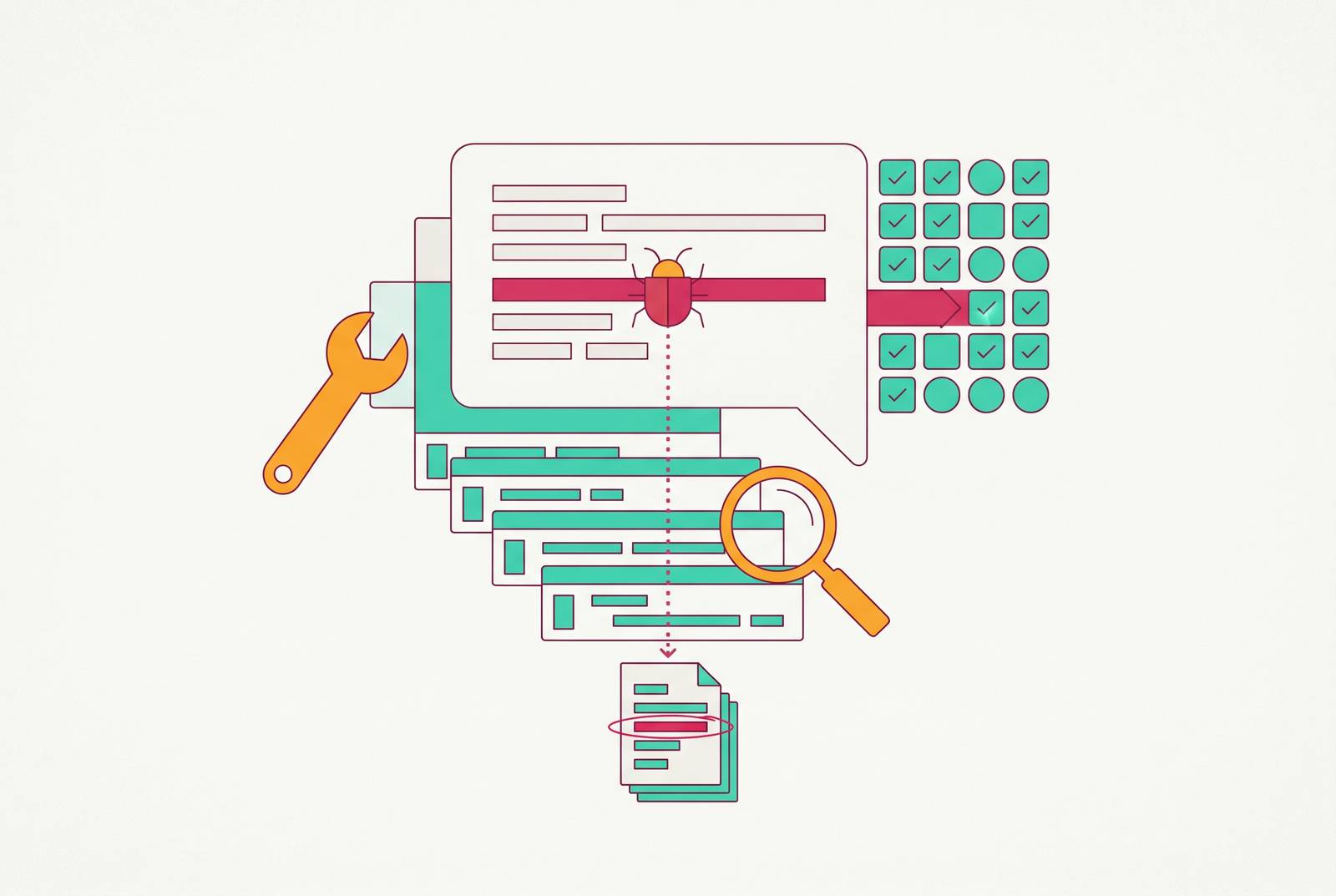
A wrong brand fact in an AI answer is a defect to diagnose. The repair starts with reproducing the claim, tracing it to a bad source or a gap in available evidence, and patching that source layer. An automated probe suite then tests whether the correction reached the answer and whether it holds after sources or models change.
Why a wrong AI brand fact behaves like a software defect, not a PR incident
AI models use training data and retrieved sources to generate answers, making a false claim an output with an underlying cause. In a noisy evidence layer, twelve outdated comparison articles can make a wrong price more prominent than the correct price on the brand’s own site.
Two failure modes call for different repairs. Retrieval error occurs when an answer repeats a wrong, stale, or low-quality source. Parametric fabrication occurs when the model lacks a high-confidence source and invents from thin internal memory. The first requires correcting or displacing bad evidence, while the second requires publishing evidence that is missing. Because the repair lives in the source layer, the defect can be traced, patched, and regression-tested like a code bug.
Detection: reproducing the bad output before attempting any fix
A screenshot captures an incident. Run each prompt two or three times in separate sessions before logging the claim as confirmed, and keep evidence that it recurs across days. The exact wording belongs in the record. Without it, a later correct answer might come from a different question even though the repair has not worked.
Build the prompt suite around the kinds of claims buyers encounter. Identity prompts ask who founded the brand or where it is headquartered, while product prompts ask what it does and how it prices its enterprise plan. Comparison prompts such as “[Brand] vs [Competitor]” expose blended details across companies. Reputation prompts ask whether the brand is legitimate or has had a security incident. Citation prompts then ask for a source supporting a specific claim.
Run the suite across ChatGPT, Gemini, Claude, Perplexity, and Google AI Overviews. An answer can be right on one surface and wrong on another. For each result, record the exact prompt, engine or surface, false statement verbatim, date, model version, cited source or absence of one, correct fact, and severity. Score factual accuracy as true, false, or unverifiable, assess whether the citation is real and authoritative, and record negative framing relative to named competitors. Automated monitoring uses this baseline to catch answers that change after a model update or recrawl, even after the first investigation ends.
Triage: sorting confirmed wrong claims before touching a single source
Which confirmed defect deserves attention first? Sort wrong-but-neutral facts, entity confusion, and defamatory claims or claims that could endanger health, finances, or safety into separate buckets. Wrong pricing, features, founding dates, and headquarters details usually need source correction at the usual level of urgency. Entity confusion needs a faster response because the answer mixes the brand with a competitor or namesake, which goes beyond getting facts about the brand wrong. False legal, criminal, or safety claims require immediate escalation to legal counsel and the platform’s personal-data route in parallel with source work.
Within those buckets, prioritize revenue impact multiplied by harm. A wrong price on a high-traffic buying query outranks a wrong founding year that nobody searches for, while a defamatory claim outranks either regardless of traffic. A prospect comparing products is already making a decision. When the answer borrows a competitor’s facts, however, treat it as an entity-resolution problem before spending effort correcting individual statements.
The stack trace: identifying which source is feeding the wrong answer
Start with the citation attached to the false claim. On Perplexity, ChatGPT with browsing, and Google AI Overviews, click through to the cited page and compare its wording with the answer. Does the page state the wrong fact, imply it, or say nothing relevant? That distinction separates a bad source from a citation that does not support the claim.
For a pricing investigation, the trace starts with “How does [Brand] price its enterprise plan?” The next entries are the answer’s false pricing statement, the exact cited URL, and the pricing language on that page. If the URL points to an old comparison article that repeats the false figure, that article becomes the repair target. If it points to the brand’s own stale pricing page, the fault is upstream on the owned site. Preserve both texts rather than reducing the finding to “pricing is wrong.”
When no citation appears, ask the assistant to “show me the sources for this claim.” Follow any URLs that relate to the claim and read what they say. Also search the exact wrong claim in quotes with the brand name, then look for older versions of pricing, product names, company descriptions, and leadership details. Likely sources include stale profiles, incorrect Wikidata entries, and forum threads where repetition amplifies bad information.
An absent citation needs its own diagnosis. If no relevant source emerges, treat the case as parametric fabrication. There may be no retrievable source behind the claim. Run the trace for each engine on its own, since the same error can come from different sources. Count high-authority pages stating the false version against those stating the correct version, because a dominant false signal can make the error recur.
Patching the source layer: fixes ordered by retrieval priority
For a retrieval error, start with the third-party sources that the engine cites. Contact the publisher with the correct fact and a verification link, making the requested correction clear. A source already feeding the answer offers a more direct lever than an unrelated new page.
Next, fix the canonical page that the brand owns, keeping it at the same URL. Add an updated date and put the correct fact early, where retrieval does not depend on finding a footnote. Then update Schema.org Organization JSON-LD with accurate name, foundingDate, founder, numberOfEmployees, and sameAs links to Wikipedia, Wikidata, and LinkedIn. The structured record gives assistants facts about the entity in a machine-readable form. Its role is especially important when the defect involves confusion between companies.
After that, address the Wikidata entity and Knowledge Graph footprint. Wikidata permits brand-owner edits with proper sourcing and mandatory conflict-of-interest disclosure, but connected-party edits face heightened scrutiny, and substantive changes are best proposed on the talk page. Link the entity to authoritative sources through sameAs references. For misinformation in Reddit threads that cannot be edited retroactively, publish recent, well-cited counter-evidence that addresses the claim directly.
Permit GPTBot, ClaudeBot, PerplexityBot, and Google-Extended in robots.txt, while distinguishing training access from live retrieval. Blocking GPTBot, ClaudeBot, or Google-Extended affects training access, whereas live retrieval uses separate agents including OAI-SearchBot and Claude-SearchBot. PerplexityBot controls live Perplexity retrieval. Blocking all four can therefore keep the brand out of live answers while still falling short of a complete training opt-out.
Reports to the platforms come after these upstream repairs. OpenAI’s help article says reports may receive Model Quality team review and lead to filters or other mitigations, while the answer a customer already read remains unchanged. Gemini’s correction tool works on one response at a time, while its Knowledge Panel path does more to fix the underlying entity. No general fact-correction portal exists at OpenAI, Google, or Anthropic. For persistent defamatory claims or claims that endanger health, finances, or safety, escalate through customer success or legal channels, with the GDPR right to rectification a parallel legal lever alongside source correction.
Publishing authoritative source material when no good source exists
A data void requires a different kind of patch. There is no bad document to amend. Publish a canonical brand-facts page and structured data so the model has something dependable to extract on a later retrieval pass or training cycle.
Make each major section begin with a direct answer that can be quoted without synthesis across the page. Write headings as questions and use schema for frequently asked questions to match what buyers and journalists ask. Put the brand name, product names, pricing tier, and founding facts in clear terms near the top. When references are unclear, the retrieval system has more work to do. Clear named entities give it a more exact unit to extract.
The brand’s own domain is necessary but insufficient. Third-party citation surfaces also supply evidence, so publishing must extend beyond an accurate owned page. Keep the canonical facts visibly dated and regularly refreshed, since retrieval-grounded engines such as Perplexity use freshness as a signal. Volume without accuracy, however, only creates another source of noise for the system to resolve.
Propagation lag and why the fix takes longer than the break
A patched source does not immediately produce a patched answer. Retrieval-grounded responses depend on when the crawl and cache happen, while facts baked into training may stay until a model refresh takes in the new signal. That second delay can last months. Neither mechanism is under the brand’s complete control, so the interval between publication and repair is a property of the system.
What if the false claim remains after two to four weeks? Re-run the stack trace to distinguish slow propagation from a deeper source that the first investigation missed. Old third-party pages may still be feeding the answer even when the owned site is current. A bad source can introduce a false fact within the same week, while correction takes materially longer. Stakeholders need to know about that difference so they do not mistake a slow result for a fix that failed.
Verification begins with the detection suite already in hand. The suite needs a fixed run cadence, comparison against the logged baseline, and a pass/fail threshold for each claim. Annotate every probe with the claim it tests, the expected correct answer, and the false variant it should catch. Keep the test specific enough to judge. A pricing probe, for example, should test whether the engine states the correct current pricing tier.
Store parameterized prompt templates in version control so changes to probe generation are visible and comparable. Each run should log the engine, model version, date, verbatim output, and pass/fail result. Run ChatGPT, Gemini, Claude, and Perplexity separately rather than treating one passing result as universal repair. A previously passing probe that fails after a model release is a regression. Quarterly runs also expose citation drift, when a source that supported the correct answer is displaced by a newer, wrong one.
Running the full cycle as a standing operational practice
One remediation cycle fixes the defect currently in view. A standing practice begins each new case with reproduction and triage, traces the source or data void, applies repairs in retrieval-priority order, and verifies the result after propagation. Continue regression runs quarterly and after every major model release. Product or pricing updates, leadership changes, and a customer mentioning a false claim should trigger out-of-cadence runs. Those events can change either the expected answer or the evidence feeding it.
The publishing operation belongs inside this cycle. Keeping owned and third-party facts current makes the correct signal more consistently available across the citation surface. AI-assisted drafting paired with human review can support that cadence without treating speed and accuracy as opposing goals. The review remains essential to source quality.
Probes that run on a schedule can send results to a tracker through an API, with a person checking flagged regressions before a source fix is committed. Citation accuracy across engines then becomes a measured signal. The operational unit is an instrumented cycle with evidence for the defect, a reasoned repair, and a test that stays in service after the incident ends.