A GEO audit that only counts final mentions can't tell you what to fix: how a technical B2B team should log each stage an AI assistant takes (recalled, searched, retrieved, read, shortlisted, picked) as data an agent can query
Stage-level logging shows where an AI answer drops your brand.
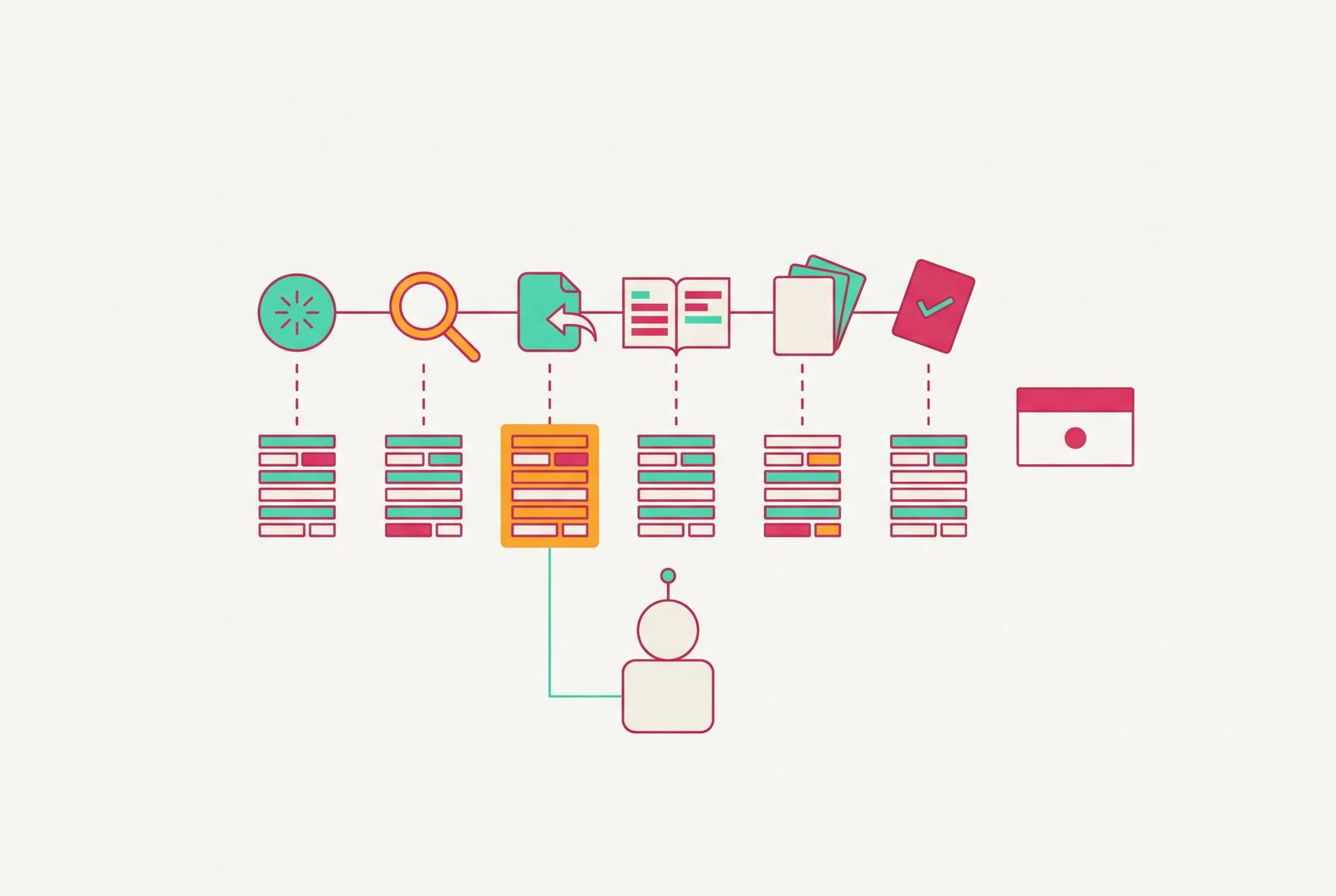
A GEO audit should explain where an AI answer engine lost a brand. For a technical B2B team, that means logging the answer path as queryable stages, from recall through retrieval to final selection. A mention count records the outcome. A stage-level trace gives the team evidence for deciding what to fix.
Why a final mention count is a verdict, not a diagnosis
A CMO sees a mention rate and asks whether visibility is improving. A growth engineer needs a different answer. Where did the brand drop out, and which change could bring it back? Standard GEO reporting often compresses that question into citability, meaning whether a brand was quoted, accurately summarized, or recommended in a generated answer. That describes the result, but it does not expose the process that produced it.
Even the result needs to be separated into distinct observations. A mention is not a citation, and neither guarantees accuracy. A brand can be recommended without an owned page being cited, or cited on a secondary theme while missing from queries that drive buying decisions. When it is absent, the cause could be missing recall, a search that never ran, a domain that was not retrieved, an inaccessible page, or a passage dropped before generation. Those failures call for different work, yet a counts-only audit puts them in the same bucket.
The six stages an AI answer engine actually runs before emitting a name
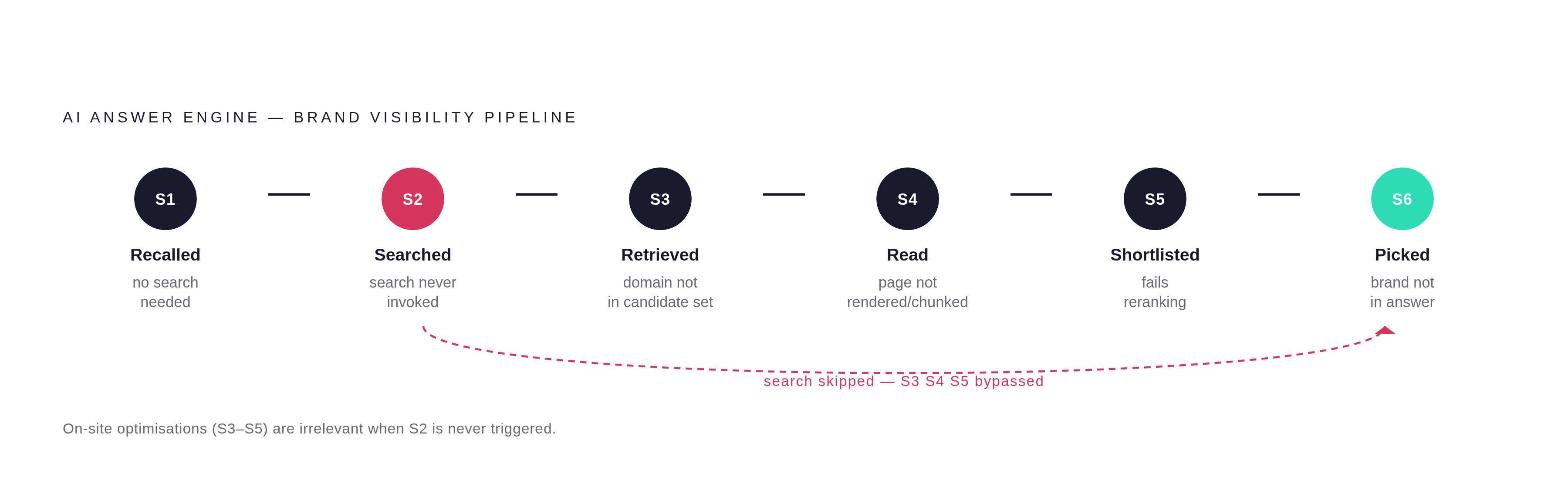
Stage 1 is recalled. Does the base model name the entity from parametric knowledge without using a retrieval tool? A brand can appear in an answer with no search and no attribution link because it was recalled from training weights. That is a distinct route to visibility. However, a single answer that omits a brand does not prove that the model has no knowledge of it.
Stage 2 is searched. Did the engine invoke a web-search tool for this query? This is the gate into the retrieval path. If search is not invoked, stages 3–5 are bypassed in this model of the answer path, and recalled knowledge is the remaining route to a mention. The distinction prevents a team from treating every missing name as an indexing problem.
Stage 3 is retrieved. Did the brand’s domain enter the candidate set returned by the retriever? Here, precision@K measures the fraction of the top-K results that are relevant, while recall@K measures the fraction of all relevant documents that reached the top K. These measures describe retrieval quality rather than final visibility. They are useful where the candidate set and relevance judgments are available.
Stage 4 is read. Was the page actually rendered, extracted, and chunked? Retrieval alone does not show that usable text reached the next stage. A robots.txt restriction or JavaScript-dependent page can interrupt that handoff, even when the underlying content would answer the question. The audit therefore needs to distinguish finding a page from processing it.
Stage 5 is shortlisted. Did the relevant passage make it through reranking into the final context window? Reranking reorders candidates, typically through a cross-encoder or model-based scorer, so a retrieved passage can still be discarded. Stage 6 is picked. Did the generated answer actually name the brand after the available context was considered?
These stages form an audit map. An external team can record only what the surface makes observable. Search results, processed text, and final context are different evidence, and an unavailable stage cannot honestly be marked as a failure. The distributed-trace analogy is useful precisely because it asks where evidence stops, rather than pretending the final answer reveals every upstream decision.
Why citation drift and platform divergence make stage-blind monitoring actively misleading
A changing mention rate is not, by itself, evidence that a content change worked or failed. Gupta/Deepak’s 180,000-answer study found that AI visibility can fall substantially within a few hours without a model update because the retrieval index moved. A team watching only final answers could take that change as a sign that something was wrong with the content. More checks would reveal the drop sooner, but would not explain it.
Platform differences compound the attribution problem. The same study found that ChatGPT and Perplexity cite the same domains only a small fraction of the time for identical queries in the same window. One platform’s healthy result therefore says little about another’s retrieval path. A shared prompt is not a shared experiment unless the engine is also recorded. Aggregating the results can hide a failure on one surface behind an improvement on another.
Suppose a brand’s mention rate goes down on ChatGPT and up on Claude in the same week. Did retrieval change, did a third-party discussion start to shape the answer, or did the model change? The counts cannot settle that question. Stage-level evidence can narrow the explanation, although it cannot reveal an internal event the platform does not expose. The fix is not simply more frequent mention checks, but a richer event structure for every check.
The logging schema that makes each pipeline stage queryable
The implementation starts with one trace per run and a span for each observable stage, using stable identifiers and typed fields. prompt_id makes repeated runs joinable, while engine, model_version, and timestamp identify the surface and time. These are the join keys for diagnosis. Without them, a comparison can mix different questions, how platforms behave, and periods of index drift into what looks like one trend.
The retrieval portion records search_invoked as a boolean and domains_in_search_results[] as the candidate set, with scores where retrievable. brand_domain_retrieved records the stage-3 outcome, while brand_domain_in_context records whether the brand survived into stage 5. A read-stage span needs the available evidence that the page was processed. Where the platform does not expose a result, the log must record it as unavailable.
The output fields are brand_mentioned_in_answer, mention_position, and brand_url_cited. Position can be first, second, lower, or absent, while sentiment can be positive, neutral, or mixed. Mention and citation remain separate. A source can influence an answer without receiving a clickable link, and a brand can be named through either third-party material or its own domain.
The value becomes clear when an agent queries the records. Runs where search_invoked = false and brand_mentioned_in_answer = false identify the no-search, no-mention pattern that calls for recall and entity-authority work. Runs where search_invoked = true and brand_domain_retrieved = false point instead toward indexing, freshness signals, or domain authority. The first pattern establishes that retrieval was not the route available in that run.
Further downstream, brand_domain_retrieved = true with brand_domain_in_context = false directs attention to chunk structure, information density, and schema markup, provided the reading evidence rules out an extraction failure. If brand_domain_in_context = true but brand_mentioned_in_answer = false, the question shifts to entity salience and contradictory signals in the context. A mention without brand_url_cited records a citation gap. That gap alone does not prove parametric recall, because non-owned sources may also support the mention.
Production logging should default to metadata, without raw PII in stored answers. raw_answer_text is reserved for accuracy audits flagged by a downstream check. Every field should be reachable through a queryable API. The schema is an interface contract through which an agent can connect an observed failure to the relevant layer of work.
What the ground site must do to pass stages 3 and 4
For teams acting on retrieval and reading failures, crawler access is the first check. The relevant robots.txt rules include those for GPTBot, PerplexityBot, ClaudeBot, and CCBot. Cloudflare changed its default bot-protection settings in 2025 to block AI bots, so access restrictions could be the cause even when the content itself has not changed. A blocked page cannot pass usable text along that path. Rewriting it before checking access would mean working on the wrong layer.
Disabling JavaScript in a browser and seeing whether key text disappears provides a direct proxy for what AI crawlers may encounter. It is not proof of every crawler’s behavior, but it exposes a dependency worth investigating. The relevant distinction is between a page that can be found and text that can be extracted. Stage-3 success does not settle stage 4.
Structured data belongs in this technical work alongside copy changes. Schema markup, clean chunk structure, and information density are the prescribed areas to examine when retrieved material fails to survive selection. The content also needs directly quotable, contradiction-free statements. A page can be indexed yet offer no clear passage that supports an answer on the requested aspect. In that case, adding more prose is not the same as making the evidence more extractable.
The logs give this work an order. Access failures lead to crawler and rendering checks, while successful retrieval followed by selection failure leads to page structure and usable facts. An inaccurate description calls for a representation review. These are different repairs.
What the off-site layer must do to fix stage-1 and stage-2 failures
When search is not invoked and the brand is absent, an on-site change cannot repair a retrieval step that never happened in that run. The relevant lever is the off-site entity record. Earned placements and structured external records can help the model recognize the brand beyond what its own pages say. They do not guarantee that an assistant will invoke search. The distinction is between improving the available basis for recall and controlling the engine’s decision to retrieve.
Wikidata deserves a specific check in that work. The recommended action is to examine whether the brand has an entry that identifies it as a coherent entity. An absent entry is a concrete gap to investigate, but it should not be treated as proof that every major model is unable to recognize the brand. The observed no-search failures remain the evidence for prioritizing this layer.
The wider off-site corpus has earned media, analyst coverage, forum discussions, and third-party reviews. Muck Rack’s analysis found that the overwhelming majority of cited links come from earned media and other non-owned, non-paid sources. Much of the evidence is therefore outside direct editorial control. For recall failures, the recommended investment is earned placements and entity records. When retrieval fails with search enabled, teams should check for gaps in coverage of the specific queries that failed.
By contrast, an llms.txt file is not a supported shortcut. SE Ranking’s scale data found no link between having the file and getting more citations. Unique, useful information and authority are the relevant considerations. That negative finding can save engineering time. Still, repair priorities can change from one month to the next, so teams need to keep measuring.
Running the monitoring pipeline: prompt corpus, cadence, and human review gates
An ongoing monitoring pipeline needs a prompt corpus that stays the same across runs and has broad category questions, specific use-case questions, and comparison questions. These query types reflect the different needs of buyers who are ready to buy. Incognito sessions help capture the cold response a stranger sees without it being tailored to that person. Keeping prompt_id values the same then links repeated runs without mixing up a change in the question with a change in visibility.
The results also need to remain segmented by engine. Visibility on one surface does not transfer to another, so two surfaces recorded seriously are more useful than four recorded once. The cadence must be frequent enough to tell short-lived drift apart from changes tied to the team’s work. Each run needs its timestamp. That records when a change was observed, even where it cannot establish the exact moment an internal index or model changed.
Automation can check crawler access and schema validity and detect mentions, while people review answers that get facts wrong. When a brand is cited but described wrongly, a prospect may get the wrong idea before reaching the site. That is not a successful outcome simply because the mention counter rose. The review gate connects the visibility trace to the quality of the representation, so the next action responds to the failure the evidence actually shows.