An AI Overview checker is a thermometer, not a diagnosis: how to turn an empty citation result into an engineering fix
A cited-or-not result is only the start of a diagnosis.

An AI Overview checker tells a team only whether a page was cited. The useful next step is a structured investigation of indexing eligibility, citation selection, and content absorption, followed by a targeted fix and re-measurement.
Why a cited-or-not result is an incomplete reading
A team runs a checker against a target prompt and gets silence. Its URL does not appear among the cited sources. What failed? The result alone cannot distinguish a page the engine could not reach from one it could reach but did not choose. It shows what came out of the pipeline without showing how the choices inside it were made.
That pipeline has two separable stages. Citation selection is whether a platform triggers search and chooses the page as a source. Citation absorption is whether the generated answer draws on the page’s language, evidence, or structure. A page can pass the first stage and contribute nothing to the second, so even a visible citation leaves an important question unanswered.
A checker measures selection. Its reading is also limited to that run, which makes an empty result a weak basis for a content rewrite. Before looking into why a page is missing, a team needs to check whether it is missing again and again. Otherwise, the team may try to fix something that is just a difference between answers.
Why the binary result is noisier than it looks
AI answer engines are non-deterministic, so citation share is a probability sampled over repeated runs. Same-day identical prompts overlap only 32–42% of the time on cited sources. A single empty result therefore establishes only that the page was not cited on this run.
The variation extends across engines as well. ChatGPT, Google AI Overviews, and Perplexity frequently return different brand sets for the same query, so one platform cannot stand in for the others. The team should start by measuring citation share, or how often a page appears across many runs of the same prompt. Sampling the engines buyers use creates a diagnostic baseline.
How to determine whether the problem is indexing eligibility before diagnosing content
Once that baseline shows a gap, the first diagnostic question is technical. Can the engine reach the relevant pages? Indexing eligibility is a prerequisite for citation selection, and rewriting content cannot repair a crawl or access problem. This is a gate to pass before pursuing new copy.
The gate concerns specific pages. An indexed homepage does not establish that the pages containing the strongest claims are indexed too. AI crawler permissions, indexed page coverage, and page freshness belong in this check. Checks of schema and entity clarity then show whether structured data names the brand, product category, and factual claims correctly in a machine-readable form.
Foglift separates these page-scoped checks in its AI Readiness audit from actual visibility in answers, measured through monitored AI Visibility. For developer-audience brands, llms.txt is a low-cost hygiene step, but it has no established measurable citation lift from any major engine. If access fails, the next action is to repair it and re-measure before diagnosing content.
How to determine whether the problem is citation selection or citation absorption
After the technical gate, the investigation branches. Is the page absent from the source set, or does it appear without influencing the answer? The first condition is a selection gap. The second is an absorption gap, and treating both as a general need for “better content” conflates selection with absorption.
To diagnose selection, the team runs the target prompt separately across ChatGPT, Perplexity, Gemini, and Google AI Overviews. A gap on one engine with presence on another narrows the problem. The investigation can then compare what those engines select for the same question.
An engine may name a brand without citing its website, or cite a page without naming the brand in the answer. A mention without a citation points toward entity recognition but a possible content-access gap.
If a query keeps drawing third-party editorial sources rather than owned domains, the brand’s pages may be left out of the selection pool for that type of query. That pattern directs attention beyond the page itself. It also prevents a team from assuming that every missing owned URL reflects weak writing.
Once the URL appears, the team needs to check for absorption. Does the answer use the page’s phrasing, evidence, or structure? If none of those elements appears, the page has been selected without an observable contribution to the answer. That is a diagnosable condition rather than an unexplained disappointment, even though a binary checker would report success.
The team then investigates what makes the selected material hard to use. Structural opacity and promotional tone are distinct from a lack of useful, factual substance. Clear, useful, factually specific pages provide material that can shape an answer before GEO elements are added. Answer capsules and FAQ sections cannot make thin or evasive content substantive, so an absorption fix must address the underlying gap.
Where citations actually come from, and what that means for root-cause analysis
Third-party editorial sources account for the large majority of citations described in this diagnostic model. An empty result can therefore originate outside the owned domain. The team needs to check both whether the site contains a good answer and whether the brand appears in the sources an engine retrieves for its category. That requires an audit of both owned content and earned media.
The owned site still comes first in the sequence. It is the canonical place for resolving a brand, product definition, or factual claim, so machine readability, schema, and freshness support that role. A disorganized site limits what earned-media citations can convert. Working off-site before that foundation is sound can bring in more citations while leaving the site's weakness in place.
The earned-media audit then checks the publications that already appear in citations for the category. Competitor-citation data maps those sources at the domain and page level. If the gap is absence from those publications, another on-site rewrite addresses the wrong layer. The intervention implied by that diagnosis is earned-media placement in the relevant publications, after the owned domain is clean and schema-annotated.
How to run the full diagnostic sequence as a repeatable engineering loop
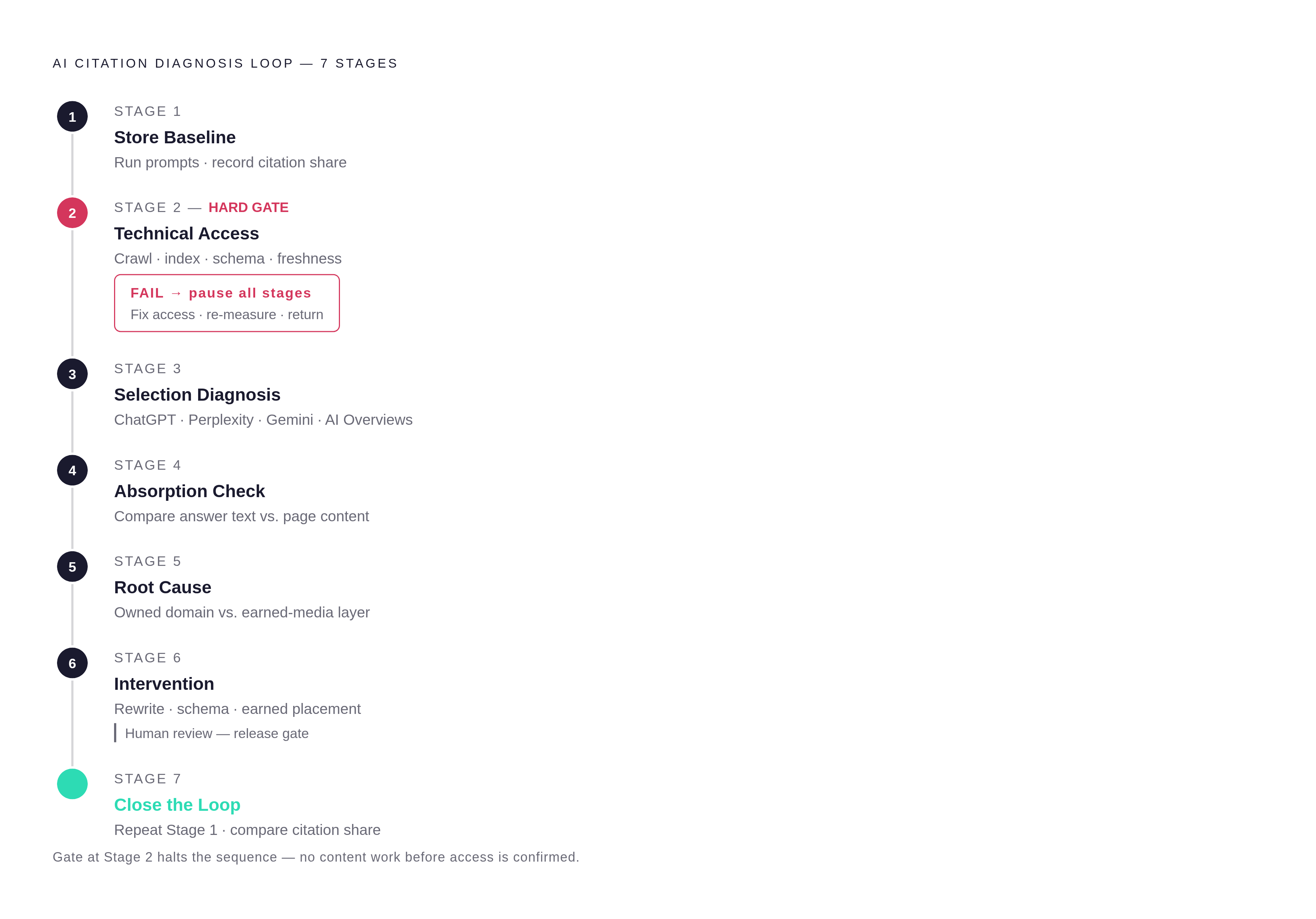
The procedure starts with a stored baseline in Stage 1. The team runs the target prompts again and again across the relevant engines and records citation share, so its result rests on more than one answer. Without it, an apparent improvement could be another instance of the variation that made the first reading unreliable.
Stage 2 is the technical access gate. The team audits crawler permissions, indexed page coverage, schema accuracy, and page freshness before changing content. A failure here pauses the later stages. The team fixes the access issue and measures again, because the fix may change the citation pattern that led the team to look into it.
Stage 3 diagnoses selection across platforms, separating complete absence from mentions without cited URLs. Stage 4 then examines absorption for pages that are selected, comparing generated answers with page content and looking for structural opacity or promotional tone. These stages produce different evidence.
Stage 5 locates the root cause in the owned domain or earned-media layer. Stage 6 turns that finding into a specific intervention, such as a structural rewrite, schema addition, or earned-media placement. Human review is a release gate here. The change should be inspectable and reversible before publication, so the team can connect a deliberate intervention to the diagnosis.
Stage 7 closes the loop after the changed material has had time to be retrieved. The team repeats Stage 1 with the same prompts and compares the citation-share figures. The diagnostic is not finished before that comparison. Stored baseline figures, crawler access reports, and absorption comparisons make the work auditable and allow another team member to pick it up without reconstructing the reasoning.
What tooling each stage of the sequence requires
A technical audit cannot establish citation share, and a single-platform checker cannot establish cross-platform presence. The stack therefore needs separate instruments for access, monitoring, and answer comparison. A product that combines functions is useful only if its readings remain distinct.
For Stage 2, Foglift’s free audit checks schema, headings, FAQ structure, entity clarity, and crawler access without requiring signup. The AI Content Visibility Checker Chrome extension, powered by Adobe Brand Visibility and formerly powered by Adobe LLM Optimizer, complements that audit. It scores “citation readability” and highlights content visible to people but hidden from AI agents. It is not a substitute for the full gate.
For monitoring, Foglift’s workspace tracks mentions, citations, sentiment, competitor mentions, and share of voice per prompt. Its free tier covers Perplexity weekly. Launch and higher plans add ChatGPT, Perplexity, Claude, Gemini, and Google AI Overview with daily frequency. The plan a team uses therefore sets which engines it can test and how often it can test them for its baseline.
The self-hosted danishashko/geo-aeo-tracker provides another route for technical teams. It uses an MIT license and scores brand visibility from 0–100 using mentions, position, frequency, citations, and sentiment across ChatGPT, Perplexity, Gemini, and Google AI Mode. It also provides citation analysis, competitor battlecards, and SRO analysis. Data stays in the browser by default, and the software is free with pay-per-API-call costs.
Other products serve different diagnostic needs. MaxAEO combines monitoring with optimization recommendations for teams that want a suggested fix with the signal. SE Ranking connects monitoring across AI Overviews, AI Mode, ChatGPT, Gemini, and Copilot to traditional rank tracking and GA4. That link helps a team look into how AI presence relates to organic performance and traffic it can measure.
AthenaHQ Starter offers broad model coverage with a monthly credit allowance. Its coverage includes ChatGPT, Perplexity, AI Overviews, AI Mode, Gemini, Claude, Copilot, Grok, DeepSeek, Meta AI, and Mistral. Breadth is useful when the diagnostic spans many engines. Regardless of the monitoring product, Stage 4 still requires comparison of generated answer text with the selected page.
GA4 brings data from real users into Stage 7. AI referral filtering can include chatgpt.com, chat.openai.com, perplexity.ai, gemini.google.com, and bard.google.com. Those referrals supplement re-measurement but cannot replace it, because citation and traffic are different outcomes.
How the diagnostic sequence changes what an empty result means in practice
The same empty result can lead to very different work. A blocked crawler calls for an access repair, while absence from the publications an engine cites points to an earned-media gap. A selected page that contributes nothing requires an absorption diagnosis despite its positive checker result.
The payoff is a specific, attributable gap with an inspectable, reversible action attached. Re-running citation share on the same prompts then creates a before-and-after comparison. The thermometer remains useful because it becomes part of a diagnostic system. What begins as silence no longer ends in a vague content mandate, but in a specific engineering fix whose effect can be measured.