"AI SEO" is two jobs under one name: how a buyer should scope and verify each before signing
Scope AI-run SEO and AI-answer citations as separate contracts.

“AI SEO” names two different jobs, namely using AI to run conventional SEO and earning citations inside AI-generated answers. Buying them as one service creates a gap between what a contract promises and what a buyer expects. The way to close that gap is to scope each job separately, with its own deliverables, instruments, and evidence of success.
Why "AI SEO" is a broken label that creates commercial risk
A buyer researching “AI SEO” can encounter the ambiguity in a Google AI Overview before even reaching a vendor’s site. If the definition describes using AI to improve search performance, what is being improved? It could mean producing pages that rank in conventional results. It could also mean getting a brand into an AI-generated answer.
The commercial risk follows from that ambiguity. A vendor can deliver AI-assisted content production while the buyer expects citations in ChatGPT, and both can believe the contract supports their reading. The disagreement is about which work was purchased. A contract naming only “AI SEO” leaves that question unresolved.
The distinction has a formal research lineage. Aggarwal et al.’s peer-reviewed KDD 2024 paper introduced “Generative Engine Optimization,” giving the second job a name beyond a vendor’s service label. Employers also signal that the scopes deserve separate attention. eBay’s Director of Product, AEO & SEO and J. Jill’s Senior Manager of SEO & Generative Engine Optimization name both disciplines rather than treating one as an invisible part of the other. Those titles show the distinction reaching organizational design.
What Job 1 actually is: using AI to run conventional SEO faster
Job 1 changes how conventional SEO work gets done. AI finds and clusters keywords, helps create briefs from live search results, and drafts pages intended to rank. The workflow can then add internal links and schema, publish to a CMS on a schedule, flag technical issues, and report rankings and clicks. It is an efficiency play. The goal is still a page that draws attention through conventional search.
A testable pipeline separates drafting from permission to publish. Its sequence is AI draft, human review, and human polish, with automated checks for factual consistency and tone followed by mandatory human sign-off before the publish queue. Review depth follows the risk of the content. A product description may need one reviewer, while legal, medical, or financial content needs two people to approve it independently, plus sign-off from a domain expert. The review gate is part of the service.
Why keep people so involved in an automated workflow? AI cannot take the place of first-hand experience, original data, source verification, or editorial judgment. Without those inputs, fluent drafts can become what practitioners call “AI slop,” thin mass-produced pages that harm. Google’s documentation says it rewards helpful, people-first content however it is produced, while its spam policies target thin, manipulative pages. Job 1 therefore has clear outputs to test, including rankings, clicks, and conversions.
What Job 2 actually is: earning citations inside AI-generated answers
Job 2 seeks a different kind of discoverability. A brand must be retrieved, ranked for relevance and authority, and selected for use in a synthesized answer. Retrieval alone is not enough to secure a citation. An engine can find a page and still discard its passages before writing the response. Strategies addressing only discovery and authority leave part of this job unfinished.
The mechanism explains the difference in scope. AI answer engines understand and expand a query, find material through keyword-plus-vector search, and rerank passages before using them to ground an answer within a limited context budget. Citation binding then connects the answer to sources in that working set. A source has to reach that set before generation to be cited at all. Conventional rank can help, but a page ranked fifth can supply a cleaner answer than the top result and win the citation instead.
That makes the passage a distinct unit of work. A self-contained, quotable statement near the start of a section is easier to extract than a claim spread across sprawling prose. Original data, named sources, and verifiable claims improve the prospect of citation. Yet a footnote is not the same as contributing to the answer. A brand can be cited without its content shaping the response, while another can be named without receiving a source link.
The engines also make different selections from available material. They weight freshness and sources such as Reddit, Wikipedia, and YouTube differently, so a tactic that improves visibility on one may do nothing on another. Job 2 therefore cannot be defined as a single effort to “rank in AI.” Its scope has to distinguish where a brand appears and what role it plays in the answer.
Why the two jobs share inputs but diverge on outputs and measurement
A careful buyer might ask whether this is just SEO with another name. Both jobs depend on crawlability, indexability, semantic depth, topical authority, parseable content, and genuine expertise. Google Search Central states that a page must be indexed and eligible to appear with a snippet, and that a site must be included in Search generative AI features in Search Console, to be eligible for those features. Conventional SEO can therefore serve as an upstream filter for Job 2.
Shared inputs do not make the outputs interchangeable. Job 1 brings rankings and clicks, while Job 2 brings mentions, citations, and a place inside answers that may lead to no direct visit. Job 2 also adds entity clarity, extractable passage structure, and third-party co-citation, meaning appearances across sources outside the brand’s own domain. A backlink campaign does not meet those needs on its own. The work has to reach beyond making a page retrievable to making its claims usable in synthesis.
AI referral traffic is currently a small fraction of organic traffic, so direct clicks alone understate Job 2’s potential contribution to brand positioning and lead quality. The report needs evidence suited to the result being purchased to assess the value of mentions. A vendor reporting only rankings and traffic is making Job 1 visible and leaving Job 2 untested, which makes separate scorecards the clearest contractual distinction.
The owned-site and off-site layers that Job 2 requires but Job 1 ignores
On the owned site, Job 2 starts with making sure AI crawlers can get access. A ground-site audit examines robots.txt for blocks on ChatGPT-User, GPTBot, ClaudeBot, PerplexityBot, and GoogleOther. If Cloudflare is in use, the work also includes reviewing AI bot traffic settings in its dashboard. Access is not one all-or-nothing decision, however. Allowing OAI-SearchBot for real-time citation while blocking GPTBot for model training is a legitimate choice that a Job 2 scope should address deliberately.
That access covers only the material the brand controls. The off-site layer is where the brand appears on high-authority third-party platforms that AI systems use to decide which brands to recommend. People who do this work call it parasite SEO or co-citation seeding. In 2026, such a placement is not only a route to a conventional ranking, but also a possible seed in the corpus used for AI answers. A workflow limited to drafting and publishing pages on the buyer’s site leaves this layer outside its remit.
Original research gives that strategy something substantive to cite. The Optimist, a B2B tech firm, achieved a 2,622% increase in LLM-referred traffic through original first-party research used as citable sources. The mechanism was becoming the primary retrievable authority for specific claims. That example does not promise that traffic will grow for everyone.
Undisclosed seeding risks account bans and erodes source trust, so a credible scope specifies disclosure practices for placements. The choice of platforms should also reflect per-engine citation behavior rather than assume every engine consults and values the same sources. For the buyer, those choices are deliverables to examine. They are not details that a generic content-production promise can stand in for.
How to measure Job 2 so the contract can be tested against evidence
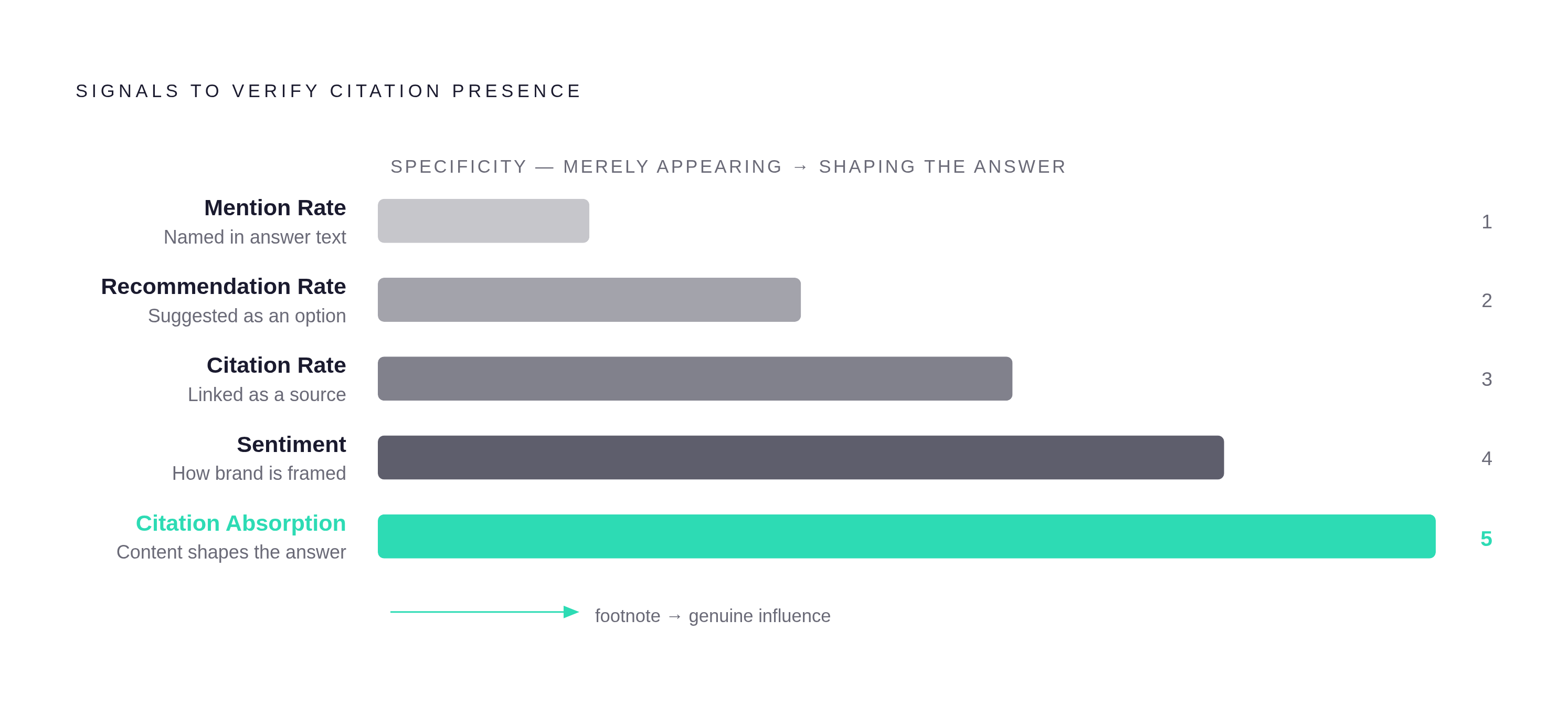
To make Job 2 verifiable, the buyer should agree on its measurement infrastructure before signing. The program needs to track five signals for each engine. Citation rate records whether the brand is linked as a source, while mention rate records whether it is named in the answer text. Recommendation rate captures whether it is suggested as an option. Citation absorption examines whether the brand’s content contributes to the answer rather than merely appearing in footnotes, and sentiment records how the brand is presented.
Claude and Gemini name brands without sourcing them at a higher rate than ChatGPT, so mention rate alone can make performance on those engines look stronger than citation rate would support. A source link and an endorsement are also different outcomes. The recommendation signal therefore remains separate.
The prompt library supplies the queries against which those outcomes are tested. It should span brand, category, and comparison query clusters and run separately across ChatGPT, Perplexity, Google AI Overviews, and Claude. A blended average hides differences the strategy needs to respond to. Tracking results longitudinally rather than taking a one-time snapshot lets the contract be judged against evidence over time. At proposal stage, the vendor should be able to specify how it will track SoM and citation absorption.
The contract checklist: how to scope and verify each job before signing
For Job 1, the buyer should ask the vendor to describe the pipeline from brief through publication and identify every human review gate. Where do automated checks end and the right to publish begin? The contract should set review depth by content risk and make the approval model explicit. It should also specify whether publishing follows a consistent cadence or arrives in batches and stalls. Rankings, clicks, and conversions need defined reporting and attribution, so production activity is not mistaken for success.
For Job 2, the buyer should ask for the owned-site and off-site scopes separately. The technical work should include AI bot access and per-bot choices, including the distinction between OAI-SearchBot and GPTBot. The off-site work should name the platforms to be used for co-citation seeding and state how placements will be disclosed. The prompt library should show which query clusters and engines are covered.
The measurement commitment should then make that scope testable. SoM, citation rate, mention rate, citation absorption, and sentiment should be tracked over time, with recommendation rate retained as a distinct signal. The vendor should explain how it handles per-engine divergence. Ask for two scorecards with distinct KPIs, one for each job, rather than a combined report that cannot show which promise was fulfilled.
Finally, the buyer should apply a reversibility test to the proposed workflow. Every AI-generated deliverable should be reviewable and reversible before it ships. A contract that lets the system publish everything without buyer sign-off on high-risk content fails that test, however fast the system can produce pages. Separating these jobs treats marketing as an engineering discipline, with each scope instrumented so that decisions can change when the evidence does.