SEO titles are a per-page test against the live results: how a technical team audits and rewrites titles across a repo with a script, not a character-count rule
A script can flag which page titles to rewrite and test the results.

An SEO title is a per-page test against live search results. A technical team can run that test across a repo with a dataset, a script, and a review gate. The goal is to find where a clearer title could earn more clicks, then measure whether the change did what the team expected.
Why the character-count rule is the wrong unit of analysis for title tags
A team shortens a title into the 50–60 character range, moves the keyword to the front, and marks the task done. The field passes its checks. Those checks address how the title fits in the results display.
Google’s documentation gives no hard limit on title length and says that search results truncate title links to fit the width of the device. The familiar character-count guidance is therefore a rendering heuristic. It can help catch an awkward display. It cannot establish that the title is competitive, because that judgment requires the query and the other results.
The distinction becomes costly when a team mistakes a ranking gap for a click-through rate gap. A page outside the useful click range may need deeper content or links. Conversely, a page already in a competitive position may lose clicks because its title fails to explain what it offers. Those are different bottlenecks with different remedies. The audit needs to separate them before anyone starts rewriting.
What it means to treat a title as a per-page hypothesis about a live SERP
A title predicts that a specific string will earn a click for a specific query. The search engine results page, or SERP, is its operating environment. That is where the prediction meets competing promises about what the searcher will find. Evaluating the string in isolation removes the very context needed to judge it.
The competitive benchmark is the live SERP for the page’s target query, including the nine other titles it has to outperform. What do those titles promise? Which question do they answer, and what uncertainty does the current title leave unresolved? Two pages whose titles have the same length and keyword placement can face very different tests. Wording that stands out in a niche can get lost among offers that look much the same on a more commoditized SERP.
That comparison also needs to account for what surrounds the organic results. AI Overviews, large paid blocks, and zero-click snippets shape the space in which those titles compete. The organic titles that get seen face greater reader selectivity. This makes a clear title more useful than one that fits another keyword into the space.
The working hypothesis should therefore concern the reader’s choice. For example, the team may expect a title that specifies what the page compares to reduce ambiguity relative to competing titles. That expectation is testable against performance after deployment. It also gives the rewrite process a direction without pretending that one wording pattern will win everywhere.
What the data export looks like before any analysis can run
To put that model into practice, the team first needs a flat dataset built programmatically across the site. Each row needs the page’s <title> text, H1 text, og:title content, canonical URL, and primary target query. The canonical URL supplies the join key. The target query supplies the competitive context, so the later audit can connect a page to the results where it is meant to compete.
The team should check any mismatch between the title element and og:title because social and AI surfaces often read og:title. Otherwise, the page can have a carefully worded search title but make a different promise when someone shares it. The H1 adds another view of how the page describes its subject.
Duplicate titles need their own check before performance prioritization. Any title shared across URLs should be flagged, because duplicates can signal thin or redundant content. This is a data-quality problem first. Treating each duplicate as an independent rewrite opportunity would leave the underlying relationship between those pages unexplored.
An API-first meta-audit pattern makes this export repeatable. Ollagraph illustrates the architecture through an endpoint that fetches a page, inspects its title, description, canonical, robots, and Open Graph fields, and returns a graded result. The useful property is structured output that can join to performance data. Google Search Console provides that second stream with position, impressions, and CTR for each URL, and the Search Console API offers date ranges that cover up to 16 months of history.
How to join the crawl output to Search Console data and flag rewrite candidates programmatically
The two exports become useful together when the script joins them on canonical URL. Each resulting row contains the title, H1, og:title, target query, average position, impressions for the rolling window, and CTR. A minimal pandas-style sketch is audit = crawl.merge(gsc, on="canonical_url", how="left"). That line establishes the shared record on which the checks operate. It does not yet decide whether a rewrite is worthwhile.
The first pass identifies formatting and duplication failures. A duplicate check can take the form audit["duplicate"] = audit["title"].duplicated(keep=False), which marks every occurrence. Length checks belong in this pass too. Over-length titles are rewritten by Google nearly every time, while titles in a mid-range character band are rewritten roughly two-fifths of the time. Because those observations do not supply a universal character threshold, the script should not disguise them as an exact cutoff.
Is the page visible enough for a better title to produce a useful click gain, and is its CTR below the benchmark for its position bracket? Positions 1–3, substantial impressions, and meaningfully weak CTR together define a very high priority tier. A small CTR improvement there can be more valuable than a larger gap on a poorly positioned page.
The score must therefore weight position and impressions along with the CTR gap when it ranks pages. In pseudocode, the logic is to find how far observed CTR falls below benchmark CTR, use impressions to estimate how many more clicks the page could get, and set its priority based on position. Position 2 should not receive the same treatment as position 15. Pages past the first page go in a separate ranking-problem bucket.
The output is a table sorted by estimated incremental click gain, with flags distinguishing formatting-failure, performance-failure, ranking-problem, and clean rows. The return remains uncertain. It helps the team review pages where gains look likely without having to read every title first.
What the controlled experiment on 423 pages shows about which title changes actually move CTR
US Tech Automations’ controlled experiment across approximately 423 pages provides empirical direction for those rewrites. In that corpus, titles that reduced searcher ambiguity outperformed titles combining a brand name with a generic freshness signal. Brand names on non-branded informational queries and bare terminal years correlated with lower CTR. The context is important here. These findings do not establish that brands or dates are always unhelpful.
For a non-branded query, the searcher is asking about a subject. A brand name can make the title seem less closely matched to that intent, while a year alone adds no specificity about the answer. By contrast, numerals, “vs” framing, and question-style titles moved in a positive direction in the experiment. Their common feature was a clearer account of what the page would deliver.
A title that says what a page answers, compares, or quantifies gives the reader more information for self-selection. The proposed mechanism is reduced uncertainty, with less pogo-sticking and a clearer signal to the ranker. That explanation should remain distinct from the reported CTR correlations. The experiment informs a hypothesis rather than proving that every step in that mechanism occurs for every page.
For variant generation, the lesson is to favor supported specificity, including selective use of “vs”. The prompt can ask for clearer answers, comparisons, or quantities where the page actually provides them. US Tech Automations’ testing tools guide also sets a validity floor of a minimum impression count per variant and at least two weeks before calling a winner. Without enough exposure and time, an apparent improvement is not a credible basis for changing the next prompt.
How to wire the variant generation, validation, and human review gate into a repeatable pipeline
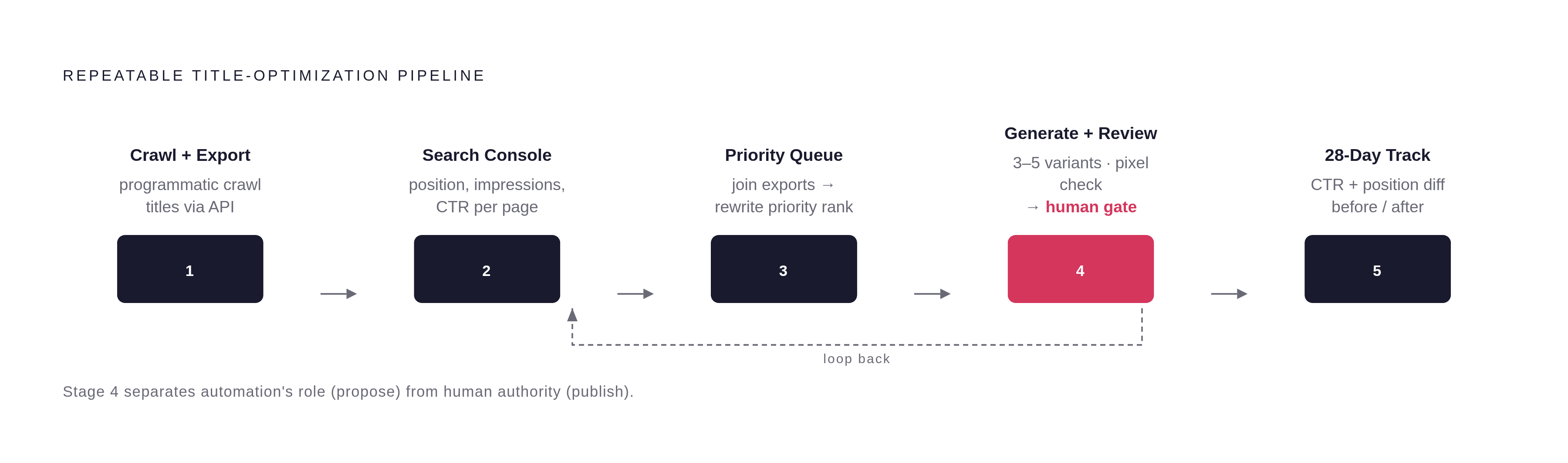
The repeatable pipeline begins with a programmatic crawl and title export through an API on every deploy. It then pulls Search Console position, impressions, and CTR, runs the join, and produces the prioritized queue. For each priority URL, it fetches live competitor titles for the target query.
The generation prompt receives the current title, those competitor titles, and the empirical direction to reduce ambiguity through specificity. It gives back three to five proposed variants for each page. Each variant then passes through pixel-width validation against the practical rendering constraint of approximately 600px, with likely truncation flagged.
These stages can run unattended in CI. A pull request touching a template can run the audit against a preview deploy, so a truncated title or duplicate tag fails the build with a specific message before merge. This makes the audit part of the change process. It replaces a periodic scramble with a check the team can inspect while the relevant code is still under review.
Content judgment needs a different control from a formatting failure. Readability, brand-voice consistency, and claims unsupported by the page body should route variants to human review rather than be treated only as automatic rejection thresholds. A fluent title can still overpromise. A named reviewer must approve or reject each variant before it writes to production, even when that review takes little time.
That gate is non-negotiable because it preserves the reviewer’s ability to say no. Automation can gather evidence, propose alternatives, and identify defects without acquiring authority to publish unchecked claims. Once approved variants go live, the pipeline tracks CTR and position in Search Console for a minimum 28-day window for each page. That operating window is longer than the experiment’s two-week validity floor, but it still needs sufficient impressions to support a judgment.
How to diff before-and-after results against real SERP data to close the feedback loop
After deploy, the team needs to compare both CTR and position with their earlier values and judge the changes against the real results where the page competes. A CTR rise at a stable position supports a title effect. A change in position can instead suggest that the page’s classification changed, while a change in both metrics makes the result harder to explain.
The next action follows from that distinction. Pages whose position improves while CTR stays flat may need another rewrite cycle. Pages where neither metric changes after a valid experiment window go back to the ranking-problem bucket. That routing decision does not require the team to keep rewriting merely because a rewrite was the first intervention.
The original scoring script can now run against the post-deploy export. Pages that leave the rewrite-candidate tier drop off the queue, and pages that drift into it appear. The queue stays tied to current evidence. It is no longer a static backlog whose priorities survive long after the conditions that created them.
The stored diff should retain the old title, new title, position before and after, CTR before and after, and variant source. Those records form a labeled dataset for improving later prompts. Patterns that worked in this site’s niche can become positive examples, giving local results a role in generation instead of relying indefinitely on a broader experiment.
The deployable artifact is therefore more than a rewritten field. It includes a script, a dataset, a CI check, a review queue, and the evidence from each completed test. Marketing becomes an engineering discipline at that point. The system is instrumented, measured, and changed on evidence.