An SEO content writer is only as good as the brief: why a technical B2B team should generate the brief from its own repo, changelog and search data instead of hiring a writer
Briefs built from your repo and changelog give writers and AI defensible facts.

For a technical B2B team, better content starts before an author receives an assignment. The brief needs to be a structured dataset drawn from the repo, changelog and search data. Those internal sources give the article facts, buyer questions and limits that the team can defend and AI answer engines can use.
Why the brief, not the writer, determines whether B2B technical content earns AI citations
Most content assignments begin with a topic, an angle, a word count and perhaps some competitor pages. That leaves the author to supply the substance. For a technical product, however, the substance includes details that public research cannot reliably recover, such as which behavior changed in a release and which caveat applies to a feature. Those answers live in the codebase, specs and release history.
What happens when the assignment leaves those answers open? A human author must ask for them or write around them, while an AI generation run may resolve the gaps by inference. The result can sound plausible without describing the product correctly. Even when the wording is free of errors, broad language gives an answer engine few specific facts to pull into an answer. The controlling variable is therefore the brief, because writing skill cannot compensate for facts the assignment never supplied.
This changes where the team’s effort belongs. Rather than outsourcing the assembly of product knowledge upstream, the team should generate the brief from its internal sources and search data. An author can still turn that material into a clear argument. But the author’s job begins with an account of what the product does.
What AI answer engines actually retrieve and why generic content is not retrieved
AI answer engines using Retrieval-Augmented Generation retrieve passages and synthesize responses across sources. Their task is not simply to return a ranked page. A passage must supply something the engine can extract and use in an answer, which makes factual specificity and clear structure more useful than repeated keywords. A long page can cover a topic broadly yet offer no clean answer to the buyer’s particular question.
Aggarwal et al.’s Princeton / Georgia Tech / IIT Delhi study at KDD 2024 found that adding quotations, statistics and cited sources improved AI visibility, while keyword stuffing reduced it. That distinction helps explain why traditional optimization is not enough. A keyword establishes that a page concerns a subject, but a supported statement gives the engine material for its response.
Access comes before either of those judgments. Gated content, script-heavy rendering and aggressive bot-blocking can prevent AI crawlers from reaching or parsing a page. Correct facts behind that barrier contribute nothing to the retrieved answer. Conversely, making a page accessible does not make its material worth citing. Retrieval needs both usable access and usable evidence, and a generic brief supplies no dependable foundation for the latter.
What the brief must contain that an external writer or agency cannot supply
Dated product facts are the first requirement. The changelog supplies feature releases and bug fixes that can be connected to a user’s problem, while the date establishes when the description became applicable. A brief built from last week’s release history can distinguish current behavior from an older limitation. A sales deck or someone’s memory cannot reliably make that distinction.
Search Console, keyword tools and recorded sales calls supply the questions and phrases around which the article should be built. What did the buyer actually ask? Keeping that wording in the brief prevents an author from substituting a broad category topic for a narrow question about comparison, setup or failure.
Correctness constraints set the limits on what the draft can claim. The codebase and specs supply terminology, banned claims and mandatory caveats that the engineering team can defend. These belong in explicit fields, including a DO-NOT-USE list, to reduce reliance on a reviewer’s memory. A caveat is a required part of the answer from the start of drafting.
Search intent is the job the page applies for, while answer intent is the job it does once retrieved. The brief therefore needs the buyer’s question and the related sub-queries an answer engine may pursue, so the article can address them cleanly.
Generating the brief from the repo and changelog: what that pipeline looks like
Release notes can be parsed into fields for feature name, resolved issue type and affected user segment. Each release item can then be matched to a pain-point category drawn from sales-call transcripts or support tickets. This supplies the connection between change and demand. The resulting brief takes its problem statement from the issue, its solution statement from the release note, and its constraints from the spec or test suite, with a pointer to the relevant public documentation.
Search data supplies a parallel input stream. Queries from Google Search Console, filtered to the product’s subdomain or docs site, can be clustered into informational, comparison and troubleshooting intent. Each cluster maps to a different brief template because each asks the article to do different work. Verbatim query strings then enter the FAQ field as questions the author or generation run must answer.
The codebase supplies the vocabulary and boundaries. The controlled vocabulary comes from terms in the public API surface, OpenAPI spec or architecture diagrams, while banned claims and mandatory caveats come from past support escalations and notes from legal review in the issue tracker. Those caveats travel with every relevant brief as non-negotiable fields.
The output is a structured document with machine-verifiable fields. It can go to a human author, an AI generation run or both, without requiring each recipient to reconstruct the product’s limits. A short problem-solution post drawn from release notes can be automated, fact-checked in minutes and published the same week the feature ships.
What happens when the brief is a dataset: the multi-stage pipeline with a human review gate
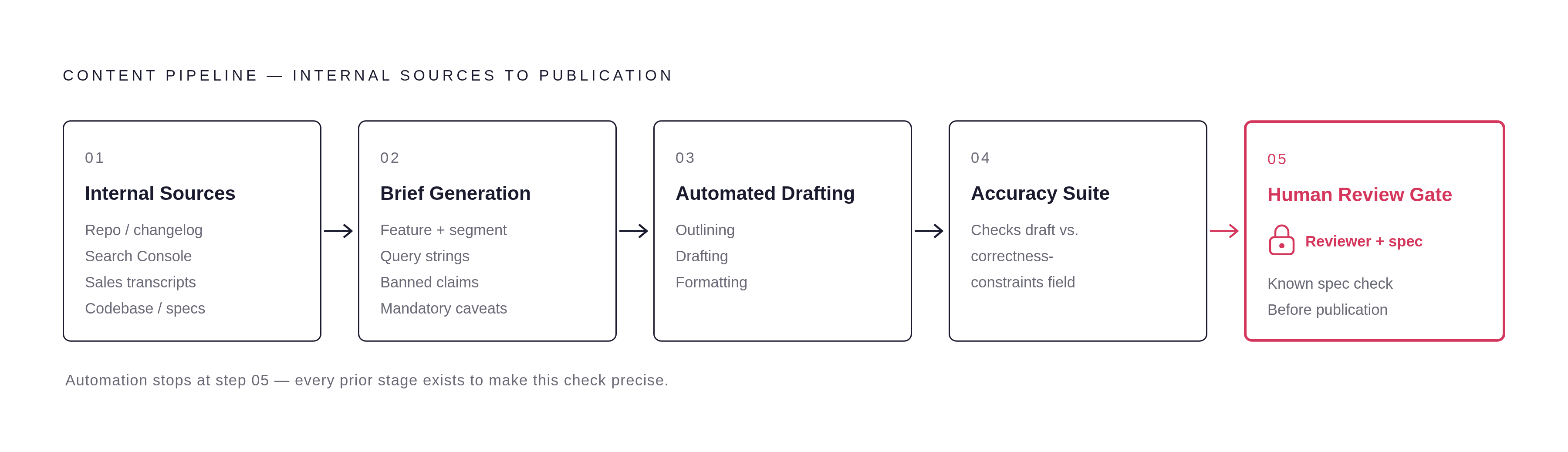
Strategized.ai’s case study describes an industrial B2B supplier whose products have safety-critical specifications and whose small marketing effort could not keep up with the pace at which technical articles had to be written by hand. That situation makes the trade-off concrete. Faster production is useful only if the specifications survive the process intact. An unchecked draft is not an acceptable substitute for a slow one when a missing qualification changes the claim.
The pipeline design suited to that problem separates strategic work from mechanical work. Humans control topic selection, audience, angle and brief generation, while outlining, drafting and formatting can be automated. Publication still requires human review. The brief sets the limits on safe product claims before generation starts, so automation does not have to decide which claims are safe to make.
An accuracy suite can then test drafts against assertions derived from the brief’s correctness-constraints field. Without that reference file, there is no defined set of product constraints for the suite to check. A draft that passes the checks still needs a human to judge whether it is ready to publish. But the reviewer has a known spec to check against and does not have to piece it together from scattered internal records.
The same distinction applies to examples and experience. AI cannot generate first-person experience, but a brief can supply specific examples and verified claims from internal data. Those inputs give the draft substance without inviting fabricated anecdotes.
Why freshness from the changelog is an AI-citation signal, not just an SEO signal
A release can make an accurate article stale. If the brief still describes an older limitation, the next draft may reproduce that limitation even though the product has changed. The published answer needs to reflect the behavior a buyer would encounter now.
AI citations tend to go to content that was published or updated recently, and freshness matters especially to Perplexity. A changelog-driven brief therefore connects two needs that are often managed separately, which are technical accuracy and current retrieval evidence. The release gives the team a reason to change the answer itself as well as its timestamp. That makes the changelog an input to citation performance as well as product communication.
The operational implication is a brief per sprint tied to each release. A quarterly editorial calendar planned outside the product team cannot, by itself, reflect changes at that pace. The automated assembly process makes sprint-cadence publishing feasible without a proportional increase in editorial headcount. Human review can focus on what changed.
Documentation belongs in the same loop. If API docs or architecture guides change in the repo without corresponding changes in published content, answer engines can continue retrieving the stale version or use a competitor’s current documentation. Connecting brief generation to the docs pipeline closes that gap.
The off-site signal layer: how internally verified facts become third-party citations
A brand’s own site is only part of the citation surface. AI answers also draw heavily on third-party sources, so an accurate product page does not by itself provide all the corroboration an engine may use. What happens to the facts after publication? The brief-as-dataset approach gives those facts a route beyond the owned site without requiring a new account of the product for every placement.
Trade publications, review sites and open directories can draw on verified product data, case study numbers and quotes from named experts. The engineering and product team must authorize that substance before it travels. A brief containing it can also seed a press release, a G2 review request or a Reddit answer. The destination changes, but the underlying claims and their qualifications should not.
The brief can define what to call the product and how to reference the company, while schema markup and structured data help distinguish the brand from similarly named peers. This is not merely a stylistic preference. Inconsistent names make corroborating references harder to connect.
The controlled vocabulary and approved claims therefore serve two purposes. They constrain drafts on the owned site and keep third-party material consistent with the product record. Off-site visibility becomes another use of the evidence already assembled for the brief.
Measuring whether the brief pipeline is producing citations: what to track and how
One successful query is too little to show whether the pipeline works. AI responses are non-deterministic, so measurement needs a fixed prompt panel that is run again and again across more than one engine. The buyer-question clusters already present in the briefs supply that panel. Using those questions keeps the test tied to the problems the content was meant to answer.
Presence asks whether the brand is named, while citations ask whether specific content is linked or quoted. Sentiment describes whether the mention is favorable, and agent traffic records whether an AI-referred visit happened. These signals answer different questions, so a brand mention should not be counted as proof that a particular article earned retrieval.
Testing should span ChatGPT, Claude, Perplexity and Google AI Overviews because their freshness windows and citation patterns differ. Results in one engine do not establish visibility in another. Citation half-life adds a further question about how quickly a citation decays. Repeated measurement can therefore expose a loss of visibility that a one-time audit would miss.
Share of Answer measures the percentage of answers across the tracked prompt set that name the brand. Citation share then helps assess whether the content produced from a brief actually earned retrieval on those prompts. If a cluster does poorly, its brief is flagged for changes. That closes the operational loop, with buyer questions shaping the input and answer-engine results showing where the evidence, structure or freshness needs more work.