Release-led content is only as good as its verification: how a technical B2B team can turn a changelog into posts a buyer can check
Every capability claim needs a link a buyer can actually inspect.

A changelog gives a technical B2B team a strong starting point for content, but a release record is not proof of every benefit a post might promise. Each capability claim needs a proof handle, a direct route to evidence that a buyer can inspect and an AI answer engine can retrieve.
Why changelog content fails buyers before it reaches them
A team can ship constantly while its product looks frozen from the outside. The release history records movement, but little of it reaches people evaluating the software. That is a translation problem. A changelog already lists specific changes with dates, written close to the work. Yet an internal QA note answers a different question from the one a buyer asks about whether the software will meet their needs.
The same public entry has three readers. Existing customers want to know whether the product is moving, prospects want to evaluate it without sales contact, and AI crawlers need dated statements they can cite. A ticket export gives all three too little context. It records what changed technically without explaining what that change means for someone managing the software.
That gap poses a risk when an AI pipeline explains the change using source material that has not been checked. A model can turn a small technical change into a sweeping promise that sounds certain. The post then says more than the release supports.
What buyers actually do with a capability claim they cannot verify
What happens when a buyer cannot cross-reference a claim? Buyers may come to doubt the vendor as well as the post. Gartner's survey published in March 2026 found that a majority of B2B buyers prefer a rep-free buying experience for at least part of their purchase. Those buyers have reason to compare marketing statements with product documentation rather than wait for a salesperson to explain the gap. An unsupported statement puts that independent evaluation at risk.
Some teams treat minor inaccuracies as harmless because technical claims seem difficult for buyers to check. That argument has the direction backwards. AI can surface the diff, the benchmark, or the support thread beside the marketing post. When those sources conflict, the post becomes competing evidence. Contradictions can weaken its prospects for citation, although they do not mean an answer engine will necessarily cite neither source.
Speed makes this exposure worse when publication outruns verification. The contradiction remains live across sources that retrieval systems can encounter later. A fast post is therefore not a neutral placeholder if it promises something the documentation does not support.
What a proof handle is and why every capability claim needs one
A proof handle is a direct pointer from a capability claim to evidence a reader can inspect. It gives the claim an anchor outside the marketing sentence. The reader should be able to follow it and judge whether the evidence supports the wording. That is a stricter test than adding a link to a general product page. The destination must substantiate the particular claim.
Four kinds of evidence are especially useful here. A diff or commit link shows the code or configuration change and when it happened. A reproducible benchmark pairs a performance result with its hardware, dataset, and methodology so that a skeptical buyer can run the test. A named public outcome connects a specific change to a result at an identifiable organization. First-party research or instrumentation data makes the team the source of evidence it collected itself.
A benchmark table on an open HTML page gives buyers and crawlers a direct route to the result. A gated PDF blocks that route for AI discovery, while even an ungated PDF is harder to access than an open page. Publication format is part of the evidence design. A claim with proof hidden behind a barrier is not as checkable as one with an inspectable source.
How Linear and Vercel structure changelog entries so claims are already checkable
Linear's changelog shows how a statement of a benefit can sit beside evidence readers can see. Its publishing rhythm is irregular, ranging from roughly weekly to every several weeks. The entry “Loops for product management,” dated September 14, 2026, combines a large image, benefit-led copy, and bundled fix sections. The image shows the UI. It lets the reader inspect the interface being described, within the limits of what an image can establish.
Vercel takes a shorter route to the same goal. As of September 21, 2026, its entries appeared several times a week and used a date, a title, two sentences, and a link to details serving as the proof handle. The summary points to technical documentation rather than asking the reader to accept its wording alone. Brevity works because the evidence is elsewhere and reachable.
Sanity extends that structure to machine-readable content. As of September 2026, every changelog entry was also available as a Markdown file, and open feeds offered another way to access it. The entry becomes a pointer. These examples establish the publishing structure that the verification workflow can build on.
The five-step workflow from release event to verified, citable post
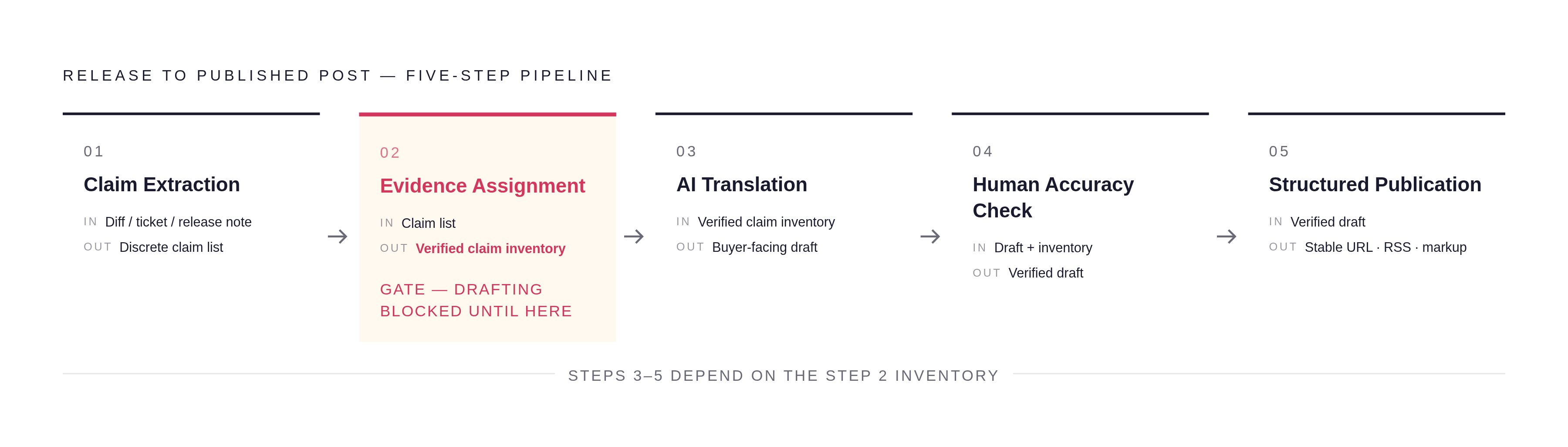
The first step is claim extraction by an engineer or technical contributor involved in shipping the feature. The starting material should be the diff, ticket, or internal release note, rather than a commit message or a prompt asking a model to summarize the release. Each claim must be discrete and testable. A statement that users can export files above a specified size without blocking the browser thread can be tested, while “improved performance” leaves the change undefined. The output is a claim list, with each statement tagged to the specific change that produced it.
The second step assigns evidence before any drafting begins. The same technical owner works with whoever ran the benchmark or holds the customer outcome data to select the strongest available proof handle for each claim. A missing handle calls for a production decision. The claim is held or reframed as a direction. The output is a verified claim inventory, a structured table or document that pairs each publishable statement with its evidence URL or reference. That inventory becomes the boundary of the draft.
The third step uses AI for translation and formatting. Its input is the verified inventory, and the prompt includes each claim, its proof handle, and the target audience segment. The model's task is to explain the buyer benefit supported by that evidence. It is not to generate evidence or infer additional capabilities. The output should be a draft with a proof handle attached to every capability claim and a human reviewer assigned before publication.
The fourth step has a human check the entities and accuracy. An editor or technical reviewer compares the draft with the verified inventory, checking whether wording has drifted beyond what each handle supports. Names deserve particular attention. A model can attribute a statement to someone who never made it or attach a feature to the wrong product, creating an error that otherwise fluent prose can conceal. The reviewer also checks that evidence links are live, correctly attributed, and directed to specific evidence. The output is a reviewed draft with every claim matched to its evidence.
The fifth step makes that draft retrievable. A developer or CMS owner publishes it at a dedicated, stable URL rather than leaving it only on an endless-scroll page. The release date belongs in the markup, an RSS feed provides a discovery route, and clean HTML makes the date, product name, and claims extractable. If capacity allows, a Markdown version follows the Sanity model. Product and release names should remain consistent across the post, documentation, and schema markup so that those surfaces do not send divergent signals. The team should aim to publish a verified post every two weeks rather than three unverified posts in one week followed by a quarter with no posts.
What to do when a release has no proof handle ready to publish
If the result is not ready to substantiate, hold the claim until the benchmark has run or the customer outcome is confirmed. Small fixes without evidence can be bundled into a later improvements entry. If a benchmark is already in progress, publish the methodology. Describing what is being measured and how creates original content without pretending the outcome is known.
This need not stop every release communication. A concise customer-facing note, a developer reference, and an internal verification record have separate jobs and should remain separate artifacts. Faster competing publication does not make an unsupported promise safer. When neither a result nor a useful methodology is ready, the most underused option is to reframe the post around direction. A supported statement that a feature is now in beta describes its current state without borrowing evidence from a future outcome.
How verified changelog posts become the citation foundation AI answer engines draw from
AI answers about current capabilities can draw on live web sources through retrieval. A dated release post gives that process a specific statement to work with, while the proof handle exposes its basis. The date gives the claim temporal context. A stable URL gives it a place that lasts. These choices make the post a usable source, although none guarantees that an answer engine will select it.
Consistency helps connect that source to the rest of the product record. When the post, changelog, and documentation use the same product and release names, they present the capability as belonging to the same entity. Keeping a changelog up to date also gives the site fresh material when its other pages may change less often. Freshness supports the record, but cannot substitute for evidence.
The practical goal is a brand presence grounded in retrievable content the team owns. That goal needs measurement rather than an assumption that publication produces citations. The team should track whether ChatGPT, Claude, Gemini, and Perplexity name and cite the brand after a release post goes live. Naming and citing are separate observations. Together, they help show whether the evidence is reaching answers.
Turning the per-release workflow into a repeatable content engine
Repeatability starts with ownership that survives the next release. An engineer or technical contributor extracts claims and assigns proof handles, the AI pipeline translates and formats them, and a human editor checks the entities and accuracy. A developer or CMS owner publishes the post with the structure it needs. Each handoff has a defined output. Automation can link those steps while leaving people to judge whether the evidence supports the claim.
Repurposing through a social thread, customer email, and documentation update preserves evidence by drawing from the same claim inventory and pointing back to the same proof handles. It also reinforces the connection between the product name, the release, and the supported capability.
A single verified post supplies one piece of evidence. A site with twenty, published on a reliable cadence, supplies a capability history that readers and retrieval systems can cross-reference. Later entries add new claims while earlier ones keep the record of what changed and when. Documentation and product pages can reinforce that record. The compounding gain is not simply a larger archive, but a connected evidence base in which each new release makes the product's public history easier to inspect.