Being quoted by AI search is a pipeline you can test: how to instrument crawl access, indexing and citations for your docs and blog
Five testable stages show why AI search skips your docs and blog.
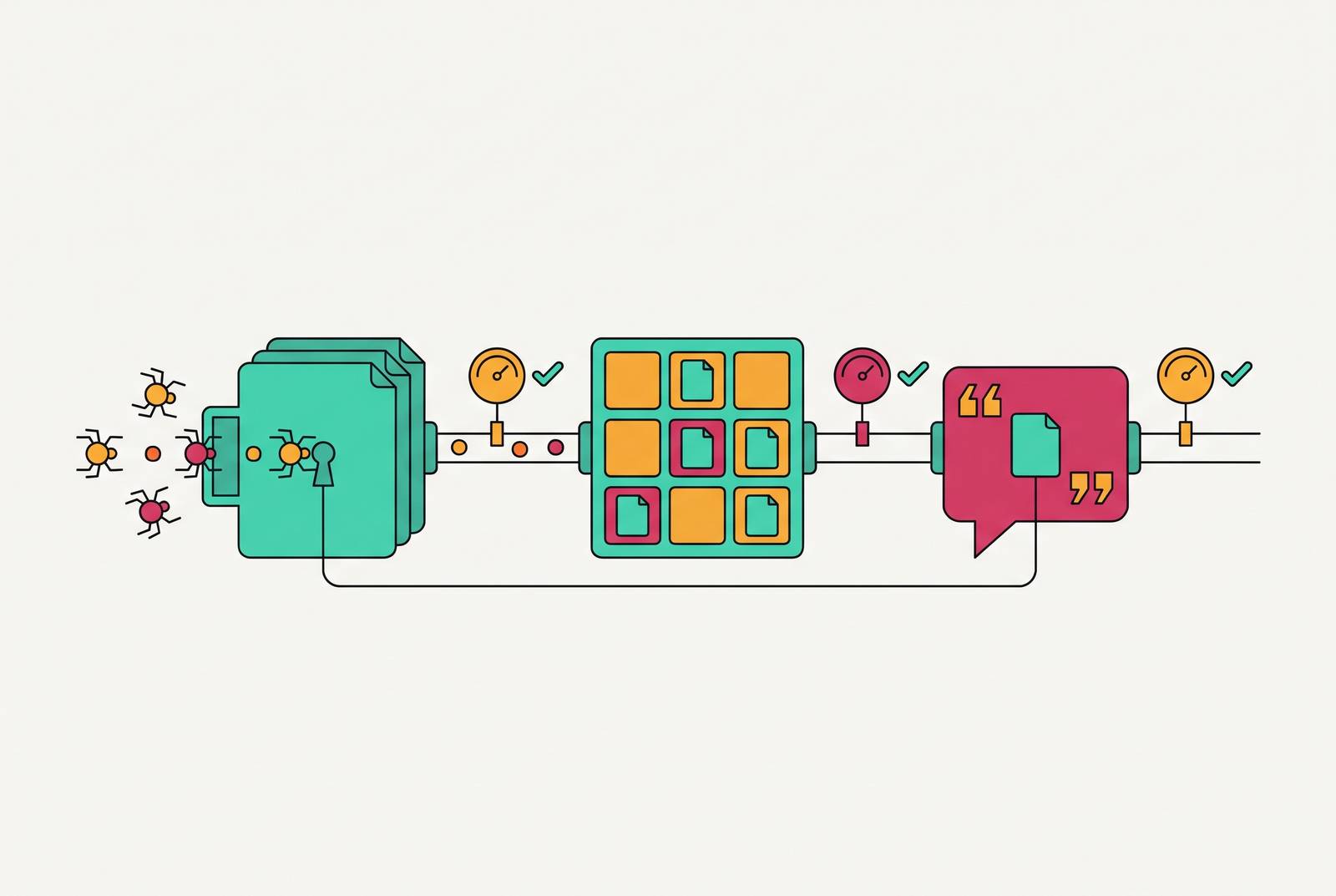
Getting quoted by AI search is a pipeline that teams can test. For docs and blogs, the work runs from crawler access through HTML delivery, indexing signals, passage extraction, and citation measurement. Treating those as separate stages gives the team a place to look when a citation is missing, without having to rewrite everything.
Why AI answer engines operate on a different retrieval logic than search rankings
AI answer engines retrieve specific passages they can extract and synthesize. That changes the unit of work. A page can rank first on Google and earn zero citations in ChatGPT because a high position does not guarantee that another system will select its sentences. Aggarwal et al., from Princeton/IIT, established an academic basis for measuring generative engine optimization at KDD 2024.
Google’s May 2026 official guide places an important boundary around that distinction. Its AI Overviews and AI Mode use the same core ranking infrastructure as regular Search, with query fan-out and retrieval-augmented generation on top. Strong SEO remains the floor for those surfaces. But Google’s account does not describe ChatGPT, Perplexity, or Claude, which have their own indexes and citation policies. A team therefore needs a model that explains where retrieval can fail across engines.
The five discrete stages where citation can succeed or fail
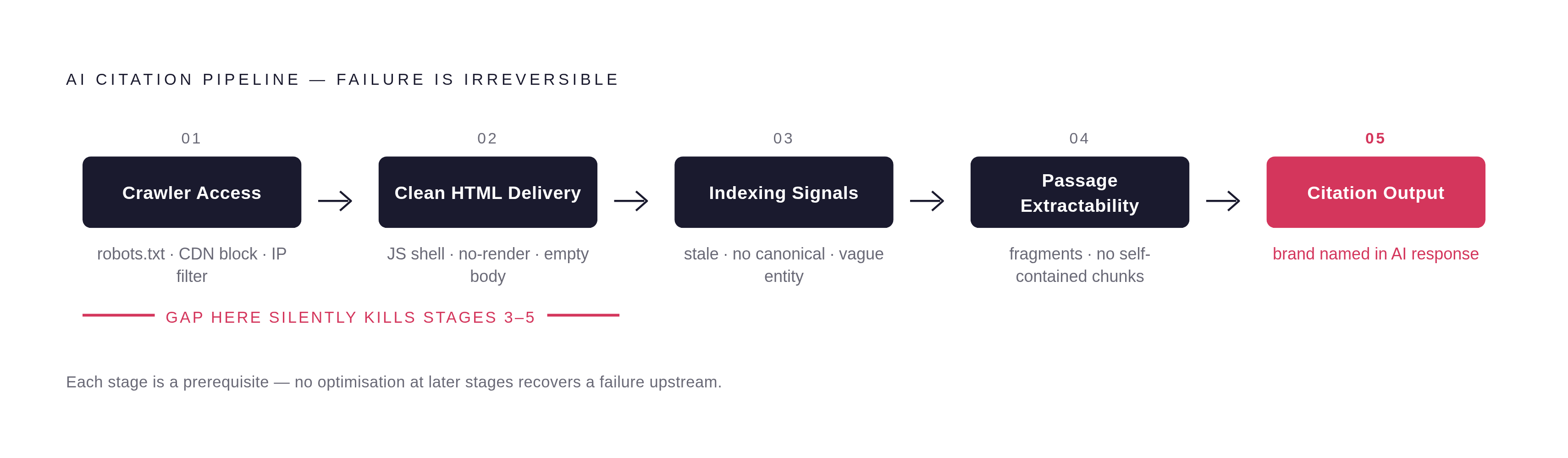
First comes crawler access, a check of whether the bot can reach the URL through robots.txt rules, CDN controls, and IP filtering. Second comes clean HTML delivery, a check of whether that request returns meaningful, indexable content or just a JavaScript shell or login screen. These are separate checks with different remedies. An allowed request does not prove that the bot received the page’s answer.
Third comes indexing signals, including freshness, canonical authority, and clarity about the entity speaking. Fourth comes passage-level extractability, which asks whether individual 100–300 word chunks stand alone as complete, citable answers. Fifth comes citation output, which is measured with prompts whose answers should name the brand. Each stage can be tested on its own. Checking in that order saves work because a better answer block cannot help a crawler that is blocked from reaching it.
Instrumenting crawler access: reading server logs to verify which bots reach which pages
Read the access logs from the server and CDN before changing the content. Filter requests by bot and page, and keep training crawls separate from search and user-triggered fetches. JavaScript analytics cannot substitute for this record because AI crawlers generally do not execute the scripts those tools depend on. The first question is concrete. Which bots reached which pages, and which requests were rejected?
OpenAI’s published documentation distinguishes OAI-SearchBot, which powers ChatGPT Search citations, from GPTBot, which gathers training material. ChatGPT-User makes user-triggered requests on live prompts. Anthropic distinguishes ClaudeBot for training from Claude-SearchBot for search quality. PerplexityBot serves Perplexity’s search index, while a separate Perplexity bot handles user-triggered requests.
User agents are spoofable, so validate requesting network addresses against each company’s published address lists before counting the traffic as genuine. OpenAI publishes separate GPTBot and OAI-SearchBot lists, Anthropic publishes a shared bot list, and Perplexity publishes its bot list. Without that check, a neatly labeled dashboard can still misidentify who visited.
To diagnose blocked access, audit explicit and wildcard robots.txt exclusions, then CDN and WAF rules that reject bots. Cloudflare configurations deserve attention here because bot rejection can be a misconfiguration. Also flag pages whose meaningful content requires JavaScript, a login, or a paywall for the delivery audit. Bing Webmaster Tools’ Topics Portfolio beta, launched in October 2026, offers a supplementary view through thematic grounding-query clusters, Sites Cited, and Opportunity Queries where other sites appear but yours does not. Microsoft labels those figures directional, so they complement log analysis.
What clean HTML delivery actually means for AI retrievability
The delivery check asks whether the bot receives the actual text. If client-side JavaScript injects the main content, a crawler that does not execute it receives an empty shell. Server-side rendering or static generation addresses that failure. With partial hydration, the same failure occurs if the primary content block is still client-rendered.
For this stage, the audit should examine the returned HTML and the signals attached to it. Use a self-referencing canonical and consistent language alternatives, and limit XML sitemaps to indexable URLs returning a 200 status. Keep titles and descriptions unique, with descriptive internal links connecting related pages. Structured data such as Organization, Article, FAQ, and Product should match the content people can see. Markup cannot stand in for a missing answer.
Google’s May 2026 guide says special markup schemes and content-fragmentation tactics are not required for its AI surfaces. The llms.txt question is narrower and remains unsettled elsewhere. Google does not use those files, while CTAIO Labs’ test of ChatGPT and Perplexity effects has results pending publication. Adding the file can be an easy test for those engines, but it has not been shown to fix missing citations. The simpler way to test delivery is to fetch the page as a bot and check whether the meaningful content arrives as readable HTML.
Indexing signals that tell a retrieval system what a page is authoritative about
Readable HTML does not establish who is speaking or why a claim deserves trust. Once delivery works, the next question is whether the retrieval system can identify the entity, the page’s subject, and its authority on that subject.
Topical consolidation makes that job easier. Dozens of near-identical pages that target small keyword variations split the subject across pages, while a strong topic cluster with clear internal links makes it easier to see how the pages relate. Freshness also affects retrieval, with recently updated pages earning meaningfully more citations than stale pages on the same topic. An accessible page can therefore remain a weak candidate if its coverage is scattered or out of date.
The trust check also reaches beyond the site. AI systems look for corroboration in review sites, forums, and publisher coverage before treating claims as reliable. Authentic mentions in community forums and industry publications can build a citation footprint that the brand’s own blog cannot create alone. A clear source page and support for its claims outside the environment the brand controls are needed before passage structure can do its part.
Structuring content so individual passages extract cleanly as citable answers
A passage must remain useful when separated from its page. That is why answer-first sections are easier to extract than sections that take several paragraphs to reach the answer. The opening states a direct, factual response, and the following sentences supply its evidence and limits. A human reader can still follow the larger argument, and the retrieval system gets a whole answer that makes sense without text from elsewhere on the page.
The GEO-bench findings give an empirical basis for that architecture. Adding concrete statistics with sources led to about a third improvement, and using inline source attribution more widely also helped. Attribution is distinct from quotation. A passage needs to make its evidence traceable, but it does not necessarily need to reproduce someone else’s words. Keyword stuffing and pure fluency rewrites produced almost no lift, which points toward evidence as the useful intervention.
For implementation, the suitable formats include comparison tables, definition blocks, step-by-step methods, checklists, FAQ blocks, and decision frameworks. Their value lies in self-contained answers. Named entities and attributable specifics also extract better than vague references and superlatives. A passage that says exactly which product, finding, or measurement it concerns asks less interpretation of the retrieval system.
A page that merely rearranges existing sentences competes with the sources that supplied them. A proprietary measurement, a structured comparison from a proprietary dataset, or an experience-based verdict signed off by a human editor gives the system something distinct to reference.
Running a human-review gate inside an AI content pipeline so published claims stay verifiable
An AI-assisted publishing pipeline needs an owner for verification before an artifact reaches production. Otherwise, polished text can pass through every handoff without anyone checking whether its claims and citations exist. That is a systems-design problem. The review gate protects the verifiable evidence that makes a passage useful for citation in the first place.
Microsoft’s July 2026 preprint illustrates the failure mode. It audited accepted papers from ICLR, ICML, NeurIPS, and USENIX Security and found hallucinated citations in the archival record. Roughly one in four accepted NeurIPS 2025 papers had at least one hallucinated reference, while roughly one in twenty had at least two hallucinated academic-paper-like references under the stricter definition the preprint headlines. Those definitions should not be collapsed into one figure. The failures were workflow breakdowns rather than fraud, with nobody owning the verification check.
For a content team, the proposed architecture assigns each handoff explicitly. An AI agent owns the brief, a human owns the draft, a second human owns review, and a third human or scheduled job owns the post-publish audit. Drafting should use parameterized prompt templates stored in version control. Direct model calls from application logic without that template layer make the output non-auditable.
At the review stage, the content goes through automated factual-consistency checks, PII detection, and toxicity scoring as well as human review. High-risk or high-visibility content must have human sign-off, and the artifact goes into the publish queue only after it passes both checks. Ownership is the crucial design choice here. The editor who reviews the content can also swap a broad claim for a proprietary measurement or named example, making the content stronger as well as catching errors.
Measuring citation output: tracking which prompts name your brand and what changes move the number
The final stage needs repeated prompt tests on a regular cadence. Otherwise, the upstream changes remain untested against the outcome they are meant to improve. The primary metric is Share of Answer, which measures the percentage of answers naming the brand across a tracked prompt set. It measures frequency rather than position because generative engines have no fixed rank. Share of Voice is a distinct metric.
Crawls, citations, and clicks answer different questions. Logs show bot access, while prompt tests capture citation frequency even when nobody clicks through. AI referral traffic tagged with parameters such as utm_source=chatgpt.com and utm_source=perplexity.ai shows what is converting in analytics.
A complete measurement stack covers ChatGPT, Gemini, Claude, Perplexity, Grok, DeepSeek, Copilot, AI Overviews, AI Mode, and Meta AI. Tool coverage varies across that set. Scrunch AI provides a real-time bot crawling feed that can connect crawler activity with citation changes. Semrush AI Toolkit offers citation tracking for an existing Semrush stack and is also available standalone or bundled into paid Semrush plans. Neither role removes the need for a consistent prompt-testing protocol.
If validated crawler access improves but citation frequency does not, access alone has not resolved the gap. Once clean delivery works, indexing signals and passage structure are the next places to look. Prompts that cite competitors but omit the brand also reveal content gaps tied to actual retrieval behavior. Each test narrows the next decision, turning “not being cited” from a vague disappointment into a fault the team can locate and work on.