Marketing channels for B2B: the "two or three channels" rule is only testable if each channel test is a logged, source-tagged experiment, and the shortlist now happens inside AI answers before any channel is touched
Tagged channel tests only measure buyers who got past the AI shortlist.

Choosing two or three B2B marketing channels works only when each choice becomes a logged experiment with a tagged destination, a pre-committed metric, and a kill condition. But those tests reach only part of the buying journey. As buyers build shortlists inside AI answers, brands need to show up there before channel performance can tell the full story.
Why the "pick two or three channels" rule collapses without instrumentation
The advice to pick two or three channels is good advice about focus. A small team needs one sharp ideal customer profile, one wedge message, and a limited set of places where it can realistically win. Written down, those choices stop marketing from becoming a new improvisation every week. The difficulty begins when a strategic choice is treated as an executable test.
Choosing a channel does not define an experiment. If its interactions cannot be connected to pipeline and revenue, the team cannot read its results reliably. Did the campaign produce those opportunities, or did they merely arrive while it was running? Most teams are failing to structure their trials so that the evidence supports a decision, and the fix begins before launch.
What a properly instrumented channel experiment actually requires
Before a test runs, its experiment record needs consistent source tagging, CRM linkage, a pre-committed kill condition, and a data-quality floor. Start with the destination of every ad, email, and content asset in the test. Apply structured UTM tagging consistently, covering source, medium, campaign, and variant. These fields are the foundation of a readable journey. Missing or inconsistent values can make an experiment uninterpretable regardless of how well the campaign itself performs.
For long B2B sales cycles, that record needs more than web analytics. Push UTM values into the CRM on the first form submission, map them to lead source fields, and preserve them through the opportunity record. Without that link, analytics may show which campaign brought a visit, but the team cannot trace it to pipeline or closed revenue.
The experiment also needs a stopping rule. Commit before launch to the metric, threshold, and time window that will trigger a stop. Without that agreement, underperforming channels can survive because ending them feels like admitting failure. Before reading results, audit inbound contacts from a recent period and check how many have a campaign value. A significant tagging gap means the baseline is already unreliable.
Even clean attribution leaves a causal question unanswered. It connects recorded interactions with outcomes, but cannot establish whether a channel created demand or captured demand that already existed. For channels taking a meaningful share of budget, use a geo-based holdout test. Turning the channel off in matched markets for two to four weeks addresses the incrementality question that source tags alone cannot resolve.
How B2B buyers now build their shortlist before any channel reaches them
A well-instrumented test can still begin later than the team assumes. Buyers increasingly use AI to summarize options and build shortlists before visiting vendor sites. By the first recorded visit, evaluation may already be well advanced. The vendor has missed part of the conversation. A campaign that looks like the beginning of a relationship may instead be reaching someone who has already narrowed the field.
That narrowing also happens outside AI answers. Private Slack channels and WhatsApp groups allow buyers to validate options with peers without leaving an attribution trail. B2B tech purchases now have several stakeholders who care about different things, and each may do their own AI-assisted research. The first visible interaction therefore need not represent the buying committee’s first encounter with the brand, or even its first decision about it.
What does a channel result tell the team in those cases? It describes performance among buyers who reached that channel. If an AI-generated shortlist excludes a brand, improving a later interaction cannot recover the opportunity to influence that earlier choice. The instrumentation remains necessary, but its scope is narrower than a complete account of buyer discovery. So what does it take to appear in those AI answers?
What determines whether an AI answer engine names and cites your brand
Generative Engine Optimization, or GEO, targets AI-generated narrative responses from ChatGPT, Perplexity, Gemini, and Claude. Its objectives include citation share and AI mention share. That changes the job of a page. It must give an answer an engine can extract and connect to an identifiable source.
On the owned domain, that begins with direct, complete answers in the opening section. Citations concentrate toward the beginning of a page, so burying the answer beneath a long introduction weakens its usefulness for extraction. Sequential headings from H1 to H2 to H3 also support citation more effectively than unstructured content. Readability has a technical condition as well. Most AI crawlers fetch pages without executing JavaScript, so content dependent on client-side rendering needs server-side rendering or static HTML to be readable.
Entity grounding is another prerequisite that content teams can overlook. An engine needs to distinguish the brand from other entities before it can reliably name it. A Wikidata entry with proper properties gives an engine a disambiguation signal, though a brand can still appear in answers without one. The practical work is to clarify the brand across Wikipedia where eligible, Wikidata, LinkedIn, Crunchbase, and homepage schema. This is not simply a page-writing task.
The evidence beyond the owned domain is important too. AirOps’ 2026 State of AI Search report found that most brand mentions in AI answers come from external domains. That calls for work beyond the website, through posts in relevant community forums and pitches to publications that answer engines often cite. Live retrieval is only part of the mechanism. Some answers draw on parametric knowledge learned during training, where mentions repeated across authoritative sources build up the model’s representation of an entity and make it more likely to recall that entity.
Why traffic and visibility have decoupled, and what that means for content decisions
A page can get fewer Google clicks and more LLM citations in the same quarter. That creates a problem for content decisions built around traffic alone. A page that looks expendable in an analytics report may be helping buyers discover the brand inside AI answers. The apparent cleanup may eliminate something the existing dashboard cannot see.
The reverse is just as possible. A page with steady organic traffic may be absent from AI answers, while one that never ranked in Google may be cited regularly by ChatGPT. Traditional rank tracking and analytics were not built to reveal that distinction. Before taking an asset down, a team should check both organic search performance and AI citation data. Neither surface can stand in for the other.
Content planning needs the same broader view. A topic that appears fully covered in search may be unrepresented in AI answers, and the opposite can also be true. Teams must assess both whether a page attracts visits and whether the content helps the brand enter evaluation before those visits happen. That makes sourced versus influenced pipeline a better way to judge the business results than MQL counts alone, even though it is harder to trace AI-assisted influence.
Measuring AI answer-engine citations alongside traditional channel metrics
AI visibility needs its own measurement layer. Brand mention rate records how often the brand appears in generated responses to relevant queries. Citation share tracks its presence among citations, while a visibility score shows the share of relevant queries where it is cited, filtered by engine and buyer journey stage. These measures answer different questions from a traffic report. A mention establishes presence, but does not by itself establish a visit or an opportunity.
The unit of comparison also needs care. Share of voice should be measured at the prompt level, by engine, and by product or service relevance. Results from ChatGPT, Claude, Gemini, and Perplexity should not disappear into an undifferentiated total that conceals where the brand is absent. Define what is being measured so that changes have an interpretable context.
Connect citation and mention data to the leads, pipeline, and revenue that follow, so success is judged by more than visibility alone. That does not make every influence attributable, especially when buyers also consult private peer groups. Google added dedicated generative AI performance reporting to Search Console in June 2026, giving teams another surface to read on its own terms. Check citation data on a recurring basis rather than once per quarter, because patterns shift as models are updated and new authoritative sources enter training corpora.
Running the AI visibility program alongside the channel experiment without doubling the team's workload
This broader measurement remit does not require a separate content team for every surface. Citation presence and channel experiments can share a production workflow with AI drafting, explicit human review gates, and measurement planned from the start. The constraint has moved beyond writing speed. With AI making drafting nearly free, topic selection, briefing, voice consistency, review, distribution, and measurement become the work that limits production.
To make that shared workflow practical, begin research with human-led customer interviews and sales call data, using AI to synthesize the material into a structured brief. AI can then produce an outline from the brief and target query. A human reviewer adds the operator framing that is missing from the outline. This division gives the draft a defined purpose before production accelerates, rather than asking reviewers to discover its purpose afterward.
Revision remains a human-led stage for credibility and voice. The named author supplies genuine experience claims, operator specifics, and perspective, while AI can handle definitions, frameworks, and mechanical explanations. Citation-friendly structure and human judgment each have a different job. Assigning each explicitly allows the same asset to support answer-engine visibility and an instrumented channel test without treating credibility as a formatting problem.
Before publication, automated checks for factual consistency and voice alignment should go hand in hand with human sign-off. The danger is treating AI as a substitute for a human author and reviewing only whether the text sounds finished. Content that fails credibility checks can damage both rankings and citations as it accumulates.
The order of operations is AI visibility first, channel experiments second
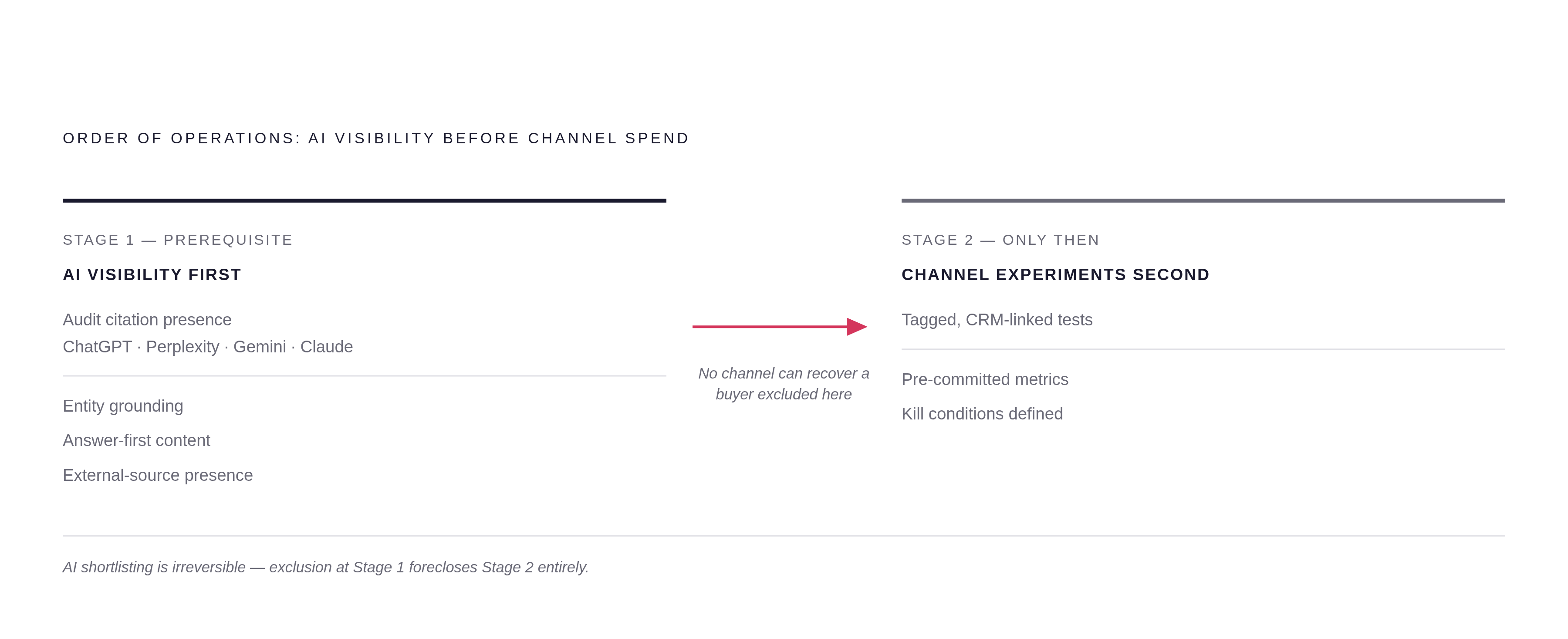
An audit of AI citation presence across relevant queries begins the program. Is the brand being named, by which engines, and at which buyer journey stages? Those answers show what the team needs to work on before adding channels, including entity grounding, answer-first content, and a presence on external sources that engines use. This is a question of eligibility for consideration. A later campaign cannot reach a buyer who has already excluded the brand and never encounters it.
Once those gaps are addressed, channel experiments need the full discipline described earlier, including tagged destinations, CRM linkage, pre-committed metrics, and kill conditions. AI visibility does not excuse weak attribution or replace a channel’s obligation to contribute to pipeline. The team needs to keep measuring both surfaces as linked programs. The sequence concerns their roles in the buying journey, while visibility work and campaigns can run concurrently.
Without that distinction, even a carefully logged experiment can invite an oversized conclusion. It may describe buyers who found the brand through non-AI means while missing those who settled on a shortlist inside an answer engine. Its result can still be readable. What it cannot support is a claim about demand the experiment never had a chance to reach.
Instrumentation makes the two-or-three-channel rule executable, while AI visibility helps make the brand eligible for the evaluation those channels serve. Neither replaces the other. The first establishes whether a deliberate marketing bet worked among the buyers it reached, and the second addresses whether buyers considered the brand before that bet could reach them. The order follows the buyer’s decision.