When AI Overviews Serve Stale Facts About Your Business
Fixing stale facts requires aligning your website, Google Business Profile, and third-party sources.

Stale facts in Google AI Overviews are not usually a problem that another page or a correction form can solve alone. They show that the brand’s website, its business profiles, and the outside sources AI systems trust do not agree. The fix is an engineering-minded one, making those sources agree, making the site easy to read and cite, and measuring whether the answers actually change.
How AI Overviews became the first impression for branded searches
Branded searches used to give a company’s website a relatively direct route to the customer. Someone searching for a business by name had already chosen what to investigate. The expansion of branded AI Overviews in September 2026 changed that relationship, placing Google’s account of a business before the business’s own homepage.
The layout changed too. By late October and early November 2026, Google began putting AI-written summaries in the right-hand column where the Knowledge Panel had usually been. That put generated copy in a space brands had spent years keeping up to date. At the same time, Google tested moving citation cards to the bottom of Overviews, behind “show more,” making the source list less immediately visible. A reader could see a description that sounded sure of itself without easily seeing the evidence behind it.
What happens if that description is wrong? A potential customer can read it, decide what the company offers, and leave without visiting the site. The brand’s accurate service page or current contact information then has no opportunity to correct the impression. For a session that ends at the summary, there is no downstream recovery.
Where the wrong facts actually come from
Errors arise from four broad categories of sources, namely the brand’s own site, Google Business Profile, third-party sources, and confusion between businesses with similar names. These categories separate errors with very different origins. An obsolete service description is not the same problem as another company’s complaints being attributed to the brand. Both can produce a misleading answer, but correcting them requires knowing where the confusion began.
The brand’s site can supply the stale fact itself. A service page may still suggest that the company offers something it stopped offering two years ago, even while the homepage gets the current business right. Google Business Profile gives another account, with its own fields that can change automatically. Beyond those controlled or partly controlled surfaces sit directories, review platforms, forum threads including Reddit, old press releases, association pages, and industry publications. A former employee bio or a discontinued product announcement can remain relevant to retrieval long after the team has stopped thinking about it.
Why not simply report the wrong answer? There are ways to request a correction, but recrawl requests can take days, while the Business Redressal Form or Google Support can take weeks or months, with no promise of a fix. Businesses have also reported Overviews that improved and then reverted. Reactive correction therefore leaves an important question unanswered, which is whether the source that supplied the error still says the same thing.
Why this is a data-consistency and site-legibility failure, not a content gap
When a website, a business profile, and a directory disagree, the retrieval system has to resolve their competing claims. It may blend the information, choose the wrong version, or hedge. An old address on a forgotten directory can compete with the current address on the site. A former business name on a review platform can complicate identification. Publishing another accurate page does not remove either contradiction.
This is like a data-consistency bug in a distributed system. Two data stores disagree, and a downstream consumer resolves that disagreement in a way the data owner did not intend. The useful part of the analogy is the discipline it suggests, identifying the sources, bringing their records into agreement, and maintaining that agreement over time. It is not a promise that the brand can control Google’s final choice. The work concerns the evidence available to that choice.
Agreement alone is not enough, however, if the authoritative page is difficult for a crawler to access or understand. Google’s guidance emphasizes clear, reliable, people-first content and pages that crawlers can access and read, rather than a separate set of “AI optimization” techniques. A current fact hidden in an image cannot do the same job as readable text. A technical marketing team therefore has two things to fix, records that disagree and authoritative evidence that is hard to read or understand.
Auditing the full signal surface before writing a single new page
The audit starts with the search that produced the error. Searching the brand name in an incognito window lets the team record the answer as it appears. The record should preserve the exact search, a screenshot, the date, the specific inaccurate statement, the cited sources, and the correct information with a supporting source.
The query set then needs to widen. Searches such as “is [company] legitimate,” “[company] reviews,” “[company] complaints,” and “[company] [city] can produce different Overviews from different sources. Someone outside the marketing team can also read the summary and explain what they think the company does. That response shows what a customer takes away, which may differ from what the team meant.
For each cited source, the audit establishes who controls it, when it was last updated, and which fact needs correction. Google Business Profile needs a close check because Google maintains it directly and can change it automatically. Its name, categories, address, service area, phone, hours, description, attributes, and automatically added services all belong in the review. The source ledger then records what each surface says now, who controls it, and what needs to be fixed. That ledger becomes the work queue for the changes that follow.
Making the brand's own site the clearest authoritative signal
The owned site is the first correction target because it should provide the ground truth for the other records. An About page needs to state who the company is, what it does, where it operates, and how long it has been in business. Service pages need to distinguish actual offerings rather than describe them in interchangeable language. An FAQ can answer the questions customers ask, while contact details, hours, and service areas show how to reach the business and when and where it works now.
The objective is machine legibility. Crawlers must be able to access the pages, and important information must appear as text, including information inside images. Structured data must also match what visitors see. Otherwise, a page that looks correct to a person can still present a contradictory record through its markup.
Google’s structured data guidance describes Organization markup as a way to help it understand and correctly identify an organization. That makes the markup relevant to name confusion, without making it a substitute for clear on-page facts. A grounding page extends the same principle by presenting verifiable information that retrieval systems can extract and attribute cleanly. Its purpose is to be quotable inside an answer. A maintenance cadence keeps those statements current, so that the authoritative page does not become the next stale source.
Bringing every off-site surface into agreement with the site
Once the owned pages give a clear account, the team needs to fix the sources outside the domain. Those sources are not peripheral to the answer. Google can draw on directories, reviews, publications, and profiles even when the brand’s site is accurate. The consistency requirement is specific, with business name, address, phone number, hours, and service descriptions agreeing across the website, Google Business Profile, social profiles, and online directories.
For eligible businesses, the profile is the highest-priority off-site surface because Google maintains it directly and updates it from external signals. Each field needs to be checked against the business as it is now and updated when the facts change. The team also needs to watch for auto-populated services or descriptions added without the owner’s input. Other records require a slower route. To fix an old address or previous name in a third-party directory, the team may need to contact the publisher directly and ask for a correction.
Accurate, attributable content in outside publications creates evidence that AI retrieval systems can cite without relying exclusively on the brand’s own assertions. That makes editorial presence part of the consistency strategy. Yet outside records can drift as directories update from other sources, reviews accumulate, and old pages resurface. Maintaining this layer therefore requires a recurring review cadence rather than a correction sprint with a permanent finish date.
Why ranking and being cited in AI answers are now separate engineering problems
A strong organic ranking does not establish that an AI answer cites the page, or represents the business accurately. Ranking shows where a link appears in search results. Citation concerns which sources a system selects to support its synthesized answer. A team can improve the first while remaining unable to see the second.
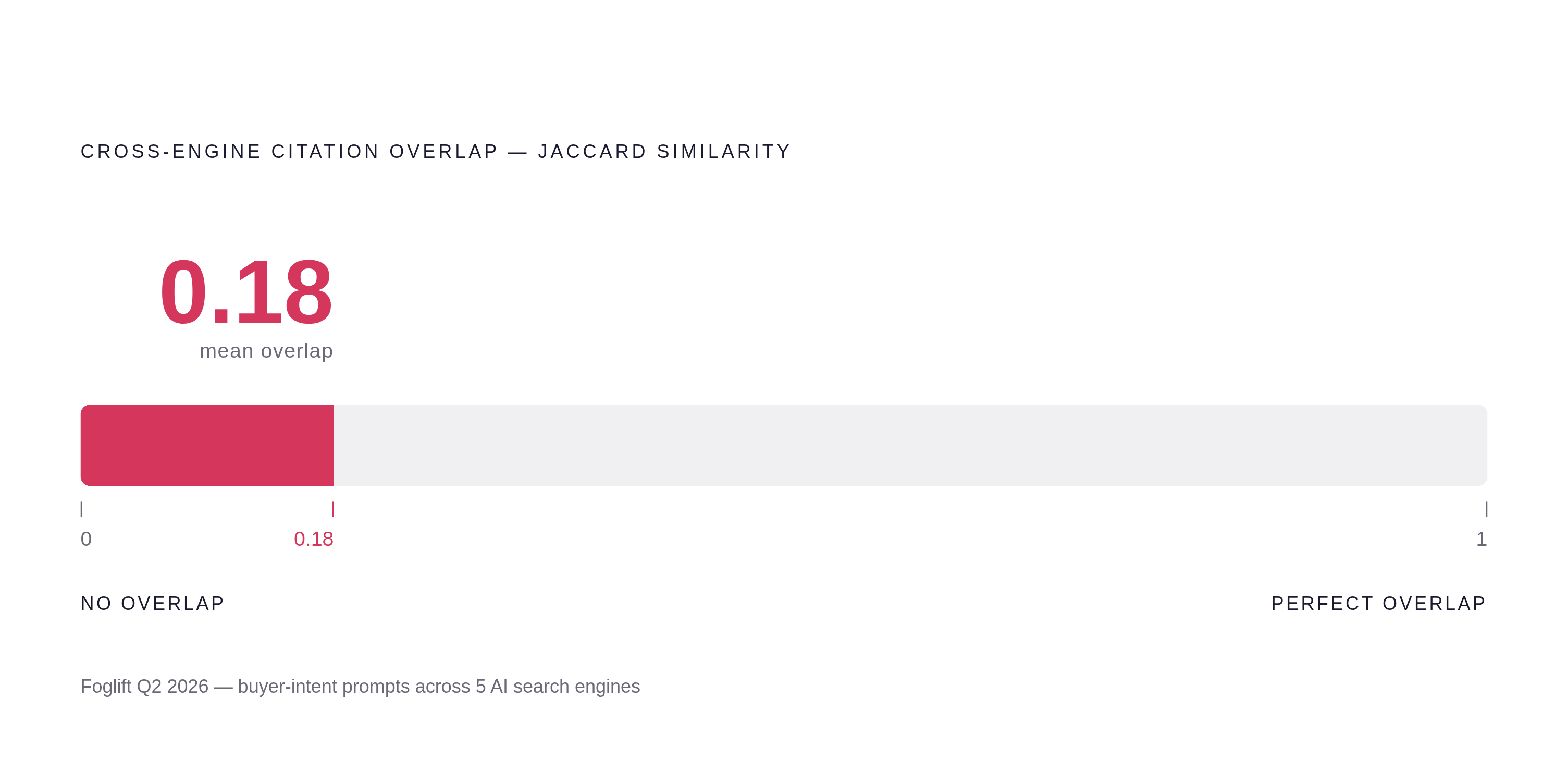
The gap also differs by engine. Foglift’s Q2 2026 benchmark ran buyer-intent prompts across five AI search engines and found that the mean cross-engine citation overlap was 0.18 by Jaccard similarity. That low overlap shows that the engines chose very different sets of sources. Citation on one platform is therefore not evidence of citation on another.
Generative Engine Optimization, or GEO, is the work of getting included in synthesized answers as well as earning a place among links. Clear content and accessible pages remain relevant, but ranking reports cannot show whether an answer repeats a discontinued service or confuses two businesses. Technical teams need a separate instrumentation layer that observes the answers and their citations directly.
Measuring whether the fix is actually working across AI engines
That instrumentation starts with a prompt set tied to the correction work. It needs branded queries, including the company name alone and in context, as well as queries that test specific corrected claims. Queries for a product or service category also show where competitors might appear instead. Together, these prompts distinguish whether the business is represented accurately when named and whether it appears when the customer has not yet chosen a brand.
A corrected answer can revert, and a successful result on one engine says little about another. The system therefore needs to track how the business is described across the engines the team is measuring, even after one Overview is correct. The team can check those answers against the facts in the source ledger.
What should happen when a stale statement survives a site and profile update? The result sends the team back to the remaining sources, looking for an outside record that still supports the old claim. Measurement becomes a debugging tool, feeding unresolved errors into the correction queue.
The outcome being measured is not necessarily a click. A customer may make up their mind without leaving the answer, so traffic alone cannot show whether the fix worked. The team needs to check whether AI systems describe the business accurately, cite current evidence, and keep doing so as the sources around them change. That is the ongoing responsibility created when the first introduction happens somewhere the brand does not control.