Claude SEO Is a Symptom. Machine-Legible Sites Are the Cure.
Fixing sites for machines, not platforms, makes your content retrievable across all AI assistants.
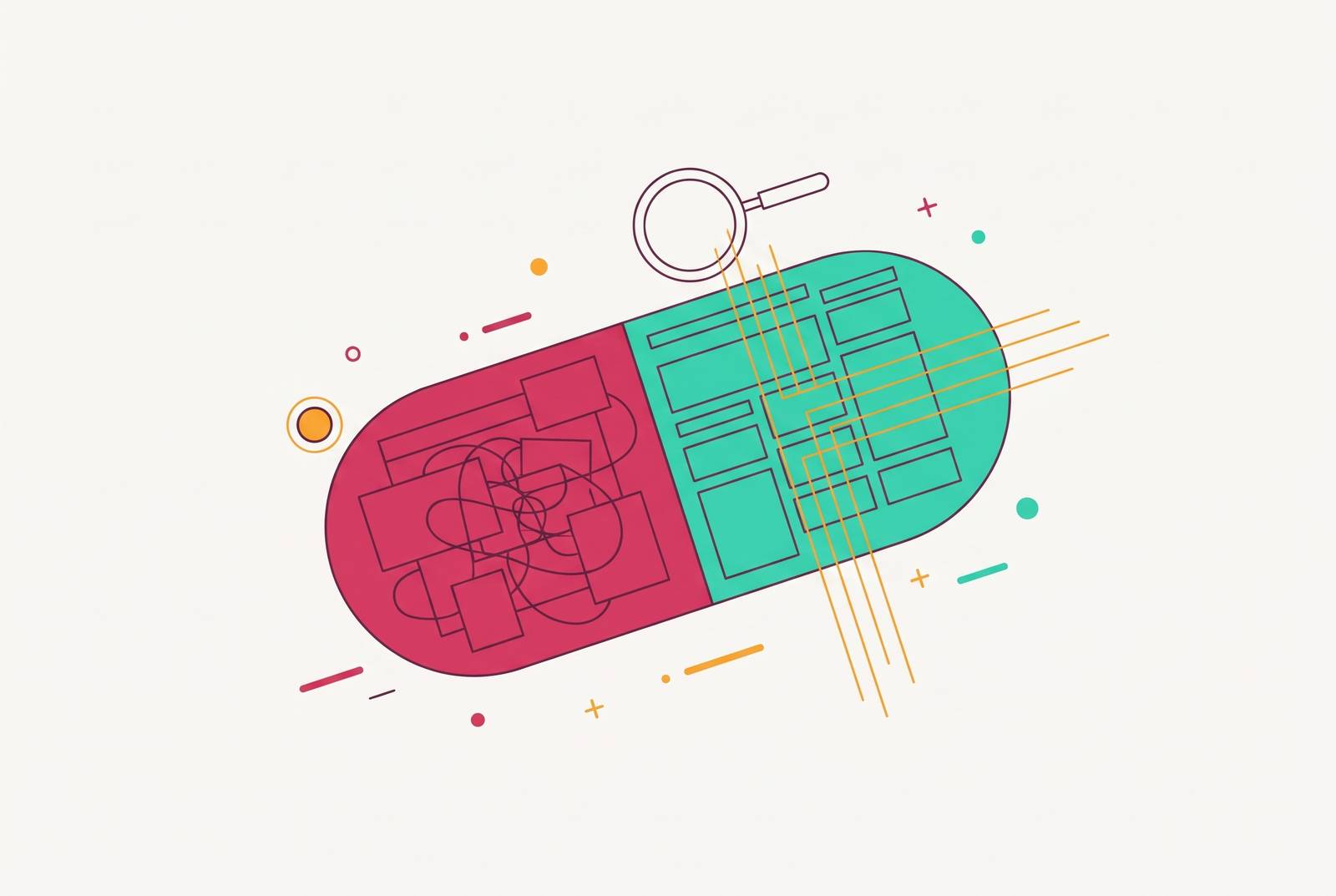
“Claude SEO” points to a problem larger than any one assistant. Sites built to look clear to people often leave machines guessing about what they contain and why it deserves trust. Machine-legibility makes accurate information easier to retrieve, interpret, and cite across Claude, ChatGPT, Gemini, and whatever comes next through durable structural improvements.
Why "Claude SEO" is a symptom, not a strategy
Cognizo’s 2026 guide presents “Claude SEO” as a six-step platform fix. The appeal is easy to understand. A brand can rank first on Google and still be absent from Claude’s answers, so a separate optimization plan seems reasonable. Claude draws on training data and live retrieval, two pools that update on different schedules and respond to different signals. Neither is simply Google’s ranked list.
An audit of 500 corporate homepages, fetched as AI crawlers fetch them, found that 46% had no usable structured data, while some served crawlers a blank page entirely. These are failures to expose and describe content in forms machines can use. A checklist for one platform may fix some problems, but the structure beneath them still needs repair.
What machine-legibility actually means, and why most sites fail at it
Machine-legibility is the degree to which an AI agent can accurately parse, extract, and trust a site’s content. It has two dimensions that work together. Machine readability is the form in which information arrives, while semantic clarity is how clearly it names entities, attributes, and relationships. A machine needs both access and meaning. Readable text can still leave it guessing about what a company does or which claims belong to which product.
Research on agent interpretability published on arXiv identifies JSON-LD, metadata, sitemaps, semantic HTML, and structured product or service data as mechanisms for machine readability. Schema.org supplies a shared vocabulary for describing that information. A page can display a brand name prominently yet never state clearly what kind of organization it names.
Some crawlers find an empty shell when all the content depends on JavaScript. Facts hidden behind logins, or in tabs and accordions whose text is absent from the HTML, are not available for citation through that page. Missing authorship and vague brand descriptions create a different obstacle. Even when the words are accessible, their identity and authority can remain unclear.
These failures affect more than one platform, though each has its own crawler controls. ClaudeBot, GPTBot, and PerplexityBot operate independently, while Google-Extended is a robots.txt control token governing how Googlebot’s content may be used for Gemini training. Anthropic also runs three separate crawlers, so blocking its training crawler does not block the retrieval crawlers governing live answers. Access settings therefore need precise interpretation.
Why AI citation and Google ranking are genuinely decoupled channels
Does doing well on Google at least give a site a head start? It does not guarantee inclusion in AI answers. A 2026 analysis of AI Overview citation patterns, covering tens of thousands of Google queries, found that a meaningful share of cited domains never appeared on the first page of traditional results. A rank report cannot stand in for an answer-level visibility report.
The signals also differ in their relative strength. Third-party brand mentions correlate strongly with AI visibility, while backlinks correlate far more weakly, reversing traditional SEO’s emphasis on links. These correlations leave the causes of citation unresolved while casting doubt on the idea that stronger search signals will bring the same gains in AI answers.
Anthropic’s Trust Center lists Brave Search, TurboPuffer, and Parallel Web Systems as three distinct web search subprocessors. Brave Search has its own index, which is separate from those of Google and Bing. This partial view of the decisions behind an answer shows why treating Google’s ordering as Claude’s starting order is unwarranted.
Princeton research supplies the more useful strategic turn. It found that “Fact Density,” including authoritative citations, statistics, and quotations, can lift lower-ranked sites in AI responses, while keyword-stuffing tactics have negligible or negative effects. This favors evidence over platform-shaped wording. A structurally sound, factually dense site can compete for citations without manipulating a particular assistant’s retrieval logic.
The off-site inversion most brands haven't internalized
Yet a perfectly readable owned site is only part of the picture. AI answers draw heavily on third-party sources, which receive more citations than brand-owned pages. This changes the scope of content strategy. Machines also need to find relevant evidence about a company beyond its own explanation.
Reddit, LinkedIn, G2, YouTube, and industry publications therefore become primary surfaces for AI visibility, rather than merely places to amplify an owned article. Third-party coverage makes claims retrievable in the contexts where buyers ask questions. Those contexts need not match the organization of a brand’s website. A source discussing a category or comparing options may supply evidence for a question that a company page does not directly address.
The domain a brand owns is a place to define things clearly, back claims with sources, and keep information up to date. Third-party sources extend the settings in which those claims can be found and corroborated. Neither does the other’s job completely.
This also changes what “more content” should mean. Adding more pages to one domain does not, on its own, make up for a lack of independent coverage. Likewise, being seen widely cannot fix a page the brand owns if it has little information that machines can use. The two weaknesses require different work. Treating them as one on-page optimization problem leaves the distribution gap untouched.
What a machine-legible site actually requires, and what freshness infrastructure means in practice
For teams turning this argument into practice, the starting point is server-rendered HTML that exposes substantive content to crawlers. The visible page is not enough. Important facts need to be present in the HTML, rather than available only after client-side rendering or behind an access wall. Tabs and accordions are not the decisive issue in themselves. The information they display needs to be available to the machine fetching the page.
Structured data then gives that content an explicit reading map. Organization, Person, Article, and Product schemas say what a page is about so machines do not have to infer every relationship. Named authors with schema-backed credentials make authorship clearer, while declarative brand descriptions establish what the organization is. The sameAs property links an identity to corroborating third-party profiles.
Schema nevertheless needs a careful evidentiary claim. Research on structured data for AI crawlers reports that pages with FAQPage schema are cited up to 3.2x more often in Google AI Overviews than pages without it. But controlled studies have found no statistically significant causal link between adding structured data and getting more AI citations. Those findings should not be flattened into a promise. Schema improves explicitness, but a citation multiplier is not something a team can assume from implementation alone.
Freshness belongs in the same structural discussion because accuracy is not a one-time publishing achievement. An ongoing system for research, publishing, and updates keeps authoritative content up to date. A periodic cleanup cannot provide that continuous cadence. Nor does a technically readable page remain a dependable source simply because it was accurate when first published.
The llms.txt file deserves much less attention than that work. Research on its adoption in 2026 found that the vast majority of files received zero requests from AI crawlers during the study period, and AI retrieval bots accounted for only a small fraction of requests that did arrive. Google’s AI optimization guidance, published May 15, 2026, and last updated July 10, 2026, explicitly says new machine-readable files or AI text files are not necessary to appear in Google Search. Adoption is not evidence of retrieval value.
Where legitimate machine-legibility ends and citation gaming begins
Making information easier for machines to use also creates an opportunity for manipulation. That objection cannot be waved away. Microsoft has reported hidden prompts in AI-linked content that try to get assistants to recommend certain companies. The OECD AI Incident Monitor records a GEO-style incident involving manipulation of LLMs into recommending fictitious or low-quality products. These are failures of the evidence pool.
Researchers studying GEO as an attack surface identify two core risks. One is concentrated influence arising from low contestability and system sensitivity. The other is undisclosed commercial influence embedded in evidence and reasoning. SafeGEO research also finds a strong correlation between how often citations mislead and how often attacked targets make it into AI responses.
Where, then, does legitimate optimization end? The useful dividing line is whether content adds to or degrades the evidence available to answer the user’s question. Making accurate, source-backed information easier to retrieve and cite strengthens that pool. Content made mainly to get a brand into an answer, whether it fits or not, pollutes it.
That boundary has practical consequences as well as ethical ones. AI systems are being hardened against citation manipulation, making tactics dependent on retrieval loopholes fragile. Phantom-site strategies designed primarily to manufacture citation surface sit close to the illegitimate end of this spectrum. Their value depends on the exploit remaining usable. Durable presence rests on real, retrievable content a brand publishes and owns, supported by genuine third-party coverage.
Measuring AI visibility as a discipline, not an afterthought
A team needs prompt-level monitoring to tell whether better access and clearer information are leading to more citations. Claude answers have a different structure from ranked search results, making position three an inapplicable measure. The relevant observation is what the model says when asked a specific question.
Cognizo’s framework identifies six metrics for this measurement layer, namely Visibility Score, share of voice, citation share, source mention rate, sentiment, and positioning accuracy. Together, they look beyond the mere presence of a brand name. A mention can describe the company incorrectly or place it in the wrong context. That distinction is commercially significant. A wrong description during a procurement conversation can cost a deal without registering in an analytics log.
Prompt-level monitoring also identifies the third-party sources cited when the brand is absent. That evidence can direct off-site content investment toward the sources and contexts actually represented in answers. Repeated monitoring then reveals how those answers shift as retrieval indexes refresh. Cadence is as important as coverage here. A single snapshot cannot show whether a publishing program is improving visibility over time.
For that reason, Claude, ChatGPT, Gemini, and Perplexity need separate monitoring even when the underlying site work is shared. Separate monitoring distinguishes a common structural improvement from its potentially different effects across platforms, while giving the publication cadence a way to be evaluated. The operating cycle is to publish, measure, adjust, and repeat.