SEO strategies are a triage function, not a plan: how a technical B2B team routes every page and query into improve, write or links-first with a script, and re-routes it when impressions arrive
A script sorts each page and query into improve, write or links-first.

For a technical B2B team, SEO works better as a triage function than a publishing plan. A script reads Search Console signals and routes pages and queries into IMPROVE, WRITE, or LINKS FIRST, then revisits those assignments when the evidence changes. The purpose is to preserve judgment for changing conditions by avoiding repeated decisions about routine work.
Why SEO decisions for a B2B technical team are a routing problem, not a planning problem
The content calendar is often where SEO decisions become commitments. Topics get dates, writers get briefs, and publishing becomes the visible measure of progress. Yet the signals that should shape the next decision arrive asynchronously, after pages go live. A calendar schedules work, leaving open whether another article is the work the site needs.
B2B buying committees make this harder. A CISO, a compliance manager, and a CFO evaluating the same purchase run different queries, so a topic planned without their query patterns may miss the actual demand. Routing connects those patterns to an action. The script assigns each page-and-query pair to one of three buckets, while a human reviews the assignment each week.
Why audit tools and severity scores produce paralysis instead of a routing decision
An audit’s severity labels reflect the tool’s assumptions. Duplicate title tags on thirty blog posts and a noindex directive added by mistake to a product category page can both look critical. Their consequences are not interchangeable. Teams still tweak meta descriptions and fix image alt tags because that work closes tickets, while noindex directives block product category pages without anyone noticing.
Aira’s 2026 State of Technical SEO Report found that developer bandwidth was the top barrier for the majority of in-house SEO teams. Under that constraint, a sprawling issue queue does not settle what deserves attention. The order of checks is Crawl → Render → Index → Rank → Click, because each later stage depends on the ones before it. Ranking work cannot rescue an unreachable or unindexed page. Business exposure also cuts across severity, since a broken canonical on a page with high social referral traffic can cost more each day than a 5xx error on a scarcely visited URL.
How the routing script works through rules that assign every page and query to a bucket
The script needs more than a Search Console export. It needs a keyword-to-URL map with statuses of existing page, refresh, consolidate, or create. A buying committee role map pairs stakeholders with query patterns, while a revenue-weighted classification distinguishes high-value service, comparison, and lead-generation paths from low-value archives. These maps make the signals usable. They establish what exists, whom it serves, and how much business is exposed.
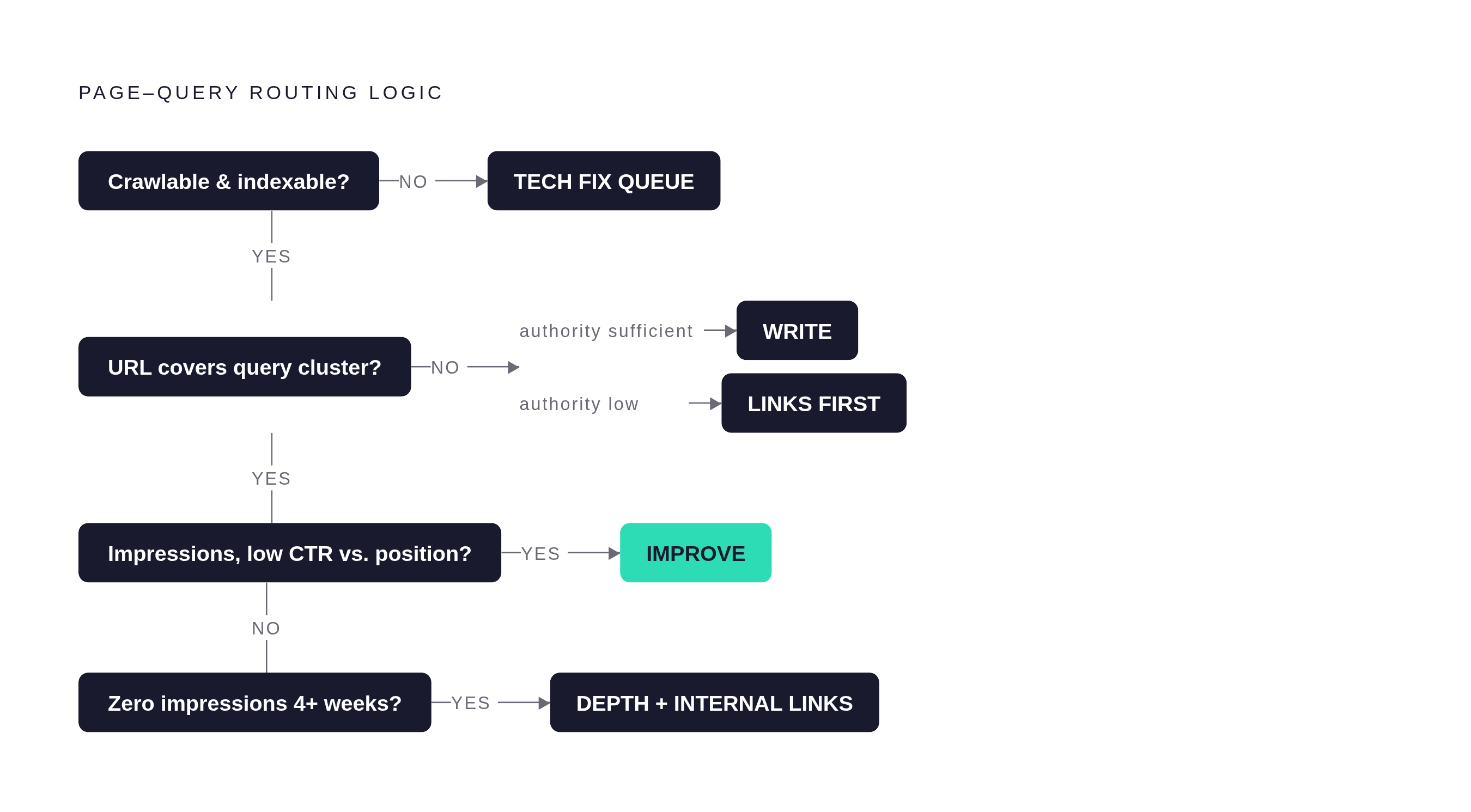
The conditional order is explicit. IF a page cannot be crawled and indexed, THEN send it to the technical fix queue before assigning a bucket. ELSE IF no URL covers the query cluster, THEN assign WRITE when topical authority is sufficient, or LINKS FIRST when it is not. ELSE IF an existing page has impressions but low CTR relative to position, THEN assign IMPROVE. Zero impressions four or more weeks after indexation on a non-competitive query trigger a content depth and internal linking review.
Those rules assign a state that can change over time. Authority assessments and query mappings still require judgment, but once those inputs are set, the assignment follows the conditions. New impression signals reopen the evaluation. The next three buckets define what happens after that decision.
The IMPROVE bucket when a page has impressions but is not compelling enough to click
Impressions with low CTR relative to position mean the page is appearing but not winning enough clicks. That points first toward packaging or freshness. The URL already has a foothold. However, a low click rate does not identify the repair by itself, because search intent and the results page may have changed.
The first check is whether the query still means the same thing. A shift from informational to transactional results may require a structural rewrite. Lost inbound links can also mean a refresh needs to be followed by LINKS FIRST, while missing subtopics in current page-one results identify content gaps. Metadata is the appropriate focus when the results page is otherwise clean. If AI Overviews or featured snippets take the clicks, getting a citation becomes part of the goal instead.
It usually takes weeks to recover as Google re-crawls. Keeping the URL preserves its existing equity, but technical faults still take precedence over the refresh. A render bug on the comparison page that converts best comes before the same bug on a low-value page, whatever the audit label says.
The WRITE bucket when a proven query cluster has no URL and needs one built correctly from the start
WRITE requires both a map showing that no existing page covers the cluster and enough topical authority for a new page to plausibly rank without a dedicated link campaign first. Otherwise, publication is premature.
Publication also creates an internal linking obligation. Every new page must link to two or three existing cluster pages, and two or three existing pages must link back at publication. An orphan page is nearly invisible to Google’s crawler and does little to strengthen the cluster. The blueprint therefore includes heading structure, required depth, and explicitly link-worthy sections such as frameworks, checklists, original research, or unique comparisons.
The stakeholder map shapes that blueprint too. A CISO and a CFO may need different structures even when their pages sit in the same cluster. After publication, the four-week zero-impression trigger sends the page back for review so it does not wait forever.
The LINKS FIRST bucket when authority must arrive before the target page
LINKS FIRST applies when technical access and content completeness are not the limiting factors, but authority is insufficient for the query’s competitive set. More writing does not resolve that dependency. New content on a strong site may rank in weeks, while a lower-authority site may have to wait months. Sequence therefore becomes a resource allocation decision.
Why not publish and build links simultaneously? On a low-authority site, that can commit a writing sprint before the condition needed for ranking exists. The stronger claim that early pogo-sticking or low CTR permanently damages the page is not established by the evidence in the notes. Low CTR at a low position may just mean that few people see the page.
The sequence begins with strengthening existing cluster pages, then developing assets that can earn citations, including research, surveys, benchmarks, proprietary datasets, and industry analyses. Outreach amplifies that existing strength. “Links first” therefore means before the target page. Once the site has enough authority, the query goes back to WRITE.
How the script re-routes when impression data arrives to change the signal
Rising impressions give the script new evidence to interpret. In the B2B SaaS publisher case, impressions rose a great deal over six months while CTR fell by nearly 15 percent. AI Overview exposure gave users enough information in the summary that they did not click. A dashboard could celebrate the visibility increase while missing the change in the page’s role.
The routing depends on the surrounding signal. When impressions rise and CTR falls, the results page needs a check, with citation work to follow if AI summaries take the clicks or an IMPROVE metadata rewrite if they do not. Flat impressions with declining clicks prompt investigation of position losses and the affected queries. Zero impressions after the specified indexation interval return the page to depth and linking review. A sudden impression drop bypasses content work for the Coverage report and URL Inspection, because indexation problems, an algorithm update, or a manual action may be involved.
Why the Search Console impression data has a corrupted window the script must annotate
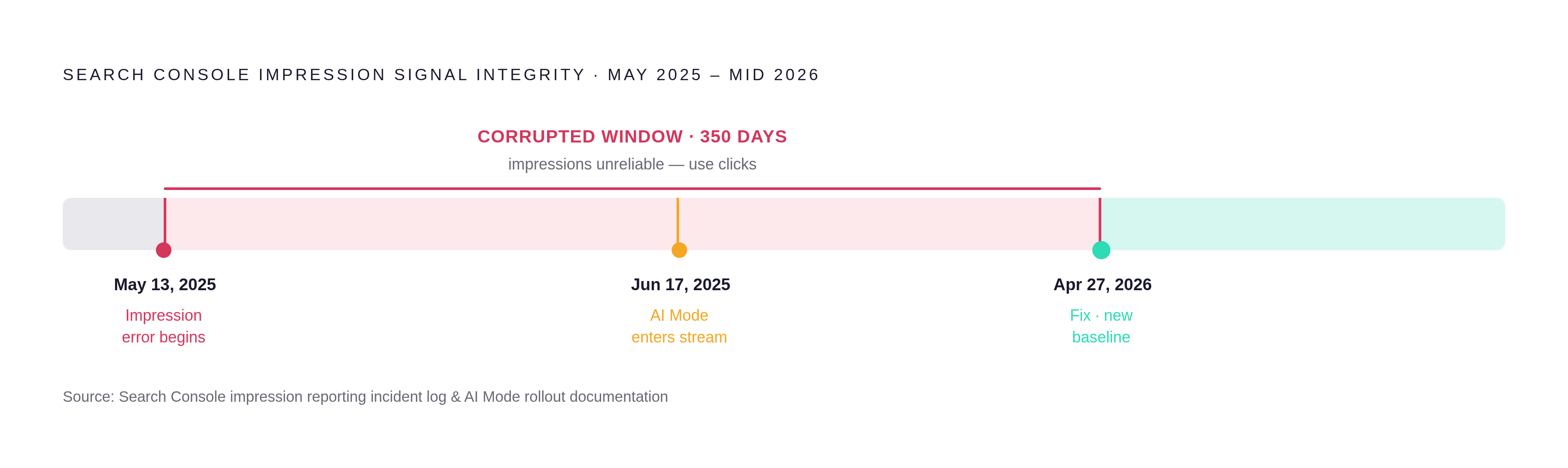
The script is only as reliable as its inputs. Google’s Data Anomalies page says an impression-reporting error began May 13, 2025, and logging was fixed by April 27, 2026. AI Mode impressions also entered the reporting stream on June 17, 2025, adding another change that the script must distinguish from a page’s performance.
Both dates belong visibly in the reporting layer. During the corrupted period, clicks are the primary trustworthy routing signal, with position data used as supporting context where available. Impressions need a new baseline from the fix date forward. Without those annotations, an automatic script can turn reporting noise into unnecessary work, making its apparent decisiveness a liability.
The AI impression layer as a fourth column in the same triage script, not a separate strategy
Google’s dedicated Generative AI performance reports launched June 3, 2026, at first for only some UK-based sites. They cover impressions across AI Overviews, AI Mode, and generative AI features in Discover, broken down by pages, countries, devices, and dates. Data begins May 18, 2026, without historical backfill. This adds a column to the same planning system. An IMPROVE page can now be evaluated against organic CTR and AI visibility together.
The two signals can pull in opposite directions. High AI impressions with low organic clicks suggest a page is useful enough to cite but creates little click intent, prompting review of conversion optimization and passage-level extractability. Low AI impressions with high organic clicks flag ranking-driven traffic for proactive refresh as AI Overviews enter its query categories. Neither pattern changes the basic routing framework. Visibility across ChatGPT, Claude, Gemini, and Perplexity requires separate measurement, because Search Console does not cover those answer-engine mentions.
What the Georgetown case shows about the content-cannot-outperform-the-foundation constraint
The consolidation case puts consolidation inside IMPROVE rather than treating every weak URL as a candidate for another article. When several URLs serve the same purpose, the decision begins by comparing their links, conversions, freshness, and rankings. The strongest canonical destination becomes the place to merge unique value, with redundant URLs redirected. The foundation comes before additional content.
The case’s relevance is the five years of traffic decline that preceded the corrective work. That is what late diagnosis looks like. An up-to-date keyword-to-URL map would flag overlapping pages for consolidation before they drifted for so long. The case illustrates the constraint the script is designed to catch. Routing is useful not only when it identifies something to create, but when it identifies something to combine.
Running the script in practice through cadence, inputs, and human overrides
For a team putting this into practice, the review cadence is weekly for high-value pages and bi-weekly for the broader keyword-to-URL map. The inputs are a live page-and-query export with sufficient history, current URL statuses, revenue-weighted page classifications, and the buying committee role map. The AI impression column is added when it is available. The cadence keeps assignments from hardening into assumptions. Audit findings can go out of date while they wait, so a backlog checked each quarter cannot take the place of regular reviews.
Human review remains necessary at specific boundaries. A strategic topic the company needs to own may override weak current impressions, with the stakeholder map governing that decision. A trigger inside the corrupted data window yields to clicks and supporting position data. A heavily resourced competitor entering the cluster can also change the authority assessment and require the LINKS FIRST threshold to be reset.
The script replaces the meeting, freeing a lean technical B2B team to spend time executing a sound decision instead of repeatedly deciding whether to execute it. Creative judgment still shapes the page, the research, and the response to a changing market.