Why Your Content Calendar Is the Wrong Unit of Analysis
Focus on systems, not schedules, to build authority that wins in AI search results.

A content calendar tells a team when work ships. The better unit of analysis is the content system, which connects publishing decisions, related ideas, production, distribution, and measurement. That distinction becomes more urgent when success means earning a place in AI answers as well as search results.
Why a content calendar is a scheduling artifact, not a strategy
A calendar organizes dates, owners, statuses, and delivery milestones. Those are production commitments. They tell a team whether a piece is moving toward completion, but not what body of expertise it belongs to or how it strengthens something already published. A deadline cannot supply that missing logic.
The confusion is understandable because a full calendar makes an abstract discipline look concrete. Leadership can see what is coming, writers know what they owe, and everyone has a shared account of progress. But progress toward what? A schedule can show that the team is delivering its assignments without showing whether those assignments deserve to exist.
Adding a topic or keyword does not settle that question. Neither explains why this subject belongs to the brand, why this audience needs it, or what relationship the new page should have with the rest of the site. The team must make those choices outside the schedule.
How workflow sophistication reinforces the confusion without resolving it
An elaborate workflow can make this gap harder to see. As work passes through briefing, production, review, approval, and scheduling, the process gives each piece a clear route to publication. It becomes easier to decide who does what and to see where work gets held up. That is a genuine operational gain.
A piece can pass every production stage without anyone resolving what it is supposed to build. Approval may establish that the work meets the brief, while leaving the brief’s strategic purpose unexamined. The publishing date remains the organizing principle.
Sophisticated tooling can make a team fluent in the language of delivery, with precise answers about who owns the next step and when it will finish. That fluency can stand in for harder answers about authority, audience, and connections between ideas. The workflow becomes convincing evidence of control over production, then gets mistaken for evidence of control over outcomes.
Workflow tools usefully solve a different problem. A content system needs reliable production, but production cannot decide on its own which work will deepen the system.
The treadmill effect: why a full calendar still produces a fragmented site
The visible symptoms appear on the site itself. Posts rank briefly and then fade, internal links get added as cleanup, and topics accumulate because each sounded reasonable in a planning meeting. A team can ship every week for a year and still struggle to explain what the resulting collection establishes.
Each assignment may look defensible in isolation. It has a topic, a keyword, a publish date, and an assigned author. Taken together, however, those fields encourage the team to treat each post as an independent deliverable. Once it ships, attention moves to the next one rather than to the relationships that could make the published work more useful.
A second assumption compounds the problem. Covering more subjects seems like a way to reach more people, but breadth can dilute the signal of what the brand actually knows. If every new page opens another subject, few pages extend an existing body of expertise. Cadence does not automatically create cohesion.
Authority instead develops through depth, clarity, and repeated treatment of a smaller set of ideas. Repetition here means returning to a subject through related questions. It establishes that the topic belongs to the brand’s knowledge. That is the missing source of momentum when a full calendar produces a fragmented site.
Why AI answer engines make fragmentation acutely more costly than it used to be
Fragmentation was already a weakness in search. In 2026, it also creates a gap across a discovery landscape that includes traditional organic search, social feeds, and AI-powered answer engines. A publishing plan organized around dates can serve the first two surfaces while leaving the third largely unexamined. The team may be shipping consistently without asking whether its work is available as evidence in an AI answer.
AI answer engines can assess thematic depth beyond an individual page. A collection of deeply connected articles on a specific subject presents a different authority signal from one article on a generalist site. The relationships between pages become part of the case for treating the brand as a source.
The weighting of signals also differs across surfaces. Topical depth, named authorship, and original data have high weight in AI search, while backlinks have lower weight than they do in traditional search. Freshness adds another demand. Publishing a page and moving on leaves no built-in reason to revisit it, even when recency influences whether it earns a citation.
An individual article has value, but judging it only as a completed assignment misses the context in which it competes. A calendar cannot show whether the rest of the site backs up its claims, goes deeper into its subject, or keeps that knowledge up to date. What was always a strategy problem is now also a visibility architecture problem.
What the right unit of analysis — the content system — actually contains
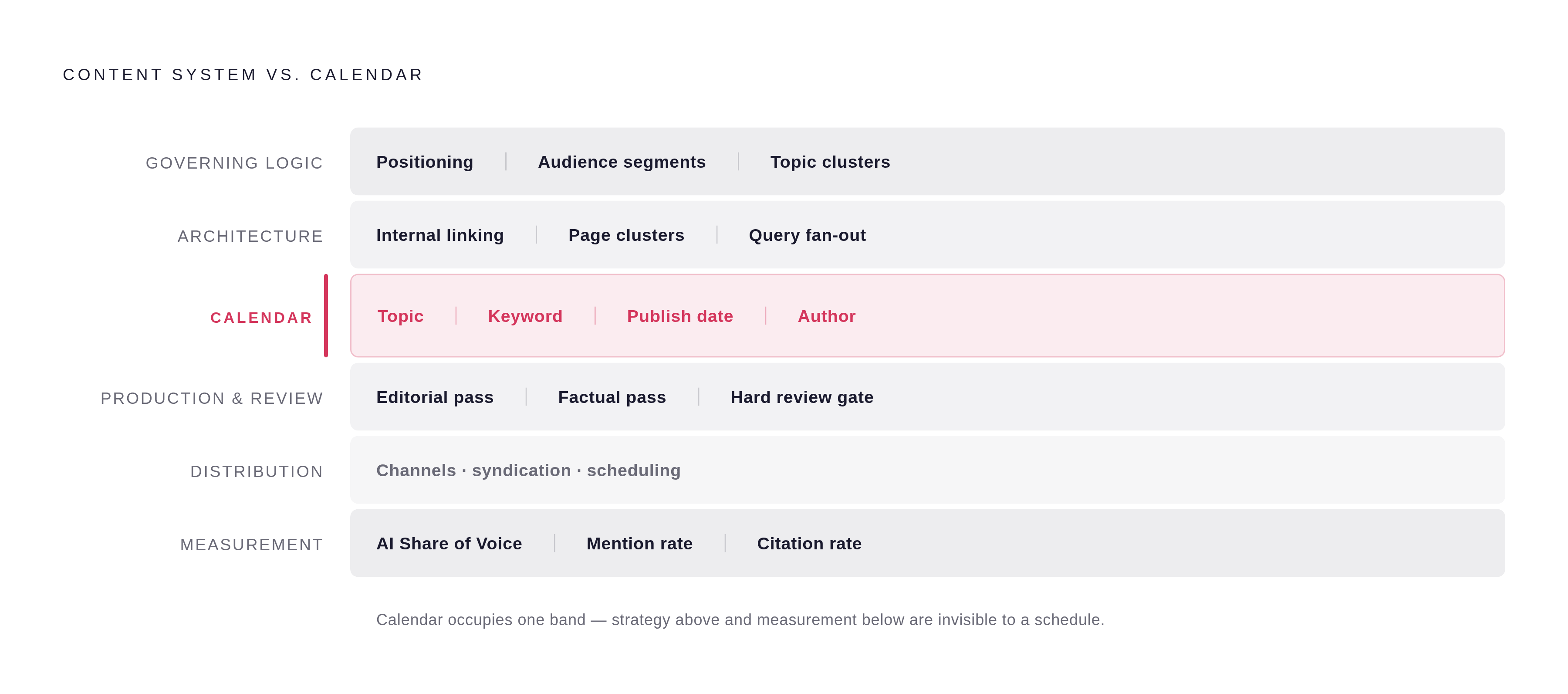
A content system begins with governing logic. Positioning establishes what the brand has a reason to say, audience segments establish whom it serves, and topic clusters organize the subjects it intends to cover in depth. These choices give each assignment a reason to exist before it gets a date. The calendar sits downstream of those decisions.
Architecture then turns that purpose into relationships between pages. Internal linking belongs in the design of the site, before there is a need to fix links after publication. A page belongs to a cluster because it develops a related concern. The page is evaluated by how it strengthens the surrounding explanation.
Query fan-out helps explain why this structure is useful. Search and AI systems expand a question into related concerns and adjacent concepts rather than treating it only as a single isolated request. A site with one page on the subject has limited depth to support that expansion. A connected body of work can address more of the question’s branches without abandoning its central expertise.
The system also contains production and review, distribution, and a measurement cycle tied to outcomes. These are not separate administrative extras. Production turns the governing logic into publishable work, review tests its quality, and distribution connects that work to the surfaces where people discover it. Measurement then shows the team whether those choices help its work get seen.
There is also a time dimension to that evidence. A system balances work aimed at near-term conversions with authority assets that pay off over time, so each page is judged on more than the response it gets right away. Otherwise, the demand for short-term results can crowd out the work that makes future conversions cheaper. The unit of analysis must be broad enough to include both the page’s immediate job and its contribution to the larger body of knowledge.
How AI-assisted pipelines with human review gates fit inside a content system
Production inside this model has to support coverage without weakening trust. AI-assisted pipelines make that cadence feasible, but generation alone does not provide the properties that earn citations. A pipeline can produce more work and more factual errors at the same time. Human review is the constraint that prevents speed from becoming the system’s only standard.
The working principle is “draft fast, review slow”. AI helps with structure and coverage, while humans are responsible for claims, voice, and getting the facts right. A hard review gate blocks publication when a piece fails the required quality checks. Without that gate, the system has a route to publication but no dependable point at which someone can stop it.
For teams using this model, every published page should have a human owner who answers for whether its facts are right. The minimum viable gate has two passes. An editorial pass examines structure and clarity, while a factual pass examines claims, calculations, citations, and legal sensitivity. Keeping those checks separate helps the team avoid assuming that a piece has its facts right because it reads well.
Microsoft’s July 2026 preprint by Russinovich, Ram Shankar Siva Kumar, and Salem illustrates the risk. The researchers audited tens of thousands of accepted papers and found that hallucinated citations had entered the permanent scholarly record. A marketing team drafting at scale faces the same kind of trap at lower stakes but higher volume, which makes checking claims and citations a production requirement.
Measuring the content system: AI Share of Voice instead of slots filled
Traditional rank tracking shows organic search positions, but it does not show whether a brand appears inside an AI-generated answer. When an AI session ends without a click, that appearance may be the only impression the brand earns. Post count cannot reveal it, and referral traffic captures only the visits that follow.
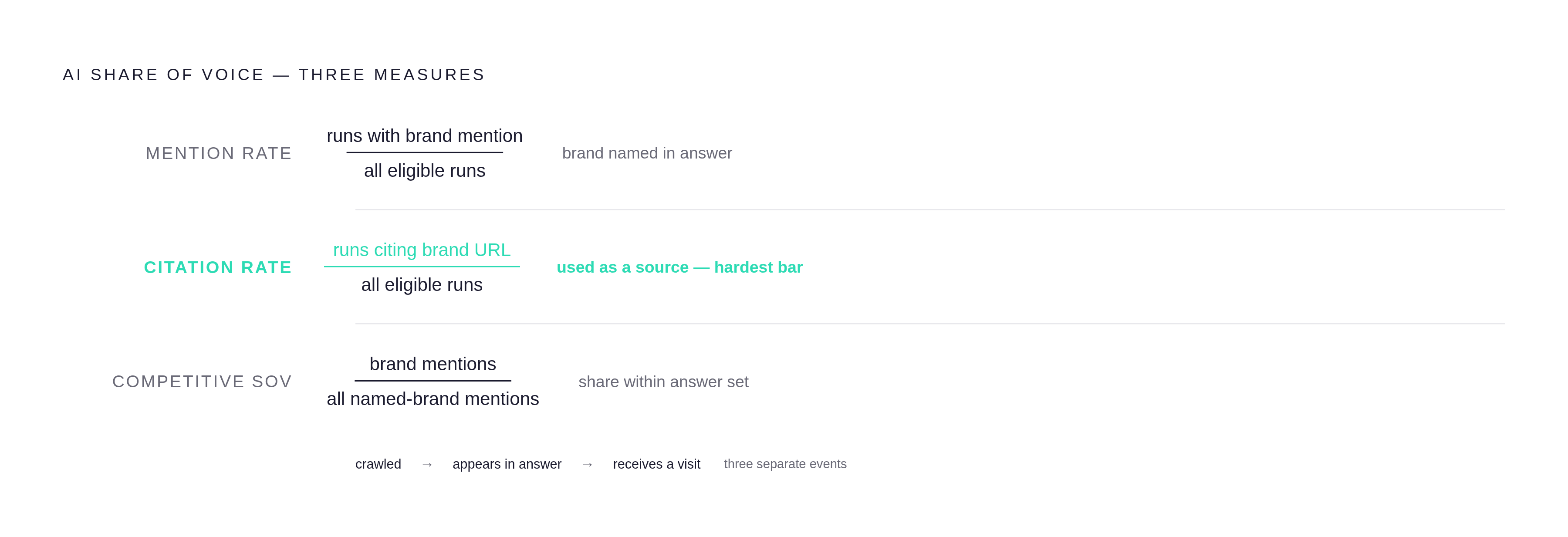
AI Share of Voice tracks whether a brand appears when a defined set of category prompts is run more than once. One version measures the percentage of analyzed answers that mention, cite, or recommend the brand. A competitive-share version instead measures the brand’s mentions relative to all brand mentions in the same answer set. Both show whether the brand gets seen, but they have different denominators, which must be clear.
For reporting, mention rate is the number of eligible runs containing a brand mention divided by all eligible runs. Citation rate is the number of eligible runs citing a brand-owned URL divided by all eligible runs. Competitive share of voice compares the brand’s mentions with mentions of all named brands in that answer set. These measures distinguish appearing in an answer from being used as a source.
Each engine also needs separate treatment. Claude draws from training data by default and does not provide live source citations in that mode, so presence in its training corpus is relevant. Its web search, available on all plans, retrieves current information and returns direct citations. ChatGPT and Perplexity behave differently, so their results cannot simply be pooled as though every engine and mode offered the same exposure.
Repeated runs are essential because answers are not stable rankings. SparkToro and Gumshoe’s January 2026 study found that the same brand list rarely repeated across runs of the same prompt in ChatGPT and Google AI, and almost never in the same order. Repetition patterns vary by engine. So a single snapshot gives the team little to go on when judging whether the system is getting seen more often.
Checking GPTBot, ClaudeBot, and PerplexityBot in server logs shows which pages AI platforms are crawling, while filtering sessions from AI platforms in GA4 shows the traffic that comes from them. Neither measure substitutes for answer-level tracking. Crawling, appearing in an answer, and receiving a visit are different events.
Google’s official position provides a serious counterargument. Original, expert content and solid SEO remain the foundation for earning citations in AI Overviews, and no AI-specific tactics are needed. That principle is sound because AI Overviews retrieve from an index responsive to standard SEO signals. The gap is in treating organic rank as a complete measure of visibility when AI Overview citations also come from outside the top ten organic results.
A deliberate content system connects SEO, topical depth, named authorship, original data, and distribution across surfaces, then measures the resulting presence in answers as well as search. Measuring AI Share of Voice is necessary to measure whether a team’s content system is working. The calendar told the team that posts shipped. The system must show whether they are building anything.