Orphan pages are a graph property, not a content problem: compute them, gate them in CI, and make the link map legible to agents
Detect zero-inlink pages in the build, block them, and review fixes.
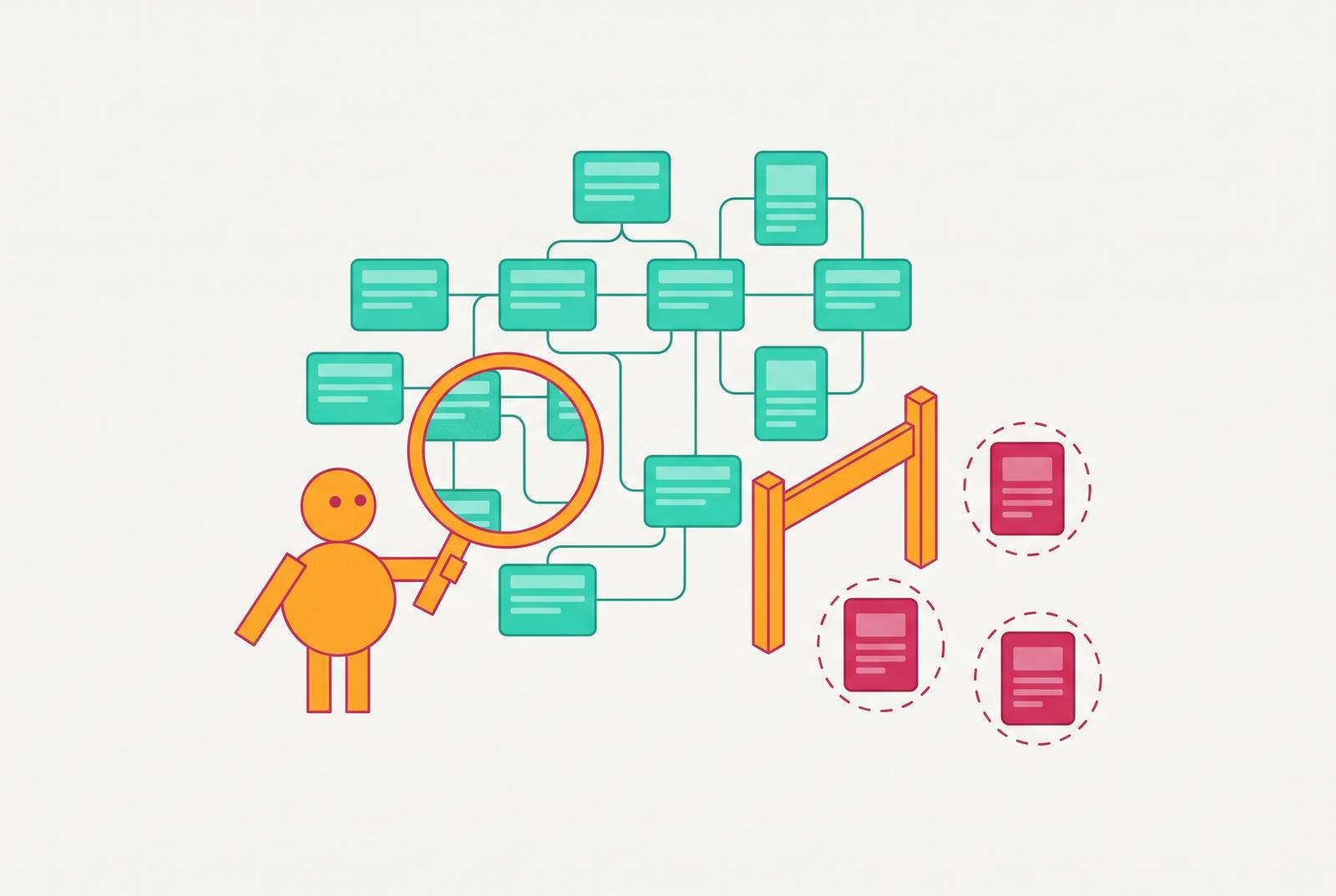
Orphan pages are a link-graph problem. Their defining feature is computable, so detection belongs in the build pipeline. Engineers should check rendered links, block new orphans in CI, and have people review proposed repairs. That creates a site that crawlers and AI agents can traverse, without confusing discoverability with a promise of citation.
Why orphan pages are a graph property, not an editorial problem
A website’s internal links make up a directed graph. Each page is a node, and a link from one page to another is a directed edge. An orphan page is a URL that exists on the domain but has in-degree zero. That definition contains no judgment about the writing. A useful, accurate page can be structurally isolated just as easily as a poor one.
What if the page appears in an XML sitemap or has external backlinks? Those can provide other discovery routes, but neither supplies an inbound edge in the site’s internal graph. The distinction is important because the missing edge has specific consequences. The page receives no PageRank flow through internal inbound links and gains no anchor-text context from other pages on the site. Improving its copy does not repair either absence.
Google’s guidance explains that Googlebot finds most new pages by following links from pages it has already visited. An orphan provides no internal trail to follow. Detection asks whether any other page points to it. Once that question is explicit, the site’s rendered links become the evidence.
How orphan pages accumulate silently in production systems
A navigation redesign may remove paths to older posts while leaving the posts as they were. A category restructure can break the taxonomy path that was the only way to reach a URL. The content still exists at its address. What changed was the surrounding graph, so a review focused on the page itself may miss the loss.
Publishing workflows can create the same condition from the other direction. Programmatic SEO templates may render large amounts of content without any logic that emits links from existing pages. The template has fulfilled its content-producing role, but the new nodes have no inbound edges. Content migrations can likewise import URLs into a new CMS without importing their inbound internal links.
Campaign and landing pages expose another version of that gap. They may be created as one-offs and never connected to the main site architecture. Nothing about their existence proves that the site offers a route to them. The shared failure is not necessarily careless writing or publishing, but a workflow that treats the URL as the whole unit of change.
A page can still load after the links to it disappear, and a publishing system can create content without checking those links at all. Orphans are the extreme end of internal-link poverty, where a page has few routes leading to it before losing the last one. Periodic audits may reveal the accumulated damage, but they do not explain it away as neglect. The common gap is that no internal-link check is attached to the publication event, allowing the graph to drift between audits.
Why crawling alone cannot detect orphans, and what detection actually requires
A crawler follows the paths available to it. If it starts from the site’s linked entry points, it cannot discover an orphan by following internal links, because no such link points to that page. A report of everything reached says nothing by itself about what was missed. Detection needs a second list that does not depend on the same traversal.
That second list contains the URLs that should exist, drawn from the XML sitemap, analytics, and Search Console. Comparing it with the URLs reached through internal links gives a set difference, which lists the expected URLs that the crawl missed. This is the core detection operation. For the precise in-degree-zero definition, the rendered graph must also establish that those URLs have no inbound internal edges, rather than merely treating every unreachable URL as structurally identical.
The input becomes especially important in script-heavy stacks such as Next.js and headless CMS deployments. If navigation depends entirely on the browser assembling the links, bots can receive an incomplete graph even though the intended navigation looks complete to its developers. Source templates are not enough to settle that question. Detection needs post-build rendered HTML so that it measures what the build emits. Google’s link guidance identifies an <a> element with an href attribute as the generally crawlable form and warns that script-driven alternatives cannot be reliably extracted.
A true orphan has no internal link from any crawled page, while a page with no contextual inlinks may still have links from navigation, footers, tag pages, or related-post widgets. Those are not the same condition. A weak page has exactly one contextual inlink, leaving that contextual support one edit away from disappearing. If that link is also its only inbound internal edge, removing it creates an orphan.
True orphans lack internal inbound PageRank flow entirely. Pages linked only through navigation are structurally connected but lack the relevant body-copy context that contextual links provide. Weak pages need attention because their support is fragile. The computation establishes the condition, while the category helps determine the response.
Encoding orphan detection as a deterministic CI gate
A periodic audit runs after the publication decision. By then, an orphan has already been deployed, and an AI answer engine may have encountered it without the internal support the site intended to provide. Placing the same test in the build pipeline changes its role from reporting an existing defect to blocking a deployment that introduces one.
A GitHub Actions workflow, or an equivalent CI step, can parse anchor href values from post-build rendered HTML and extract the expected URLs from sitemap.xml. It then compares those sets to find sitemap URLs that are missing from the internal link graph. The algorithm is small. The step can exit non-zero when the orphan count exceeds a configured threshold, or raise a blocking warning.
A sitemap URL can have a corresponding HTML page and still have no inbound internal links. Checking only that the file exists would reproduce the publication gap in another form. Parsing the anchors supplies the missing evidence about edges. With the same rendered output, inventory, and configured rules, the detector should make the same deployment decision.
Zero tolerance for new orphans blocks any new sitemap URL absent from the crawled link graph. A regression check can flag a page that falls from two or more contextual inbound links to zero, while keeping that contextual loss distinct from complete orphan status. A further warning can trigger when the sitemap URL count exceeds the crawl-discovered count by a configured percentage. These checks answer different questions, so a count mismatch should not replace page-level evidence.
Screaming Frog version 24 added an MCP server that lets an AI assistant run crawls, analyse them, and export data from a chat window. That allows more of the loop to run on its own, from crawling and orphan detection to suggesting links, drafting anchors, and making a file for review. The tool illustrates where the workflow is heading. It does not change the underlying test or remove the need to decide which operations may write to the site.
Human review as a non-negotiable gate in the link-suggestion pipeline
Adding a link redistributes authority and alters the semantic signals connecting pages, so the safety of automatic detection does not establish the safety of automatic edits. This is where editorial judgment properly enters the process. Editorial judgment is needed to decide whether a proposed edge belongs.
AI can do useful work before that decision. It can group pages into topic hubs, make a shortlist of source pages, pick a paragraph for a possible link, and suggest anchor text without writing anything to the live site. These outputs give a reviewer concrete choices. The reviewer must still judge whether the relationship is semantically appropriate, whether the anchor could create cannibalization, and whether the source page’s authority should be concentrated elsewhere. A mechanically valid link is not automatically a good editorial connection.
WebKnoGraph, submitted in June 2026 as an arXiv paper, examined that trade-off using a production crawl of Kalicube.com. Automatic selection produced stronger authority redistribution but larger semantic coherence costs. Expert-assisted selection better preserved semantic coherence and achieved the highest Authority Yield when targeting low-PageRank pages. The result supports a hybrid approach.
In practice, that approach begins with an automated crawl and automated detection of orphan, weak, and deep pages. Automated topic clustering follows, with a human sanity check before candidate links are suggested. Each suggestion then reaches a human approval or rejection gate. Only after deployment does the workflow measure changes in authority and semantic coherence.
Human approval also changes what counts as a completed repair. A lower orphan count shows that connections were added, but it does not show whether those connections preserved the site’s topical logic. Post-deployment measurement addresses that separate question. The aim is not simply to distribute links until every node has an edge.
What graph-theoretic link repair means for AI agent traversal and citation eligibility
For AI agents, an internal graph provides routes to passages as well as context about how pages relate. An orphan interrupts that route before traversal can begin. Google’s stated eligibility requirement is that a page be indexed and able to show a snippet. Internal orphan status alone does not show that a page has failed either test.
Guidance from practitioners for 2026, independent of official Google standards, says extractive passages should be within two internal link hops of the homepage to help with AI search discovery and citation by making them easy to reach from an authoritative entry point within the linked structure. An orphan lacks that internal route, although a sitemap or external backlink may still make it discoverable elsewhere.
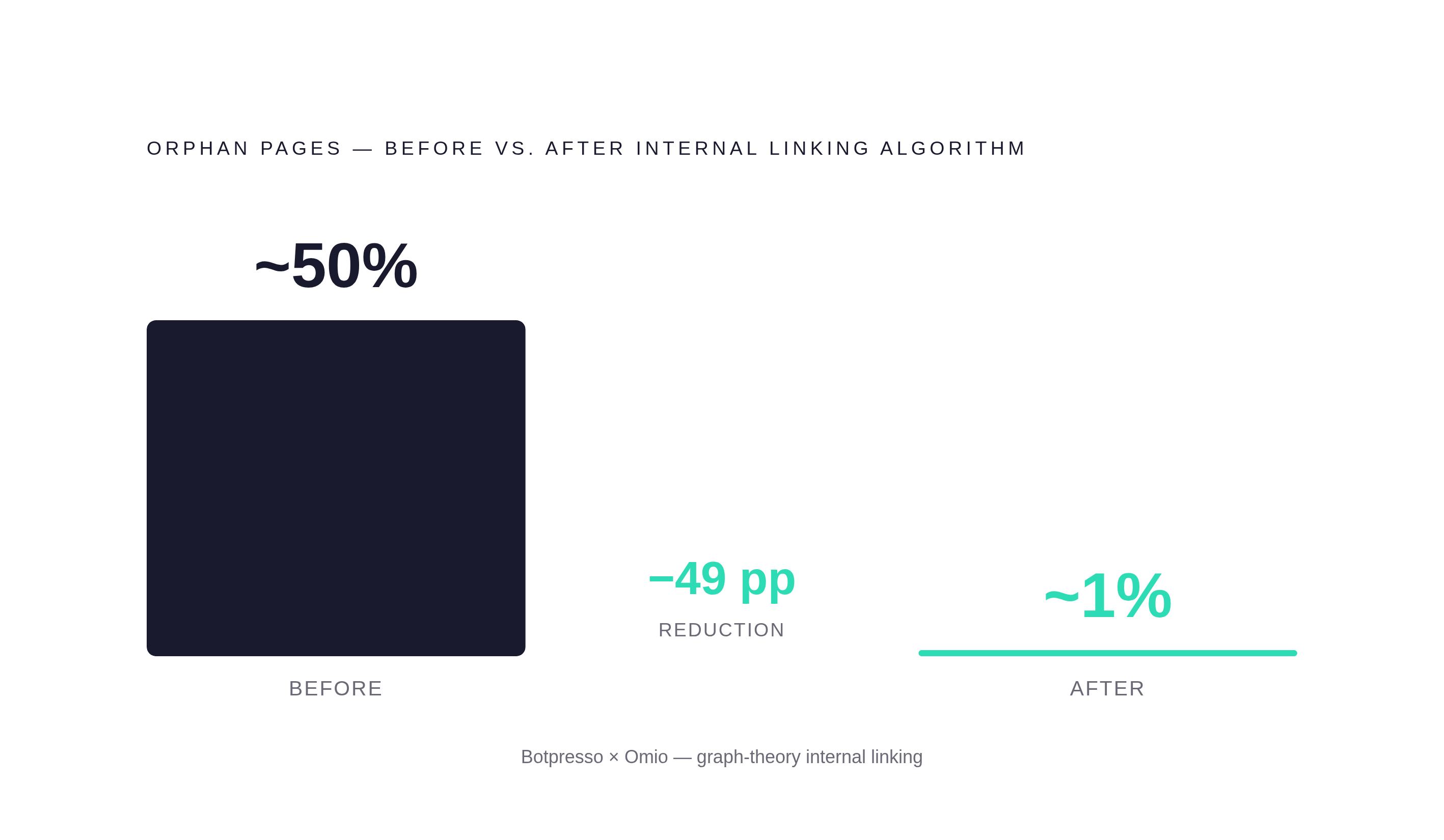
Making the map legible requires more than eliminating isolated nodes. Clear hub pages, consistent bidirectional cluster links, and limited click depth give an agent a structure it can traverse without ambiguity. Botpresso’s published Omio case study says a graph-theory-based internal linking algorithm cut orphan pages from roughly half of all pages to approximately 1% across the domain before the site added more pages. That is a concrete traversal improvement. It is not, by itself, evidence that AI answer engines cited more of those pages.
Repairing the graph removes a barrier to internal discovery, while content quality and topical authority still influence whether a page becomes a useful citation source. A page-one Google ranking and a citation in a ChatGPT, Claude, Gemini, or Perplexity answer are different outcomes driven by different signals. The CI gate can establish that a passage has a route into the site’s linked structure, but only citation measurement can show whether an answer engine chose it.