Programmatic internal linking is a graph engineering problem — and SEO tools are finally catching up
SEO tools now treat link architecture as a measurable system, not an editorial checklist.
Programmatic internal linking is a graph engineering problem. Its success depends on where links direct attention and authority across a site. SEO tools are finally catching up to that distinction, turning link architecture into something teams can design, measure, and deploy as a data system.
Why internal linking is a graph problem, not an editorial one
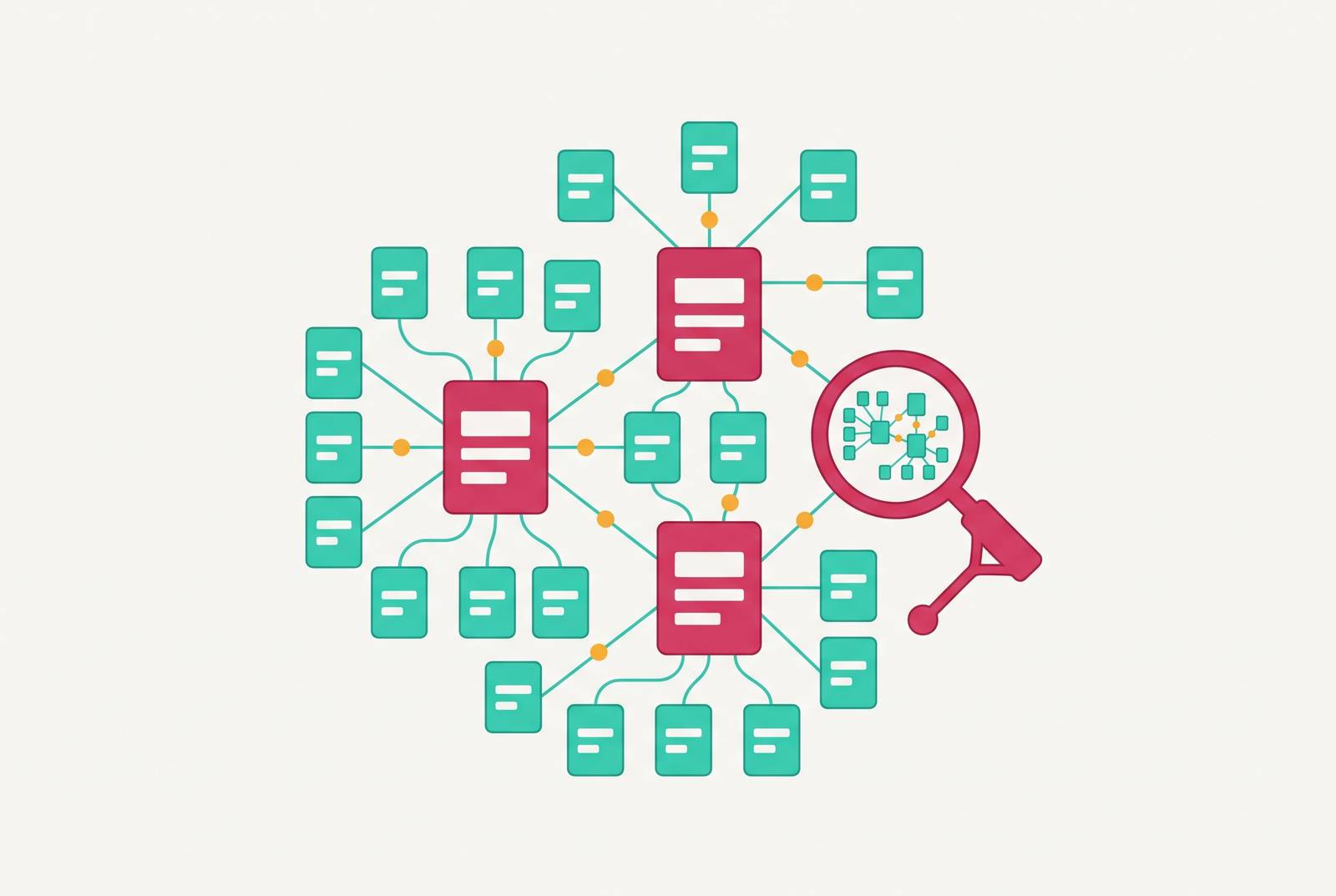
A website is a directed graph. Pages are nodes, and links are edges pointing from one node to another. That direction is the central design choice because PageRank-style propagation distributes authority through those connections. Adding links changes the graph, but it does not necessarily improve where authority lands. An editorial checklist that asks whether a page contains internal links misses that distinction.
The original PageRank formula makes the connection explicit. Its damping factor of 0.85 models the probability that a user follows a link, with a jump to a random page as the alternative. A link therefore participates in a distribution of probability mass across the graph. A connection’s value depends on both whether its destination deserves a mention and what role it plays in the site’s wider structure.
72Technologies describes intentional linking as a recommendation-system problem, with the graph sketched before the template is built. That framing explains a familiar programmatic failure. Templates ship, pages become indexable, and repetitive links make almost every page roughly two clicks from every other page. Yet proximity alone establishes no priorities. Without a hierarchy that concentrates authority, the site can be easy to traverse while its rankings remain mediocre.
The topological pathologies that cause structural collapse
The first diagnostic distinction is between orphan pages and dangling nodes. An orphan page has no inbound internal edges, while a dangling node has no outgoing edges. An orphan has no internal discovery path and gets no authority through internal links. A dangling node can receive authority but provides no outgoing route for redistributing it.
That difference becomes important in a stochastic transition matrix, which represents the probabilities of moving between pages. A node with no outgoing links leaves that transition undefined unless the calculation handles it. Rank leakage describes the resulting problem in an untreated model. Google has stated that internal links help Googlebot discover pages and understand their relationships.
Too much crawl depth puts nodes too far from the root, while link dilution spreads what a node passes on across too many destinations. Dilution is arithmetic. A flat graph has a different flaw because its pages all have much the same weight in the structure. Repetitive anchors compound that lack of distinction, leaving a collection of pages without hubs that make its priorities legible.
These defects can coexist within the same site. Some leaves can still be buried or cut off even when the central network is flat. That is why a count of internal links cannot diagnose the architecture. The graph needs to reveal which pages connect, in which direction, and with what concentration of authority.
How the tiered graph architecture fixes authority flow
The 72Technologies model allows three or four tiers, with the four-tier version starting at Tier 0 with the homepage and a handful of pillar pages. Tier 1 contains category hubs such as /plumbers/london. Tier 2 contains sub-hubs or filters such as /plumbers/london/emergency. Tier 3 has the long-tail leaves, which include individual listings, comparisons, and combinations of a location and a service.
Direction then defines the hierarchy in practice. Navigation leads down to more specific pages, and breadcrumbs and canonical hub links lead back up. Sideways links connect semantically related siblings. This gives a leaf both a place in the hierarchy and a set of relevant neighbours. It also separates broad navigation from recommendations between closely related destinations.
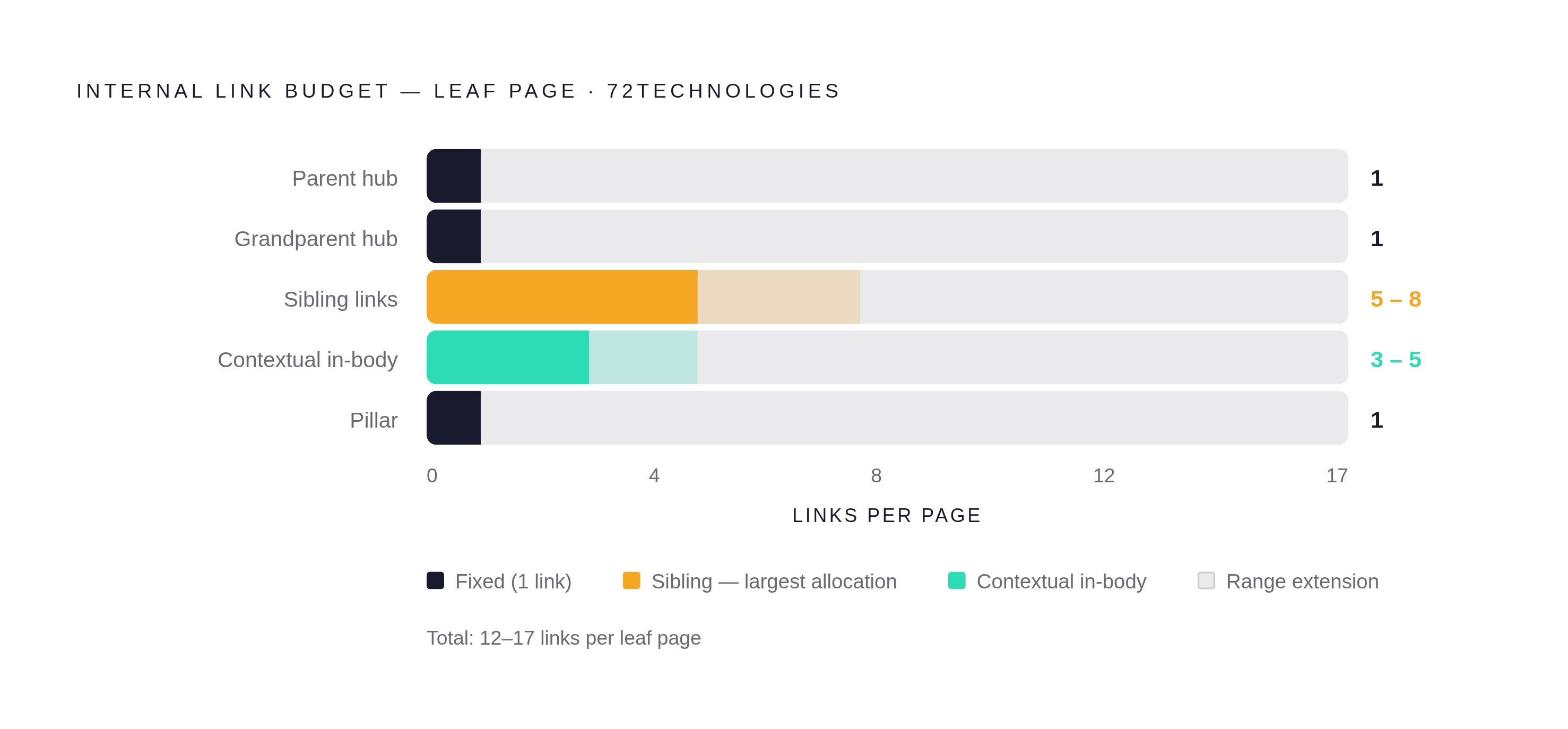
The source’s leaf-page budget makes that design concrete. It allocates 1 link to the parent hub, 1 to the grandparent hub, 5–8 sibling links, 3–5 contextual in-body links to related leaves, and 1 link to a relevant pillar. That produces roughly 12–17 internal links per leaf. The contextual range also limits how much the body copy becomes a vehicle for distributing equity.
Hubs cannot function only as link grids. The source calls for real editorial copy and a hub that ranks for its own keyword. Each leaf also links back to exactly one canonical hub. That rule gives each leaf one parent and still allows the grandparent and pillar links in the budget.
The sibling selector problem: replacing random with principled
The related-pages block is where a coherent architecture often becomes templated noise. Picking pages at random can keep to a link budget but miss why two pages belong together. A similarity score gives that choice a basis. It turns the block into a recommendation mechanism. SQL is sufficient for the selector described here.
The 72Technologies example scores candidates on category match, city match, price tier, and service-tag overlap. Its eligibility filter is p.status = 'indexable', excluding destinations that should not receive links from the block. It then uses ORDER BY score DESC, p.click_depth ASC. Similarity comes first, with click depth breaking ties. The “related” rules are explicit enough to inspect.
The sort direction deserves close attention here. Ascending click depth favours shallower pages when scores tie. The published query gives no support to the claim that this tie-breaker pushes equity toward buried pages. That distinction illustrates why implementation details belong in the SEO discussion. Before a selector’s effect can be judged, the order it uses must match what it is meant to do.
The choice of anchors needs to be as stable as the choice of destinations. The source recommends rotating structured patterns such as {Service} in {City}, {City} {service}, and {Service} near {Neighbourhood} deterministically by target page ID. That keeps anchors from changing at random with every request. It also introduces variation without abandoning a controlled vocabulary or making every link from a London plumber page read “Plumbers in London.”
Measuring the graph: PageRank proxies, crawl depth distribution, and indexation rate
A designed graph still needs observable outputs. Click depth distribution shows how far pages sit from the crawl’s starting point, plotted against page count. Screaming Frog and Sitebulb both have crawl-depth views, and a custom crawler can give the same graph. The distribution reveals more than an average. It exposes whether a substantial part of the site sits beyond the well-connected core.
An internal PageRank proxy asks a different question. A PageRank-style iterative algorithm produces normalized scores that show where authority concentrates within the crawled graph. Sorting those scores can expose weakly supported pages even when their raw inbound-link counts look healthy. Those pages are not technically dangling nodes. Their problem is that their incoming edges originate from nodes with little equity to pass on.
Indexation rate connects that structural analysis to an outcome. It measures the share of submitted pages that are actually indexed, so crawl data needs to be read with submission and indexation data. A crawl alone does not establish that share. Together, these measurements distinguish changes in access, changes in authority distribution, and changes in search inclusion.
WebKnoGraph formalizes the comparison of possible interventions. Submitted to arXiv in June 2026, the framework examines authority redistribution, volatility, loss-gain balance, and semantic coherence. It uses a production crawl of Kalicube.com and evaluates link selection in an empirical web-corpus-based host graph and a synthetic Barabási–Albert host graph. The value is a way to compare candidate link sets before live outcomes become difficult to attribute. Its authority metrics remain models to be considered alongside observed indexation or rankings.
Why the SEO industry is only now catching up to what graph theory already knew
The delay was not a shortage of graph theory. The industry optimized for what was easy to screenshot and sell. A crawl report with a few link suggestions fits that model well. A programmable graph model embedded in a publishing workflow demands a different kind of product. So internal linking stayed an afterthought in tools built to produce reports.
The available building blocks now support a different approach. SQL-based semantic selectors, open-source PageRank libraries, and frameworks that compare competing graph objectives put this work within reach of engineering teams without a research budget. A team can express a linking rule, calculate its likely effects, and make it part of a repeatable workflow.
The incentives have shifted toward that work too. As link building costs more and yields less quality, a site’s internal structure becomes more appealing because teams can control it, while the growing weight of topical authority rewards coverage that fits together. Every new page also creates potential connections across the existing corpus. A backlink, by contrast, is a discrete acquisition that may not persist. This is marketing becoming an engineering discipline, with compounding structure replacing isolated edits.
An arXiv submission is not proof of peer review. The framework’s significance is its treatment of internal linking as a formal intervention problem with explicit evaluation criteria. That is a stronger foundation than another checklist.
How link graph architecture now determines AI citation eligibility, not just search ranking
The same architecture also affects how clearly machine readers can interpret a site’s topical coverage. A hub connected to relevant sub-hubs and leaves expresses relationships that a flat collection leaves implicit. It makes coverage legible through structure as well as text. That gives link architecture a role in AI citation eligibility, beyond its established role in crawl access and authority distribution.
Eligibility is not the same as a promised citation. The notes’ approximate 12% citation rate for pillar-topic queries on sites without hub-and-spoke linking is not a universal threshold. Nor does a disconnected graph establish that an AI system will cite none of its pages. The sounder distinction is between clearly expressed topic ownership and coverage that a machine must infer from scattered pages. Link structure supplies evidence of that ownership.
This extends the measurement task beyond conventional search. Googlebot-related outcomes include crawl frequency, indexation, and authority concentration on priority templates. AI visibility requires a defined prompt set run regularly across core AI surfaces, with automated parsing for brand mentions, citation sources, sentiment, and position. Citation overlap across engines is low. A single engine therefore cannot stand in for the wider picture.
The investment serves two discovery systems, but its results still need separate observation. Better crawl coverage alone does not show that AI visibility has improved.
Deploying link graph changes as a pipeline, not a one-time edit
Architecture changes should follow a CI/CD-style pipeline. Teams model the graph and define its tiers and edge directions before they write the code for templates. Linking rules then live in templates and run at publish time. That makes the architecture part of the publishing system. It is no longer dependent on someone remembering to add links after publication.
A pilot limits the scope of the first deployment. The pilot should start with one to five templates, followed by validation through crawl logs and Search Console before expansion. Automated CI checks guard against broken edges, noindexed targets, and link-budget overruns. These checks test whether the deployment obeys its rules. They do not decide whether every suggested connection belongs in the content.
That decision remains at the human editorial gate. A reviewer approves suggestions and removes forced links before they ship, preserving the ability to reject a mechanically valid recommendation. Without it, a system can make plenty of links that follow its code but fail to fit the content.
After deployment, crawl-depth distribution and indexation tracking provide the feedback needed for iteration. Rollback automation supplies a response when a change degrades coverage. The resulting workflow ties a proposed graph change to validation, approval, and observed outcomes. That is the engineering standard internal linking should meet, rather than a quarterly edit whose effects nobody can isolate.