How AI decides which products to recommend — and what it means for your marketing stack
AI recommendations favor visible, well-documented brands over quality or cost.

AI product recommendations turn a brand’s public web presence into a commercial advantage, but not necessarily one that reflects product quality. This changes what marketing teams need from their stack. Winning a place in an AI-generated shortlist depends on structured content, credible proof and measurable visibility, making it a software and data problem.
How AI recommendation engines actually work — pattern matching on public web signals, not ad spend or intent
Nature Health published a large-scale evaluation on 26 October 2026 that tested five leading LLMs across a large battery of synthetic recommendation scenarios and found that their outputs converged overwhelmingly on the same products. The study concerned drug recommendations, but it exposes a broader question. What makes a product easy for an AI system to recommend? The findings suggest that recommendations track how visible products are to the public more closely than they track practitioners’ choices or the evidence behind those choices.
Here, “famousness on the open web” means something more specific than name recognition. It means a deep web presence, structured and retrievable information, and documentation that other sources cite. Those signals give a model material from which to construct an answer. Campaign intent is not the same input. A company’s desired position in the market does not establish whether its product is clearly described, consistently referenced or supported by accessible evidence.
That distinction puts legibility at the centre of the problem. AI recommendations reflect patterns in the information available about products. Public prominence can therefore become a proxy for suitability even when the two differ. Engineering must make a brand’s information readable and credible enough to enter that pattern.
Why this matters outside pharmaceuticals — AI recommendations are now a purchase-funnel event for any product category
Jasper’s GEO and AEO guide notes that users often go directly to LLMs for answers they previously would have sought through search. For B2B and consumer products, users ask for recommendations, comparisons and help with particular uses. An answer can take a buyer from discovery to a decision without a website visit. The shortlist can form before a click happens. A brand missing from that answer has a purchase-funnel problem.
The Nature Health study projected that following LLM recommendations rather than actual prescribing patterns would raise annual pharmacy acquisition costs enormously, driven by a preference for high-visibility brands over cost-effective alternatives. A visible product can capture demand that a comparable or superior alternative might otherwise earn. That explains why recommendation visibility deserves commercial attention.
Nor is visibility portable across AI systems. Citation volumes for the same brand can differ by hundreds of times between platforms. Buyers may encounter very different shortlists depending on where they ask.
Why classic SEO and analytics stacks cannot see this problem, let alone solve it
Traditional SEO analytics measures impressions and positions on search engine results pages, while website analytics tracks visits and what users do next. Those tools were built around links and clicks. An AI-generated answer can bypass that entire sequence by supplying a recommendation directly. If no visit follows, website behaviour cannot reveal whether the brand was recommended, ignored or never considered in that response.
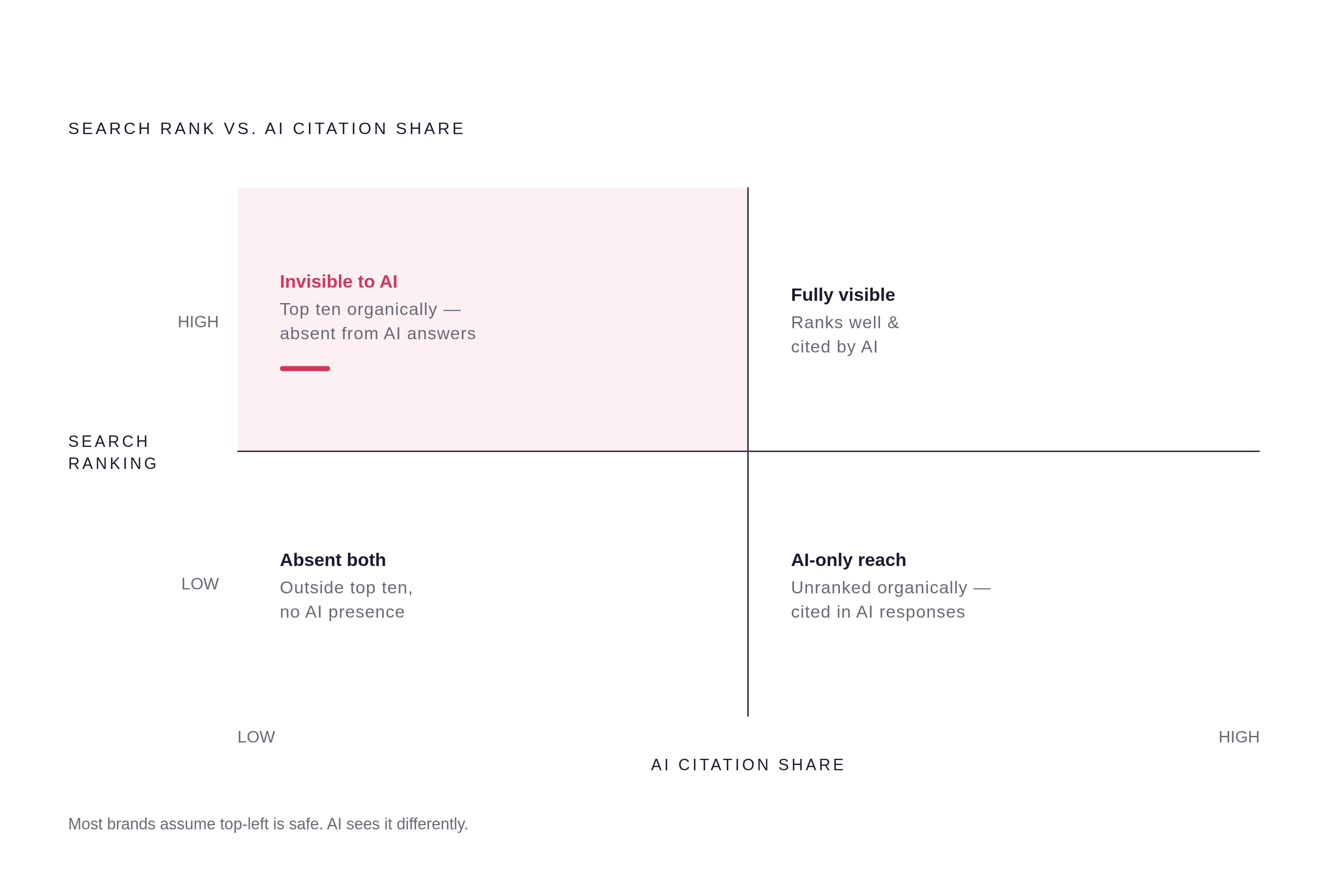
Strong rankings do not resolve that uncertainty. A brand can rank well organically and still be absent from AI-generated recommendations in its category. Pages outside Google’s top ten can also earn a large AI citation share. Ranking and citation describe different outputs. Treating one as a proxy for the other can leave a team improving a search position without knowing whether its recommendation visibility changed.
What, then, is missing from the stack? It needs a way to query AI systems and record whether the brand appears in their answers. That observation separates a visibility problem from a traffic problem and gives teams evidence for deciding what to change. The missing capability is measurable, but it requires an explicit definition of the output being measured.
What GEO and AEO actually are, and why they are not just SEO with a new name
Jasper’s April 2026 GEO/AEO guide distinguishes three disciplines by what each tries to produce. SEO works to win rankings and click-through traffic from search engines. Answer Engine Optimization, or AEO, structures content so that a system can extract a direct, precise answer. Generative Engine Optimization, or GEO, works at the brand and entity level to build the authority and consistency that lead models to mention, cite or recommend a brand.
AEO operates chiefly at the page and content level, targeting outputs such as featured snippets, AI Overviews and voice responses. It suits informational questions and early research, when a short answer may give the user what they need. GEO addresses longer synthesized responses that name and compare brands during consideration and decision-making.
A page can be easy to extract an answer from without establishing enough brand authority to win a recommendation. Equally, a strong search position does not guarantee either outcome. For product selection, GEO becomes especially relevant when a buyer asks for the best tool for a task, compares providers or asks which platform offers a capability. These answers help buyers choose which products to keep on their shortlist.
The web signals AI actually reads when it decides whether to name your brand
The Nature Health study’s multivariable analysis ranked the signals linked to which products the models preferred to recommend. Originator or brand-name status served as a proxy for the depth of web presence and third-party documentation. Search volume showed how much attention the public paid to a brand. Dedicated reference pages on authoritative domains were another signal, and Wikipedia was the clearest example of a structured, citation-backed entity page. These are associations.
Still, they make the engineering task more concrete. A brand’s own site contributes only part of the information that establishes its identity. When trusted external sources mention a brand consistently, they add authority beyond what on-site optimization alone can build. Documentation by others is a distinct structural advantage. It cannot be purchased directly in the way that campaign exposure can.
Within the site, clear headings and direct answers make content easier for LLMs to parse and extract. This is where AEO contributes to the wider GEO effort. The structure of a page determines how clearly its questions, answers and supporting claims are presented. Recency also plays a role, with pages updated within the past year earning measurably higher citation share. Freshness belongs in content operations.
Product naming adds a more basic requirement. A recommendation page needs to state what the product is and which category it belongs to, rather than relying on language about what buyers hope to achieve. A concrete noun gives the system a clearer referent. Schema supports the same goal by making entities and claims machine-readable at publication. Teams can engineer some of these signals through choices about site architecture, content structure and documentation, instead of relying on them to arise by chance from advertising spend.
Why content volume without verifiability is a liability, not an asset, in AI citation
Once content becomes part of the recommendation mechanism, publishing more of it can look like the obvious response. AI-assisted production can help with how content is structured and what it covers. But coverage is not proof. More pages can expand the material available about a brand while also expanding the number of claims that need factual review. Without a verifiability gate, scale can weaken the authority it is supposed to build.
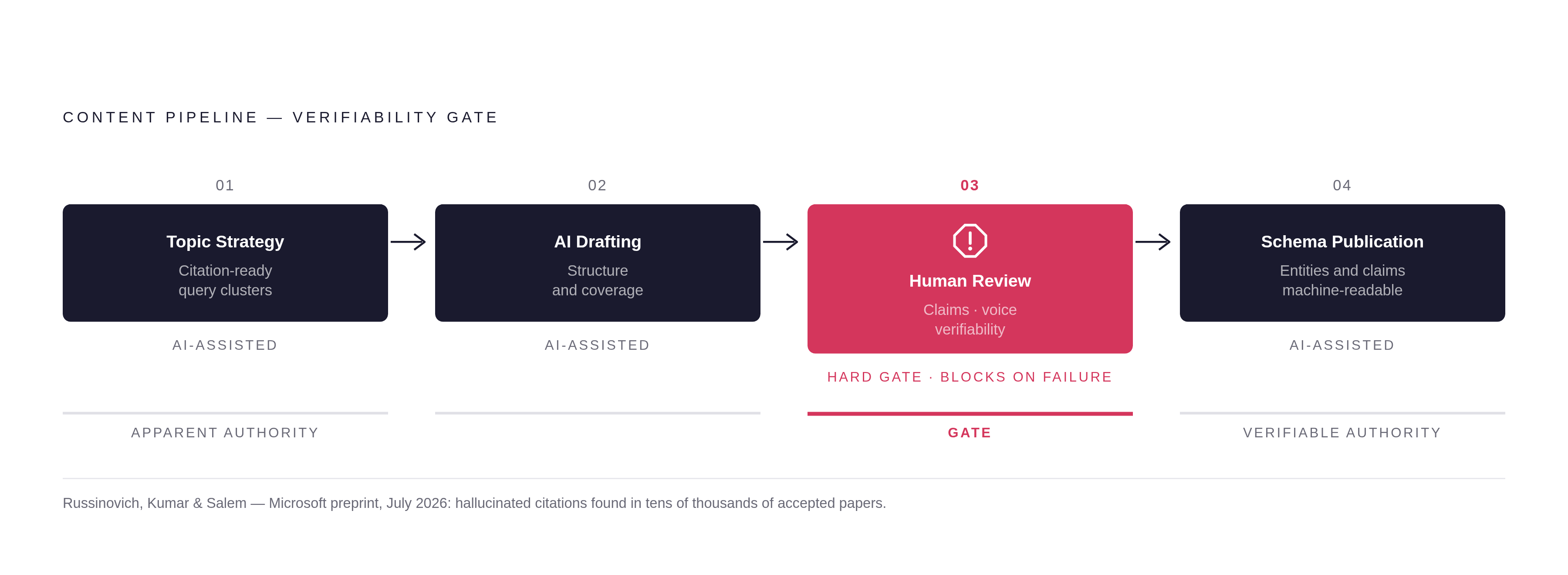
Microsoft’s July 2026 preprint “Phantom References,” by Russinovich, Kumar and Salem, audited tens of thousands of accepted academic papers and found hallucinated citations in the peer-reviewed record. The finding concerns academic publishing. Its operational lesson is nonetheless clear. A reference that looks credible is not necessarily a reference that exists, and a fast publishing process cannot safely assume otherwise.
For a brand seeking AI citations, that creates a direct conflict between apparent authority and verifiable authority. A page may look well supported while resting on phantom sources. If those failures are discovered, they risk damaging the entity authority that GEO is meant to strengthen. The appropriate response is to separate the work that generation can accelerate from the judgments that factual and editorial review must make.
Topic strategy focuses on the query clusters where citations help buyers choose products, and AI drafting helps with how content is structured and what it covers. Human review then handles claims and voice, with a hard gate that blocks publication when a page fails a verifiability check. Schema at publication makes the resulting entities and claims machine-readable. Each stage answers a different requirement rather than leaving one reviewer to repair an undefined process.
Does review make the pipeline too slow? To address the concern that checking claims reduces output, generation handles the portions suited to scale, while human review concentrates on evidence and editorial judgment. A well-designed pipeline makes speed and quality compatible. Its success depends on what is allowed through the publishing gate.
Measuring AI citation share — the instrumentation layer the engineering framing requires
A production pipeline needs feedback about its results. Brand visibility score measures the percentage of AI-generated responses in a defined prompt set that include the brand name. Citation Share of Voice compares the brand’s citation rate with named competitors across the same prompt cluster. The distinction is useful because appearing somewhere in an answer is not the same measurement as earning citations relative to alternatives. Both depend on a clearly defined set of questions.
AI referral traffic conversion rate adds a downstream view of what happens when users do reach the site. The reported 2026 conversion figure of 14.2% shows why that traffic matters to the business. It does not describe every recommendation’s outcome. Answers that complete discovery or decision-making without a click remain outside that traffic-based measure, so referral conversion complements answer monitoring.
Bot-log analytics provides a different diagnostic layer by tracking whether and how crawlers such as GPTBot and ClaudeBot access site pages. That helps teams spot access and indexability problems before they blame the quality of the content. Crawl activity shows whether part of the information-access process is happening, while prompt-based monitoring observes the resulting answers.
Those answers need to be measured across platforms. A brand’s citation share on Perplexity does not predict its share on Gemini or ChatGPT, so each requires independent tracking. A combined view can otherwise conceal where the brand is absent. The same caution applies to prompt-volume estimates, because no measurement platform has full access to AI providers’ query logs. Panel-based estimates are directional proxies.
Teams should track trends and relative share using estimated volumes as directional proxies. Measurement can then connect changes in content structure, documentation and publishing quality to changes in observed visibility. That connection gives teams a basis for adjusting inputs.