How to get on AI vendor shortlists — the engineering view
Make your product discoverable to AI assistants evaluating vendor shortlists.

Getting onto AI-generated vendor shortlists is both an engineering problem and a branding exercise. A product needs a machine-legible site, facts that agree across independent sources, and clear proof that it fits the buyer’s constraints. The work is to make that fit retrievable and credible, then measure whether assistants actually include the vendor when buyers ask.
Why the vendor shortlist now forms before buyers visit your site
A buyer types a question that names a company size, a budget, an integration requirement, and a compliance need. The assistant returns four names, each with a short explanation of why it belongs. The buyer visits those sites to find out more. The buyer arrives with a view of which products to look at, before learning about the category through sellers’ websites.
That changes the job of a vendor’s public information. It must help the product make the shortlist before it gets a chance to win over a visitor. These prompts are not invitations to browse. Their constraints give the assistant reasons to exclude products as well as reasons to recommend them, so a broad claim about helping teams work better has little use. A vendor may meet every requirement in practice yet lack the public evidence needed to make the list.
How costly is that absence? The Day One shortlist has a strong effect on what the buyer chooses, so being left out early hurts both the pipeline and the vendor’s visibility. A vendor outside the initial set may never enter the evaluation, even if its sales team could make a strong case. There may be no later round in which to explain the missing detail. The buyer is working from the market the assistant has presented.
The difficulty is that exclusion leaves no ordinary site signal. There is no analytics cookie, form fill, or sales enquiry to record a recommendation that never happened. A team looking only at visitors has visibility limited to the people who arrived. Before a company can improve its position, it needs to know what the assistant can recognise, filter, and support.
How an AI assistant actually constructs a shortlist
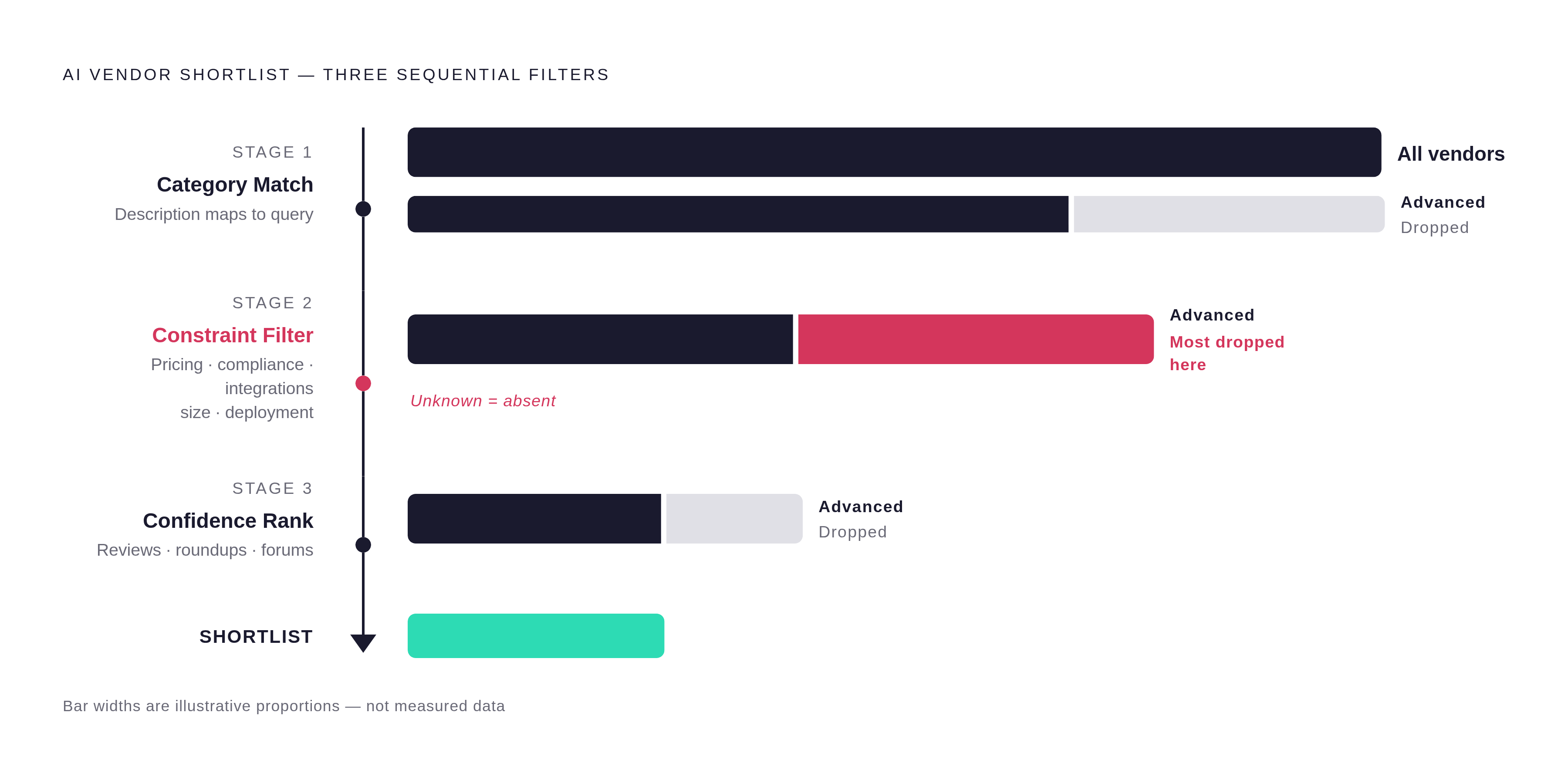
Category matching is the first hurdle. A buyer asks for a recognisable kind of product, while a vendor describes itself as “the operating system for modern work”. The description may sound bold, but it leaves unclear what kind of product this is. If the assistant cannot connect the product to the category in the question, it may skip it.
Constraint filtering then narrows the candidates that remain. Pricing tier, compliance certification, integration, company size, and deployment model become tests of fit. Public facts supply the answers to those tests. When a required fact is missing, the assistant cannot reliably distinguish an unsupported capability from an unavailable one, so unknown can function as absent. The important distinction is between what the product does and what its accessible information says it does.
Confidence ranking adds another test after basic fit. Independent sources that describe a vendor consistently give the assistant stronger grounds for recommending it. This is where clarity can outweigh a larger budget. A smaller competitor whose pricing page, documentation, and review profiles agree makes a clearer case than a product with more funding whose descriptions are vague or clash. The evidence must support both the category and the specific reasons for inclusion.
Retrieval-based systems such as Perplexity and Google AI Overviews typically cite live sources to support the names they surface. They can also fall back on uncited model memory when retrieval is insufficient, so a citation is not guaranteed for every recommendation. Even so, missing crawlable evidence can cost a vendor inclusion when a claim needs support. That makes the process engineerable without making every answer fixed or guaranteed. It is a legibility test, with identifiable points at which public information can fail.
What your site must state explicitly for a model to include you
The site’s first job is to state what the product is, who it serves, and what it costs. Those facts need to be prominent, crawlable, and written in plain sentences. Consider “A powerful, flexible platform that helps modern teams move faster”. An assistant cannot extract a clear category, team profile, integration, or pricing model from it.
Now compare “Async-first project management for distributed engineering teams of 10 to 200, with native GitHub sync, flat per-workspace pricing, SOC 2 Type II certified — not built for agency client billing”. Each clause supplies a distinct matching fact. The negative statement is useful, too. It keeps the product out of unsuitable evaluations and makes the positive claims more credible by defining their limits.
That plain-language description also needs a machine-readable counterpart. The engineering work includes SoftwareApplication, Product, Organization, and FAQPage schema, declaring category, pricing, operating system, and features. Public pricing belongs in publicly accessible HTML text. Documentation and changelogs should also be indexable and accessible without a login. These pages give the assistant specific evidence beyond the main marketing description.
Identity needs the same precision as product fit. A Wikidata entry with proper properties gives entity recognition systems a machine-readable reference for the brand. The homepage’s Organization schema should include the exact brand name, logo URL, official website, and same-as links to authoritative profiles. Those profiles include Wikidata, LinkedIn, Crunchbase, and GitHub where applicable.
Access is the final part of this work. The recommended setup includes an llms.txt file at the site root listing key URLs and robots.txt permissions for GPTBot, OAI-SearchBot, PerplexityBot, Google-Extended, and ClaudeBot. Google-Extended is a robots.txt control token. OpenAI’s official crawler documentation describes GPTBot and OAI-SearchBot tags as controls for how sites and content work with AI. Teams should set these controls with care because limits on access can keep pages out of the sources an assistant can use.
Why on-site clarity alone is not enough to make the shortlist
Across AI engines as a whole, shortlist citations draw more from third-party sources than from vendors’ own sites. Review platforms, ranked roundups, and community discussions supply much of the supporting evidence. The split varies substantially by engine. ChatGPT places a higher share of citations on brand sites than other engines in some findings, so there is no single source mix to target.
The distinction follows the buyer’s question. A direct query about a brand’s pricing or a particular feature naturally calls for the vendor’s own information. A constrained request for suitable vendors asks for a comparative judgment. Independent corroboration then takes on more weight because the assistant is selecting among alternatives.
Where should that corroboration come from? Review platforms are prominent sources for commercial and recommendation queries, particularly in Perplexity and Google AI Overviews, and their influence can deepen further into the buying funnel. Ranked “best-of” pages also feature heavily in AI answers. Practitioner forums, Reddit, and LinkedIn add accounts of how well a product fits the needs of a given segment. A vendor’s own research is another way to earn citations when an answer to a category question needs its data.
However, the engines do not all draw from the same places. ChatGPT and Perplexity have narrow overlap in the domains they cite, so strong coverage in one source pool does not establish coverage in another. Run the actual shortlist prompts first and identify the sources each engine already uses. From there, review depth, named roundup inclusion, and community presence become identifiable work. Vendors cannot control those sources, but they can earn participation and audit the result.
Winning constrained prompts by stating fit explicitly across the buying group
A shortlist prompt often compresses several people’s requirements into one question. Company size, industry, region, existing tools, and budget may all appear together because the buyer is speaking for a group. Each qualifier narrows the acceptable answer. Content that explains only the main user’s benefits leaves other conditions unsupported, even when the product would satisfy them. Good fit must be stated across the whole decision.
The business owner wants outcomes and time to value. The IT lead wants integration and security detail, while finance wants the pricing model and the factors that drive cost. These are different questions about the same purchase. A page that answers the champion’s questions may therefore leave others in the buying group without the facts they need. If the vendor does not publish the relevant facts, third parties may end up supplying the answers instead.
Evaluation requires details about implementation effort, integration, security and compliance, pricing, support, and sector track record. None is interchangeable with a promise of better results. For a team working on shortlist inclusion, the task is to make these criteria explicit rather than expect the assistant to infer them from positioning. A product’s claim to serve a segment needs evidence that addresses how that segment buys.
Comparison and alternatives pages can answer these questions directly. A criteria table covering deployment model, integrations, support hours, contract terms, and implementation time gives buyers concrete grounds for comparison. Honesty is essential to that format. A page that only praises its publisher reads like an ad, while a fair account of tradeoffs helps show where each option fits. Stating when a competitor is the better choice can sharpen the vendor’s own boundaries and prevent inclusion in evaluations it would lose.
Those boundaries also differ by segment. The evidence needed for “best tool for enterprise security teams” is not the same as the evidence needed for “best tool for a small marketing team”. The relevant content may belong in different places because the assistants draw on different sources for those questions. Success in one segment therefore says little about another. If a vendor is absent from a segment it genuinely serves, the next question is which part of the public case is missing.
What to measure to know whether the engineering is working
That question requires measurement of actual shortlist answers. Organic rankings and general brand mentions cannot show whether an assistant lists the product when a buyer asks for the things they need to make a purchase. The prompts need to be commercial and constrained. Useful patterns include “best [category] for [segment]”, “alternatives to [competitor]”, and “[category] for [use case]”.
The first measure is whether the brand appears at all, tracked as a rate over a rolling window. Share of voice against named rivals and position when included add different information. Being present is not the same as leading. A vendor can appear often but stay behind the same alternatives, while another may drop out of the list whenever a given constraint comes up. Those patterns call attention to different gaps in legibility or corroboration.
Measurement must also separate engines and segments. A combined view can hide strong performance in one company-size tier and absence in another that is commercially more important. Engine-level tracking is necessary for the same reason. Different source pools can lead to different shortlist coverage, even when the facts about the product stay the same between prompts. Tracking should show where the process fails and whether the site is unclear or independent support is missing.
The engineering loop is to instrument the prompts, identify the gaps, fix the legibility or corroboration problem, and measure again. A missing integration statement calls for different work from a lack of credible review coverage. Neither should be mistaken for a problem that more general brand language will solve. Repeating this process makes an otherwise invisible point of exclusion observable over time. It gives the team a way to test whether its public evidence earns a place in the buyer’s consideration set.