Why safety and usage queries are the new front door for AI search — and what that means for CPG brands building machine-readable marketing stacks
CPG brands must build machine-readable data stacks to win AI search citations.

Safety and usage questions are becoming the front door to AI search for CPG brands. Brands need a machine-readable marketing stack built around ingredients, safety, usage, and compatibility, with facts that agree across channels and evidence that answer engines can retrieve and cite.
How AI answer engines field CPG queries — and why the queries are almost never brand searches
Is a food compatible with a nut-free diet? Is a shampoo gentle enough for color-treated hair? The shopper wants a product that fits a need, and the answer engine must find evidence of that fit before it can recommend a name.
BCG’s research describes an agentic purchase flow beginning with “gentle shampoo for color-treated hair, under $15”. The agent scans reviews, weighs ingredients, cross-references sources, and places the order without the shopper typing a brand name or seeing a logo. BCG also finds that about 70% of consumers using AI to shop use it to compare product attributes. Price comparisons add another filter to that process.
Dietary restrictions such as vegan, gluten-free, and nut-free call for attribute data that can establish whether a product qualifies. Safety questions call for evidence that supports the relevant claim. A brand homepage may explain the company well while supplying little of what the engine needs for either task.
What AI answer engines actually do with a CPG safety query — the retrieval mechanics that determine who gets cited
An answer engine can cite an old ingredient list from a third party instead of the current formulation on a brand’s website. That is a brand safety risk. When owned data is thinner or less consistent than a retailer listing, the outside source may become the evidence used to answer the shopper. An outdated formulation or discontinued safety claim can then appear authoritative because it is attached to the source the system selected.
Why would the brand’s own page lose? AI shopping agents retrieve products, rank them by how well they meet the shopper’s constraints, and check the data that supports them before citing them. The product page has to compete with retailer listings, review aggregators, and community forums, with no automatic place ahead of them. In a retrieve-rank-verify pipeline, a discrepancy between a Walmart supplier feed and a Target partner portal can register as a reliability failure and disqualify the SKU.
Source weight also changes with the question. For oral care usage-experience queries, Amazon and Walmart outweighed even the American Dental Association and NIH in citation weight. That does not make retailer reviews a substitute for clinical evidence.
Before either kind of evidence can help, the system must identify the product and brand reliably. Consistent names and descriptions across sources support that recognition, with Wikidata providing a useful entity signal. If sources describe the same entity differently, the engine has a harder task connecting their claims. Identification comes before reliable attribution.
The visibility gap the retrieval mechanic creates — and why incumbent scale does not close it
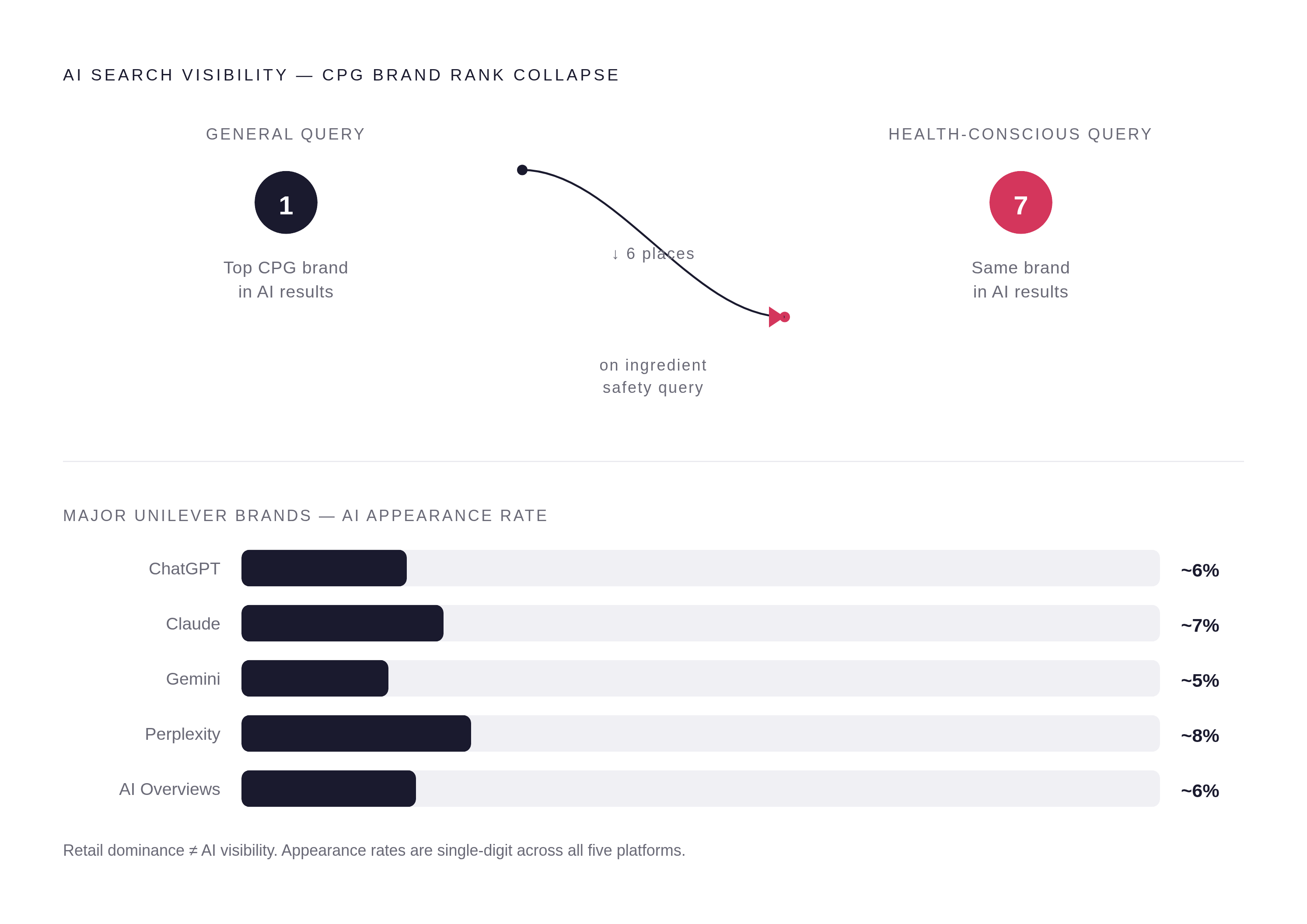
The 5W CPG Citation Index 2026 found single-digit appearance rates for major Unilever brands across ChatGPT, Claude, Gemini, Perplexity, and Google AI Overviews despite decades of retail dominance. Dove appeared far more often than Vaseline in those answers. The divergence points to Dove’s clinical authority and third-party endorsement infrastructure, rather than the scale shared by established consumer brands.
AiRR’s June 2026 data reveals the same structural weakness from another angle. The most visible CPG brand in general queries fell to seventh when ChatGPT answered as a health-conscious shopper evaluating ingredient transparency. The brand had not become less familiar. The question had changed, exposing thinner support for ingredient and safety answers than for general product discovery.
Together, these findings challenge the idea of a single, stable position in AI search. A brand can be prominent overall yet poorly supported for questions about a product’s suitability for a particular shopper. Cross-brand differences reveal the value of authority infrastructure, while persona differences reveal where that infrastructure is incomplete. Neither gap is explained by awareness alone.
The commercial exposure is substantial. BCG’s assessment for a global CPG player found 20–30% of its online revenue potentially at risk as discovery shifts to AI search. Unlike a search results page where a lower-ranked link can still receive traffic, an AI answer may name only one or two brands.
What the winning content infrastructure actually looks like — machine-readable answers to the specific query types that surface CPG brands
The practical response is to build a fact architecture around the questions shoppers ask. For ingredient queries, that means a full ingredient list in descending order by weight, with standardized nomenclature such as INCI or GS1. Each ingredient should connect to the allergen schema so that dietary claims can be audited. Names are part of the verification process. A non-standard ingredient name can prevent an agent from matching the evidence and cause the SKU to fail verification.
Safety queries require claims with a verifiable basis. Certifications such as USDA Organic, Non-GMO Project Verified, and Certified Gluten-Free should map to machine-readable schemas that let agents corroborate them. Provenance fields, including country of origin and supplier identifiers, help with the retailer API checks used to assess products.
Compatibility questions need equally explicit answers. Negative claims such as “no artificial flavors,” “no preservatives,” and “no added sugar” should appear in discrete attribute fields. Allergen links and certification data then give the engine evidence for the shopper’s restriction. What is absent can be as important as what is present.
Answers to usage questions need both plain language and structured specifications. A sentence such as “Formulated for post-workout recovery in adults following a plant-based diet” connects the product to a recognizable need. The use-case sentence gives the engine language that matches the question, while the specifications provide the supporting detail.
Across all four query types, consistency is essential. Pack sizes and units of measure must agree across the owned page, Walmart supplier feed, Target partner portal, and Amazon listing, with each distinct pack configuration assigned its own GTIN and schema object. Conflicts can corrupt unit-price comparisons as well as verification. Brand names, founding descriptions, and core attributes should also match across the website, LinkedIn, industry directories, and Wikipedia or Wikidata.
The authority layer — why owned content alone is insufficient and which third-party sources AI treats as authoritative for CPG query types
Structured owned data lets a product be considered, but evidence from outside the brand helps decide whether it gets cited. The majority of AI citations trace back to earned media. A brand therefore needs more than a technically sound website. It also needs support in the sources the engine treats as authoritative for the question being answered.
For OTC and oral care usage-experience questions, retailer aggregators such as Amazon and Walmart have strong weight. For safety and efficacy questions, clinical authorities such as the FDA and ADA provide a different kind of evidence. Retailer experience and clinical authority are not interchangeable.
The lesson for brands is to seek mentions within their category’s “seed set” of trusted domains. The purpose is to become part of the evidence the engine reasons from. Branded web mentions correlate with AI visibility more strongly than backlinks alone. An authoritative unlinked mention can therefore contribute something that a hyperlink-only strategy overlooks.
Proprietary evidence can strengthen that position further. A formulation study, allergen audit, or user-reported experience dataset gives the engine an underlying source for questions about those findings. Owned facts and third-party authority can reinforce each other when the outside source has something substantive to cite.
A luxury fashion group provides a measurable example, although it is not a CPG case. The group prioritized 500 consumer prompts, introduced structured-data and metadata fixes, and then pursued targeted authority placements. Its brand site’s citation rate more than doubled within eight weeks, while LLM-sourced traffic more than quadrupled within six months. This shows what technical work and authority building can achieve together, though results in another category could differ.
The grounding page as the structural anchor for safety and ingredient queries
A grounding page gives this infrastructure a concrete owned anchor. It is a dedicated, encyclopedic, externally verifiable fact page that the engine can retrieve when answering a specific question. For CPG brands, that can mean an ingredient page, an allergen fact page, or a compatibility guide. The page should make the relevant facts easy to identify and compare with outside sources.
For a product-level page, the questions are direct. What is in the product, and what evidence supports its safety for a particular population? Which certifications govern it, and when was the formulation last updated? The page should answer these questions with facts that can be cross-referenced against retailer feeds and clinical sources. External verification reduces the need for the engine to accept the brand’s word alone.
This makes the grounding page an engineering artifact. Ingredient data and pack-size attributes should have timestamps so that an agent can assess whether the information is current. An undated formulation claim leaves that question unresolved. The page’s usefulness depends on its agreement with the wider data architecture.
Ranked “best-of” listicles are the most-cited format across a large sample of AI prompt responses. A grounding page strategy should therefore also include category-level content addressing questions such as “which protein powders are safe for people with dairy intolerance”. That format places the brand within the shopper’s comparison frame. The ingredient and compatibility evidence still has to support its inclusion.
Measuring whether the infrastructure is working — AI visibility as an instrumented, ongoing signal
Brands need to track ingredient, safety, usage, and compatibility questions across ChatGPT, Claude, Gemini, Perplexity, and Google AI Overviews. Each engine retrieves and cites sources in its own way. A citation in one does not establish visibility in the others, and improvement should be assessed over weeks to months.
Share of Model provides a core measure. It divides a brand’s mentions by total brand mentions across answers in the tracked query set. That makes the selected questions central to interpreting the result. A strong score on general product queries can conceal weak performance on the ingredient questions that a health-conscious shopper asks.
Brands therefore need to track results by persona. AiRR’s findings show how a change in shopper perspective can reorder brand visibility even within the same product context. Measurement needs to preserve that distinction rather than blend every answer into one reassuring average.
In AI search, 40–60% of cited domains change each month, while AiRR’s 34-day data shows that the order of brands below the top position changes in almost all daily comparisons. A weekly snapshot can suggest stability that is not there. Tracking all the time or at short intervals makes changes easier to spot.
Visibility alone is not enough to monitor. The system also needs to track which third-party sources appear beside or instead of the brand’s grounding pages, because an answer citing outdated formulation data presents a different problem from an answer omitting the brand. That difference helps show what to fix next, whether the data conflicts, evidence is missing, or authority is weak. Sustained AI visibility depends on treating those findings as engineering signals, with measurement informing iteration and reporting campaign results.