Why brand and content alignment is an engineering problem, not a style guide problem
Consistent brand requires building alignment into your content pipeline, not just your style guide.

Brand and content alignment is an engineering problem because a style guide cannot enforce itself. Good taste still counts, but consistency at scale depends on shared inputs, a pipeline that uses them during creation, and feedback that catches drift. The task is to turn brand judgment from something people must remember into something the content system can apply.
Why style guides fail at scale — the structural problem, not the effort problem
You ask ChatGPT to write something, and it returns polished prose that sounds nothing like the brand. The sentences are clear, the structure is sensible, and the draft still needs rewriting. Fluency has arrived without the judgment behind it. The tool has generated without the shared understanding that makes the writing recognizably yours. A reviewer must now supply what the creation process lacked.
That gap exists without AI, too. A message gets softened during feedback, interpreted differently by a regional team, and adapted again by an agency. Each change may be reasonable on its own. Together, however, they can shift both what the brand says and how it sounds. When enforcement depends on people remembering earlier decisions, a review queue becomes the place where the organization tries to reconstruct its own intent.
Brand strategy lives in guidelines, but much of its meaning lives in people’s heads, and those people leave, rotate, or reinterpret it. AI accelerates this weakness by giving everyone generative capability without necessarily giving them shared brand grounding. Social, sales, and editorial teams can each produce competent work that sounds as though it came from a different company. Uploading a style guide helps supply context as a static snapshot.
Why is this especially costly for a distinctive brand? Because generic output erodes the very difference the brand has built. A static PDF cannot govern work across changing tools, teams, and channels unless its standards become part of how that work is made. More conscientious review may catch individual failures, but it leaves the underlying dependence on human memory intact.
What brand engineering actually means — primitives, not policies
Brand engineering encodes judgment into structured, machine-readable inputs that people and machines can use during creation. The word “engineering” names concrete work. Its deliverables are reusable components, or primitives, that express voice, permitted claims, visual constraints, and content types. Instead of asking every creator to translate the same policy afresh, the system gives them a shared starting point.
“Friendly” leaves a great deal open to interpretation. “Friendly like a knowledgeable colleague, not a best friend” narrows the intended relationship with the reader. At a smaller scale, a rule such as “use ‘build,’ never ‘leverage’” gives a pipeline a choice it can enforce. The distinction is between describing an impression and expressing a decision that can guide generation or be checked afterward.
Examples supply another kind of precision. Nucleus Institute’s content engine model has a voice model trained on the corpus of content that a company has approved and published. That corpus demonstrates how the brand behaves in actual writing, rather than asking a handful of adjectives to stand in for its voice. It gives adjectives context. A machine-usable brand needs both the intended quality and examples of what that quality looks like.
The same move applies beyond voice. Visual standards become generation constraints that a pipeline can check, while a claims library holds the vocabulary the company has approved, words it bans, and proof points legal will accept. A taxonomy links each content type to the platforms where the company publishes it. These are different kinds of inputs with different jobs. Their value lies in making brand decisions available in a form the production process can use.
The institute’s model therefore puts the encoded brand before the content itself. That order is consequential. If generation begins before the standards are usable, the system can produce confident, polished, generic work faster than people can correct it. The first deliverable is not a pile of drafts, but a brand expressed clearly enough for a machine to follow.
How a content pipeline calls brand context at the moment of creation
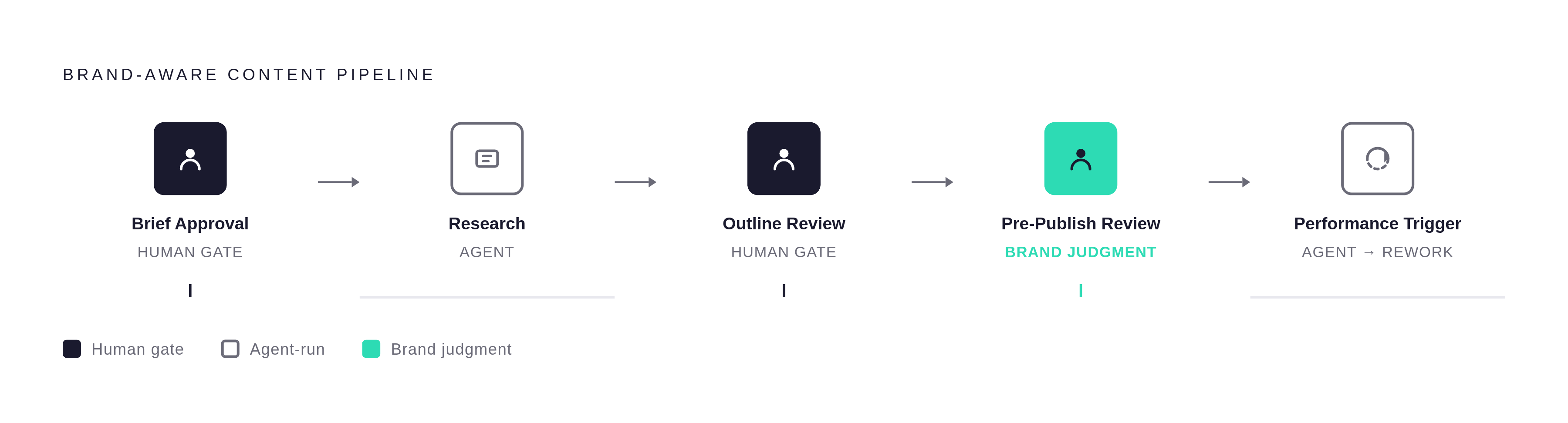
A brand-aware pipeline queries structured inputs before generation begins and uses them throughout the work. This changes when brand judgment enters the process. The AI starts with the voice model, claims library, and vocabulary rules instead of receiving them as corrections after drafting. A better prompt may help with a single task, but the pipeline makes access to shared context part of the workflow.
Jasper’s content engineer framing separates that workflow into specialized agents. A researcher gathers context and structured inputs, and a drafting agent drafts against the voice model and claims library. A critic then checks the draft against brand and editorial rules, while a publisher stages the result for human approval. Each agent has a bounded role and can be replaced. The brand standard remains in the shared inputs, so it does not depend on the behavior of any one agent.
Brief approval comes before generation because people need to agree on a direction before the system starts to produce work. Outline review follows research and precedes drafting, giving people a chance to judge the proposed argument before it becomes finished prose. Pre-publish review controls what is released, and a post-publish performance trigger brings underperforming work back for rework. These gates make accountability part of the structure rather than an informal promise that someone will look eventually.
But what is the human reviewer actually judging? Automated checks cannot evaluate strategic alignment, emotional resonance, or cultural sensitivity. A draft can obey vocabulary rules and still fail to reflect how the brand wants to be perceived. AI writing often settles into a middle-ground register that sounds like no one in particular. At the pre-publish gate, accepting readable prose is therefore not enough. The reviewer must judge whether it expresses the brand’s specific voice and intent.
That responsibility sets a limit on autonomy. A working pipeline replaces “set and forget” with team control over which actions need approval and which agents may run unsupervised. The distinction is between human judgment used to direct and assess the work and human effort spent repeatedly repairing preventable mistakes. Agents run the repeatable middle. Humans decide direction and quality.
Why consistent brand signals are now an AI citation prerequisite
Published content also becomes evidence for AI systems that people use to find organizations, compare them, and judge them. Brand alignment therefore affects more than the reader’s impression of a page. It affects how clearly an answer engine can identify the organization and understand what it stands for. An inconsistent brand risks being ignored as well as misrepresented. The internal problem of conflicting inputs becomes an external problem of conflicting signals.
This is where optimization for answer engines and generative engine optimization, or GEO, meet brand engineering. They all need published signals to tell a clear, consistent story that AI can use. McKinsey’s State of Marketing Europe 2026 ranks branding as the top marketing priority for the year ahead. As AI accelerates production, that priority reaches into both the strategy and the systems responsible for publishing. A clear position loses force when the content gives several different versions of it.
What does consistency look like outside the pipeline? A Wikidata entry matches the brand’s own claims, while schema, LinkedIn, and owned web pages tell the same factual story. Entity recognition is the hinge. A model is less likely to cite an organization it cannot confidently identify, so agreement across these surfaces supports citability.
A first-party data asset adds something different to that foundation. A named report or proprietary dataset provides a unique fact that needs attribution to its source. Consistent identity helps establish who the source is, while original evidence gives an answer engine a reason to cite it. A piece can lose Google clicks while gaining LLM citations in the same quarter, and a page that never ranked in search may be cited regularly in AI answers.
Measuring brand drift before it compounds — what to instrument and why
An engineered system needs feedback about both the work it produces and the presence that work earns. These are distinct measurement problems. Internal measures show whether brand context is used in generation and stays in the work through review, while external measures show whether AI engines mention and cite the brand. Combining them into a single idea of “performance” obscures where a failure begins. A production problem and a visibility problem may be related, but they require different evidence.
For internal consistency, the recommended foundation is one versioned, searchable library containing both newly generated assets and previously approved work. In the institute’s model, an updated asset changes every downstream surface that references it. When something falls out of brand, it leaves the library and every downstream page that references it. Versioning makes change part of the system. Without that shared source, an approved correction can coexist with older material that keeps supplying the wrong example.
Review gates also need to report what they checked and what they changed. That record provides an audit trail showing where drift starts in the process and helping separate checks that work follows the rules from decisions that need judgment. The approval meeting can then focus on those judgment calls, with compliance proofreading handled by the checks. A correction becomes useful feedback only when the system can learn more from it than the fact that one draft passed.
Edit time offers a particularly direct diagnostic. AI output that fits the brand should need small edits to get the facts and wording right, rather than full rewrites to bring back the brand’s voice. Tracking whether edit time falls month-over-month tests whether the inputs are becoming more effective. When work keeps needing heavy rewrites, it points upstream to brand context that is not getting through to generation. The recommended response is to repair that connection.
External measurement needs a separate tool for each engine. ChatGPT, Claude, Gemini, Perplexity, Copilot, and Google AI Overviews can cite the same brand at meaningfully different rates, so a single-platform check gives an incomplete picture. Standard web analytics do not capture these citation signals. Tracking AI mentions and citations across engines makes that presence measurable independently of search rank. It also avoids mistaking a change in clicks for the whole change in visibility.
The feedback loop can compound in either direction. When a distinctive brand keeps publishing generic output, audiences learn to see it as ordinary, while published signals that conflict shape how an AI model understands the organization. An effective library builds in the opposite direction because approved output can improve the voice model and claims library used in the next generation cycle. Measurement shows which examples can help the system improve in that cycle.