What "technical marketing" actually means when your stack is code, not campaigns
Developer buyers test code samples, so broken examples cost more than silence.

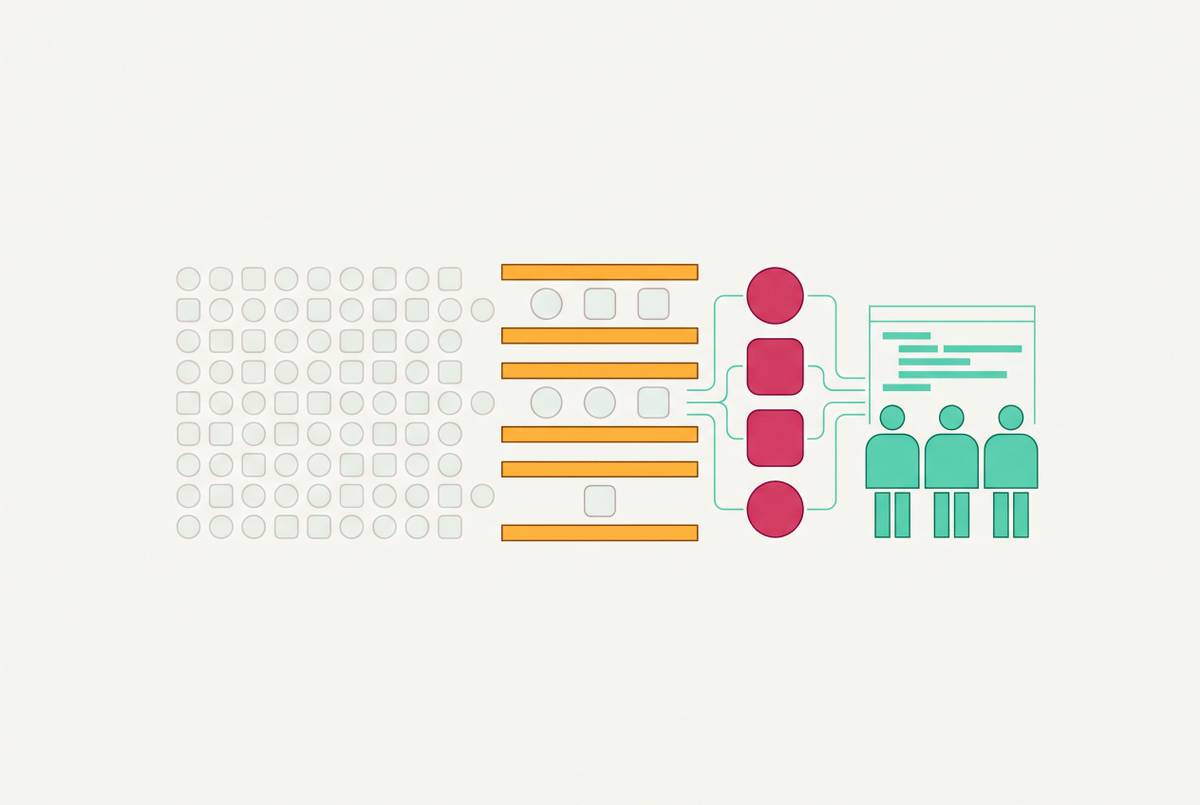
Technical marketing is an engineering discipline for connecting technical proof to a buyer’s decision. When the stack is code rather than campaigns, the work is to build small, connected components, measure their outputs, and give people control over what ships. The result should be a system that improves over time.
Why "technical marketing" as a writing style fails the developer buyer
“Technical marketing” conflates three different kinds of work. It can mean practitioner depth, which brings together knowledge of the technology and how to help sell it. It can also mean technical content marketing, including tutorials, API references, comparisons, and community work. Or it can mean developer relations, where trust-building comes before the ask. These activities overlap, but they are not interchangeable.
The most damaging confusion reduces all of them to prose that sounds technical. Just add code samples, and the job looks done. But a code sample is a claim a reader can run. Developer buyers put that claim under stress by testing it, so one published tutorial with a broken example can do more damage than ten unpublished ones. The production process lets the appearance of proof stand in for proof.
The narrow band technical content has to occupy — and why campaigns can't be engineered to hold it
Technical content has to avoid two opposite failures. On one side is the polished commercial, built around brand voice, search volume, and how smoothly it reads. The developer gets to the end, finds no proof, and leaves. The piece may have met every editorial requirement while failing the reader’s basic test of whether the product can do what it claims. Polish cannot make up for missing proof.
On the other side is the exhaustive whitepaper. Engineers can produce an accurate account that pursues completeness without helping a buyer decide what to do next. Nothing in it has to be wrong for the handoff to fail. The useful band lies between these extremes, where the reader gets enough technical depth to trust the practitioner and can then move to a sales engineer for customer-specific work. That requires a clear boundary between what the content can establish and what still depends on the customer.
How does a team hit that band repeatedly? Better writers can help, but individual judgment cannot substitute for a production and review architecture. AI-generated tutorials show this weakness because getting the happy path right does not prove that the edge cases work. A campaign can fund an excellent piece without creating a repeatable way to calibrate the next one. The lasting requirement is a system that connects technical substance, review, and the buyer’s next decision beyond any single publishing run.
What an engineering discipline actually looks like — composable primitives, not campaign logic
An engineering discipline starts with composable primitives, which are small, useful parts that can work together. A changelog-to-post pipeline, an AI citation monitor, or a prompt-based share-of-voice tracker can each do a job with clear limits. Each has an output to meter. The team wires these tools into a stack instead of keeping them apart, so it can make the parts work together and improve them without rebuilding the whole thing.
Campaign logic starts from a different unit. A campaign has a launch date, a budget, a run, and a teardown, so it is organized around a moment. That structure can support a launch, but it does not by itself create a lasting production system. Engineering logic asks which useful component should remain after the moment passes. Its value depends not just on what it produces today, but on whether later work can use it.
For that reason, an interface for a person is not enough. Each primitive should also be reachable by an agent through an API, so the stack can be orchestrated. Even useful applications leave work disconnected if someone has to move between screens to link each step.
Notra illustrates the production side of this approach. It connects to a GitHub repository and generates changelogs, blog posts, and social media updates from commits, pull requests, and releases. The source is development activity rather than a separate writing brief. That gives the production step a defined input and a reusable role in the wider system.
Why the distribution of technical content across owned, earned, and AI channels requires deliberate architecture
A production pipeline solves only part of the problem. Developers find tools through search, GitHub, Reddit, Hacker News, newsletters, and technical communities, so publishing on a company’s site does not cover the paths they take. More often in 2026, AI assistants answer discovery questions before a search results page opens. Questions such as “best error tracking for a Node API” or “alternatives to Postman” put the assistant between the buyer and the underlying sources. Content distribution must account for where the answer draws its evidence.
This changes what a well-designed content presence requires. Owned pages give a team control over its explanations, while earned coverage places the brand on credible third-party domains. AI-indexed channels add another layer because different engines draw from different source types. No single surface wins across all of them. Distribution therefore needs an architecture that accounts for these differences rather than a promotion task attached to a finished article.
The on-site and off-site distinction is especially important. A company can have well-structured pages and perfect markup while having no credible third-party mentions or citations. Those are necessary conditions mistaken for sufficient ones. Entity authority requires consistent, structured brand mentions across sources AI models trust.
Content format belongs in this design as well. Quotations from credible sources and statistics that add factual density are among the signals that can affect AI citation share. Treating them as design decisions means considering what an answer can substantiate and what another system can use, while keeping the underlying claims useful to the human reader.
Why AI visibility must be measured per engine, not assumed from rankings
Once distribution spans AI engines, search rankings cannot tell the whole story. AI share of voice measures how often a brand is cited, mentioned, or recommended in generated responses relative to competitors. It is a separate measurement problem. A team that tracks traditional SEO alone does not know whether its content is appearing in the answers through which a developer may discover a tool.
The measurement work requires prompt-based auditing, citation counting, and sentiment classification across ChatGPT, Perplexity, Gemini, Google AI Overviews, Claude, and Bing Copilot. Was the brand included, was it used as a source, and how was it described? Keeping those distinctions visible prevents a broad label such as “AI visibility” from concealing a weak result.
A brand can appear in the footnotes without contributing anything to the answer itself. Citation and absorption are separate stages. Optimizing only for the first can reward content that is referenced but does not shape the response the buyer reads.
Only a small fraction of domains are cited by both ChatGPT and Perplexity, and strong share of voice on one engine can coexist with negligible presence on another. An aggregate can hide that imbalance. To connect visibility with business results, teams also need AI referral traffic filtered by source, pipeline contribution from leads who report discovering the brand through AI search, and branded search trends that correlate with share-of-voice improvements. Correlation is useful feedback, but it should not be presented as proof that every change came from AI discovery.
Where human review fits in a pipeline built for speed and scale
The strongest objection to this architecture is straightforward. If the team produces work faster and automates more of it, what keeps subtle technical mistakes from reaching readers? Authoritative-sounding errors are especially dangerous because they can survive a superficial review. A piece that is clearly short on detail shows its limits, while a confident explanation can hide them until an expert tries to use it. More output increases the need for a dependable checkpoint.
Multi-stage AI drafting paired with human review provides a place to catch errors before publication and reject an output that should not ship. The checkpoint is part of the design. Its role is not to make every automated step manual, but to preserve a human decision where technical credibility is at risk.
Full autonomy and human-in-the-loop operation can both be valid, and the choice belongs to the team. The architecture should let the team use both within the same system. Otherwise, automation can force a team to hand over more work than it chose to.
The design requirement is that every AI-generated suggestion remains reviewable and reversible before it ships. Speed should not remove the right to say no. This is also why review cannot be reduced to whether the prose reads smoothly, since the failure at issue is a technical claim that sounds plausible.
How a technical marketing stack compounds when every component is metered and wired together
A campaign stops when its budget stops, while connected primitives can still serve the next release, question, or chance for a buyer to find the brand. Each piece of original data, cited answer, and third-party mention can give the next query a stronger starting point. That is the compounding effect. It comes from retaining useful work and connecting it to later work, rather than treating each publishing run as a separate project.
In practice, the components have distinct roles. Development activity can feed a changelog-to-post pipeline, with a review checkpoint where the team decides what is ready to publish. Earned coverage gives the brand a trusted presence off-site, so the company’s own pages do not have to do all the work. Per-engine measurement then makes the resulting visibility observable, and downstream attribution connects that visibility to business outcomes. These are not interchangeable jobs, but their connections make the stack useful.
Measurement closes the loop only when it informs change. Important questions can go unanswered when teams track citation counts without absorption, visibility as a whole without engine-level detail, or traffic without a link to pipeline. A metered system makes those gaps easier to identify. It gives the team evidence for changing a component or its connections instead of relying on an impression that the content seems to be working.
“What content should be produced this quarter?” is still a useful question, but it is no longer the organizing one. The deeper questions are which primitives are being wired together, how their outputs are being metered, and what the stack will look like in twelve months if it keeps running. Technical marketing earns its engineering label when the team has clear answers to those questions and more than an empty brief to build the next useful piece on.