Distribution Channels for Reaching Software Developers With Technical Content
Developers research solutions across platforms.

Reaching software developers with technical content takes several layers of distribution, because no single channel can do all the work. Community platforms, syndication, newsletters, contextual placements, and AI answers reach practitioners at different stages of research. Content teams need to assess what each layer contributes, how it strengthens the others, and whether developers are finding it.
Why the old single-channel playbook fails developer audiences in 2026
Developers often evaluate and test tools before a vendor knows they are interested. Engineers look into a problem, try ways to solve it, and become internal champions before procurement gets involved. Distribution has to reach these practitioners while they do that research. A strategy aimed only at decision-makers misses the work that shapes their eventual choice.
Attention has both a location and a context. Developers spend most of their working day inside tools rather than social feeds, while many use ad blockers and distrust promotional language. Even when content reaches them, a vague claim or technical error can end its credibility immediately.
What follows from those constraints for a content team? The task is to map the moments when developers need an explanation, peer validation, or a way to try something, then understand which distribution layer serves each moment. Reach alone is an incomplete guide to that work. Compound channel presence is the competitive condition.
Community platforms: Stack Overflow, Reddit, GitHub, and developer-first feeds
Stack Overflow, Reddit, GitHub, and Hacker News belong in this foundational layer because technical credibility is subject to public scrutiny. Trust begins with useful participation. A brand can publish a claim elsewhere, but community discussion is where developers can challenge whether it holds up.
Reddit concentrates those discussions in communities such as r/programming, r/webdev, r/devops, and technology-specific subreddits. Their organic surfaces are not an invitation to promote. Honest comparisons, architectural decisions, and postmortems give readers technical details they can check, while marketing language gets in the way of that work. Reddit and Stack Overflow also offer paid options, but paid availability does not erase the need to earn community trust.
GitHub makes the product's working materials part of distribution. For tools with open-source components, a well-documented README, active issue management, and GitHub Discussions support organic discovery. Documentation helps make the repository useful enough to find and explore, while issue discussions give developers a place to assess how a tool's problems are handled.
Hacker News puts a different kind of technical work under scrutiny. Front-page placement can generate thousands of qualified visitors in hours, but promotional or technically thin content risks being flagged. Posts about hard problems, honest retrospectives, and data-backed analyses fit the audience's expectations. For a team entering these communities, the lesson is to participate genuinely before introducing the product. A premature mention can damage the credibility later distribution depends on.
Syndication networks: amplifying technical content without SEO cannibalization
Republishing lets one technical article reach different groups of developers without writing a new article for each group. The original still needs a clear identity. Otherwise, a platform with higher domain authority can receive the search credit the source article was meant to build.
The recommended sequence is to publish on the owned domain first, wait for indexing, and then syndicate. Each republished copy needs a canonical tag pointing to the original URL. That tag identifies the preferred source for search.
Dev.to makes tutorials easy to find through tags, while another developer publishing platform has series, domain mapping, and canonical republishing through a developer community feed. DZone serves an enterprise-leaning audience interested in Java, cloud, architecture, and DevOps, with editorial review that favors diagrams and measurable results. These are different contexts for the same expertise. The choice turns on where the article's subject and level of detail fit.
Smashing Magazine, CSS-Tricks, and LogRocket reach readers who work on front-end and web-performance topics, and part of their value comes from how carefully they edit the work. Medium publications, including Stackademic, offer reach for general engineering stories and tutorials, although canonical attribution needs to be set explicitly through Import Story. Hacker Noon and The New Stack are a good fit for thought leadership and in-depth technical work written for engineering leaders. Across these routes, earned referring domains can compound over time in a way that a brief burst of social clicks does not.
Newsletters: reaching developers through opted-in, high-trust curation
Newsletters replace uncertain discovery with a scheduled relationship. Readers have explicitly asked for technical curation, so the content arrives with a kind of permission that a platform impression lacks. Open rates for developer newsletters are 40–60%, well above the average for marketing email. That engagement rests on the promise of useful selection.
The value becomes clearer in a focused technical community. This Week in Rust, DevOps Weekly, and Bytes concentrate audiences around particular interests, allowing a relevant placement to reach practitioners likely to care about the subject. The fit is more important than the breadth. A narrowly useful article can belong in a niche newsletter even when it would struggle for attention in a general feed.
Does that make newsletters a replacement for platforms? No, because their reach is bounded by an opted-in list, while platforms offer discovery through search, tags, and algorithms. Newsletters instead provide scheduled delivery to that list.
A brand has full control over its own newsletter, whether it uses Substack, Ghost, or self-hosted publishing. For a team building this layer, each new article should trigger a broadcast, even if it is only a short excerpt and a read-more link. RSS-to-email automation removes the repeated sending work. This gives newly published content a direct route to an audience that has already chosen to hear from the brand.
In-IDE and contextual advertising: reaching developers inside their workflow
An ad shown during distracted scrolling has little connection to the technical task occupying the reader's working day. In-IDE and contextual placements change that relationship. They reach developers inside tools or beside material they are already consulting, including during natural pauses in their workflow.
Contextual placement uses the setting of the current activity, rather than treating a presumed audience profile as sufficient reason to show an ad. Carbon Ads and BuySellAds run networks of developer publications, including documentation sites and technical blogs. The ad sits beside content that someone is reading for a specific technical reason. Relevance begins with that reason.
CircleCI ran native advertising campaigns on websites for developers and saw a large drop in cost-per-lead. The example supports a narrower point than “advertising works.” Developer interest in hands-on access can be a conversion signal, making a relevant trial prompt more useful than another invitation to passively consume content. The format and the next step need to suit the moment.
For content teams, the implication is to use these placements for awareness and trial prompts. A contextual ad provides an entry point when the surrounding task makes that entry useful. Earned and owned channels still supply the depth needed to evaluate what the prompt introduces.
AI answer engines as a distribution surface: how developer content gets cited in generated answers
AI assistants increasingly shape how a developer sees a technical problem before they visit a source page. A developer can ask for a summary, compare approaches in a generated answer, and then seek deeper material. Blogs still offer nuanced tradeoff analysis, deployment war stories, and benchmarks that include failure modes. Content absent from generated answers can miss the moment when a researcher first forms a view of the problem.
This is a separate distribution job from search ranking. Answer engines retrieve and weight sources differently from the way search algorithms rank pages, so success on a results page does not automatically produce a citation. What does a team need to change? It needs to make its technical knowledge available in forms an engine can identify and use, without stripping away the substance that makes the source worth reading.
Clear definitions, Q&A formats, and structured statistics make it easier to pull out specific claims than prose alone does. Comparison pages with structured tables also earn more ChatGPT citations than unstructured alternatives. Give important facts and comparisons an explicit form within technically sound content, while retaining the explanation a developer needs to judge them.
Distribution breadth can support that work as well. Publishing on the owned domain and republishing through Dev.to or Medium increases the surfaces available for citation, with canonical attribution preserving the original-source relationship. Technical access is another prerequisite to examine. Blocking GPTBot, ClaudeBot, or PerplexityBot in robots.txt can prevent the crawler access the distribution plan depends on. A content team that wants to appear in those systems should check that its access rules let their crawlers in.
A Wikidata entry can provide a machine-readable identity, but it is not a requirement for appearing in AI-generated answers, and its influence varies by platform and retrieval conditions. The broader recommendation is consistent entity information. Names, descriptions, and services should match across the website, LinkedIn, industry directories, and Wikidata where an entry exists, so that conflicting descriptions do not obscure what the brand is.
A dedicated encyclopaedic brand page, distinct from the homepage, gives this information a factual anchor. Its purpose differs from persuasive product copy. It provides a clear account that an engine can retrieve when describing the brand. Beyond owned pages, mentions in authoritative publications within the technical category can weigh more heavily for citation than dofollow links on low-authority sites. An unlinked mention in a leading publication may therefore be more useful for this layer than a linked mention on a minor one.
Measuring AI citation alongside traditional channel metrics
A layered stack needs measurement that distinguishes its different jobs. Traffic, newsletter engagement, and paid conversions can show whether people respond through those channels, but they cannot show whether a brand appears in generated answers. AI visibility needs its own instrumentation. Without it, a team can mistake strong performance on familiar surfaces for coverage of the whole research journey.
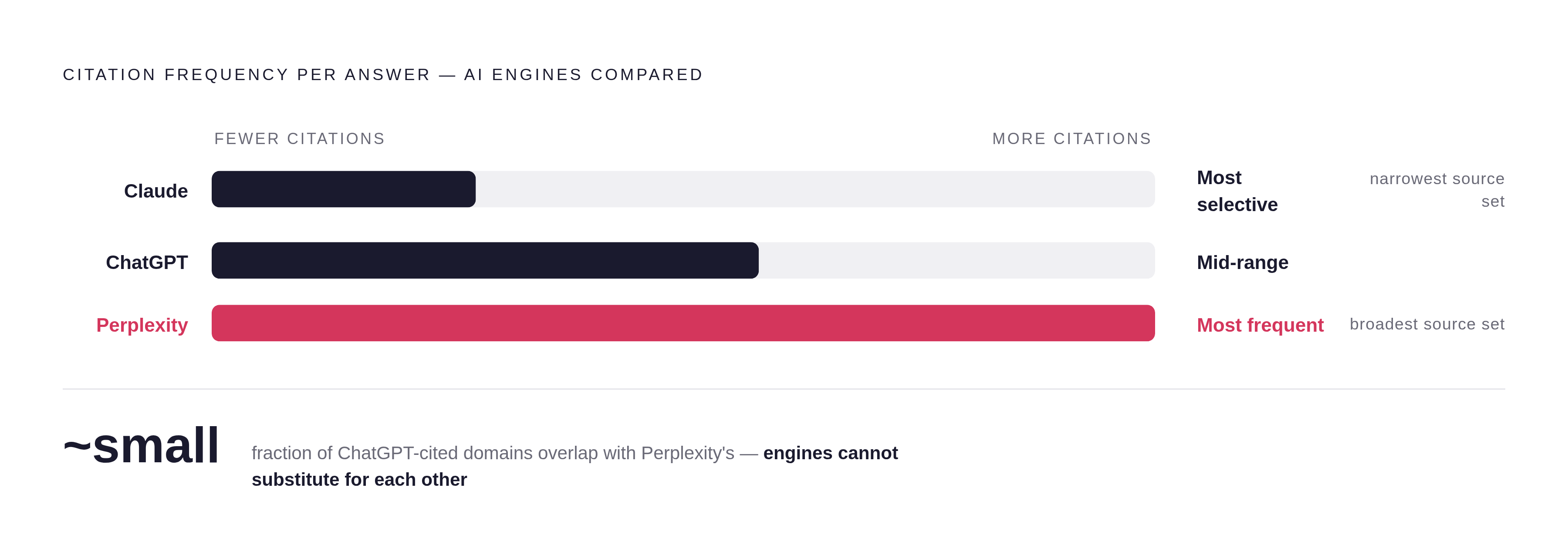
Measuring one answer engine is not enough. Only a small fraction of the domains cited by ChatGPT overlap with those cited by Perplexity, so a result from one cannot stand in for the other. Citation behavior differs as well. Perplexity cites brands more frequently than ChatGPT, while Claude is the most selective of the three. Those differences affect how a team interprets results and directs content investment.
For every answer being measured, the recommended record includes whether the brand appears, its position in the answer, the sentiment of the mention, and whether the engine cites a link to the site. These observations answer distinct questions about visibility. A mention establishes presence, while position and sentiment show how the brand is presented. A cited link records whether that presence also includes a path to the source.
The channels can then be understood as reinforcing parts. Community credibility can support authoritative mentions, those mentions can feed AI training and retrieval, and syndicated content expands the material available for citation. Newsletters and in-workflow placements sustain awareness while answer engines contribute discovery. Instrument distribution, measure it, and change it on evidence, as an engineering team would assess a system. The proof is whether the brand appears at the different moments when developers research, validate, and evaluate a solution.