Four truths and a lie about content — and what they mean for technical marketing teams
AI discovery happens outside your website now, and citation matters more than rankings.

Ranking well and informing an AI answer are different achievements. Four truths about discovery, authority, production, and measurement explain why, while one inherited belief confuses the two. Build for citation and recommendation instead of assuming they will follow from search position.
How the top of the funnel moved inside AI answers — and what that means for technical marketing teams
Similarweb’s 2026 Generative AI Brand Visibility Index found that 35% of US consumers now use AI at the product discovery stage. That puts answer engines where consideration begins. When someone asks ChatGPT or Gemini for the best tool in a category, the answer can establish a shortlist before that person opens a search bar. A brand missing from that answer loses an opportunity to enter the buyer’s thinking.
For technical marketing teams, this changes the role of content that once brought buyers onto a website for early education. That education can now happen somewhere else. Teams must now assess both whether a page attracts visitors and whether its information helps shape the answer buyers receive. Five claims clarify the change, covering AI-led discovery, off-site authority, human-reviewed production, citation measurement, and the supposed link between high rankings and AI citations.
Truth 1: AI answer engines have displaced traditional search at the top of the funnel
Similarweb’s zero-click research found that by May 2025, 69% of news-related Google searches ended without a click to a website, up from just over half the year before. Even so, it shows why organic clicks alone give an incomplete account of how people find information. People can get the answer they need without going to its source. For publishers and marketing teams, the visible visit is no longer a reliable record of the whole discovery process.
The buying journey has changed in a related way. Rather than visiting a series of top- and middle-of-funnel pages, buyers can remain inside a generative experience through discovery and early evaluation, then change channels when ready to convert. Similarweb’s 2025 GenAI Landscape report documents that ChatGPT prompts average far more words than a typical Google search. The query itself contains more of the buyer’s needs. AI-referred visitors therefore arrive with more specific intent and are more likely to act than organic search visitors.
What discipline addresses a journey that happens partly beyond the website? Generative engine optimization, or GEO, focuses on making content and authority useful to platforms generating answers. Researchers at Princeton University, Georgia Tech, the Allen Institute for AI, and IIT Delhi formalized the term in a paper presented at KDD 2024. If AI is the front door for discovery, content decisions must account for what those systems can find and cite, including information outside the brand’s own domain.
Truth 2: On-site content is necessary but not sufficient — AI citation authority is built off-site
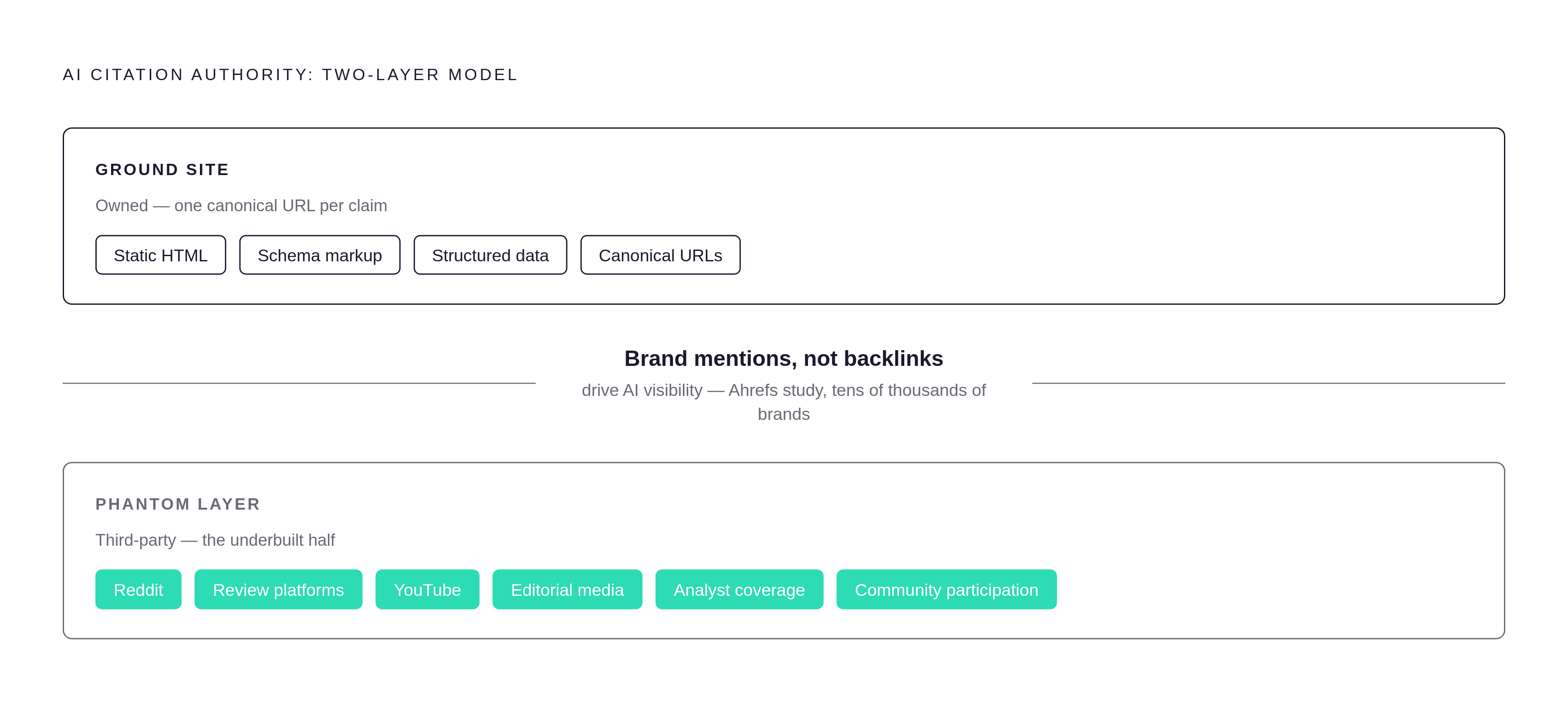
A strong website gives an AI engine a source for a brand’s claims, but it does not supply every source the engine consults. The mechanism is known as AI “fan-out.” Modern AI search engines break a prompt into parallel sub-queries to get a fuller picture of the topic. Each sub-query can find its clearest answer in a different place, including Reddit, a review platform, YouTube, or editorial media. The brand’s own page is only one candidate.
That makes authority more distributed than an owned-content program might assume. A “ground site” provides authoritative, structurally clear information under the brand’s control. A “phantom layer” supplies presence in third-party communities, directories, and editorial coverage that engines can use as independent corroboration. Neither serves the other’s exact purpose. A technically sound website can still leave gaps in the sources an engine uses to evaluate a category or compare products.
But do strong backlinks already give the brand that outside support? Ahrefs’ study of tens of thousands of brands found that brand mentions correlate far more strongly with AI visibility than backlinks do. That correlation undermines the assumption that the signals used to build Google domain authority are interchangeable with those associated with AI visibility, while leaving individual citations uncertain. For a team with excellent owned content, the next constraint may be independent discussion.
Truth 3: Multi-stage AI pipelines with human review produce better outcomes than either pure-AI or pure-human workflows
Building a ground site and keeping up an off-site presence takes more content. Most teams cannot do all that work by hand, yet more pages alone do not give people more useful content. Multi-stage pipelines divide the work differently. AI supplies throughput, while people control strategic direction and editorial quality.
Some practitioners put the critical review at the outline stage, before the system commits to generating thousands of words. Others place it at final publication. An outline review lets an editor reject a weak premise or redirect the argument before drafting, while publication review judges the finished content. Both give people a chance to step in that a fully automated publishing process lacks, though the stage of review sets when they can do so.
Google’s spam policies target “scaled content abuse,” meaning the generation of many pages without adding value for users. The target is not AI use itself. An editorial gate must therefore check what the content offers users. For AI citation, that assessment includes accuracy, authority, and usefulness, because thin or inaccurate content fails the purpose of providing dependable source material. Production should scale what deserves publication.
This also limits what the workflow claim can promise. Human review is a control. It helps only if the reviewer can change where the work is going or stop it from being published when it falls short. A process run only by people may keep that judgment but struggle to produce enough for both owned content and the citation layer.
Truth 4: AI citation measurement is a distinct discipline that rank tracking cannot approximate
When teams make content for AI discovery, they need to check AI answers to see how it does. A rank tracker cannot show whether a platform cited a brand, used its explanation, or recommended it to a buyer. Those are different observations from search position. Doing well in one engine also does not prove a brand does well elsewhere, because engines use very different sets of sources. Measuring only one platform can make partial visibility look complete.
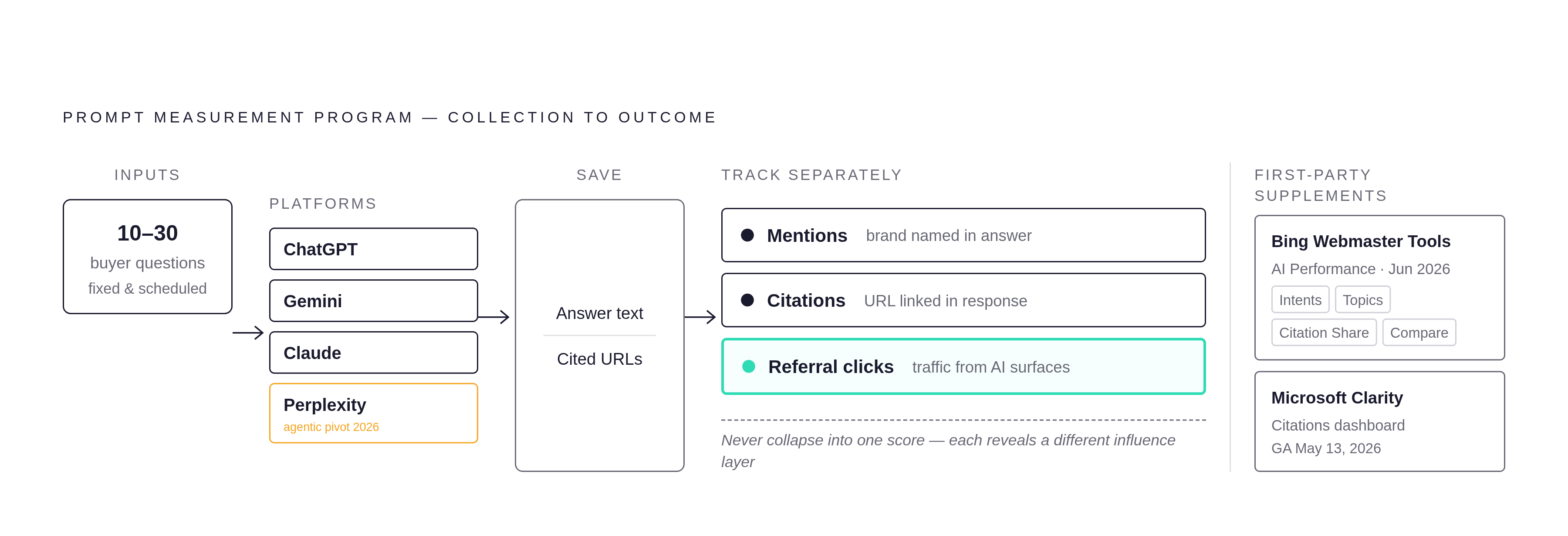
The practical response is a repeatable prompt program. A team should fix ten to thirty buyer questions and run them on a schedule in ChatGPT, Gemini, Perplexity, and Claude, noting Perplexity’s 2026 pivot toward agentic AI. Saving each answer and cited URL makes the output available for comparison. Mentions, citations, and referral clicks should remain separate outcomes, rather than being folded into a single visibility total. Google Analytics 4 can use referral source filters to show traffic from AI platforms, but it shows only the visits that reach the site.
A harder question follows from that separation. Did the source actually shape the answer? A brand can receive frequent citations while contributing little to the response, whereas a single appearance can supply its central explanation. Citation influence, meaning whether the answer draws on the sourced content, is more diagnostic than simply counting appearances.
First-party tools are beginning to expose some of this activity. Bing Webmaster Tools expanded its AI Performance report in June 2026 with Intents, Topics, Citation Share, and a Compare view, exposing grounding-query-level activity and cited URLs for Copilot/Bing-powered answers. Microsoft Clarity’s Citations dashboard became generally available on May 13, 2026, providing a free, first-party view of grounding queries built on a site’s own data. That is useful but scoped evidence. It supplements the cross-engine program rather than making the answers from other platforms observable.
The lie: the page that ranks highest is not the page that AI will cite
The false belief is that a brand’s highest-ranking page will also be its most-cited page in AI answers. The four truths expose why that inference fails. A ranking report cannot stand in for evidence of citation.
The underlying distinction is grounding. AI systems use retrievable sources to support an answer, and the relevant unit can be a passage. A system may use one sentence and ignore the rest. The optimization target is therefore the passage that answers a particular question. A page’s overall ranking does not establish which part, if any, an engine will use.
Success also extends beyond obtaining a source link. Success includes brand mentions with or without links, positive sentiment, and a consistent share of voice across prompts that matter to the brand. Neither a rank tracker nor website analytics shows those results within an answer. “Ghost Rankings” name a particularly revealing failure, in which ChatGPT or Perplexity cites a brand’s content and recommends the brand, but then suggests a competitor for the purchase. Citation and commercial preference can come apart.
The strategic response is to designate one canonical URL per claim, concentrating authority on a linkable, updatable source of record. Reviews, analyst mentions, and authentic community participation can then reinforce that source through the fan-out layer. This connects the passage an engine can retrieve with independent support for the brand behind it. Yet knowing which claim is false is useful only when it changes what the team does next.
What a content calculus built on all five looks like in practice
A team using this framework should start its audit by checking the gap between how it does in search and how it does in AI answers. Strong organic rankings do not establish that buyers encounter the brand during AI-led discovery. A fixed, cross-engine prompt program gives the team evidence of where that encounter happens and what follows from it. Citation influence reveals which information is doing useful work. Separate referral tracking then shows which of those interactions lead to a site visit, without treating visits as the whole channel.
That evidence should guide architecture. The ground site needs content AI crawlers can parse, including static HTML, schema, structured data, and one canonical URL per claim. Passages that are actually grounded in answers should become assets the team updates, links, and distributes off-domain. Support from outside the site should come through reviews, a presence in communities, editorial mentions, and analyst coverage. The priority depends on the gap, whether it is unclear owned evidence or too little independent corroboration.
The team then uses an AI pipeline to make the content it needs, with a human gate at the outline stage or before publication where someone can change or stop the work. The gate keeps the demand for output from displacing the reason to publish, while scheduled measurement tests whether the resulting content influences answers. This puts the work where it is needed rather than into promoting whichever page already ranks best. It gives technical marketing teams a basis for deciding what to maintain, what to strengthen, and where additional work is justified.