Developer Community Platforms Compared for Strict Membership Standards
Membership rules shape community trust more than size or features ever could.
Developer community platforms differ most sharply in how they decide who gets in and whose contributions count. This comparison argues that membership architecture, rather than size or features, is the clearest guide to the signal members experience. Open registration, strict moderation and personal vouching can all support useful communities, but they build different kinds of trust.
Why membership architecture — not size or features — determines community signal quality
Most comparisons begin with member counts, tooling or price, while the more revealing distinction is how a platform admits people and filters their work. Size shows how many people a platform could reach, but it does not explain why a question gets a useful answer. Features operate on top of those rules. Search can help someone find a discussion, but it does not explain why that discussion deserves attention. Badges, Collectives and channels also depend on how that trust is built.
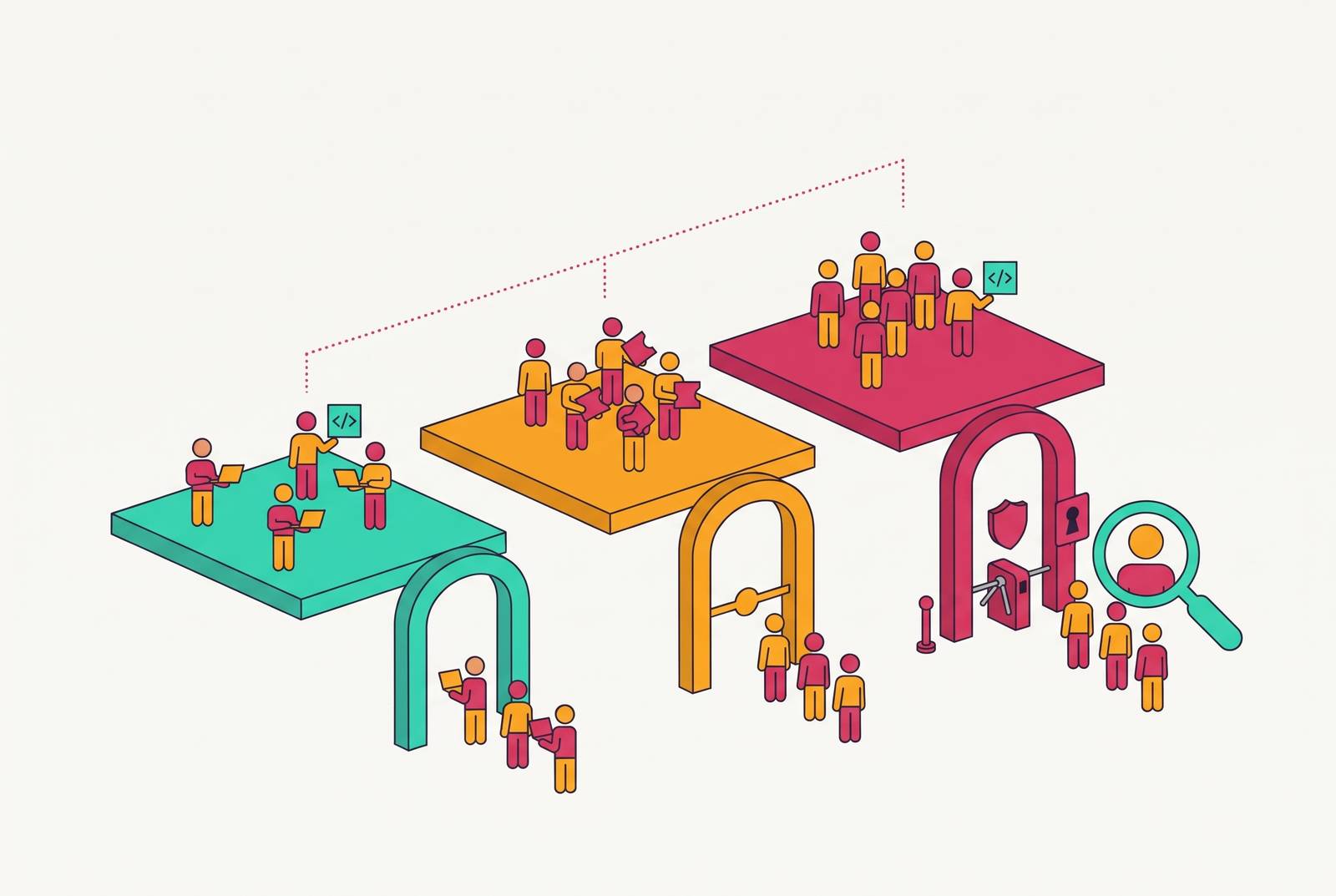
That architecture has two parts, which are permission to enter and authority to shape what stays. A platform may welcome anyone while giving established contributors more editorial weight. Another may ask an existing member to vouch before a newcomer can participate. The useful comparison runs from open entry with reputation-weighted moderation to invite-only admission with personal accountability, with each arrangement suited to a different kind of exchange.
How open-access platforms manage quality through moderation rather than admission
Stack Overflow shows how open registration can coexist with demanding contribution standards. Its downvoting, duplicate closure and strict formatting rules screen work after someone joins, helping build a corpus of over 35 million answers. The reputation system gives high-reputation contributors more say over what stays, so some members are trusted more than others even though newcomers can join without an invitation.
That distinction explains why the same rules can frustrate a beginner and benefit someone searching for an answer. A question that feels reasonable to its author may still duplicate an existing one or fail the required format. The friction serves the archive. Stack Overflow optimizes for reusable answers, which is not always the same as making every first interaction feel welcoming.
The same broad logic appears in r/programming, where registration is open and quality depends on votes and subreddit rules. Its anti-self-promotion rules reduce promotional noise, but they can also constrain legitimate new voices without a posting history. Hacker News is another open platform that lets people reach many developers without the personal endorsement that comes with a vouched network. These communities leave much of the work of establishing trust until after someone arrives.
The strongest objection to admission-based arguments is that open platforms have produced exceptionally useful developer knowledge bases. They plainly can support high-quality technical work. Their constraint is the ongoing labor needed to preserve it, because post-admission filtering depends on volunteer moderator bandwidth and community enforcement of norms. As participation grows, that workload can outstrip available attention. A searchable archive and a high-trust real-time conversation are different products, so success at the former does not settle which model best supports the latter.
What vouching and invite-only admission actually do to contribution quality
Lobsters moves part of that quality control ahead of participation by connecting each new member to an inviter. Its About page states that the full user tree is public and each profile shows who invited that person. A poor invitation is therefore not just an isolated newcomer’s action, because the connection to an established member remains visible. This adds a social cost to indiscriminate vouching that contribution-level moderation alone cannot reproduce.
The site also separates admission from permission to extend the network. New accounts have a 70-day probationary period during which they cannot send invitations, giving the community time to assess their contributions first. Trust does not propagate immediately after entry. Lobsters’ public moderation log lets people check how the site is run, and its strong anti-self-promotion norms shape what members post.
The iOS Developers Slack uses a related model with a different restraint on growth. Its code of conduct allows members in good standing to invite up to two people per calendar month and makes them responsible for those they invite. The monthly cap acts as a rate limiter. The code offers the advisory rule of thumb, “A good rule of thumb is to invite people you've worked with, collaborated with, or know personally”. Personal acquaintance is guidance rather than an absolute requirement, but it ties admission to relationships beyond the platform.
These rules favor professional conversation among people who have some reason to trust one another before they speak. They also impose real costs on accessibility and diversity. A good developer who does not know the right people may find it hard to join, whatever they could bring to the group. For someone seeking broad reach or easy access to beginner support, that barrier can be actively unhelpful. Vouching can improve signal density without being a universally better way to organize a community.
Comparing six platforms across the admission-to-moderation spectrum
Lobsters sits at the high-friction admission end of this comparison, with invite-only access, a public invite tree and the 70-day restriction on new members sending invitations. Its signal is curated technical links. Membership is small relative to the open platforms discussed here, though no comparable membership figure is supplied. The public moderation log also shows why admission and moderation are complements.
The iOS Developers Slack pairs vouched admission with a narrow professional focus. Its membership is not publicly sized, so a numerical comparison would add false precision. The two-invite monthly allowance constrains how quickly each member can extend the network. Responsibility for invitees gives that allowance weight beyond a simple access privilege. The resulting signal is iOS-specific professional conversation, where someone’s word for a new member does some of the work that a record of contributions does on open platforms.
Stack Overflow lets anyone join while keeping strict standards for what they post. Registration is open, and its over 35 million answers describe the scale of the knowledge corpus. That distinction prevents a misleading audience comparison. Reputation-weighted editorial influence, duplicate closure and formatting rules optimize for searchable technical answers.
Hacker News also belongs on the open-access side of the spectrum, with broad developer awareness as its clearest role in this comparison. No membership figure is supplied for it here. Unlike a vouched professional group, it offers access without an inviter’s personal endorsement. Its value is therefore better judged against a need for broad developer discussion than against the intimacy of a specialist Slack community. Consistent contribution is the relevant route to standing.
r/programming has open registration and millions of subscribers, with votes and subreddit rules filtering what people post after they join. It offers broad reach with moderate signal, rather than the more concentrated curation of an invite-only community. Posting history can influence how a contribution is received. Anti-self-promotion rules help preserve discussion quality, while also creating friction for legitimate newcomers who have not established themselves.
DEV Community is open to registration and has 4,000,000+ members, with a notably welcoming tone compared with more strictly moderated platforms. It has the lowest admission friction in this group. Accessibility and beginner inclusion take priority over high-signal curation.
Why high-moderation communities have become disproportionately important for AI citation
Moderation now has implications beyond the experience of the people using a community directly. Archives that are searchable and strictly moderated give AI systems technical material written by people to draw on for answers. The archive becomes a source, not just a destination. This gives a brand’s useful contributions potential value for generative engine optimization, or GEO, as well as for direct audience engagement. The relevant asset is credible material that remains available to be found and cited.
r/LocalLLaMA illustrates why contribution rules deserve a closer reading than a general label such as “strict moderation”. Its first three rules deal with searching before asking, off-topic posts and low-effort posts, and self-promotion is Rule 4. Those rules do not name marketing campaigns or SEO. The focus is on useful participation rather than marketing vocabulary. These rules help filter the technical corpus that AI systems may find, though a post that stays may still fall short of an authoritative answer.
Stack Overflow’s strictly moderated Q&A provides material that AI models draw on heavily for technical answers, so a genuinely useful answer can have a life beyond its original discussion. Search visibility is only one possible route. A brand’s contribution can also become relevant to training material or retrieval, although those are distinct from receiving a visible citation. Presence in an archive does not guarantee attribution by an answer engine.
Lobsters adds visible provenance through its invite tree and public moderation log. Those features make the community’s accountability structure legible, rather than leaving readers to infer how participation is governed. Provenance strengthens the case for taking material seriously. It does not establish that every AI system assigns the same weight to that structure, or that admission rules alone determine citations. Moderation and accountability help make source material worth trusting, though how often it gets cited still needs to be measured.
How a technical brand should choose a community to build presence in, given these differences
For a technical brand, the lesson is to begin with the trust signal it needs. If AI citation is the goal, prioritize communities with strict moderation and searchable material, including Stack Overflow, r/LocalLLaMA and Lobsters. Contribution quality should guide that investment. The fit still depends on the community’s norms, especially where self-promotion is tightly constrained.
If the goal is professional peer credibility in a specific field, seek admission to a vouched community such as the iOS Developers Slack. There, the invitation itself signals a relationship and some standing. What members do after joining then has to earn that trust. If the goal is to become known among more developers instead, Hacker News, DEV Community and r/programming are open platforms where a brand needs to keep contributing to be heard above the noise. Which path is better depends on whether the brand wants to be known among peers or to reach many developers.
The common mistake is to treat member count as evidence that either outcome will follow. Membership architecture gives a better basis for choosing where effort belongs, but selecting a community is only half the job. Measurement has to close the loop across engines. For AI citation goals, track citation frequency rather than inferring success from community size or posting frequency, because a brand cited frequently on Perplexity may be nearly absent on Gemini. Engine-specific monitoring reveals which community investments are compounding and which are not.