FAQ schema is a lint rule, not a strategy: treat buyer questions as a dataset you can query and test
Schema only formats answers; evidence and testing earn citations.
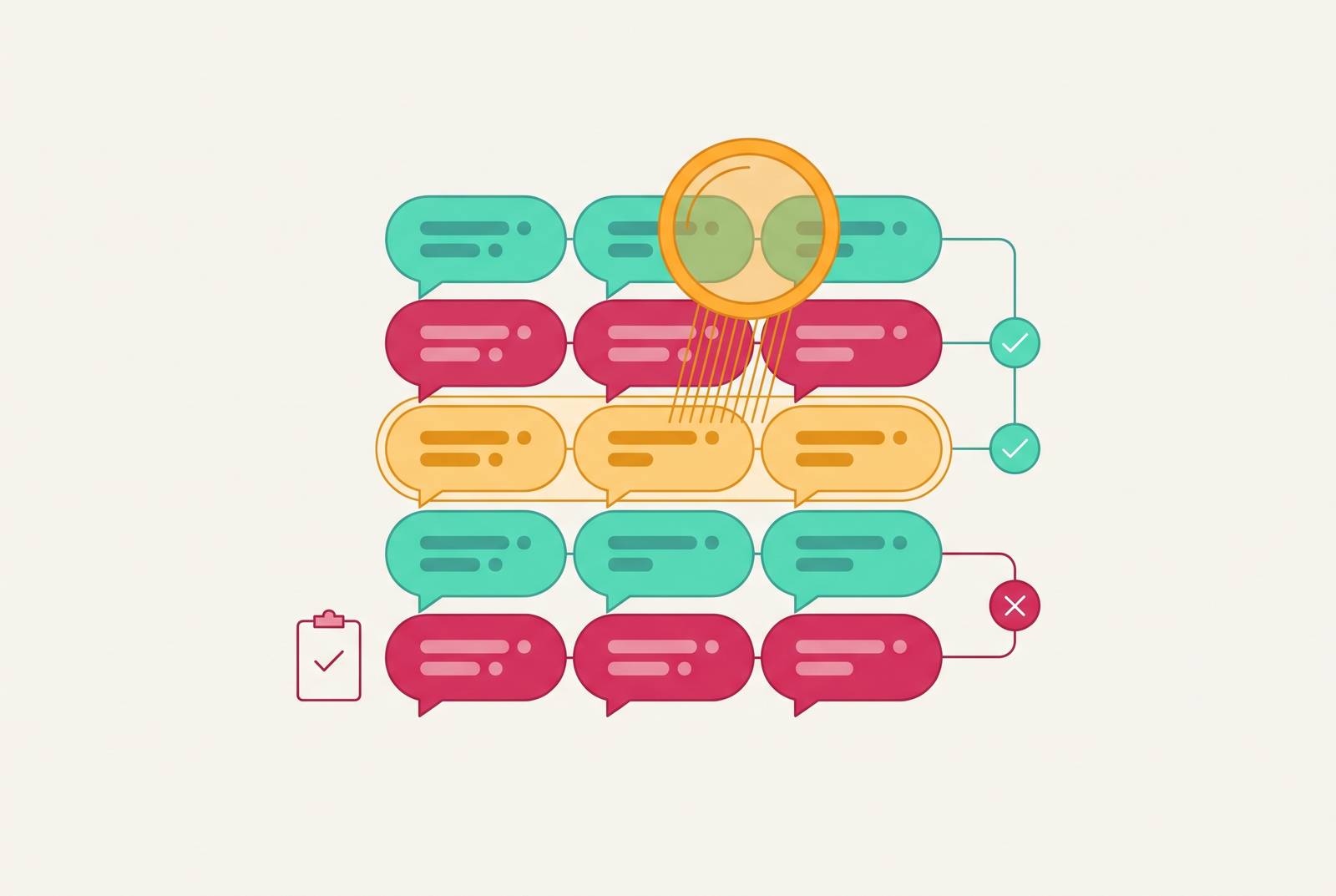
FAQ schema makes answers machine-readable, but it does not make them worth citing. A stronger strategy keeps buyer questions in a live dataset, uses evidence to answer them, and tests whether AI engines cite those answers. Schema is the lint rule in that system.
Why FAQ schema lost its Google feature but not its job
Google removed FAQ rich results on 7 May 2026, ending the visual accordion dropdowns beneath organic search listings. The removal followed systematic abuse, as marketers padded pages with keyword-stuffed questions to occupy more search space. The feature rewarded expansion without requiring genuine buyer questions. Its removal was a signal about that abuse.
The distinction is narrower than “FAQ schema is dead.” Google’s updated documentation says the markup can stay in place, and FAQPage remains a valid Schema.org type. The FAQ rich result report in Search Console is scheduled to retire in June, with API support following in August. The reaction on LinkedIn and X blurred a search display feature with the structured data used to describe the page underneath it.
What FAQPage schema actually does for AI answer engines now
Clean FAQPage markup gives an AI system an explicit description of the questions and answers on a page. It identifies the content as Q&A and supplies machine-readable question-and-answer pairs, reducing ambiguity about which answer belongs to which question.
This is where the lint rule comparison fits. A lint rule catches errors and enforces format, but it does not write the code. FAQ schema similarly makes answers machine-readable without supplying their substance or earning trust for them. The practical requirement is that marked-up answers match the visible text on the rendered page. Answers hidden in markup rather than shown to readers create a validation problem.
What, then, should a successful implementation prove? It should show that the published Q&A has a clear machine-readable counterpart. A page can pass the format check while offering nothing distinctive enough to become evidence in an AI answer.
Why ranking on Google and getting cited by an AI answer engine are separate problems
A Washington University audit found that nearly a third of domains cited in AI Overviews did not appear on the first page of organic results. That finding casts doubt on the belief that a top Google position guarantees a place in an AI answer. The channels overlap, but they are not interchangeable. Grounding queries and organic search queries run through separate ranking systems, so a report about one cannot stand in for a report about the other.
Traditional search shows a list and lets a person choose which link to open. Grounding removes that middle step, as the model selects evidence and folds it into a response. The competition shifts from a position in a list to a place in the model’s evidence set. Rank tracking misses some of the ways people find a brand because it measures a different channel. This is an instrumentation problem as much as a publishing problem.
For teams responding to that shift, crawlability and snippet accessibility are basic requirements. A nosnippet directive can reduce citation visibility because AI engines rely on snippet data during grounding. Clear entities and content structure also help systems parse and quote a page. Name, description, founding year, and services should match exactly across the website, LinkedIn, and industry directories. Conflicting descriptions introduce ambiguity, and a conflict can leave neither source cited.
Buyer questions as a live dataset, not a content brainstorm
The operational response is to collect questions. Sales call transcripts show what prospects ask before they sign, while support tickets show which questions remain after they buy. Support tickets can show where the product falls short of what marketing claims. Site search logs show what visitors look for but cannot find on the current site.
AI probe logs add the channel-specific input that those sources lack. They record queries run against ChatGPT, Claude, Gemini, and Perplexity to reveal what engines say about a category and which sources they cite. The questions come from buyers, but the probes show the answer environment around them. Together, these records support a more useful question than “What should the next FAQ cover?” Which genuine buyer concern has a published answer, and which engine answers it without citing that page?
To query the dataset, teams should group questions by buyer stage, match them to answers they already have, and find citation gaps. Go Fish Digital’s GEO gap analysis framework starts with pages receiving ChatGPT-User hits and AIO impressions in Ahrefs, inventories their H2/H3s, FAQs, and tables, then enriches them. That process links signs that an engine has seen a page to the passages that need work. It also makes prioritization concrete rather than dependent on a broad impression of search intent.
The result need not be an enormous FAQ library. Five to ten well-researched questions addressing genuine buyer concerns outperform a much larger generic set. Padding repeats the behavior that undermined the rich result feature in the first place. A live dataset instead gives editors a reason to select each question and a way to revisit that choice when new calls, tickets, searches, and probes arrive.
What content actually earns AI citations — and what it cannot
Once the questions are grounded in buyer needs, the answers need evidence a model cannot simply reconstruct from generic training data. AI-generated text can cover familiar ground, but familiarity alone gives an engine little reason to attribute a claim to a particular page. Original evidence creates that reason for attribution. The strongest sources include original surveys or benchmarks that name the methodology used, proprietary case studies that name the outcomes, and opinions from named experts in documented conversations.
A benchmark points back to a method, a case study connects an outcome to a named case, and a documented conversation anchors a quotation to its speaker. They are the substance an answer contributes beyond an explanation the model could already produce. For FAQ content, the editorial standard is therefore a direct, complete, specific answer that can stand alone when extracted.
Ahrefs found in a controlled study that schema markup alone had no impact on citation rates. That is a substantial limit on schema-first thinking. Markup can clarify the signal, but it cannot create the evidence that gives the signal value. A technically clean implementation is not a substitute for a source-worthy answer, nor is original evidence a guarantee of selection.
Orbit Media’s 2026 citation study of four LLMs found that the models almost never cited the same sources. On one B2B brand’s question set, ChatGPT and Perplexity shared only 7.6% of their cited domains. An answer that succeeds with one engine may earn nothing from another. Teams therefore need to track citation rates separately by engine rather than let a pooled average conceal where their evidence is being ignored.
Why unreviewed AI-generated FAQ answers compound the citation problem
The tempting shortcut is to let AI generate the whole answer library. But publishing those answers without human review brings a risk that goes beyond generic writing. An invented statistic or misattributed quotation can become part of the public record that another system treats as evidence. The page gives that error a source an engine can cite.
A July 2026 Microsoft preprint audited accepted papers from four of computing’s most selective venues and found hallucinated citations in the permanent scholarly record. The references looked valid and had passed peer review, yet pointed to no real work. The parallel with FAQ publishing is direct. A fabricated claim can acquire the appearance of authority once it sits on a published page, then return to AI answers as supposedly sourced information.
That failure also distorts the measurement of success. A citation pointing to the brand’s domain may look like progress even when the engine is repeating a claim nobody verified. Volume makes that liability larger. For teams that need AI’s speed, the response is staged production with a human gate.
A multi-stage pipeline that publishes FAQ answers at scale without losing editorial control
A staged pipeline separates AI-led synthesis from human responsibility for evidence. Its starting input is the research brief built from buyer questions and the gaps those questions reveal. That gives the draft a clear job to do, keeping it tied to the brief instead of plausible FAQs. Humans retain control over what deserves publication and what supports it. Speed comes from assigning work clearly.
At Stage 2, AI generates an outline from the research brief, and a human editor reviews the structure, adds operator framing, and prioritizes questions. Stage 3 produces an AI-generated draft from that reviewed outline. The separation creates a checkpoint before prose hardens around a weak premise. It also keeps question selection distinct from the ease with which a model can answer something generically.
Stage 4 is human-led revision and experience injection. The named author adds experience claims, operator specifics, named evidence, and voice alignment, making this the stage where the E-E-A-T signal is earned. Stage 5 publishes the answer with structured data checked against the content readers can see. Every AI-generated suggestion should remain reviewable and reversible before publication.
Its second layer is a named human editor who verifies factual claims against source documents. First-pass yield then measures the percentage of drafts passing all automated guardrails without regeneration. A rate below 70% indicates prompt or model issues.
Measuring whether AI engines actually cite you for the questions you answered
Once an answer is published, teams still need to measure how it does. The major AI answer engines have no unified API for citation data, so teams need to run structured probe queries against each engine and log what gets cited. The buyer-question dataset supplies those probes.
The measurement unit should be cite rate per engine. Raw mention counts are harder to compare because engines differ in how they construct answers and present sources. Perplexity lists far more sources per answer than Claude, so a count across engines partly measures how the answers are built as well as how good the citations are. An aggregate visibility score can similarly hide an engine that consistently omits the brand.
In practice, the loop runs through probing, logging, finding gaps, and enriching answers. Teams run buyer questions against each engine, record the cited domains and their positions, then identify published answers that are missing from the evidence set. Those answers return to editorial review for more specific, attributable evidence before another probe.
The final test starts with questions from sales calls. When the published answers fail to appear, a valid schema implementation is not a reason to declare the job complete. The evidence gap belongs back in the research brief, together with new questions from support, site search, and probe logs.