Domain Authority Is Dead for AI Citations — What Actually Gets Your Brand Into LLM Answers
Third-party mentions matter far more than domain authority for AI citations.

Domain Authority is a poor guide to whether a brand will appear in an LLM answer. AI citation depends on passages that answer the question, facts corroborated by other sources, and proof that can be traced. Building that presence means treating content structure, third-party coverage, and measurement as a discipline of their own, rather than assuming that strong Google rankings will transfer.
Why Domain Authority fails as a proxy for AI citation probability
A brand can rank at the top of Google for its core query and still go uncited by ChatGPT. That is the mismatch a search dashboard can conceal. Domain Authority explains roughly 3% of the variation in AI citation probability in the analysis described here. It offers little guidance on which sources an answer engine will select, even when it remains useful for the search task it was designed to predict.
The error is treating two different selections as one. Google ranking and LLM passage retrieval do not evaluate the same unit of content through the same architecture. A domain’s backlink profile does not tell a retrieval system whether a passage answers the question it was given.
Does that mean success in Google has no value? No, but it cannot stand in for evidence of AI visibility. A large-scale domain study found only a small fraction of domains appeared in both Google AI Overview citations and LLM citation lists. Those largely separate source populations make transfer an assumption to test.
How LLM retrieval actually works, and why it selects for different signals
Retrieval-augmented generation, or RAG, fetches candidate passages when a question is asked and supplies them as context for the model’s answer. Semantic retrieval matches the meaning of the query to the meaning of the text, often with keyword retrieval and reranking added. The unit of selection is a passage. Its usefulness depends on whether it answers the question precisely and without ambiguity.
That explains why a strong domain can supply a weak candidate. If a passage needs several earlier paragraphs to make sense, its meaning is harder to recover in isolation. A self-contained answer offers a closer match to the task. Tampere University’s bibliometric analysis identified fine-tuning and RAG as the two most prominent strategies for improving LLM trustworthiness, placing retrieval at the center of this practical reliability work.
ChatGPT gives more weight to editorial authority, while Perplexity gives more weight to real-time user-generated content and data sources such as G2. Gemini draws more from Google’s own ecosystem, and Claude favors long-form writing that explores a subject in depth.
Internal data from multiple accounts shows that generic schema markup had no effect on citation rates, while attribute-rich, fully populated implementations showed a measurable advantage. Technical SEO hygiene alone is not evidence that a page has become more retrievable.
The signals that actually predict AI citation, ranked by measured impact
Third-party brand mentions are the strongest of the signals measured. They correlate with AI citation probability roughly three times more strongly than backlinks and several times more strongly than DA. This makes earned media the primary lever in the supplied findings, ahead of owned-page optimization alone. Mechanically, mentions create other places where a system can retrieve and corroborate facts about the brand.
Correlation is not a guarantee of causation, however. The finding does not mean that any mention, in any context, will cause a citation. Its practical force is comparative. A team that measures only backlink growth is watching a weaker predictor while overlooking the independent sources that can substantiate its claims.
At the passage level, definitive phrasing is the next priority. Specific Subject-Verb-Object sentences earn citations at a materially higher rate than hedged or passive language because they state a claim that can be extracted. “Stripe reportedly handles a significant volume” leaves both the action’s scale and the claim’s basis vague. Clear phrasing cannot rescue an unsupported fact, but it can make a supported fact usable.
Topic clusters that cover a concept across five or more pages are cited more often than isolated pages, giving retrieval more passages that answer related questions. That favors depth over a single hero page. The notes do not provide comparable effect sizes for every writing and coverage signal, so this priority order should not be mistaken for a universal numerical ranking.
What about evidence that authority helps in AI Overviews? AI Overview citations and standalone LLM citations draw on largely different domain populations. Findings about one surface need to stay attached to that surface, rather than becoming a general claim about all AI answers.
What passage precision means in practice: putting the answer in sentence one
Consider the contrast between a niche page that answers a question immediately and a DA 92 site that buries the answer. The niche page can be the better choice for retrieval even with its lower domain score.
Position can act as a citation gate. When the core definition or claim sits in paragraph eight, most LLMs will not retrieve it. For a content team, the practical change is to put the answer in sentence one, then develop the evidence and qualifications beneath it. The opening sentence should name the subject and state the claim so it makes sense without an introduction.
LLMs favor comprehensive “single source of truth” documents that can be divided into useful chunks. A long page can serve that purpose when each section remains intelligible on its own.
The supporting tactics are modest but useful. Clean heading hierarchy separates questions, while ordered or unordered lists can make a sequence or set easier to parse. SE Ranking’s study found those structures on a large majority of cited pages, though their role is to enable chunking.
Why entity consensus — third-party corroboration of your facts — functions as the new trust signal
Why should a system trust the claim it has retrieved? Entity consensus supplies part of the answer through multiple independent sources asserting the same fact about an entity. Brand mentions and E-E-A-T signals act as proxies for that corroboration.
The relevant sources differ by category and platform. Reuters, the Associated Press, Bloomberg, Forbes, and the New York Times form part of the trusted editorial layer for news and finance. LinkedIn is a source for B2B, while Reddit and G2 carry more weight on Perplexity. A brand’s strategy depends on identifying which third-party sources corroborate its facts in the engines and categories that concern it.
Yet repetition alone does not establish truth. The Bar-Ilan / UNC deep research citation study found poor citation recall and showed how content and citations can become corrupted as information passes through multiple agents. That risk gives provenance a practical role. Named authorship, editorial authority, and evidence that can be traced to its source let people check a claim even if they have heard it before.
Original data that humans have checked gives a claim that kind of backing. If AI-generated content cites other AI-generated content containing fabricated citations, apparent agreement can become a self-referential loop. Traceable source material offers a way out.
Attestation extends this principle to customer proof. Named, verifiable companies using a product contribute something that anonymous case studies cannot supply. Pages with at least one named-source citation in the body are cited 2.1x more than pages with none, though that finding should not be read as a customer-proof-only effect. Signed, traceable customer evidence belongs in this trust architecture because it makes the brand’s claims independently examinable.
The measurement gap: most brands cannot tell whether AI engines are citing them or ignoring them
These signals cannot guide investment if a team never measures their outcome. Only 14% of marketers actively track AI citations, though a large share say AI search is a key part of their strategy. Teams may know that retrieval differs from search ranking but still use dashboards that cannot show how they differ.
Published research identified in the notes as an arXiv paper distinguishes citation from absorption into the answer. A brand can appear in a footnote without contributing to the explanation the user reads.
Platform divergence makes that task more demanding. Citation volumes for the same brand can differ by a very large multiple between engines, and the overlap between domains cited by ChatGPT and Perplexity is extremely small. A strong result on one platform can conceal absence on another.
To set a baseline, a team tracks mention rate, citation rate, and AI share of voice for each engine. AI share of voice is the brand’s share of all the visibility measured for the brands being tracked and compared. Fixed prompts, a fixed baseline, and a regular cadence make changes interpretable as trends. Active categories show material month-to-month citation drift, so a one-time audit cannot supply a durable baseline.
Repeated runs also expose instability within the same query. AirOps research found that only a small fraction of brands remain consistently visible across consecutive runs. A peak result is therefore a weak health measure. Consistency of presence is the stronger test of whether the content and corroboration are producing a dependable outcome.
Building the stack that replaces DA: topical authority, entity consensus, passage precision, and attestation as instrumented disciplines
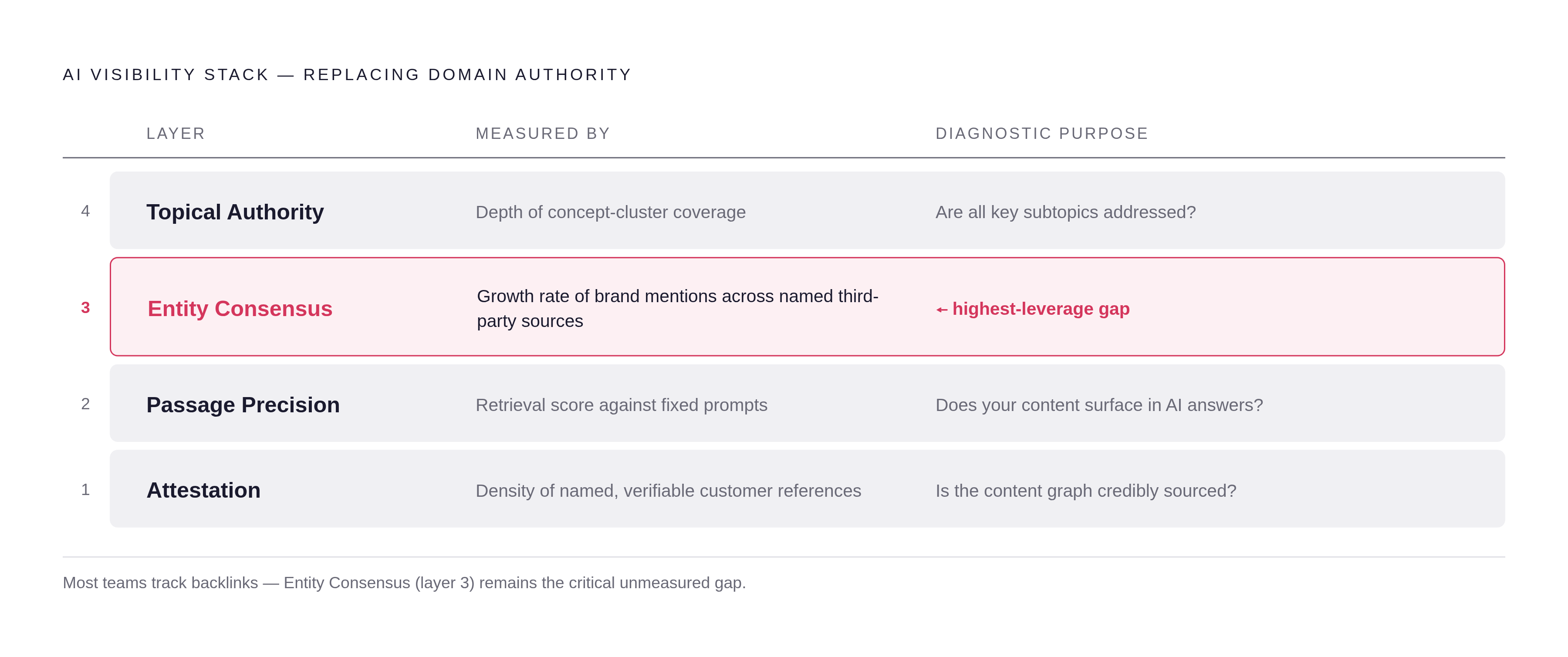
The practical response is a four-layer stack with a measurement method for each layer. Topical authority is measured by how deeply the content covers a concept cluster. Entity consensus is measured by how fast brand mentions grow across named third-party sources. Passage precision is tested against fixed retrieval prompts, while attestation is assessed through the density of named, verifiable customer references in the content graph.
Those measures serve different diagnostic purposes. A coverage gap calls for different work from an answer that exists but cannot stand alone as a passage. Similarly, a clear owned-page claim is not the same as independent corroboration of that claim. Keeping the layers separate lets a team see what is missing before it turns to more backlinks or more pages.
Internal data from multiple accounts shows why that distinction is useful. Brands with backlink moats saw no protection for AI visibility, while brands publishing structured, linked, proven, current content built citation presence from a standing start. This does not establish that every content investment will succeed.
Sustaining the work calls for production controls as well. Multi-stage AI pipelines can handle drafting and optimization at cadence, while humans own judgment, verification, and the original data layer. The deep research study’s account of errors propagating across agents makes that division consequential. Human review is not just a final polish when the evidence itself can be distorted along the way.
The owned site remains the foundation of this work. Comprehensive source documents give third-party coverage something substantive to amplify, so earned media and owned content are complements. Measurement then connects the investment to its result by tracking whether ChatGPT, Claude, Gemini, and Perplexity name and cite the brand on a fixed cadence. The shift is from trusting an inherited score to testing whether clear, corroborated, traceable content becomes part of an answer.