Google AI Overviews are reading your content and citing your competitors — here's the engineering fix
Google must fix how it extracts content versus which sources it cites.
Google AI Overviews can use a brand’s product or pricing content while sending buyers to a competitor through the citation link. Closing that gap is chiefly an engineering task. The fixes are concrete, including structured data on canonical pages, fresh crawl state, and a link graph that makes the site’s topical authority clear.
How Google AI Overviews decouple extraction from citation
A B2B company’s pricing page supplies facts for an answer about its category, but the visible citation points to a competitor or a third-party list. The answer may describe the company accurately. Yet the buyer gets no direct route to the page that supplied those facts, and the company may see no obvious sign that its content helped ground the response.
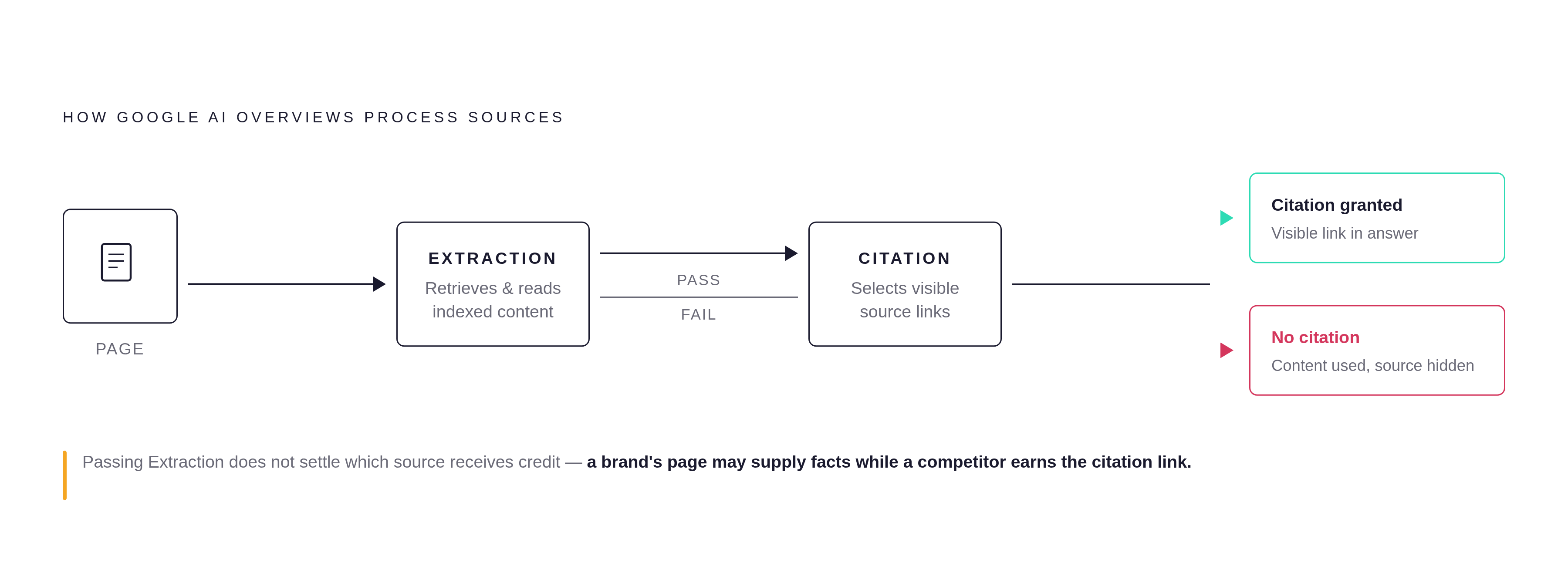
The distinction comes from two sequential stages, extraction and citation. Extraction retrieves and reads content from the index, while citation selects which sources to show to the user. These stages depend on each other. A page must pass retrieval before it can be evaluated for citation, but passing retrieval does not promise a visible link.
That explains the otherwise puzzling case of a page ranking in the top three organic results while remaining absent from the AI Overview’s citation set. Organic visibility gets the page into contention. It does not settle which source receives credit in the generated answer. For a technical founder or marketing team, the useful question is therefore not just whether Google can find the page, but whether the system can recognize it as the source worth citing.
Why the citation gap is a structural machine-legibility problem, not a content quality problem
A competitor’s citation does not establish that its explanation is more informative. Its page may instead give the retrieval and reranking layer clearer signals about the entity, the facts, and the source’s authority. That distinction changes the work. Rewriting an already useful pricing explanation will not add the missing structured data or update the old indexed copy.
Google Search Central’s May 2026 AI optimization guide says AI Overviews are rooted in the core Search ranking and quality systems, with no separate AI index. Within that shared foundation, AI Overviews apply their own retrieval, reranking, and passage selection. The resulting citation choices can diverge from organic rankings. A conventional rank report therefore cannot diagnose this gap on its own.
Machine legibility has three concrete failure modes. When structured data is missing or has gaps, the page’s entity, price, or subject is unclear. When crawl state is stale, Google is reading older pricing, specifications, or claims. Thin topical authority means the link graph provides too little evidence that this domain is a strong source on the subject.
Schema validation, canonical hygiene, crawl budget, and the link graph belong in the investigation before another content rewrite. Content still needs to answer the question, but its usefulness is only part of the problem. The system also needs clear evidence of what the page represents and why it deserves the citation.
Schema.org markup as a citation tiebreaker on canonical product and pricing pages
Schema.org markup gives a canonical product or pricing page explicit labels for the entity it describes and the facts it asserts. Those labels leave less for the system to work out during extraction. That association supports treating markup as a citation tiebreaker.
For implementation, a SaaS pricing page’s structured data block can use Product as its @type, with name, description, brand, and an offers object containing price and priceCurrency. The pattern is compact and recognizable. It makes the relationship between the product and its offer explicit, rather than leaving the machine to infer that relationship from the page layout.
Other page roles call for other types. FAQPage identifies buying questions and their answers as distinct units. Article or TechArticle can include author, dateModified, and publisher to establish authorship and recency. The goal is not maximum markup, but a clear description of the page’s actual role.
Canonical hygiene is equally important because product data can appear across filtered URLs, pagination, or session variants. Markup on the wrong variant does not consolidate authority to the intended citation target. The rel="canonical" tag and the schema must point to the same URL. Before requesting a recrawl, validate the implementation with Google’s Rich Results Test and the Schema Markup Validator, since broken or conflicting markup can work against citation selection.
Forced recrawl via Search Console to close the staleness gap
Correct markup on the live page cannot help if Google’s index still has the version from before the change. The citation layer reads the indexed content. A deployment and an indexed update are different events.
To put the corrected page back into the crawl queue, start with its canonical URL in Google Search Console’s URL Inspection tool. After validating the markup, use “Request Indexing” for that URL. Google’s Search Console Help identifies this as the mechanism for requesting a crawl of an individual page. Despite the shorthand “forced recrawl,” the request is a queue hint, has a quota, and does not guarantee indexing.
Prioritize canonical product and pricing pages where schema was just added or corrected. Next come pages with changed prices, features, or specifications, because an outdated answer can misrepresent the offer a buyer is considering. Pages that are losing citations to competitors also need to be checked. Confirm that pattern through citation tracking, correct the schema, and then request the recrawl.
After the recrawl, inspect the URL again to see whether the indexed version reflects the current page. Use “test live URL” to check the live structured data, while keeping that result distinct from evidence about the indexed copy. The relevant question is whether Google now has the revised content available for retrieval.
Internal linking architecture that signals topical authority to the citation layer
A pricing page with links to comparisons, use cases, and integration documentation has more context than a landing page with no links to other pages. Those links show the citation layer how much depth the site has on the topic. The domain connects its claim about a product to the supporting material a buyer needs to understand it.
To make that depth legible, use the canonical product or category page as a hub. Supporting pricing, feature, comparison, FAQ, case study, and integration pages should link back to it. Where their subjects overlap, supporting pages should also link to each other.
Anchor text should describe the page it links to and use terms that match the entity’s name and key attributes in the schema, so the links reinforce the structured data. More pages are not automatically the answer. Existing pages that are orphaned or weakly connected may need better integration before the site needs more material.
External links strengthen the same authority signal. Links and citations from directories, review platforms, and industry publications in the same category can strengthen the canonical product page. The owned-site work remains more directly actionable, but authority does not stop at the site boundary.
How the extraction layer selects passage-level content, and what that means for page structure
The extraction layer retrieves passages as well as whole pages treated as single documents. It evaluates whether a particular paragraph can answer a sub-query without requiring the surrounding text. That changes what “clear enough” means. A page can make sense from beginning to end while containing few passages that remain useful when separated from it.
To support that retrieval pattern, put the key fact in the opening paragraph before background or calls to action. On a pricing page, that means the price and what it describes. On a comparison page, it means the comparison point before the extended explanation. The system has a harder time extracting important facts buried midway through the page than direct answers near the start.
H2 and H3 headings should describe the specific claim or subject beneath them. The heading supplies context for the passage. Short, self-contained paragraphs then give the system answer units that do not depend on an earlier paragraph to identify the product or explain the claim. FAQ sections with FAQPage schema fit this pattern because each question-answer pair already has a clear job to do.
Schema identifies the entity, and the link graph supports its authority. Passage structure gives the system a useful answer to retrieve from that source.
Measuring whether the fixes are working — citation tracking as the feedback loop
Schema, crawl, and link changes need outcome monitoring just as code changes do. Without it, a team cannot distinguish an improvement from no effect or a competitor’s subsequent gain. Organic rank is not a substitute. Internal data shows enough divergence between AI citation rate and organic position to require a separate instrumentation layer.
Before making changes, establish a fixed set of fifty to two hundred buying-intent questions that target customers actually ask. Run that set against Google AI Overviews on a schedule. For each query, record whether the brand appears, whether its own domain receives a citation link, which competitor domains are cited, and where the brand is mentioned in the answer.
Use citation rate, the share of tracked queries that cite the brand’s domain, as the primary metric. Track competitive share of voice as well, comparing the brand’s citations with each named competitor’s. This shows whether citation credit is shifting. A brand can appear in answers more often without gaining the links the engineering work is intended to recover.
Run the query set weekly immediately after schema changes and recrawl requests, then every two weeks once citation rates stabilize. If a pricing page’s citation rate has not improved two weeks after a recrawl, revisit schema validation, canonical consistency, and the completeness of its internal link cluster. When a competitor gains citation share, the team should review whether a recrawl is needed. These steps help find what is wrong, but they do not promise that every change will bring a gain within that window.
First-party reporting can add context where it is available. Microsoft’s Bing AI Performance Dashboard, public since February 10, 2026, provides citation and grounding-query data for Bing-based AI surfaces. Microsoft describes that data as a sample of citation activity. It can inform broader monitoring, but it does not replace the fixed Google query set needed to evaluate these fixes.
Why the same structural discipline that wins AI Overview citations also serves the broader agent-era stack
The same page can face different citation choices across AI surfaces. Ahrefs research found that Google AI Overviews and Google AI Mode share only a small fraction of cited URLs for the same queries. A successful citation on one surface therefore does not establish visibility on another. Each retrieval pass can make a different selection.
That variation is a reason to invest in site structure. When entity markup is consistent, the link graph fits together, and indexed content is up to date, retrieval-augmented generation systems have clearer material to work from. This also helps systems beyond Google, such as Perplexity and enterprise agents. They need legible evidence, even when their retrieval choices differ.
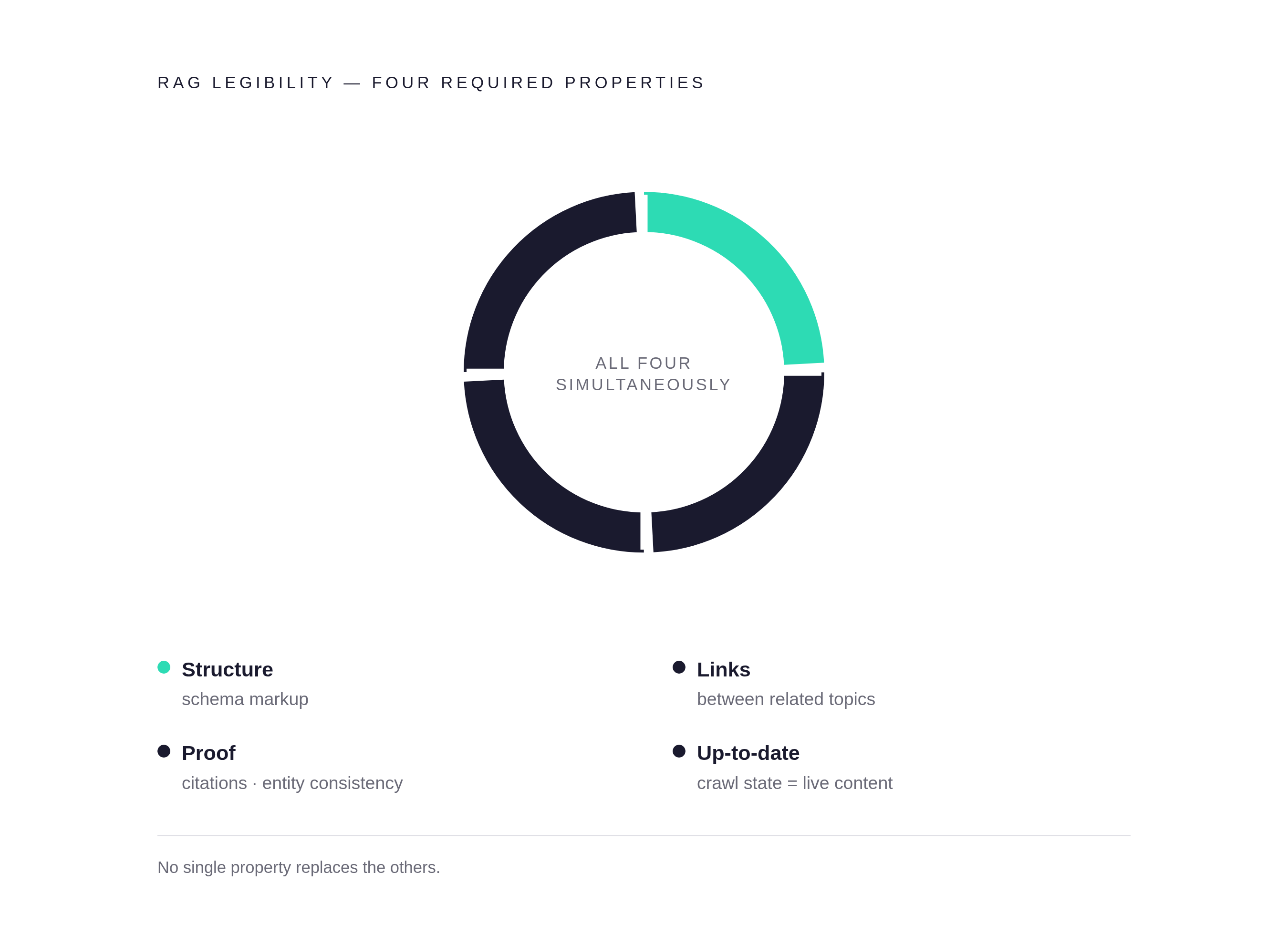
Operationally, that evidence has four properties. It has structure from schema, links between related topics, proof from third-party citations and entity consistency, and up-to-date content because crawl state reflects what is live. No single property replaces the others. Even with a clear price, a stale page with no links to other pages still has gaps.
The investment compounds when these properties become part of normal publishing and maintenance. Schema that has been validated gives the page a foundation, while the link graph grows as new supporting content joins the cluster. Citation monitoring catches drift and gives the team a reason to revisit the underlying implementation before lost visibility costs pipeline.