Who changes the page after a GEO finding arrives? Why a findings file plus a services team is not a closed loop, and what a technical B2B buyer should require from GEO tools instead
GEO reports show where you're missing, but not who fixes it.
GEO tools can reveal where a brand is missing from AI answers without providing a way to fix the page. For technical B2B buyers, that difference should guide what they buy. A findings file plus a services team is not a closed loop. Measurement, content generation, and publishing need to live in the same automatable pipeline, with human review built in before anything ships.
Why GEO findings don't translate into page changes on their own
A gap report lands in an inbox. It shows prompts where competitors appear in AI answers and the brand does not. The missing visibility is clear, but the report contains no draft, publish date, owner, or mechanism for getting a fix onto the page. Someone now has to turn a finding into work that another person can approve and deploy. The report has identified a problem without creating a path to resolve it.
That is an execution gap. GEO tools track whether AI answer engines including ChatGPT, Perplexity, Google AI Overviews, Gemini, and Claude cite a brand inside generated answers. Classic rank trackers were not built to capture that signal, so the report supplies information the team needs. But knowing where the brand is absent does not establish who will change the content or when the change will reach readers and engines.
Who has room to take that on? Content teams are already behind on existing roadmaps, while engineers have sprint backlogs that will not absorb an unticketed GEO task. Even someone hired with enough GEO knowledge to do the work needs months of onboarding. In the meantime, the finding waits, and the citation patterns behind it can shift. The obstacle is not a lack of interest in the report but the absence of an execution path.
How the findings-file trap is built into the category's architecture
Most GEO platforms were designed around measurement as the product, leaving remediation for someone else. Their natural endpoint is therefore a finding. Monitoring-only and optimization-focused tools dominate the category, while full-stack automation is the exception.
If the product stops at tracking or recommendations, content production and publishing have to happen outside it. A services team may take on some of that work, but the arrangement introduces a second vendor, a handoff, and a delay. Those dependencies sit outside the discovery-to-fix loop the buyer thought was being purchased. They are not evidence that the people involved are doing their jobs badly.
The distinction is between adjacent capabilities and an integrated system. A monitoring product can show what needs fixing in a findings file, and a separate team can act on it, without either controlling how the work passes between them. Who turns the file into a production task? Unless that transition is part of the architecture, the buyer inherits responsibility for connecting the pieces and keeping work moving across them.
Time makes that responsibility harder to discharge. A gap analysis done once and filed away goes out of date within months as citation patterns shift. So a workflow built around files sent from time to time must both get changes published and check whether the proposed fix still needs to be done.
What citation engines actually require before they cite a page
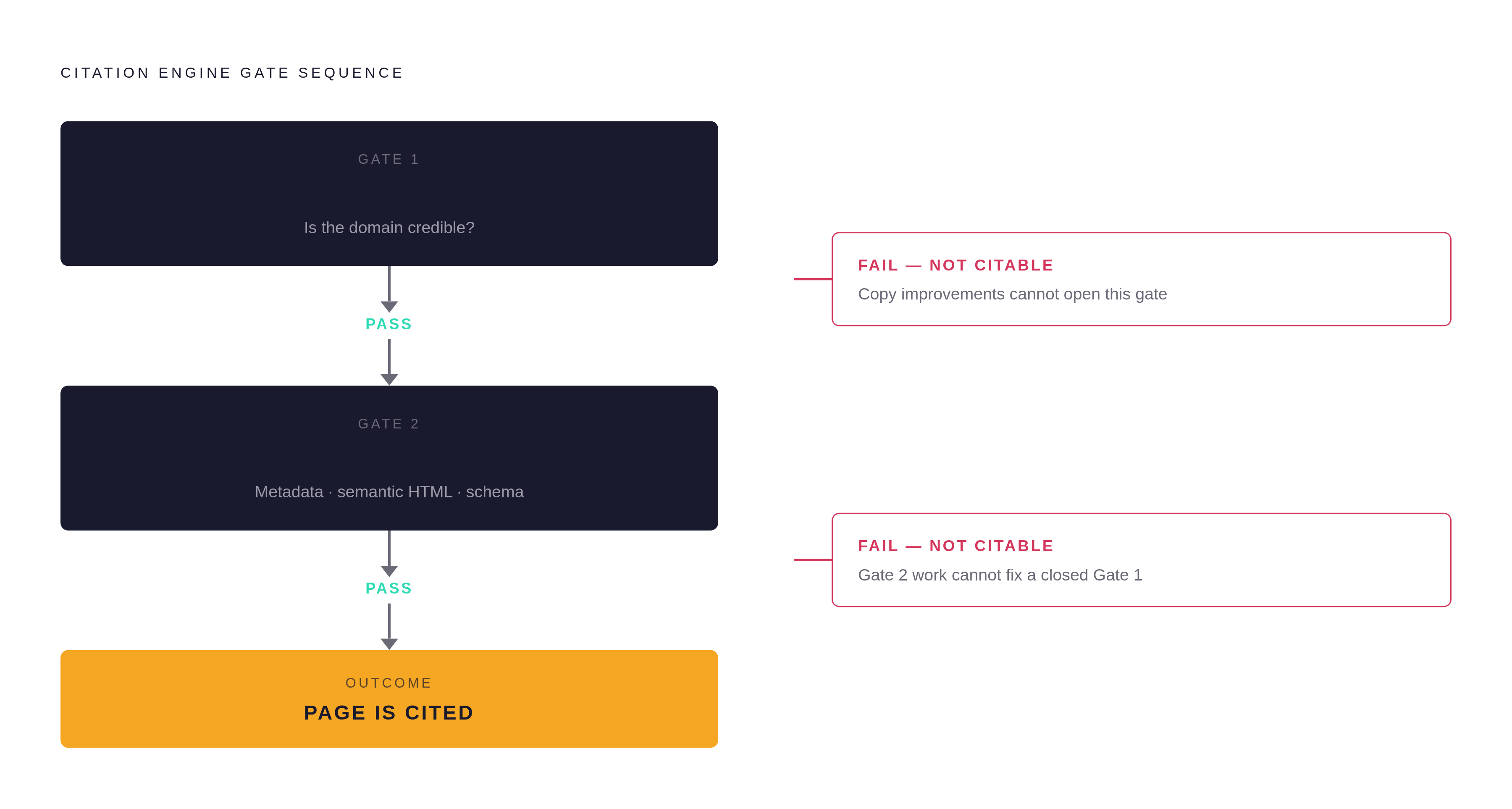
Citation decisions involve two sequential gates, and work on the later gate cannot compensate for an earlier one being closed. A page may have content that answers the query but still be ruled out for citation because of crawl access or how the engine treats its domain. That is why an absence in an answer requires diagnosis before it becomes a writing assignment.
Gate 1 is domain trust. Does the engine treat the domain as a credible, citable source, or does it deprioritize self-published brand content by default? If the domain is not being treated as citable, improving the copy on it addresses a different problem. The page can become clearer without clearing the gate that kept it out.
Gate 2 is content structure, once domain trust is established. Here the question is whether the page meets the standards needed for extraction, including metadata freshness, semantic HTML, and structured data. These are deployed properties of a page. When a tool recommends improving them, the technical work stays unfinished until those changes are live on the page. Strong prose is only part of the requirement.
Engine differences complicate both gates further. Engines differ sharply in what they cite, so a strategy for a single page cannot be assumed to work on every surface. Different buyer personas use different AI tools, and monitoring only one or two can create false confidence about visibility elsewhere. A dashboard showing citation counts can reveal uneven results, but it does not explain them. The explanation requires structural diagnosis of why a source was cited in some answers and absent from others.
Why adding a services team to a monitoring tool doesn't close the loop
The obvious response is to pair the monitoring tool with an agency. That can bring expertise to the diagnosis and give the findings an audience responsible for acting on them. It does not, by itself, connect measurement to deployment. A monitoring tool plus a services retainer remains two separate systems, with a handoff at the point where the finding must become a page change.
The handoff is where ownership becomes difficult to pin down. Someone must change templates, someone must publish content, someone must check that the product details are right, and someone must fix technical issues. Agency-led GEO work spans at least three internal functions and one external vendor. A services team can describe what needs to happen without controlling every action required to make it happen. A roadmap is not a deployment mechanism.
The delay can therefore survive a well-scoped engagement. The services team hands back a roadmap, the roadmap enters a backlog, and nobody’s calendar includes “deploy the fix by Thursday”. The client still has to get the findings from measurement into content production.
The two gates make the limits of that arrangement clearer. A domain-trust problem may need work beyond the owned site, while a content-structure problem may call for changes to templates or structured data. Both still need a route to deployment. Meanwhile, citation patterns and engine behavior keep changing, so a gap identified in one month may no longer be the highest-priority fix two months later. Improving the people or the roadmap does not eliminate the architecture’s dependence on a handoff.
What a closed loop actually requires at the architecture level
A closed loop has measurement, content generation, and publishing in the same automatable pipeline. The signal from measurement starts work on a draft, and publishing gets the reviewed work onto the right surface.
Measurement begins with prompt-level tracking across ChatGPT, Copilot, Gemini, and Perplexity. It logs brand appearance, position, sentiment, and whether the engine cites a link to the site. Those signals are distinct. A brand can be named without a link, or linked without being named, so appearance alone cannot stand in for citation performance. Preserving the distinction gives the next stage a more precise account of the gap.
Generation then follows from the measurement signal, rather than waiting for a person to read a report and open a ticket. This is the critical connection. Draft production becomes part of the system’s response to a finding. Publishing must complete that connection by deploying to the right surface, whether that is an owned domain, a third-party placement, or a structured data layer, without requiring another team or vendor.
To build domain trust, the strategy must reach beyond the owned domain through third-party placements, guest content, and citation-source seeding on authoritative domains that engines already treat as credible. Addressing content structure requires metadata freshness, semantic HTML, and structured data to be deployed. An architecture that only drafts owned-site copy cannot do both kinds of work by writing more text.
Every AI-generated draft should be reviewable and reversible before it ships, with human review embedded inside the pipeline. People can then review the work without having to connect separate systems by hand.
The procurement questions that reveal whether a GEO tool closes the loop or just reports it
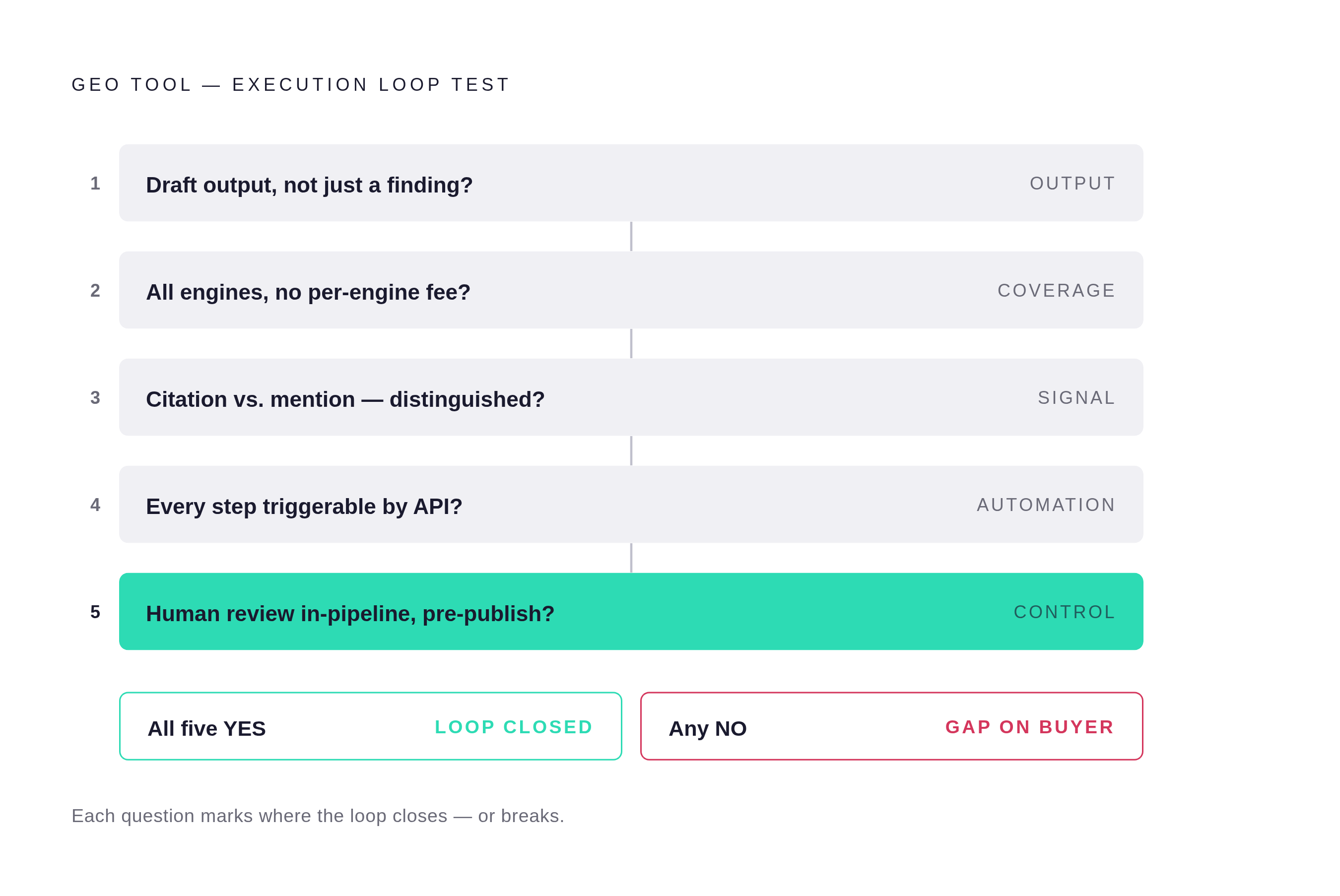
For a technical B2B buyer, the lesson is to evaluate the path from finding to publication. Five questions show where that path ends or needs people outside the system to keep the work moving. Together, they make the vendor explain what the buyer is actually purchasing and what work remains outside the product.
Buyers first need to check whether the tool produces a draft or only a finding. A gap report leaves the buyer to supply the entire remediation layer. Draft production is a necessary step beyond that boundary, though it does not on its own establish that publishing is connected.
Buyers second need to check whether the tool covers the engines the buyer’s audience actually uses, without charging per engine. Coverage should follow the market being measured. Some vendors sell engine coverage as paid add-ons, so the view of AI visibility can be limited to the engines the buyer paid for and miss places where buyers seek answers.
Buyers third need to check whether the tool distinguishes a mention from a citation. These signals answer different questions about visibility. Being named without a link is not the same as being cited as a source, while a link can appear without the brand being named. A tool that collapses those events can create false confidence about citation performance and obscure the gap its execution pipeline is supposed to address.
Buyers fourth need to check whether every step can be triggered by an API as well as by a person in a user interface. A pipeline that depends on manual steps to move from finding to fix cannot scale or be audited as a system. Every capability needs to be available that way so the pipeline can connect to the buyer’s own stack.
Buyers fifth need to determine where human review lives. If review happens only after the tool hands work to a services team, the architectural break remains. If it happens inside the same system before the draft publishes, people can judge the work within the loop without sending it elsewhere for review.
These questions describe an architecture that exists and that technical buyers should hold vendors to. A platform that meets all five requirements and exposes every capability through an API serves as both the measurement and execution layer for AI visibility. That is the basis for treating GEO as an engineering discipline.