"Google Ads agent" that launches only on your yes: what a technical B2B buyer should test before trusting an approval gate, a negatives limit and a stop rule
Three tests show whether an ads agent's controls are enforced or only promised.

A “Google Ads agent” that launches only on your yes needs more than an approval button. Before granting write access, a technical B2B buyer should test whether its approval gate, negatives limit, and stop rule enforce the boundaries they promise.
Why an approval gate, a negatives limit, and a stop rule are only as strong as what you can verify underneath them
“Launches only on your yes” describes a promise. An architectural guarantee must explain what stops a change to a live account when nobody says yes. Those are different standards of evidence, especially when an interface fails or a change reaches the system through another entry point. The buyer’s question is therefore not whether an approval control exists, but whether every relevant write must pass through it.
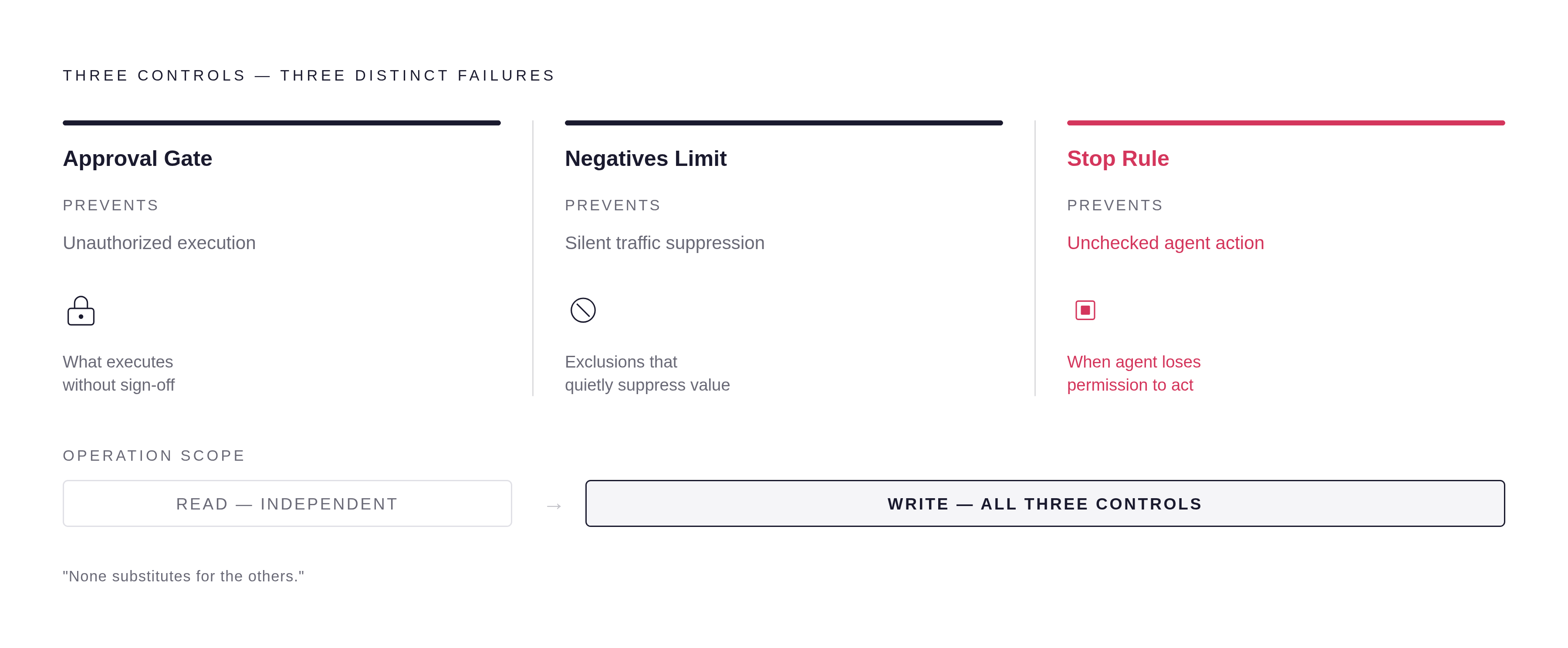
The three controls address different kinds of failure. The approval gate governs what executes without sign-off, while the negatives limit constrains exclusions that can quietly suppress valuable traffic. The stop rule defines when the agent loses permission to act. None substitutes for the others, and Google’s July 2026 terms give advertisers another reason to establish exactly where those boundaries sit.
What separates a true agent from a recommendation tool, and why that distinction reframes the control problem
An agent combines perception, reasoning, action, and learning. It reads live campaign data, diagnoses why performance changed, executes changes directly, and updates its model from the result. A system that recommends pausing a campaign presents a decision, while one that pauses it exercises authority.
Google’s Ads Advisor, powered by Gemini, launched in November 2025 and reached all accounts in one language in early December 2025. At launch, it responded to prompts with answers and proposed changes requiring approval. Its agentic safety features, announced in April 2026, added unprompted account scanning and monitoring. That makes the assistant label less complete, but does not by itself establish autonomous write authority.
Recommendation platforms such as Opteo and Optmyzr surface suggestions for a human to review and push live. The human remains the bottleneck by design. With an agent, however, human involvement extends only as far as the architecture requires it. A buyer who treats these models as equivalent may test the quality of recommendations while overlooking the system’s power to execute them.
How the July 2026 Google Ads terms shifted output accountability onto the advertiser, regardless of which system generated the output
Google’s July 2026 terms place responsibility for machine-generated advertising outputs on the advertiser. “Google’s automation wrote it” is not a usable substitute for review. For an agentic workflow, that responsibility reaches the outputs created or selected through live-account writes. The advertiser needs a way to review, approve, or remove them rather than assuming the generating system absorbs accountability.
The consequences are concrete. AI-generated copy can introduce a competitor name or restricted term, while a landing-page summary can strengthen a regulated claim beyond what was approved. A disputed asset also creates a provenance problem if the team cannot establish whether it was human-authored, AI-assisted, or auto-generated. These are distinct failures, but each makes the review record more important.
Google Ads API v24.2 exposes Asset.synthetic_content_info, Ad.synthetic_content_info, SyntheticContentInfo, and SyntheticContentAttestation for provenance tracking at the API layer. That infrastructure does not replace human judgment. An approval gate provides the mechanism for showing that a person reviewed and confirmed a proposed change before it ran. It helps show who approved a change, but an approved output can still be unsafe.
Testing the approval gate: what an architectural guarantee looks like versus what a UI convention looks like
A server-side approval gate blocks the write itself. The agent drafts a change, the operator reviews a diff, and explicit confirmation releases the API call. Pausing campaigns, bulk-updating bids, adding negatives, and changing budgets must all pass through that boundary. Read operations can run independently because audits, diagnostics, and dashboards do not change the account.
If a write can proceed after the prompt is dismissed, times out, or is bypassed through another entry point, the interface is asking for permission without enforcing it. The decisive test concerns the API. Can a write reach Google Ads before a human explicitly confirms it?
To establish that boundary, a buyer should request a technical architecture document or a written statement covering that exact question. Coverage needs scrutiny too. Does the gate include budget increases, campaign launches, audience expansions, and new ad creation, or only selected changes? If the approval UI is unavailable, does the change remain queued or execute anyway?
Adstudio describes a confirm-first workflow with no autonomous mode. Its agent analyzes the account, shows reasoning, and presents a proposal card for confirmation. For Google Ads, Google validates the exact change before approval, and Adstudio reads the account back after applying it. Adszy describes a read-only-by-default, chat-led workflow in which nothing touches the account until approval, though it does not cover multi-channel work.
Ryze AI illustrates why positioning alone cannot settle the question. Its autopilot description emphasizes continuous monitoring and automatic proposals, while its confirm-first description says every action waits for human approval. Continuous monitoring can coexist with per-change approval, so the word “autopilot” does not prove that writes bypass a gate. The buyer still needs approve/deny prompts backed by a written architectural guarantee.
By contrast, groas describes full autonomy within an agreed strategy, with a human account manager’s oversight limited to strategy supervision. Google’s Smart Bidding, Performance Max, and auto-applied recommendations also execute autonomously within the platform. Google’s dual role as platform and automation provider also creates a conflict of interest when its systems optimize with the advertiser’s budget.
The Claude + MCP DIY path shifts enforcement to the buyer. Write operations are blocked only if the buyer explicitly excludes them from tool definitions, so a hallucinated campaign ID can otherwise become a real paused campaign. Access hygiene is therefore part of the gate. Buyers should keep read and write tokens separate instead of giving an agent the account owner’s credentials, and use Google Ads Multi-Party Approvals for sensitive access changes that need a second administrator. The API exposes that mechanism through MultiPartyAuthReview and MultiPartyAuthReviewService.
Testing the negatives limit: what an AI-generated exclusion list can silently destroy
If the reviewer approves a negative that conflicts with an active positive keyword, impressions can disappear without an error or alert. Single-word negatives and overly broad match types are common sources of this failure. Negating “free,” for example, can block a query such as “is your inspection free with purchase,” even though that query may express buying intent.
Scope determines how far the damage can spread. A negative can apply at ad-group or campaign level, through a shared list, or across the account. The platform also imposes limits at those levels. Account-level negative keywords have a hard cap across Search, Performance Max, App, Shopping, Smart, and Local campaigns, while shared lists have per-list caps and manager-account and child-account limits. Campaign negatives have their own cap, and ad-group negatives fall under the ad group targeting items cap.
Bulk additions therefore need more than a count. They need a review of conflicts and reach before the operator approves them. Does the agent show which positive keywords already in the account each proposed negative might block? Does it distinguish ad-group, campaign, and shared-list scope, or default to the broadest application? If it cannot show conflicts, the reviewer must perform that check manually.
Performance Max adds a separate coverage problem. Its campaign-level negative keywords apply only to Search and Shopping inventory, leaving Display, YouTube, Gmail, or Discovery placements outside their scope. A negative list therefore cannot govern the whole campaign in the way a buyer might assume. The agent can prioritize exclusions, but the human retains the final decision on scope and match type. An approval click without that understanding may satisfy the gate’s mechanics while defeating its purpose.
Testing the stop rule: what a hard boundary actually requires before you widen agent autonomy
A stop rule removes the agent’s ability to act. A performance target or alert threshold merely describes a condition unless something enforces the consequence. Before autonomous write access is granted, the boundary needs to be enforced at the platform level independently of the agent’s configuration. Otherwise, the system that makes decisions also controls whether it stays within its own limit.
Clean conversion tracking is a prerequisite. An agent that cannot see qualified conversions may optimize toward clicks, micro-conversions, or whatever other signal it receives. A stop rule calibrated against that signal can trigger at the wrong time or fail to trigger at all. The buyer should audit conversion tracking before connecting the agent, because a broken tag can teach it the wrong lesson.
The spending boundary needs equally direct scrutiny. Is it enforced at the Google Ads account level as a hard cap the API respects, or only inside the agent’s logic? The buyer should establish what happens when that boundary is reached, including whether pending actions queue for review or the agent simply waits for its next scheduled run. It should also log every executed write with timestamps and the reasoning that preceded it. Without that trail, the buyer cannot reconstruct whether the rule held.
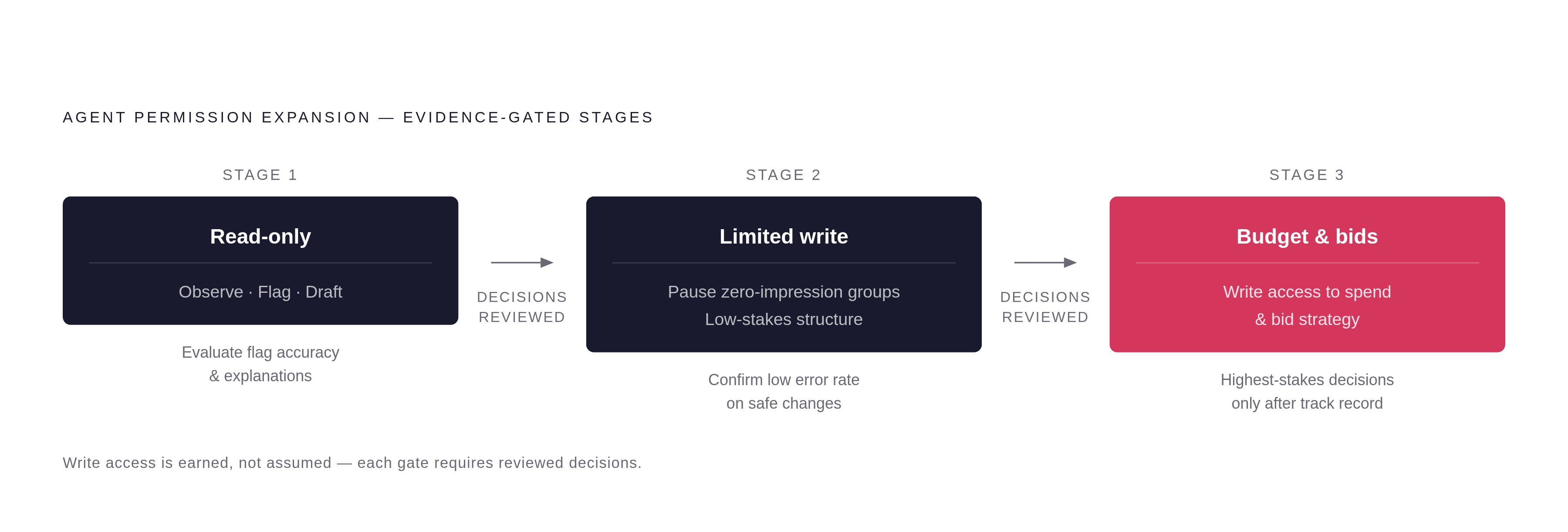
Approval thresholds should depend on how much is at stake when a change is made. Pausing a zero-impression ad group is not equivalent to increasing a campaign budget, switching bid strategy, or creating a campaign. At first, anything that touches budget or bid strategy should need human approval, and any later increase in what the agent can do should be based on decisions that have been reviewed. That is a time-bounded test of reasoning whose permissions remain unchanged when a trial ends.
The safest way to start is with read-only operation. The agent can observe, flag, and draft while the buyer evaluates whether its flags are accurate, its explanations hold up, and its proposed negatives avoid active-keyword conflicts. Write access can then become a deliberate, staged decision based on that evidence.
What a human-supervised agent workflow looks like in practice, and what the agent should never be asked to do alone
In a human-supervised workflow, the agent does the repeated checks and prep work while people handle strategy, risk, and communication. The agent can pull spend, conversions, CPA, and ROAS, compare them against targets, group search terms by intent, and draft a performance narrative using verified metrics. These are read operations and preparatory work. Every write touching budget, bid strategy, campaign status, audience targeting, or ad creative still passes through a human, as does the interpretation of why performance changed and what to do next.
That division requires a usable review queue. If every normal fluctuation triggers an alert, operators may stop reading it. Thresholds should therefore fit the account, metric, and conversion cycle, with different anomaly rules for high-volume e-commerce and low-volume enterprise SaaS. Structural changes with little at stake can go into a queue for quick approval, while changes to spend and strategy need careful sign-off. Changes affecting the account’s compliance posture need a named human reviewer.
The review also has to separate evidence from explanation. “CPA increased 14 percent” is a fact if the data is correct, while “competitor pressure caused the increase” remains a hypothesis unless Auction Insights or another source supports it. The agent’s draft should preserve that distinction. Likewise, “shall I proceed?” is not an approval gate if silence allows execution. The workflow must hold the write until permission is given, even if it has already asked for permission in the conversation.
Finally, the workflow needs a record of what happened. Every AI action should be logged with enough detail to reconstruct what the agent saw, what it decided, and what it changed. The measurement obligation extends beyond recording approvals to tracking performance changes attributable to agent actions and reviewing whether its reasoning held up over time. That evidence is how a buyer establishes whether the approval gate, negatives limit, and stop rule actually worked.