"Generative AI tools" for B2B marketing writing: what a buyer should ask for beyond the draft
A good AI writing tool needs source, coverage, voice, and approval layers.

A generative AI writing tool for B2B marketing should be judged by how its drafts read and what surrounds them. Source handling, coverage checking, voice consistency, human approval, and citation measurement are necessary for the work to become evidence in an AI-generated answer. Without those layers, even a well-written draft may never reach the buyer who is building a shortlist inside a chat window.
Why B2B buyers now form vendor shortlists inside AI chat windows, before any search result appears
G2’s 2026 Answer Economy research found that a majority of B2B software buyers now start research with an AI chatbot more often than Google. Semrush’s March–April 2026 survey found that a large share of U.S. B2B professionals who use AI at work say it has shaped a vendor shortlist. ChatGPT is the primary platform for this research, with Gemini and Copilot also heavily used. Buyers are asking for candidates. When an answer supplies those candidates, an absent brand has no place in that conversation.
That absence is harder to see than a poor search ranking. A ranking tells a marketing team where its page sits, while an AI answer can omit the brand entirely. GA4 does not show the missed consideration that never became a visit. A tool that only helps produce another draft addresses production, but not whether the brand enters the buyer’s research.
What actually determines whether an AI answer engine cites a brand — and why a well-written draft alone cannot clear those gates
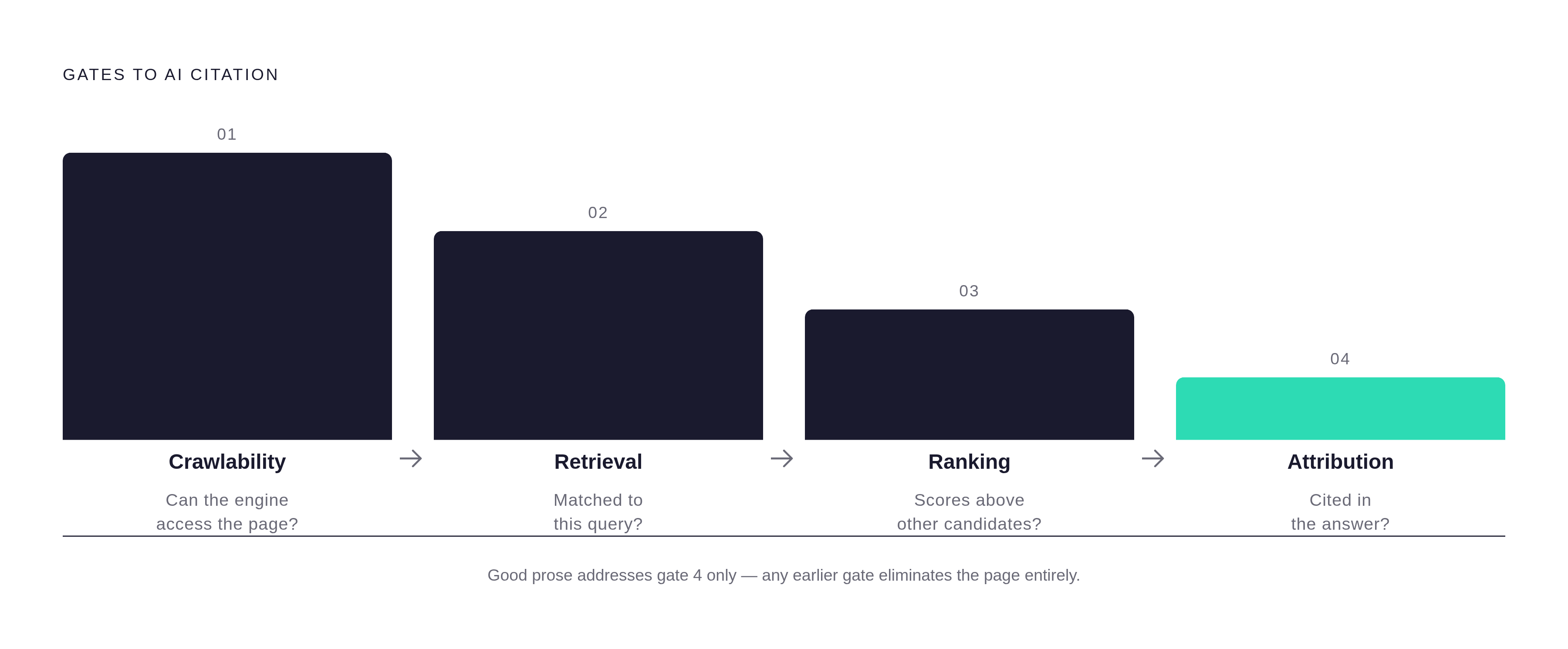
Retrieval-augmented generation, or RAG, ties an answer to source material that the system has retrieved. RAG-based systems such as Perplexity and Google AI Overviews retrieve live web content at query time and synthesize across sources. A page must clear four gates, namely crawlability, retrieval for the particular query, ranking against other candidates, and final attribution. Each gate can exclude otherwise useful content. Good prose cannot compensate for a page that the system cannot find or does not select as evidence.
Generative engine optimization, or GEO, is the discipline concerned with visibility in those answers. Princeton, Georgia Tech, IIT Delhi, and the Allen Institute for AI published peer-reviewed research at ACM KDD 2024 that found GEO methods could meaningfully improve visibility in generative engine responses. The research found that using statistics, external citations, and quotations in the content could help it appear in those answers. Those choices make evidence easier to extract. Readability and keyword density alone do not address the same job, and a draft-only tool cannot control the full route from discovery to citation.
Why evaluating AI writing tools on output quality alone produces content that no AI answer engine will ever cite
DerivateX’s June 2026 research found that third-party “best of” lists earned the greater share of citations, while recommended products’ own websites earned much less. The finding changes what a successful deliverable looks like. A polished article on a vendor’s site is competing with independent pages that compare several choices in one place.
Yet the familiar demonstration remains prompt in, copy out. Buyers can inspect fluency, accuracy, and tone immediately, while source architecture, entity grounding, and third-party presence are less visible. A draft can pass that inspection and still fail to become a citation. Does the engine have enough consistent evidence to recognize the brand, and is that evidence present where it retrieves answers?
The buyer’s mistake is treating the draft as the finished product. Traditional search rewarded being the site people went to, while AI citation rewards being a source that other sources draw from. The corrective is to evaluate the pipeline around the prose. That pipeline must make the content usable as evidence.
Source handling and content structure — the first capability that separates citation-worthy content from readable content
Sources must enter the process as inputs before drafting. A claim tied to verifiable external evidence gives an answer engine something more useful than an unsupported assertion. Structure then makes that evidence accessible. A direct answer in the opening paragraph answers the query right away, while H2 and H3 headings written as questions help set apart the answers on a page. Specific data gives a system evidence it can extract without having to rely on a long narrative introduction.
A “grounding page” takes this approach further. It is a fact-dense asset with one truth per sentence, designed to serve as evidence for LLM retrieval. An “Answer Object” content block serves a related purpose through a self-contained opening answer, supporting data, a proof strip, and a scope definition. Scope gives the answer its boundaries. These formats do not replace readable writing, but a tool that produces only narrative blog posts leaves this retrieval work undone.
Coverage checking against existing content — why publishing more without mapping what already exists accelerates the wrong problem
Even well-structured evidence can become fragmented across too many pages. When several articles partially answer the same question, they split authority signals instead of presenting one clear source for retrieval. More production can deepen that split. A competitor’s consolidated answer may be easier to retrieve than a brand’s scattered treatments, even when the scattered pages contain useful information.
Coverage checking belongs in the brief before generation begins. The pipeline should map existing material, identify gaps, and distinguish a need for new content from a need to update or consolidate. That distinction becomes more important as output grows. Without it, an on-demand writing tool accelerates publication while making the brand’s evidence less coherent.
Voice consistency at scale — what breaks when AI-generated content has no memory of the brand’s established positions
A coherent library also needs coherent positions. Here, voice consistency means using the same product and category terms, framing the core arguments the same way, and keeping articles from contradicting each other. It is not stylistic uniformity. Two pieces can sound different while expressing the same position, just as two smoothly written pieces can make incompatible claims.
That distinction connects voice to citation credibility. Entity coherence means that signals from within the brand and from independent sources point to the same facts, positions, and identity, which helps an LLM recognize the brand reliably. Divergent signals weaken that recognition and can encourage hedging at the expense of clear attribution. Editorial consistency has a technical purpose here. It helps the body of content function as evidence from an identifiable source.
When few articles are published, editors may catch drift by checking each one. At AI-enabled volume, a tool without memory of established arguments leaves writers to reconstruct that context manually. The alternative is gradual divergence across the library. A useful voice layer preserves the brand’s positions while allowing each article to address its own question.
The human approval gate — why removing it is not an efficiency gain but a hallucination multiplier
Memory and structure do not remove the need for judgment. A fixed error rate applied to a much larger publication volume produces more published errors, so occasional review is not a substitute for an approval gate. Speed expands the exposure as well as the output. Google’s guidance states that it is critical to manually fact-check and review all AI-generated content for accuracy and trustworthiness before publishing.
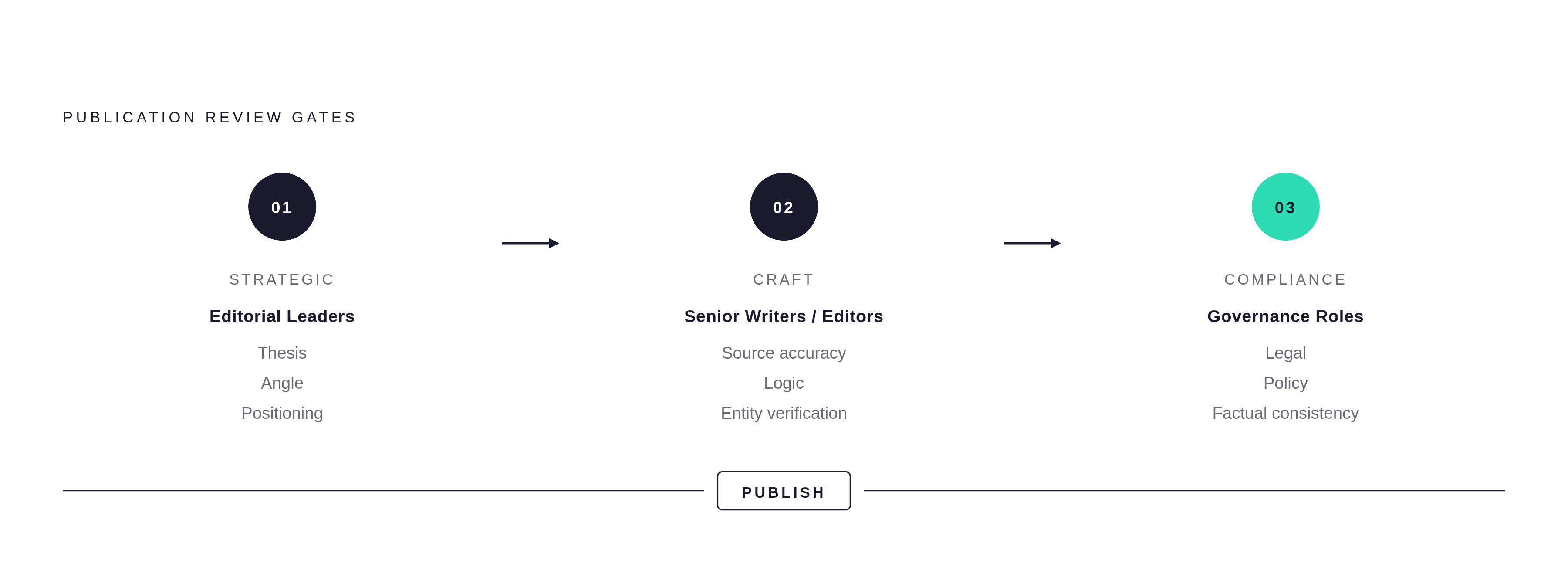
At strategic gates, editorial leaders are responsible for the thesis, angle, and positioning. At craft gates, senior writers or editors are responsible for source accuracy, logic, and entity verification. Compliance gates cover legal, policy, and factual consistency, with governance roles responsible.
The source audit is especially important under a company byline. Every statistic, percentage, and research finding must trace to its original source document. If the original cannot be located, the claim should be removed or rewritten as practitioner opinion. Human judgment owns that distinction. It also owns whether a source is trustworthy and whether a piece should ship at all.
For buyers, the practical question is how the tool enforces sign-off before content enters the publish queue. “Full autonomy” offered as the default can remove the very checkpoint that limits reputational damage. Human review should not depend on someone remembering to intervene.
Measuring AI answer-engine mentions — why citation tracking is a distinct discipline from SEO analytics
When the goal is citation, teams must measure what appears inside generated answers as well as visits. A brand can appear in an answer without getting a click, so AI referral traffic and citation share show different results. Only a minority of organizations have a dedicated GEO measurement owner, leaving this work without clear responsibility in many teams.
First-party reporting now provides part of the picture. Microsoft’s Bing Webmaster Tools AI Performance dashboard has been public since February 10, 2026, and added citation share on June 16, 2026. Microsoft explicitly notes that its data shows a sample of actual citation activity. Google added reporting specifically for generative AI performance to Search Console in June 2026.
Coverage across ChatGPT, Claude, Gemini, and Perplexity still requires a separate approach. That approach uses a fixed set of commercial-intent, informational, and competitive-comparison prompts monitored on a cadence, with third-party tracking covering gaps in native reporting. Consistency makes the observations useful over time. The measurement layer should link where a brand is cited to AI-referred sessions, branded demand, and pipeline, because citation count alone does not show what those citations are worth to the business.
The off-site dimension — why content that lives only on the brand’s own domain is structurally under-cited
Measurement also has to account for where the evidence lives. DerivateX’s finding about third-party lists points to a retrieval corpus problem. Independent pages that cover several brands can compare them in ways that a vendor-owned page does not. The owned domain is only part of that corpus. A pipeline confined to it cannot address the full set of sources from which an answer engine draws.
The off-site work therefore extends beyond producing more articles for the brand’s site. It includes a Wikidata entry and schema markup that support a consistent identity across LinkedIn, Crunchbase, and the owned domain. It also includes earning listings and reviews on frequently cited platforms, contributing to relevant community forums, and pitching trusted publications. Those surfaces serve different purposes. Review platforms and directories are useful opportunities, but the research does not establish them as the dominant cited format.
Branded web mentions correlate with AI visibility more strongly than backlinks alone. That makes appearing by name in trusted third-party content a strategic concern in its own right. A buying team should ask whether the service has a plan for off-site content seeding or stops at sites and pages the brand controls.
The evaluation checklist — what to ask a vendor before signing a contract for AI-assisted B2B content
The vendor conversation should test these capabilities together rather than treat them as optional upgrades to a drafting service. Does the pipeline create content with direct answers at the start, headings written as questions, statistics in the text, and external citations? Can it create grounding pages and Answer Object blocks, or only narrative drafts? Sources must be part of that demonstration. How does a claim remain traceable to the original evidence through drafting and review?
Before it generates content, does the tool check what is already covered and find pages that need to be combined or updated? Does it preserve established terminology, arguments, and positioning across articles? The review workflow needs equal scrutiny. Are strategic, craft, and compliance gates mandatory, and how is human sign-off enforced before publication?
What measurement does the engagement provide across ChatGPT, Claude, Gemini, and Perplexity, beyond traditional SEO metrics? How does it connect citation presence to referred sessions, branded demand, and pipeline? Does the service help the brand earn a place in third-party lists, directories, review platforms, and trusted publications?
The full capability stack gives each new piece a chance to reinforce what came before it. Sources, coverage, positioning, review, measurement, and off-site presence work toward accumulated citation history. As AI search usage grows, that history becomes structurally harder to displace.