Buyers search the problem, not your category: what a $10 click and a $100 click teach about getting cited in AI answers
Problem-shaped content can win AI citations, if you measure.
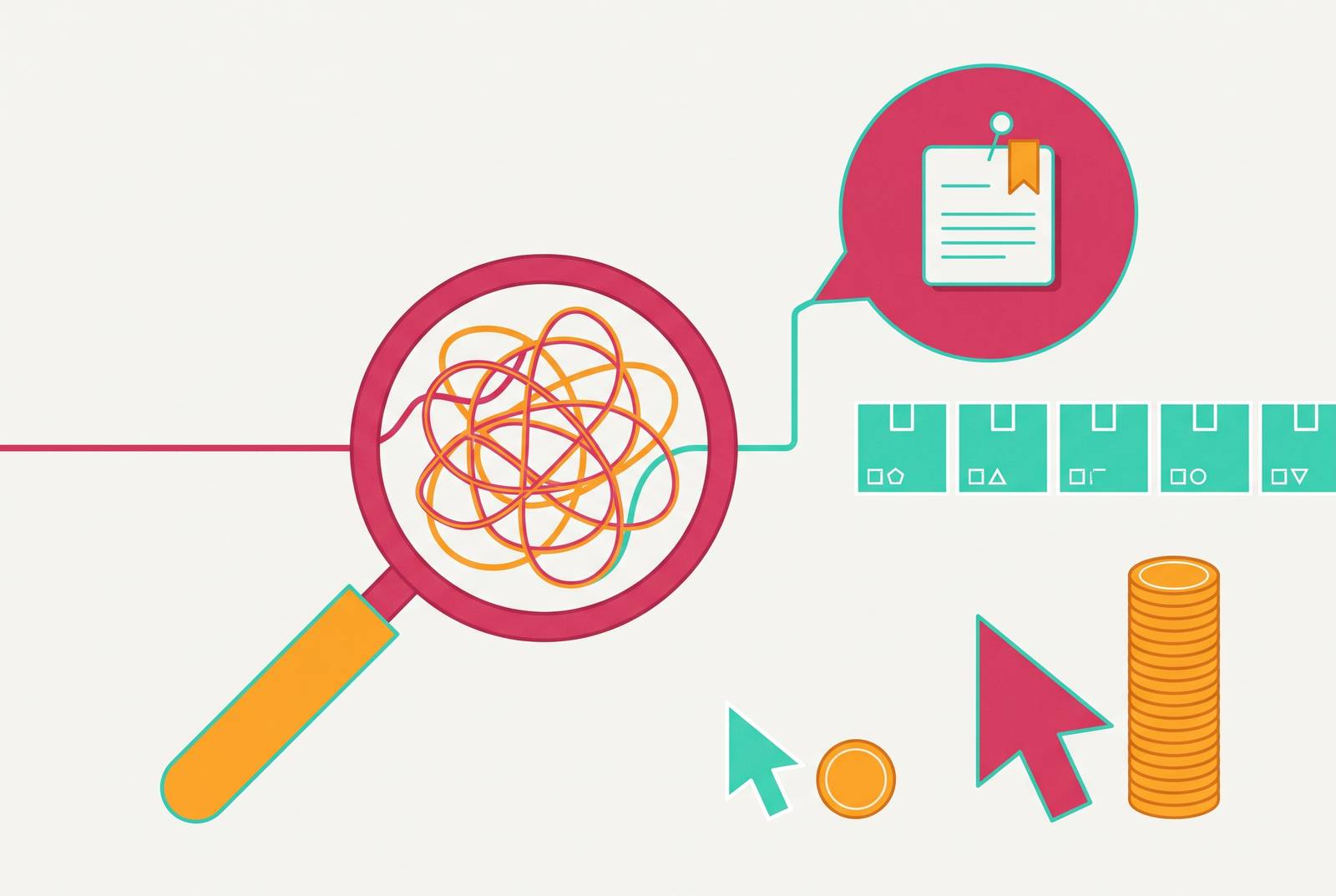
The gap between a cheap problem-search click and an expensive category click reveals more than an advertising opportunity. It shows where vendors compete hardest and where buyers still need answers. That same mismatch shapes AI discovery. For technical founders and growth engineers, the opportunity is to publish around buyers’ problems, then measure whether AI engines actually cite those answers.
Why buyers describe symptoms, not solutions, when they search
A buyer can name a problem before knowing what kind of product solves it. A packaging line keeps stopping without warning. The person responsible searches “how to reduce unplanned downtime in packaging lines,” not necessarily “predictive maintenance platform.” The first phrase describes something they need to change. The second assumes they already know which category deserves their attention.
That distinction changes which content can reach the buyer. A page about platform features may help someone evaluating products, but it asks an earlier researcher to make the connection between the symptom and the solution. The buyer may not make that connection yet. A page that answers how to reduce unplanned downtime starts where the research begins and can explain why predictive maintenance belongs in the answer. Category language still has a role, but it cannot stand in for the whole path to a purchase.
What the CPC gap is actually measuring
The cost-per-click gap reflects how densely advertisers compete for different searches. Broad category terms draw vendors who are trying to reach the same buyers, while more specific queries can have less competition. The price is therefore a useful clue. It can show where buyers want answers but little content speaks directly to their needs. It is not, by itself, proof that every cheaper query is valuable.
Compare “CNC machining” with “CNC machining services Michigan. The broad phrase can draw students, job seekers, and hobbyists as well as people who might become customers. The narrower phrase points toward an engineer or buyer looking for a supplier. Although this is a supplier search rather than a symptom question, it illustrates the same asymmetry between a crowded category and a more precise need.
When lower click costs coincide with higher conversion rates, the advantage extends beyond cheaper traffic. But what about the objection that category searches capture buyers at peak commercial intent? By the time someone knows the category name, they may have done most of their anonymous research and already eliminated possible suppliers. Competing only at that point means paying for access after earlier answers may have shaped the shortlist.
How AI answer engines reproduce the same buyer behavior
When buyers open ChatGPT, Claude, Gemini, or Perplexity, they can describe a problem much as they would to a colleague. They might ask “how do I stop leads from going cold after the first email” or “what’s a scalable way to run outbound for a ten-person team.” These questions contain circumstances, constraints, and a desired outcome. A category label leaves much of that unsaid. The answer engine must respond to the situation the buyer described.
That is the connection between the CPC gap and the citation gap. In search advertising, direct answers to specific needs can face less competition than category terms. In AI answers, content written to the same needs can supply the material an engine needs to answer the question. A page about marketing automation features may describe a product that could help without directly answering why leads go cold.
AI Overviews and answer engines also compress the informational search journey by presenting an answer without requiring a visit to each source. Does the answer name the brand or cite its content? Earning that citation resembles owning a low-competition long-tail keyword because the opportunity comes from answering a specific need that other pages leave underserved. This is an analogy about intent and content supply.
Why most content fails to get cited — and what the failure modes reveal
A 2026 taxonomy of citation failures locates problems across parsing, fetching and context, and generation. Malformed HTML or too much noise from navigation can stop an engine from cleanly extracting the text before it gets a fair chance to use what the page says. Writing a more persuasive introduction does not address an extraction problem.
Fetching and context failures can also get in the way. Content may be truncated, poorly ordered, or arranged so that the useful answer sits behind a long preamble. Putting the answer early does more to fix this failure than adding more background. It also makes the page more useful to a reader who arrived with a specific question.
At generation, the taxonomy identifies entity gaps, intent mismatch, and competitor disadvantage. An entity gap means the brand or claim is not named precisely enough, while competitor disadvantage means another page answers the question more directly. Intent mismatch connects most clearly to the CPC argument. A category-focused page can miss a problem-shaped question even when the product would help. The remedy is to answer that question explicitly, rather than expect the engine to supply the missing explanation.
How much can individual content changes accomplish? Aggarwal et al.’s KDD 2024 GEO paper found that citing authoritative external sources helped pages get seen, with lower-ranked pages gaining most. Subsequent 2026 research found that these levers had inconsistent effects on citation on modern engine families, limiting what any structural prescription can promise. Clear sourcing and readable structure remain sensible requirements, but their effect on citation needs measurement to establish whether the older benchmark still applies.
Different AI engines cite different sources, and citation share decays
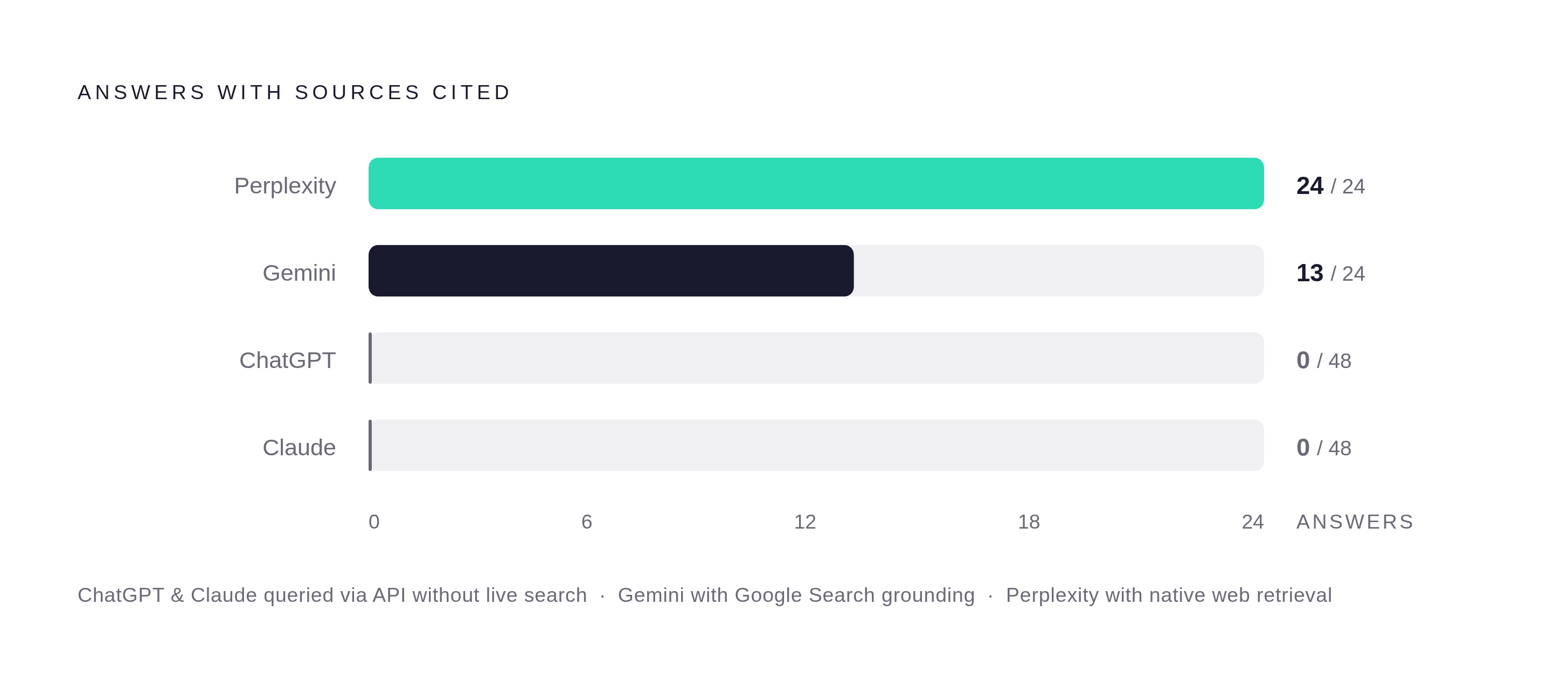
One team’s October–November 2026 monitoring shows why it matters how the tests are set up. Across 24 prompts, Perplexity listed sources in all 24 answers, while Gemini with Google Search grounding enabled did so in 13 of 24. ChatGPT and Claude, queried through their APIs without search enabled, listed none in 48 answers. Those settings change what the result can mean. The finding does not show that ChatGPT and Claude never cite sources, because the test did not give them live search.
Citation share also shifts on cycles of roughly 3–6 weeks, depending on the platform. A position won today is not a permanent asset. A brand cited now may be absent in three months without active maintenance, much as a paid-search position can erode when competitors raise bids. A one-time audit therefore cannot establish whether a publishing effort is holding its ground.
The engines also draw on different source portfolios. A 2026 per-engine audit found only a small overlap between domains cited by ChatGPT and those cited by Perplexity. Success on one can conceal absence on another. For teams deciding where to invest, the practical response is a measurement layer that distinguishes engines and test settings. Running the same fixed prompt list across all four engines each week gives engineers a task they can repeat to check how the platforms differ.
What content actually earns citations — the structural requirements
The first section of a problem-focused page should give the actual answer. For a question such as “how do I detect bearing failure before it shuts down a line,” the opening needs to address detection, rather than begin with a tour of predictive maintenance platform features. The supporting argument can then explain and qualify the answer. This order serves both the reader and a retrieval system working with limited context.
A named study or a data point with a unit gives an engine something specific to quote and gives a reader something to assess. Vague authority claims do neither job well. The brand, relevant entities, and their claims should be named clearly, while clean, parseable HTML keeps the content accessible for extraction. These properties address the failures already described, though none guarantees a citation.
The same principle holds for digital PR as well as owned pages. For citation value, the recommended targets are publications that AI models draw from, including industry trade press and authoritative general-business outlets. The contribution should be an attributed expert claim. A citation in a high-authority publication can raise the probability of appearing in answers to related questions. The goal is a useful claim addressing a buyer’s problem that can travel with its attribution.
Publishing at the cadence the problem landscape demands
One category can have dozens of problem-shaped questions. Different roles, industries, and stages of awareness produce different ways of asking for help, even when the same product could answer them. One category page cannot do all that work. As citation share changes over time, the publishing task includes both maintaining existing answers and adding new ones. That combination creates a workload a small team cannot sustain through manual production alone.
A stage-gate pipeline offers a way to handle that workload without treating an AI draft as finished work. AI can help from brief through draft, but the work must pass human editorial review before it is published. At the brief stage, the team specifies entity coverage and checks that the question matches actual buyer language. The draft stage establishes an answer-first opening, concise definitions, and specific attributed claims.
Human review then tests the draft against brand, accuracy, and citability requirements. It checks that structured data is clean, that the answer appears early, and that key claims have citable sources. Speed does not excuse skipping this gate. The architecture makes review part of production so that work can responsibly ship under the brand’s name.
A phantom-site or ground-site architecture gives teams more places to publish through owned properties built for topical authority. These properties can answer problem-intent questions across different verticals and audience roles, so a single homepage has less of the work of earning citations. They do not replace the editorial requirements. Their usefulness rests on the same direct answers, precise claims, and review process required of the main site.
Instrumenting AI citation the way a growth engineer would instrument any channel
For a team putting this approach into practice, the prompt list is the instrument. It should contain the problems buyers actually ask about. The team can run that fixed list weekly across ChatGPT, Perplexity, Claude, and Gemini. Keeping the questions fixed creates a basis for comparison. Distinguishing live-search settings from tests without search keeps unlike results from being mistaken for a change in content performance.
For each prompt and engine, the measurement stack records five signals, which are mention rate, URL citation rate, sentiment, prominence, and share of voice relative to named competitors. Mentions and citations must remain separate. A mention references the brand without a link, while a citation links to its content, and the two can respond to different interventions. Folding them into one visibility number would conceal whether an engine is naming the company or directing readers to its evidence.
GA4 can segment sessions from AI platforms through referral source filters for “perplexity.ai,” “chatgpt.com,” and “claude.ai.” That helps show when citations lead to visits as well as appearances. It does not make referral traffic a substitute for citation measurement. The two signals answer different questions about whether the content is being used and whether readers follow it.
When monitoring exposes a gap, the next action becomes concrete. A missing answer calls for content, a structural weakness calls for revision, and an extraction problem calls for an HTML check. The team can then run the probe again in the next cycle to check whether the change worked. The discipline is to instrument citation share, diagnose the gap, and change the content on evidence.