"Autonomous, but it waits for approval": what a buyer should ask before trusting an agent that stops at the publish button
Ask what runs before the gate, what the reviewer sees, and what rejection does.

An agent that runs a content pipeline but waits for approval can still be autonomous. For marketing and growth buyers, the question is whether that pause gives the owner real control or merely a publish button. The approval gate is the product’s revealing feature. What happens before it, what the reviewer can judge, and what happens after a rejection show whether the buyer is getting an operating model or faster drafting.
Why "autonomous" means two different things and only one of them matters to buyers
An AI-assisted tool and an autonomous agent put the human in different jobs. With a copilot, the human drives each step while the AI speeds up individual tasks. The person decides when to research, when to draft, and when to move the work forward. The human is still the operator.
An autonomous agent, by contrast, initiates work on a schedule and executes a multi-step pipeline without prompting at every stage. It delivers finished output for human review. The AI is the operator, while the human is the governor. The distinction rests on who runs the process. Requiring approval does not, by itself, make a system less autonomous.
Yet both products can be sold under the same label. The fast-growing agentic AI market gives vendors a reason to claim autonomy to win sales, while buyers are looking for pipeline automation. A team expecting an agent may discover that it still performs the coordinating labor it thought it had bought out of. Once two architectures share one label, the approval gate becomes the place where their differences can no longer stay hidden.
What the approval gate actually reveals about pipeline architecture
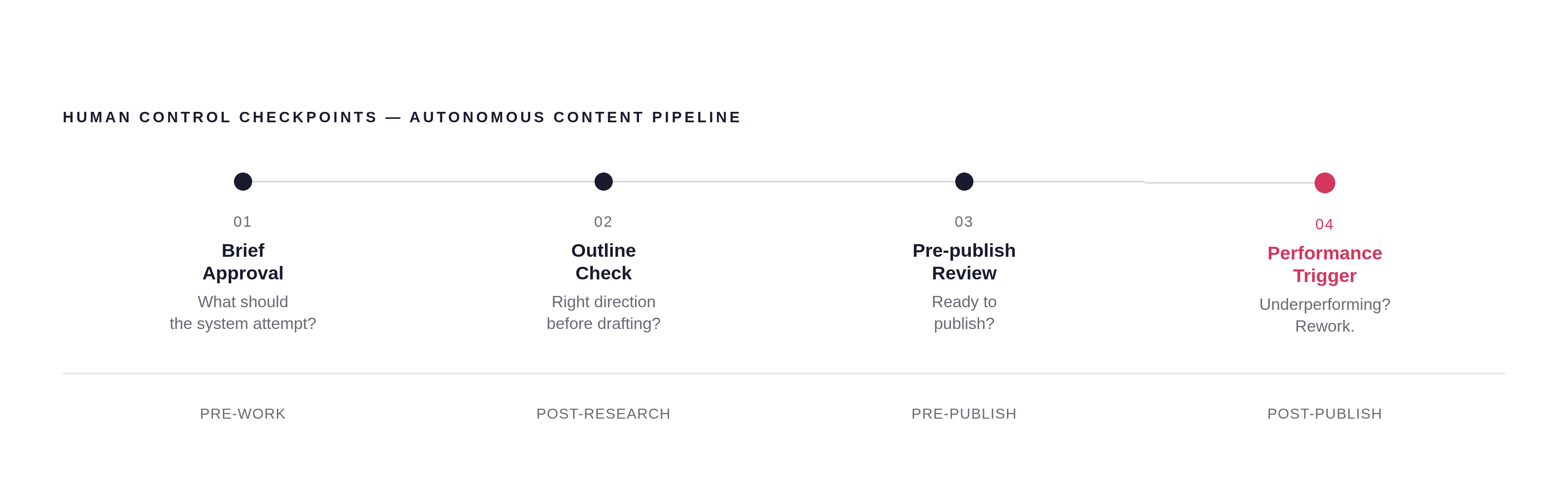
A researcher agent, a drafting agent, a critic or quality-check agent, and a publisher agent have run before the finished artifact reaches the reviewer. The publishing step gets the work ready but waits for permission to release it. The human’s role is to approve the finished artifact.
An AI-assisted tool can show a screen that looks much the same. Its draft may also sit beside an approval button, but the human has directed the work that brought it there. No independent research or quality loop has run. In that case, the button marks the end of a human-operated drafting process. The interface alone cannot settle the question.
A well-designed content pipeline also gives people control before and after that final handoff. Its four checkpoints are brief approval before work begins, a post-research outline check before drafting, a pre-publish review, and a post-publish performance trigger when output underperforms and needs rework. These checkpoints serve different decisions. Approving a brief establishes what the system should attempt, while checking an outline tests the direction before a full draft exists. Final review and performance-triggered rework address whether the result is ready and whether it worked.
A vendor offering only “you approve before it publishes” has not explained those upstream controls. That is a warning to probe the architecture. The opposite promise, “fully autonomous, no oversight needed,” also deserves scrutiny because human review remains the dominant evaluation method among teams running agents in production. Neither slogan explains who controls the work. For buyers, the next step is to ask what actually runs, what evidence it leaves, and where a person can intervene.
Questions to ask about pipeline architecture before accepting any autonomy claim
The evaluation conversation should begin with the components. How many distinct agents run, and what does each do? A defensible answer names research, drafting, critic or review, and publishing agents as separate components with separate responsibilities. A system in which one agent does every task is a single-agent, or monolithic, system. It should not be presented as a multi-agent pipeline merely because its work passes through several stages.
With those roles established, the buyer can follow the work from topic to draft. What does the research agent retrieve, from where, and how is it grounded? Grounding in verified internal data lowers the risk of hallucination, but errors can still occur. Factual claims, statistics, and pricing details still need human verification before publication, so the answer should make clear what evidence will be available for that review.
The next question follows the output into its destination. Is the CMS the source of truth, and can the system publish directly without manual copy-paste? For a buyer seeking an end-to-end content operation, a tool that stops at text generation leaves a key handoff with the human. That tool is a draft generator. The purchase is for orchestration rather than word count, so the vendor needs to show how content reaches the CMS under the approval rules.
Execution also has a starting point. Does the system initiate work on a schedule, or does every run require a human prompt? A system that waits for someone to start every assignment leaves that part of the operator’s job unchanged.
Finally, the conversation should test what happened inside the workflow. What critic loop runs before review, and can the vendor show its output on a past piece? Flagged passages, revision notes, and quality scores make a claimed loop auditable. A quality claim without an artifact is unverifiable. This question connects the pipeline’s named components to evidence that they performed their stated roles.
What "approval" must mean in practice, not just in the pitch deck
Even a real pipeline can have a weak gate. Approval is a genuine control only when the reviewer has enough context, enough time, and enough reversibility to say no with consequence. A person clicking a button does not prove that a meaningful review occurred. The buyer needs to look as closely at the conditions in which the reviewer works as at what the agent can do.
Context begins with what the approval view reveals. What does the approver see, and does it include sources and intermediate outputs? The draft alone is not enough. Research inputs, source material, and flags from the quality loop help the reviewer decide whether to approve the finished piece. Without that provenance, the reviewer is being asked to judge conclusions without seeing what supports them.
What is the expected review time per piece, and what happens if the reviewer is unavailable for 48 hours? If output arrives faster than a person can evaluate it, the gate becomes a bottleneck likely to be bypassed in practice. More production is not automatically more usable production.
Reversibility means that every AI-generated suggestion remains reviewable and reversible before it ships. What happens when the owner declines a piece? Rejection should be a recorded workflow state that preserves the decision and its reason and informs future output. Otherwise, the owner may have to reject work for the same reason again and again.
People can keep up with those demands only if the work is split appropriately. The 80/20 operating model assigns process-intensive work, including research synthesis, first drafts, format adaptation, and SEO structure, to agents. Humans retain strategic narrative decisions, voice consistency, fact-checking, and final approval. Strategic narrative development, authentic thought leadership, crisis communications, creative direction, and deep cultural nuance remain human responsibilities.
For the buyer, the practical question is what the system expects at approval. Must the reviewer verify facts, make structural changes, or only judge final quality? Those are different workloads, and the answer should match the promised division of labor. Human judgment is not the same as redoing production. If the reviewer must routinely reconstruct the process-intensive work, the approval gate has become a repair station.
What the system does with output the owner declines
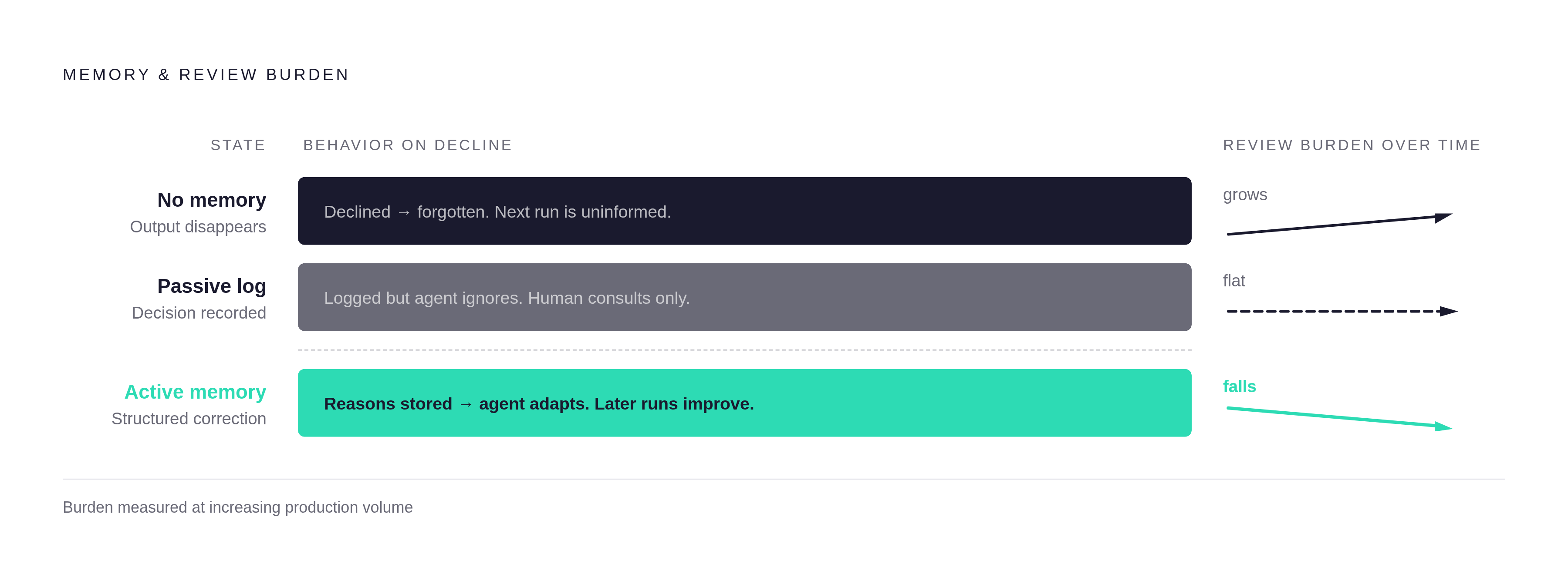
Rejection exposes what approval alone can conceal. A smooth demonstration may show a finished draft moving straight to publication, but that path says little about how the system responds when the owner disagrees. What happens to declined output shows whether human judgment changes how the system works. It is the strongest single signal of whether the gate was designed as a control or a formality.
One possible behavior is that declined output disappears. The system retains no memory of the rejection, and the next run remains uninformed by what failed. A second behavior records the decision but leaves it passive. A human can consult the log for better recordkeeping while the agent leaves it unused and the learning loop open.
The reasons for rejection, patterns in the decisions, and corrections that humans make are stored as structured information that changes later runs. The difference is not merely whether a record exists. It is whether the recorded judgment affects how the agent works next time. That is what allows a decline loop to reduce review burden over time instead of preserving it at a higher production volume.
To test that distinction, the buyer should ask for a case where a reviewer declined or heavily revised output. What did the system record, and how did it affect the next piece on the same topic or brief? The vendor’s answer needs to connect the correction to subsequent work. A stored comment alone does not demonstrate that connection. Nor does a better-looking next draft, without an account of how the rejection informed it.
The record itself needs scrutiny as well. Can the full history of approvals, declines, and corrections for a given agent run be exported in machine-readable form? Structured data makes the governance layer available for measurement. Marketing should be measured and changed on evidence, and its approval process needs the same discipline. This is the clearest distinction between a vendor selling speed and one selling a sustainable operating model.
Assembling the questions into a usable evaluation framework
A sustainable operating model has to pass all three dimensions together. Pipeline architecture establishes whether the promised work happens, approval design establishes whether humans can govern it, and rejection handling establishes whether their decisions improve later runs. A strength in one does not excuse a gap in another. A sophisticated pipeline can still overwhelm its reviewer, while a careful review screen can sit on top of little more than a draft generator.
The evaluation should therefore start with a demonstrable chain of work. At a minimum, the architecture needs named agents that each have their own role, CMS-native publishing, schedule-initiated runs, and a documented critic loop whose output can be audited. This catches a copilot or single-agent tool being marketed as a multi-agent pipeline. The buyer then needs to see that chain reach a usable review stage. People must be able to see sources and intermediate outputs, have time to review the work they receive, and create a recorded workflow state when they decline a piece.
A structured, stored rejection reason, subsequent runs shaped by accumulated corrections, and an exportable, machine-readable decision history establish the minimum feedback mechanism. This catches a gate that assigns liability without helping the owner change the process. The evidence belongs in both the documentation and the vendor demo. Before signing, the buyer should ask for a live demonstration of a declined piece and its downstream effect, because that is where a promise of control has to become visible behavior.