Full-service agency vs. an instrumented growth stack: why a weekly review of channels is not a measurement system
Owning the measurement layer, not renting activity, shows what drives revenue.

The agency supplies execution, while the stack connects that work to evidence about pipeline and revenue. For B2B founders and technical buyers, the choice is between owning a measurement system and renting activity whose value a weekly deck cannot establish.
Why a weekly review deck is not a measurement system
The Friday deck arrives with an impressions chart, a click-through rate, and a cost-per-lead cell. Form fills are up or down, the team talks through campaigns, and they plan next week’s work. The ritual gives the team a useful rhythm. A reporting cadence tells people when to look at the numbers.
That distinction begins upstream of the agency relationship. An agency typically inherits whatever the client’s GA4, ad platforms, and CRM happen to surface, then optimizes within that perimeter. When those sources disagree about where pipeline came from, campaign decisions can follow numbers that finance cannot reconcile. More effort does not resolve that structural gap. Neither does a retainer agreement, unless it covers building the missing measurement layer.
What would the founder need to know instead? CAC payback period and the LTV-to-CAC ratio address whether growth is sustainable, rather than whether a campaign produces inexpensive leads. Answering those questions requires reporting that ties ad spend to closed revenue in the CRM. A deck that stops at cost per lead lacks that connection, however well the campaigns perform. The execution can be competent while the evidence remains incomplete.
What a large share of B2B pipeline never shows up in a channel review
A podcast mention never fires a pixel. A workplace chat thread sends three qualified leads, but the discussion that shaped their interest stays outside the tracking system. Communities and dark social create the same problem. These are dark-funnel sources, where discovery can lead to pipeline without leaving a usable channel signal. A review built only from tracked activity cannot show that path.
A substantial share of B2B pipeline originates in these sources, and the dark-funnel share rises further in product-led growth models, where discovery can lead to a trial without passing through a tracked channel. Better settings alone cannot bring back every missing signal. The measurement approach has to account for activity that its tracking tools cannot directly observe.
The best agencies acknowledge this limit and combine tracking with incrementality testing and qualitative data. That work goes beyond what a standard retainer covers. When unattributed pipeline is treated as a rounding error instead, the founder gets a ledger with missing rows that may say more about what keeps demand going than the rows it shows. The measurement system must account for more than what the agency’s managed channels happen to reveal.
How AI answer engines opened a third channel the weekly review cannot see at all
AI answer engines give buyers another way to find and compare vendors. A buyer asks a plain-language question and receives a composed answer naming two or three options, rather than a list of search results or an advertisement. Selection happens inside the answer. Vendors left out of it may never enter that buyer’s consideration, even when their conventional channel reports look healthy.
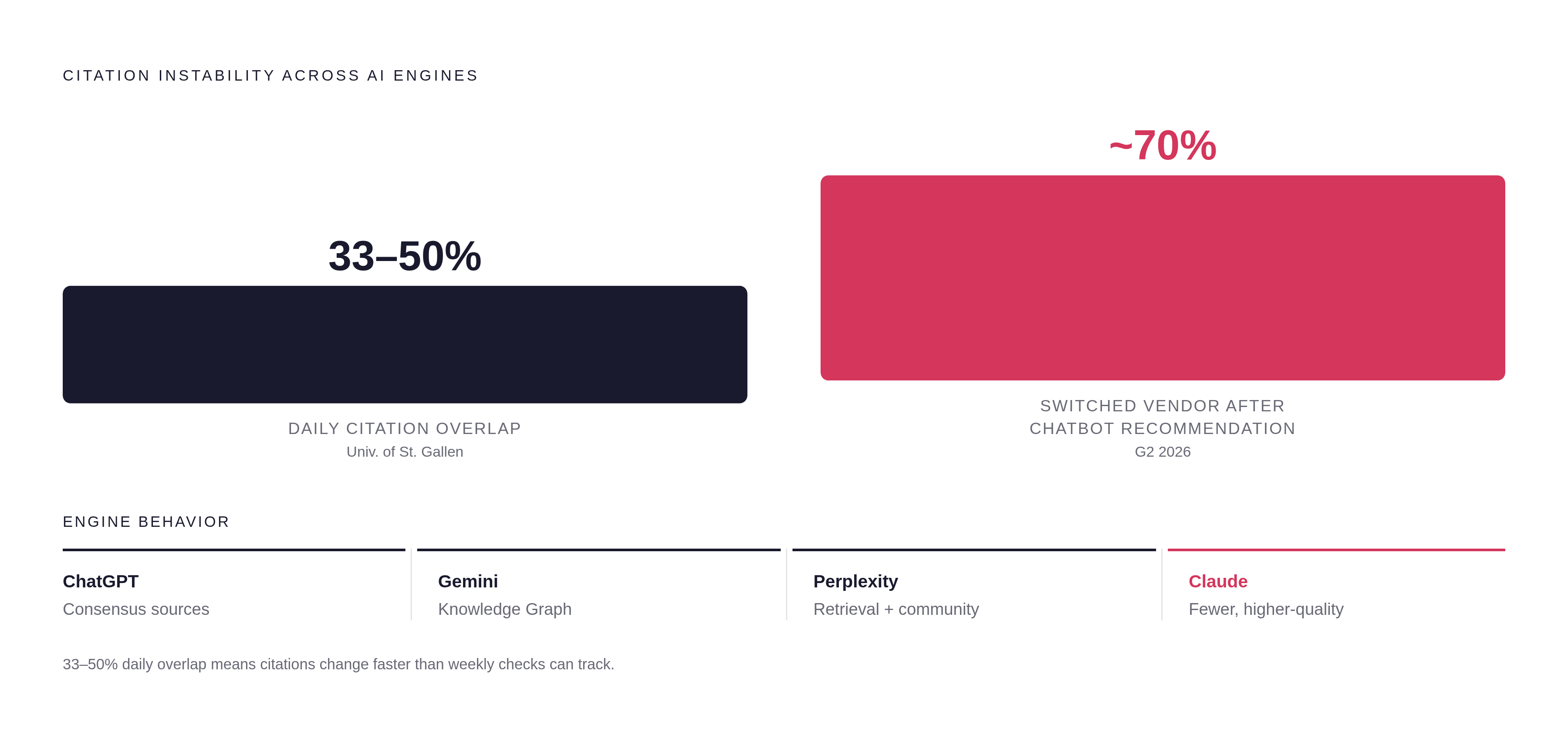
G2’s 2026 research found that a majority of B2B software buyers now start research in an AI chatbot more often than in Google. The same research found that nearly seven in ten chose a different vendor than planned because that vendor appeared in a chatbot recommendation. This is more than another source of website traffic. It is a channel that can change which company the buyer intends to purchase from.
Classic SEO aims for a position in a list, while Generative Engine Optimization, or GEO, aims to make a source useful when a model composes an answer. There is no page two of that answer. Some AI-driven visits can be tracked, but referral data cannot show recommendations that lead to no click. A channel review can therefore record a visit without measuring the wider recommendation environment, including the answers in which the brand never appeared.
Why each AI engine behaves differently and a single weekly check produces noise, not signal
That environment does not behave like a stable ranking. Each engine retrieves information in its own way and rewards different signals, so the same prompt can lead to different sources and recommendations. ChatGPT with Search rewards consensus sources, while Gemini leans on Google’s Knowledge Graph and entity data. Perplexity is retrieval-first, with community discussion among its prominent sources. Claude tends toward fewer, higher-quality citations.
Those differences change what a measurement means. A brand mentioned without a citation has not earned the same kind of presence as a source cited in support of an answer. When teams compare engines without keeping mention rate, citation rate, and share of voice separate, differences in how the engines work can make campaigns look as though they succeeded or failed.
The University of St. Gallen’s academic research found that citation overlap from one day to the next ranged from roughly a third to under half across AI engines. A single weekly prompt run is therefore a noisy observation. The answers can change while the brand’s own work stays the same. Checking again next Friday does not explain what happened between the two checks.
A defensible measure requires sampling real buyer prompts across engines against a fixed baseline. AI share of voice measures the percentage of answers that mention, cite, or recommend a brand across a defined set of category prompts. The prompt set gives the comparison its frame. Continuous measurement, with repeated sampling on a cadence and results separated by engine, makes changes interpretable in a way that a human-reviewed spot check cannot.
What the content itself must do to be cited — and why structure is a machine-legibility problem, not a writing problem
Measurement reveals where a brand appears, but the content system determines what an engine can extract. A model composing an answer needs a passage it can lift with confidence, beginning with a clear question and a direct answer in the first two or three sentences. Supporting detail follows that answer. Content that buries its conclusion makes extraction harder, even when a patient human reader could eventually find the point.
Aggarwal et al.’s GEO study found that quotations from credible sources, statistics, and inline citations each meaningfully increased a source’s share of the AI answer. Quotations produced the largest lift of the three. These elements back up what a passage says with evidence from beyond the passage itself. For a technical marketing buyer, the publishing system needs to make supported, self-contained answers a repeatable format.
FAQPage and QAPage schema, question-based headings, short declarative answer blocks near the top of sections, and descriptive internal links reduce friction between a buyer’s question and the relevant passage. But schema should not be confused with search-result decoration. Google retired FAQ rich results in May 2026 and deprecated HowTo rich results in 2023. Schema remains useful as machine-readable structure.
The system also needs a maintenance path. Freshness is a retrieval signal, so dated content and maintained “last updated” dates belong within a real update cadence. Entity consistency also helps across the site, LinkedIn, Crunchbase, and third-party profiles. Conflicting descriptions weaken the evidence about what the brand is. Consistent descriptions give engines a clearer representation to retrieve and use.
Why owned-site content alone captures only a fraction of AI citations — and what a phantom-site strategy adds
A well-structured primary website does not cover the whole citation landscape. On most engines, the majority of citations come from third-party sources, including editorial roundups, review platforms, Reddit, YouTube, and comparison sites. The brand’s domain is only one possible source. Publishing more on its own domain alone leaves many of the sources that engines draw on untouched.
Stacker’s controlled study from March 2026 found a substantial median lift in AI citations when the same article was distributed across third-party publishers compared with publication only by the brand. The content did not need to remain confined to its original domain to contribute. Distribution increased its opportunities to be cited. This gives off-site publishing a distinct role rather than treating it as a secondary way to promote owned content.
SE Ranking’s research places vendor and e-commerce sites at the largest share of citations, with community platforms representing a meaningful secondary share. Review platforms, media outlets, and aggregator profiles give engines more places to draw from. Those categories make distinct contributions that need measurement.
A phantom-site strategy extends publishing to third-party and owned auxiliary properties in addition to the primary domain. Its purpose is broader citation coverage. Blank pages should not be recommended, and structured-data work must follow Google’s spam policy. The useful principle is to make substantive information machine-readable across relevant properties. That extends the content architecture without confusing a technical experiment with a durable publishing strategy.
What an instrumented growth stack actually looks like versus what an agency retainer actually covers
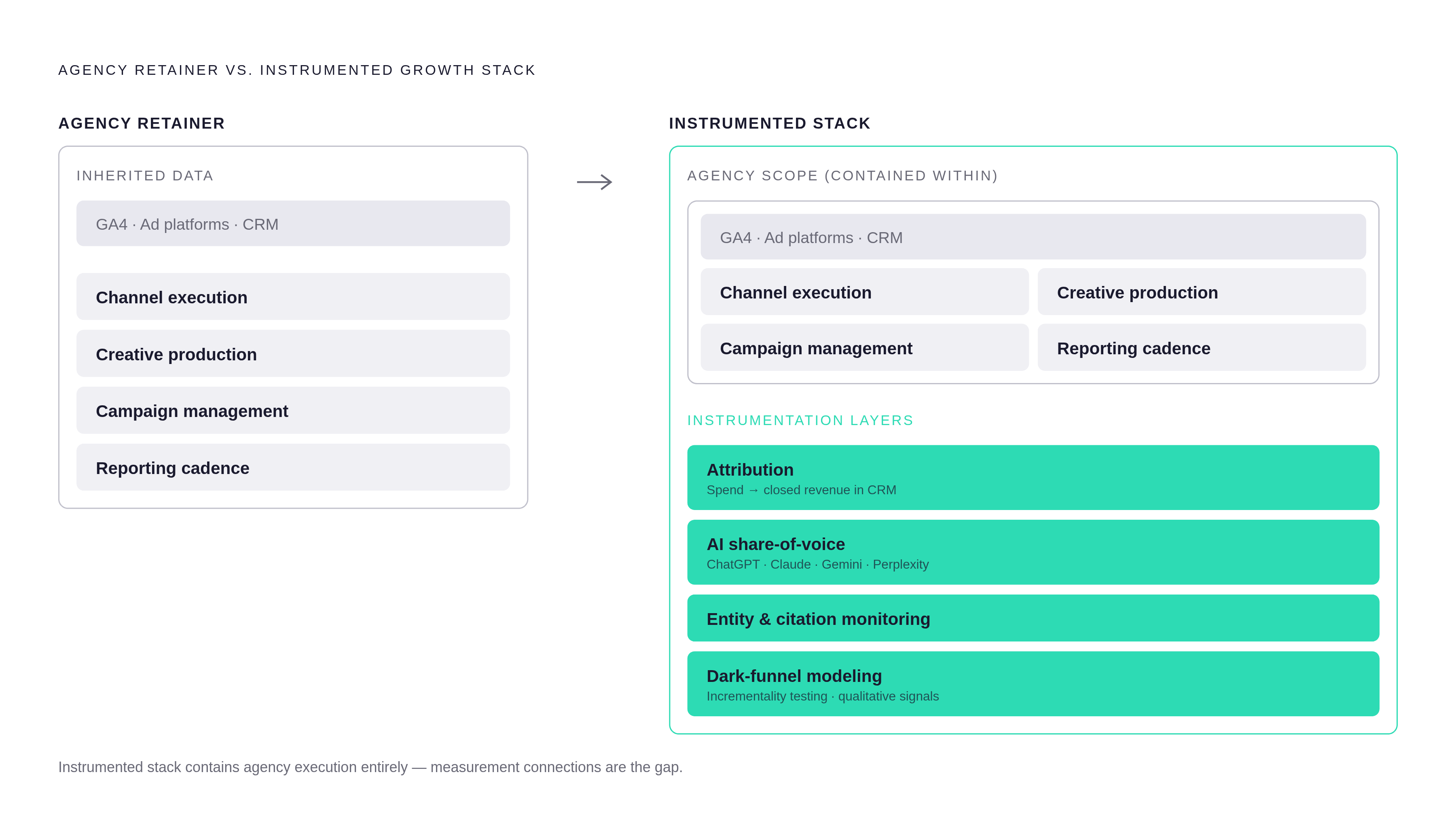
An instrumented growth stack connects spend to pipeline in the CRM continuously, rather than reconstructing that connection for a weekly meeting. Its attribution layer ties channel spending to closed revenue. That supplies the financial connection missing from lead-only reporting. It also gives the company one way to judge work across channels, rather than relying on each platform’s own account of success.
The stack tracks AI share of voice across ChatGPT, Claude, Gemini, and Perplexity by sampling real buyer prompts against a fixed baseline. Entity and citation monitoring flags descriptions that do not match across the sources engines retrieve. Dark-funnel modeling combines tracked data with incrementality testing and qualitative signals. None is a default consequence of hiring a full-service agency.
The agency still provides real value within its scope, including channel execution, creative production, campaign management, and a reporting cadence. An agency works with the data it inherits and the channels it manages, while instrumentation spans the connections between those channels and the outcomes the company needs to understand. An agency can work within an owned measurement system without becoming its sole custodian.
Execution speed remains a separate consideration. A growth hacking agency can launch, measure, and iterate within a single sprint cycle, while a traditional marketing agency takes substantially longer from brief to launch. Teams can usefully compare experiment velocity by looking at tests that actually shipped and have their outcomes on record. Speed without evidence only shortens the wait for another uncertain result. In the instrumented stack, every capability is reachable by an agent through an API and by a person through a UI, so the measurement layer can fit into the founder’s or technical buyer’s existing toolchain.
What a founder is actually choosing between — renting activity or owning evidence
What remains when the retainer ends? That question distinguishes an execution relationship from an owned measurement system more clearly than a list of deliverables does. If the data, attribution model, and content infrastructure are tied to the agency relationship, the company can lose them when that relationship ends. A founder can spend two years buying campaigns and still lack a reliable answer about which channels drove closed revenue because that connection was never instrumented.
Owned evidence accumulates inside the company’s infrastructure. Each new month of data adds context to the measurement system, content archive, entity graph, and AI share-of-voice baseline. The company retains the published sources and measurement history needed to understand changes in retrieval behavior and AI visibility.
An early-stage founder may not have the capacity to run a broad stack. The choice need not be binary. A lean instrumented stack with a narrow scope can be more useful than a broad retainer without instrumentation because it lets the founder see what is working. External execution can sit on top of that foundation, with responsibilities separated from ownership of the evidence.
The practical first step is therefore not replacing the agency. It is connecting spend to pipeline, establishing an AI share-of-voice baseline, and auditing entity consistency across the sources engines retrieve. With that measurement layer in place, agency work, in-house work, and further tooling can be judged against documented outcomes. The weekly review then has a sound role, as a place to discuss evidence the company owns.