When "free SEO software" means free reports and a paid person: what a technical B2B founder should check before choosing
Free SEO tools are cheap until someone has to act on them.

Free SEO software is rarely just a software choice for a technical B2B founder. The real decision is where the cost lands, whether in tools, internal engineering hours, or a paid operator who turns reports into changes. The useful comparison is not which subscription costs least, but which setup can deliver shipped, indexed, measured work with a clear owner and an auditable bill.
Why "free SEO software" is three different things, and why the distinction matters for a B2B founder
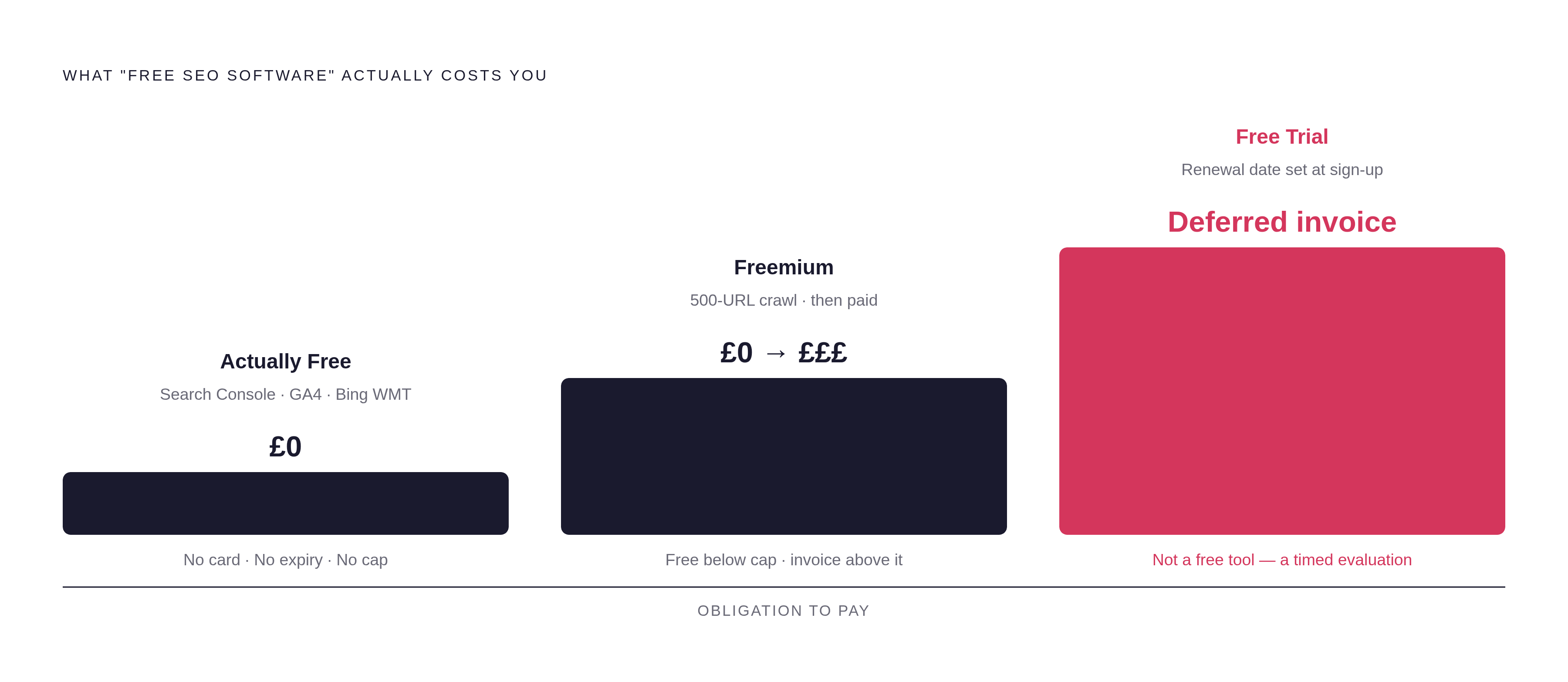
“Free” describes three different arrangements, and each creates a different obligation. Actually free tools have no cost, expiry, or card requirement, as with Google Search Console, Google Analytics 4, and Bing Webmaster Tools. Freemium tools have a free tier with a cap, such as Screaming Frog’s 500-URL crawl limit, and a paid plan above it. A free trial simply delays the invoice. That makes it a product evaluation.
The distinction changes what a founder must manage. A trial introduces a renewal date, while a freemium tool introduces a limit that may interrupt the work. Neither makes the free options inadequate by default. Search Console, GA4, Bing, Screaming Frog’s free tier, Ahrefs Webmaster Tools for verified sites, and PageSpeed Insights together cover keyword demand, crawl data, indexing, backlinks, and performance without a monthly subscription.
What the free tier of each major tool actually stops you from doing
Semrush’s free plan allows ten reports a day on one demo project, enough to try it out but too few to keep monitoring over time. Screaming Frog’s free crawl stops at 500 URLs, which bounds the site work it can cover. Ahrefs Webmaster Tools provides site audits and own-site backlink and keyword data for verified sites. Competitor data requires a paid plan. These limits affect different jobs, so “does it have a free tier?” is less useful than “does that tier cover this task?”
Google Keyword Planner introduces a different constraint because access does not guarantee precision. The team gets search volume in wide ranges unless it spends enough on ads to get exact numbers. It is built for advertisers and groups related terms. The supplied keyword example shows “seo agent” being folded into “seo agency,” producing a volume figure that overstates demand for the specific phrase by a large multiple. The tool is a reasonable place to start, but its number covers a bucket of terms that may differ from the exact wording a founder wants to target.
If most of that demand is for a related term, the team may be weighing the wrong opportunity before it starts writing. More reports would not fix that misunderstanding. AI-search visibility presents an access gap: Bing’s AI Performance report and Ahrefs’ public AI Visibility Checker offer free entry points, but prompt- and query-level citation tracking across ChatGPT, Perplexity, Gemini, and Claude sits in paid tiers.
Why the tool cost is usually not the largest line item
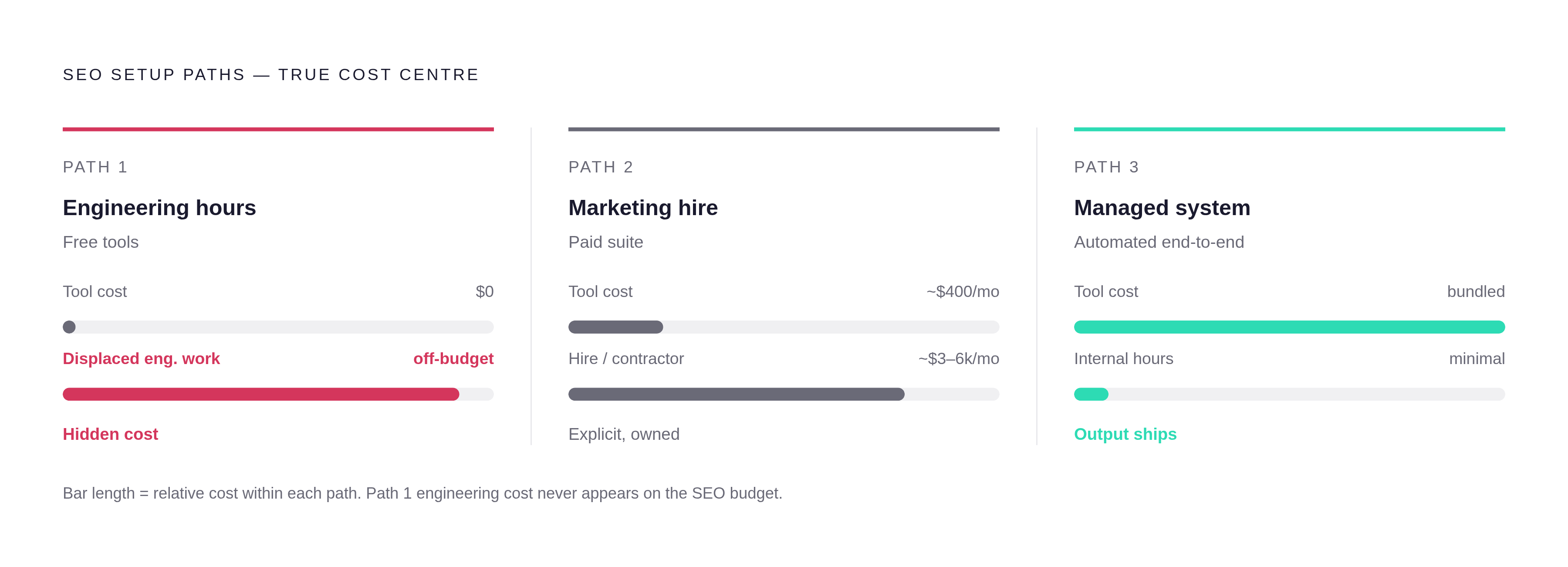
Even when a free tier covers the task, someone still has to act on its findings. A CSV export is not a merged pull request, an updated page, or a resolved crawl error. A person or pipeline fills that gap. The cost includes interpreting the report, deciding what deserves attention, and turning that decision into a change. None of those hours appears in a subscription price.
Although some paid features unlock genuinely different data, a skilled operator using free tools can outperform a poorly run paid subscription. The three practical paths are therefore free tools with internal engineering hours, a paid suite with a marketing hire or contractor, and a service or managed system that runs the tools and ships the output.
What if an engineer already has the skills? Even when the work is possible, that engineer’s time must be correctly priced against the output. Report triage displaces product engineering, even when the SEO budget records no expense. Paying an operator puts a bill on the books but may make it clearer who is responsible for the work. The comparison has to include that substitution, or the apparently cheapest path benefits from hiding its largest input.
The instrumentation gap: most free stacks cannot tell you whether anything shipped or whether it worked
An operator can turn a report into work without making the outcome traceable. That leaves a second cost, namely the effort required to connect findings, deployments, indexing, and results. A dashboard alone cannot make that connection. For a founder treating marketing as an engineering discipline, “a PR, not a PDF” is a useful output test because it distinguishes a proposed change from a report about one. A PDF or spreadsheet may have good advice, but someone still has to own the work and bring it into the delivery loop.
Search Console shows ranking and click data after the fact. It does not establish that a specific content edit caused a specific movement, or separate the effect of a merged PR from an algorithm update. A properly instrumented loop begins with a defined change and an opened PR, then follows deployment and index confirmation through URL Inspection. Keyword-level position tracking and traffic attribution follow those steps. Most free stacks expose the research and performance views while leaving the connection between them opaque.
The counting unit also has to survive that journey. If a tracked volume figure combines a target phrase with a larger related term, movement in the aggregate may say little about the intended query. Attribution starts with a well-defined measurement. Otherwise, even a documented deployment cannot test the original hypothesis cleanly.
For a team auditing this architecture, the next question is whether the data can be queried programmatically and connected to the system that tracks shipped work. Search Console and GA4 make their APIs free to use. Most third-party SEO tools with a free tier require a paid plan for that level of access to automation. That difference affects how much it costs to connect systems, as well as how easy it is, because a UI-only workflow needs a person to move information between them.
Where AI-search visibility sits in a free stack — and why it is a separate measurement job
Ranking on Google and being cited in an AI answer are different outputs. Measuring one does not establish the other. For a B2B company whose buyers begin research in an answer engine, a Google-only dashboard leaves part of discovery unobserved. Ahrefs’ public checker offers a free benchmark to start with, but its preview falls short of full citation tracking across multiple AI surfaces.
GA4 can filter sessions from perplexity.ai, chatgpt.com, or claude.ai to identify downstream visits. That answers a useful but narrower question. A recorded visit shows that traffic arrived from an AI source, not which prompt produced it or how the brand was framed. The measurement layer needs both citation monitoring and referral reporting because the latter cannot replace the former.
A manual baseline uses a library of category, comparison, and use-case prompts run weekly across ChatGPT, Perplexity, and Google AI Mode, with results logged in a spreadsheet. Its tool cost is free, but its operator time is not. Paid options including Semrush’s AI Visibility Toolkit, Ahrefs Brand Radar, and AthenaHQ cover multiple AI surfaces and add editing guidance. Those capabilities belong on the cost side of the comparison. Leaving them out leaves the coverage absent.
What to actually audit before choosing: a concrete checklist for the technical founder
A technical founder should make five checks before choosing a free stack, paid suite, or managed system. The first is where findings land. Does the tool or service produce a PR, a CMS draft, or a resolved ticket, rather than only a PDF, Slack message, or shared Google Doc? A draft still needs review before publication. If the output stops at a report, name the person responsible for converting it into a change and include that person’s hourly cost.
The second check is what each number counts. Before trusting a volume, rank, or citation figure, inspect whether it describes a specific query or combines related terms. Units define what the metric can support. A total of “mentions” across surfaces is different from cited passages in answers to specific buyer-intent prompts. Ask whether the methodology is documented and whether the same query run at the same time can reproduce the number.
The third check is what gets metered and billed. Free tiers may count reports, URLs, or keywords, while service retainers may charge by deliverable or time. Even when the cap is clear, the cost to upgrade may be unclear. For paid work, inspect the relationship between inputs such as hours, prompts, and pages crawled and outputs such as published pages and merged PRs. Prefer a line-by-line, reproducible bill to a flat fee for unspecified effort, applying the same scrutiny used for cloud infrastructure spending.
The fourth check is whether AI-search visibility is measured or merely assumed. At a minimum, the baseline needs Bing’s free AI Performance report, GA4 filtering for AI referrals, and a manual prompt library. These cover different parts of the question. Bing gives a first-party view of citations across Microsoft Copilot, AI-generated summaries in Bing, and select partner integrations, while referral data shows visits without the prompts behind them. Full citation tracking across ChatGPT, Perplexity, Gemini, and Claude belongs in the paid tool or service budget, and manual checking belongs in the hours budget.
The fifth check is whether each step can be automated while remaining reviewable and reversible before publication. A UI-only workflow has a human-hours floor, whereas an API, CLI, or agent-callable interface can connect the work to a delivery pipeline. Automation still needs a review gate. Ask whether the system produces drafts that a person can inspect, edit, or decline, and whether the proposed changes and their reasons are visible before they go live. A specific, confidently wrong B2B claim can damage credibility, so publishing autonomy is not a substitute for editorial control.
How to match the right path to the actual constraint
A free stack is a strong starting point for a site under 500 URLs when someone on the team can interpret crawl data and Search Console reports. It also fits when there is little enough content to review by hand and AI-citation visibility is not yet a priority for the sales funnel. The team can test its hypothesis without subscription spending. In this profile, the constraint is not data access so much as having enough internal time and fluency to use the available data.
A paid suite helps when the site grows beyond free crawl limits, the team needs competitive intelligence, or rank tracking has to cover more than a handful of keywords. It also needs a dedicated operator who will run it weekly, whether in-house or under contract. If nobody can interpret and act on the reports, the subscription adds capacity to a workflow that still lacks an owner.
A managed or automated system fits when a publishing cadence must grow without proportional headcount, and the delivery loop needs end-to-end instrumentation. It can also fit when AI-citation tracking must be built into measurement to avoid a separate manual job. The architecture is the deciding feature here. A coding-agent approach with metered primitives, API/MCP/CLI access, and human review before publication offers an advantage over an unautomated free stack or an opaque retainer when auditability and reversibility are requirements.
Regardless of the path, set up Search Console and Bing Webmaster Tools first because they provide free first-party data that third-party tools cannot replicate. Bing’s AI Performance report also provides the free first-party window into AI-citation data. Then ask the question that assigns ownership. Who is accountable for the step between this finding and a shipped, indexed, measured change? If that question has no clear answer, another tool will not close the loop.